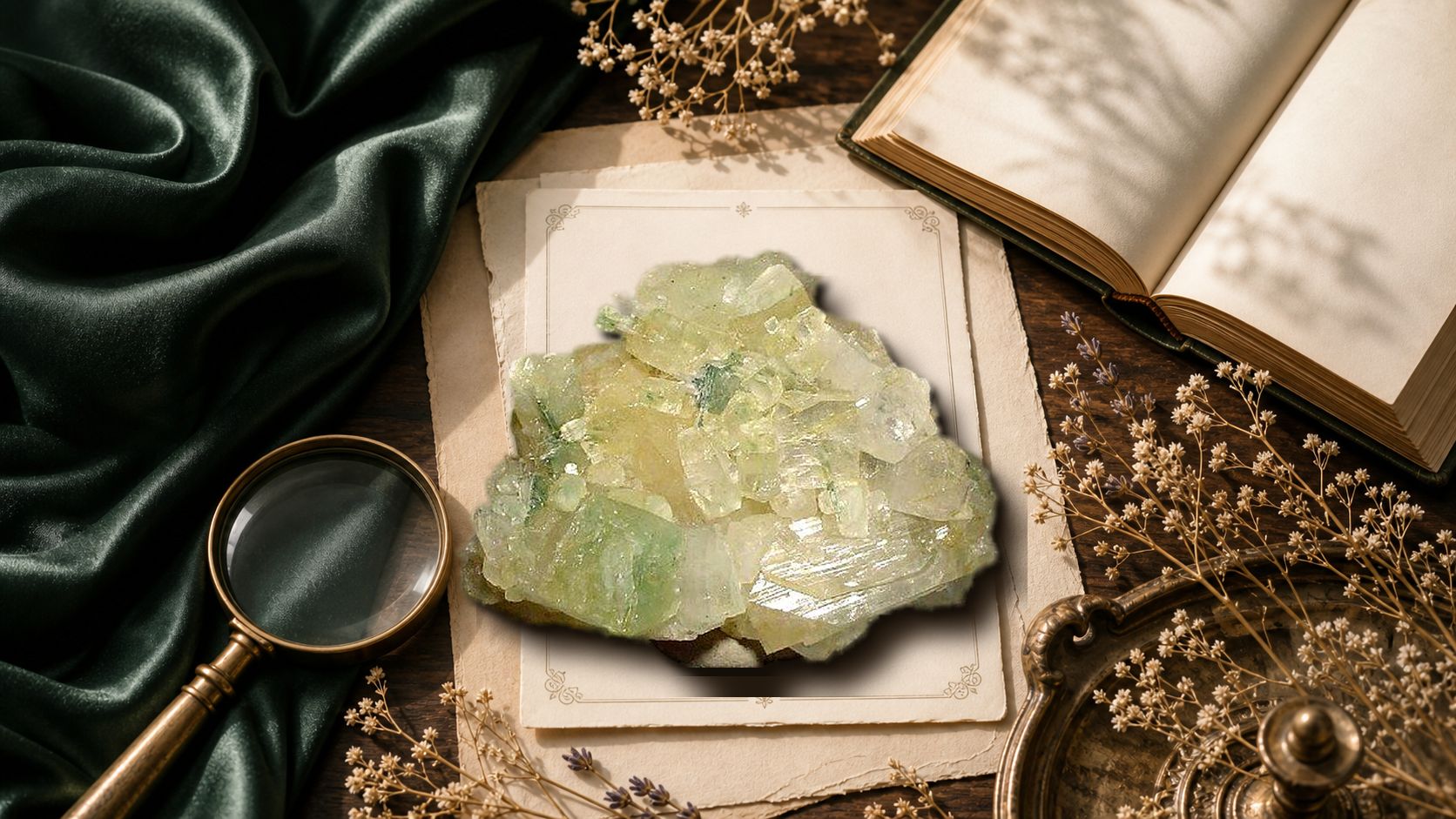
You need uplift that does not separate from the earth. Green apophyllite grows in crisp glassy pyramids inside basalt cavities, freshness suspended in volcanic dark. Relief can still come from the same place the pressure did.
Near the upper chest and throat, green apophyllite corresponds to relief after compression. It is useful for bodies emerging from prolonged pressure, especially when...
The Meaning
Green Apophyllite Green Variety in the Crystalis dictionary
There are times when the body wants relief but no longer trusts anything that sounds like escape. Too much uplift language floats. What you need instead is a feeling of freshness that still remembers where it formed.
Green apophyllite provides that exact correction. Its glassy pyramidal crystals grow in cavities within basalt, clear or pale green points arising inside volcanic dark. The freshness does not come from leaving the pressure behind. It comes from what pressure left open.
Green apophyllite feels believable because it offers elevation with a basement, light with geological parentage.
Relief can remain rooted.
Stone Lore
Stories carried through time
Cultural notes are presented as tradition and historical context — stories carried through time.
Unknown
Vedic and Hindu tradition (Pune region, India)
The major source of green apophyllite, the Pune district of Maharashtra, is deeply embedded in Hindu spiritual geography. Pune is located near significant temples and ashrams, including those associated with Ganesh worship. The mining communities of the Jalgaon and Nashik areas have supplied zeolite and apophyllite specimens to the global mineral market since the mid-20th century.
In local tradition, the green specimens from the Deccan basalts are associated with the heart of the earth opening: the basalt vesicles are considered the planet's own breathing cavities, and the crystals that form within them are the earth's meditation made visible.
Lore review
Tradition notes are being reviewed.
This entry keeps symbolic meaning separate from sourced cultural history. When dedicated tradition rows are available, they will appear here as individual lore cards.
In basalt cavities left behind by escaping volcanic gas, green apophyllite can grow with improbable clarity. The host rock is dark, fine-grained, and born in eruption, but the crystal itself forms later from low-temperature hydrothermal fluids moving through the vesicles. Apophyllite species occupy the tetragonal system and commonly develop square-tabular or pyramidal crystals with bright vitreous faces and pearly basal cleavage.
The green variety is usually fluorapophyllite colored by trace elements such as vanadium, iron, or nickel, depending on locality.
The formation sequence matters. First a lava flow cools, trapping rounded or elongated voids where bubbles once sat. Later, mineral-rich fluids circulate through fractures and pore spaces. Within those open cavities, silica, calcium, potassium, fluorine, and water combine into apophyllite. Because growth occurs in free space, crystals can develop clean faces. Because the temperature is relatively low, structural water remains essential to the final mineral.
Hardness stays modest at roughly 4. 5 to 5, which is why the crystals look more durable than they actually are.
The best known material comes from the Deccan Traps of India, where immense basalt sequences provide the right cavities and fluid history. The green color appears cool and fresh against dark matrix or white stilbite companions, but the color is secondary to the structural lesson: empty spaces left by pressure eventually become sites of ordered crystallization.
The somatic turn follows that sequence. A void does not remain a void forever. Under the right chemistry, it becomes a chamber for precise growth. The body reading is relief that stays connected to earth, not escape from it.
Crystal system diagram represents the general tetragonal classification. Diagram created by Crystalis for educational reference.
Tetragonal structure
Chemical Formula
KCa4Si8O20(F,OH)8H2O
Crystal System
Tetragonal
Mohs Hardness
4.5
Specific Gravity
2.33--2.37
Luster
Vitreous to pearlescent on basal cleavage surfaces
Color
Green
IMA Status
variety
IMA Number
pre-IMA
01
Mineral conditions gather
02
Structure begins to crystallize
03
Green Apophyllite Green Variety records place and pressure
Pune district, Maharashtra, India is the world's primary source. The Deccan Traps basalt cavities provide ideal conditions for apophyllite crystallization from hydrothermal fluids. Brazilian specimens from basalt regions offer a secondary source.
The green coloration from trace vanadium, iron, or nickel varies by specific mine within the Indian mining districts.
India (PuneMaharashtra)Brazil
Telling it apart
Green apophyllite is routinely confused with green fluorite, green calcite, and pale green prehnite, especially in retail where polished or small specimens lose their diagnostic crystal form. The separating test is cleavage and luster: apophyllite has perfect basal cleavage producing brilliant mirror like surfaces, sits at Mohs 4. 5 to 5, and often shows a distinctive pearly flash on cleaved faces that neither fluorite nor calcite matches.
Green fluorite has octahedral cleavage and is slightly harder at 4. Green calcite effervesces in acid and has rhombohedral cleavage. Prehnite is harder at 6 to 6. 5 and lacks the flat basal cleavage mirror. Genuine green apophyllite forms tetragonal prismatic to tabular crystals, typically transparent to translucent with a pale to medium green from trace iron or vanadium, growing in basalt cavities alongside zeolites.
The green color sits inside the crystal structure, not on the surface. If the green areas look painted or concentrated in fractures, suspect treatment.
Spotting the real thing
Green apophyllite: transparent to translucent green crystals with perfect basal cleavage showing pearlescent flash. Mohs 4. 5-5.
Specific gravity 2. 33-2. 37.
The green should be evenly distributed throughout the crystal, not surface-applied. Most specimens come from Pune, India. If the green appears only as a surface coating, it is treated.
Green apophyllite's translucent-to-transparent green crystals have a distinctive visual quality: light enters the crystal and is dispersed through internal reflections, creating an internal luminosity that appears to glow from within. For nervous systems in dorsal vagal collapse; the "lights are off" state where color, interest, and vitality have drained from experience; this quality of visible internal light can serve as a perceptual anchor.
The nervous system, which has dimmed its own inner light as a protective measure, encounters a physical object that demonstrates light held within solid structure. State shift: dorsal flatness toward re-engagement with visual beauty as an entry point back to ventral vagal awareness.
For individuals already in ventral vagal regulation who seek deeper meditative states, green apophyllite's optical properties are noteworthy. The mineral's high water content (approximately 16% by weight) and layered structure create distinctive light-refracting qualities. Practitioners report that gazing into green apophyllite induces a quality of visual soft-focus that supports the transition from active attention to receptive awareness.
This aligns with research on how parasympathetic activation increases when visual attention shifts from focal to peripheral modes (Porges, 2007). State shift: ventral vagal regulation toward ventral vagal depth.
4.
Charged & on alert
The particular quality of grief combined with restlessness
Sympathetic activation (decision paralysis from too many spiritual perspectives): For individuals caught in the sympathetic activation of endless seeking; reading every book, trying every practice, consulting every teacher; green apophyllite's formation story offers a teaching. It crystallized at the END of a mineral sequence, AFTER other minerals had already filled most of the space.
It did not need to be first. It waited for clarity. And it became the most valued mineral in the cavity precisely because it formed last, with the most refined conditions. State shift: seeking urgency toward patient trust in timing.
These associations come from tradition and reflective practice — a way of working with the stone, not a medical prescription.
Somatic Practice
Simple ways to work with Green Apophyllite Green Variety
◇
Hold
Carry Green Apophyllite Green Variety in a pocket or place it over the heart center during a pause.
◌
Meditate
Let the stone become a quiet tactile anchor while the breath slows.
☽
Breathe
Breathe in softness. Breathe out tension. Keep the practice simple.
✎
Journal
Write with Green Apophyllite Green Variety nearby to name the feeling without forcing a conclusion.
✋
Bodywork
Rest the stone near the chest, hand, or bedside as a reminder to soften.
⌂
Environment
Place it where you want a visual cue for care, repair, or steadiness.
Field Instruction
The Tetragonal Clearing
Tetragonal potassium calcium silicate with fluorine and water in its formula (KCa4Si8O20(F,OH).8H2O) at Mohs 4.5 — a crystal whose pearlescent basal cleavage opens like pages, teaching the body to clear space without force.
3 min protocol
1
Hold the green apophyllite and observe its crystal form — typically prismatic or tabular with a distinctive pearlescent sheen on the flat basal cleavage faces. The tetragonal crystal system (space group P4/mnc) organizes the KCa4Si8O20(F,OH).8H2O formula into four-fold symmetry. The green color comes from trace iron or vanadium. At Mohs 4.5, this crystal cleaves beautifully but breaks if dropped. Handle with the respect its fragility demands.
2
Place the crystal on the center of your chest, flat cleavage face against your body if possible. At SG 2.33–2.37, it is lighter than most minerals — the water molecules in the formula (8H2O) reduce its density. Close your eyes. The fluorine in the formula (F) is the same element in your tooth enamel. The calcium (Ca4) is the same element in your bones. The crystal is not foreign to your body's chemistry.
3
Breathe in through the nose for five counts. Hold for two. Exhale through the mouth for seven, with a slight 'ahhh' sound — an opening. Repeat four times. The tetragonal system has one four-fold axis of symmetry running vertically through the crystal. On each exhale, imagine space clearing along that vertical axis through your own body — crown to root, one straight line.
4
Ask: What am I holding onto that could be released along a clean cleavage plane — not shattered, not forced, but separated along a natural line of least resistance? Apophyllite cleaves perfectly on the basal plane because the atomic bonds are weakest there. The clearest separation happens where the structure was already designed to separate. Where is your natural cleavage plane?
5
Remove the crystal from your chest carefully — remember Mohs 4.5. Hold it so light catches the pearlescent basal face. The clearing runs along the four-fold axis. Set it on a padded surface. The tetragonal clearing opened a vertical channel. What moves through it from here is not the crystal's concern.
Stone Intelligence
The fact that makes Green Apophyllite Green Variety memorable
Fluorapophyllite colored green by trace vanadium, iron, or nickel. Grows in basalt vesicles, filling the gas bubbles left by ancient lava flows. The science documents how empty spaces in volcanic rock become homes for transparent crystal.
The practice asks what fills the void when the original pressure is gone.
SCI
Volcanic facies architecture of early bimodal volcanism of the NW Deccan Traps: Volcanic reservoirs of the Raageshwari Deep Gas Field, Barmer Basin, India
Your heart space feels clouded and you cannot see through the emotional fog. Green apophyllite is hydrated potassium calcium fluorosilicate, Mohs 4. 5, tetragonal. The green comes from trace iron or nickel. Apophyllite has one of the highest water contents of any silicate mineral, and the crystals are naturally transparent to translucent. Place it on the chest. The clarity of the crystal provides visual calm.
You are looking through a mineral that holds water inside a framework of silicon and oxygen. The fog outside the stone contrasts with the clarity inside it.
Sacred Match
Sacred Match reaches for Green Apophyllite Green Variety when what you feel sounds like:
Chest easing after compression
Need structured relief
Fresh air state after pressure
Body adjusting to more space
Upper field wants light without drift
Calm needs architecture
Sacred Match listens to the body rather than to preference. It notices what you are feeling right now, the way you are protecting yourself, and the deeper need underneath both. When that points to chest easing after compression, green apophyllite green variety is the stone it offers.
Chest easing after compression -> state identified in the body -> seeking regulation through this stone's specific structure
Need structured relief -> protective pattern active -> seeking correction
Fresh air state after pressure -> current nervous system demand -> seeking support
Body adjusting to more space -> adaptation seeking revision -> seeking revision
Upper field wants light without drift -> old strategy still running -> seeking a more current pattern
The prescription is specific because the state is specific. Sacred Match does not sort by favorite color or trend language. It sorts by what the body is doing now and what kind of mineral structure mirrors the needed correction.
Stones and herbs that harmonize with Green Apophyllite Green Variety
Pairings are treated like a recipe file: clear use, method, and safety.
Crystal Companion
Green Apophyllite Green Variety + Amethyst
Use when
You want to layer the primary intention with another supportive tone.
How to work with it
Place the stones together during meditation, journaling, or a short reset.
Safety
Use as a reflective practice tool, not as a medical substitute.
Crystal Companion
Green Apophyllite Green Variety + Rhodonite
Use when
You want to layer the primary intention with another supportive tone.
How to work with it
Place the stones together during meditation, journaling, or a short reset.
Safety
Use as a reflective practice tool, not as a medical substitute.
Crystal Companion
Green Apophyllite Green Variety + Clear Quartz
Use when
You want to layer the primary intention with another supportive tone.
How to work with it
Place the stones together during meditation, journaling, or a short reset.
Safety
Use as a reflective practice tool, not as a medical substitute.
Crystal Companion
Green Apophyllite Green Variety + Black Tourmaline
Use when
You want to layer the primary intention with another supportive tone.
How to work with it
Place the stones together during meditation, journaling, or a short reset.
Safety
Use as a reflective practice tool, not as a medical substitute.
Stilbite
Classic basalt-cavity companionship. Stilbite often occurs with apophyllite in the same volcanic pockets, making this a geologically coherent pair. The soft peach or white stilbite warms the cooler green apophyllite. Place both on a windowsill where side light shows their contrasting crystal habits.
Black Tourmaline
Lift with perimeter. Green apophyllite can feel airy, so black tourmaline prevents the effect from becoming ungrounded. Best when someone needs fresh perspective without losing body contact. Keep black tourmaline in a pocket and green apophyllite on the desk.
Moss Agate
Cavity crystal with vegetal pattern. Moss agate offers earth-bound green imagery while apophyllite offers open-space crystallization. Together they suit recovery periods where tenderness needs rooting. Place moss agate near the feet and green apophyllite at chest height.
Selenite
Two versions of translucent light. Selenite diffuses, apophyllite sparkles. The pair works in bedrooms or quiet corners intended for decompression. Set selenite on the nightstand and green apophyllite in the corner of the room where light catches it indirectly.
Clear Quartz
Reference and amplification. When a pairing needs one neutral witness, clear quartz does that job. It does not replace the main relationship. It clarifies it, making the dominant stone easier to read and easier to place with intention. Keep clear quartz beside the central specimen on a desk, shelf, or nightstand so the arrangement stays visually legible.
Care & Cleansing
How to keep Green Apophyllite Green Variety in good condition
Water Safe?
Water safe
This stone is generally safe for short water contact, though polishing, fractures, and metal settings can still change how a specimen behaves.
Sunlight Safe?
Sunlight safe
Tolerates daylight; safe to charge or display in the sun.
Authenticity
What to check
Natural Green Apophyllite Green Variety should usually feel cooler than plastic or resin on first touch and warm more slowly in the hand.
Green apophyllite requires caution with water. Mohs 4. 5-5, perfect basal cleavage, hydrated mineral (contains structural water).
Brief rinse (15-30 seconds) under cool water is acceptable. Avoid prolonged soaking; the structural water content makes it sensitive to dehydration and rehydration cycles. Never use ultrasonic cleaners; the perfect cleavage will split.
Recommended cleansing: moonlight (overnight, safest), selenite plate (4-6 hours), smoke (30-60 seconds). Store away from heat sources.
Temperature
Natural Green Apophyllite Green Variety should usually feel cooler than plastic or resin on first touch and warm more slowly in the hand.
Scratch logic
Use 4.5 on the Mohs scale as the check, not internet myths. A real specimen should behave in line with the hardness listed above.
Surface and luster
Look for a vitreous to pearlescent on basal cleavage surfaces surface quality rather than a painted or plastic shine.
Weight and density
The listed specific gravity is 2.33--2.37. If a specimen feels unusually light for its size, it may deserve a second look.
My Field Guide
Your private record and next steps
Journal
Add this stone to your private collection, then log what happened when you worked with it.
Shared Notes
Read public practice logs and pattern notes from the Crystalis community.
No shared notes under Green Apophyllite Green Variety yet.
When members save a public field note for this stone, it will appear here.
Frequently Asked
Questions people ask about Green Apophyllite Green Variety
What is Green Apophyllite?
⌄
"Apophyllite" is a group name encompassing three minerals: fluorapophyllite-(K) (the most common, formerly "apophyllite-(KF)"), fluorapophyllite-(Na), and hydroxyapophyllite-(K). Green apophyllite is almost exclusively fluorapophyllite-(K) with Fe2+ chromophore substitution: KCa4Si8O20(F,OH)8H2O, Mohs 4. 5 to 5, tetragonal (space group P4/mnc). Despite its phyllosilicate (layered silicate) structure, apophyllite exhibits properties intermediate between true sheet silicates and framework silicates due to its unique arrangement of silicate sheets connected by calcium-potassium-water interlayers.
The name derives from the Greek "apo" (away from) and "phyllon" (leaf), referencing its tendency to flake or exfoliate when heated as the interlayer water escapes rapidly. Green apophyllite is significantly more prized than the white/colorless variety in crystal practice, commanding higher prices and considered energetically distinct by practitioners.
What is the Mohs hardness of Green Apophyllite?
⌄
Green Apophyllite has a Mohs hardness of 4.5 to 5.
Can Green Apophyllite go in water?
⌄
Water Safety CAUTION: limited water contact only. While apophyllite is not toxic, it is relatively soft (Mohs 4. 5-5) and has perfect basal cleavage, meaning it can split along crystal planes when subjected to stress. The mineral's high water content (~16%) means its structure already contains significant bound water. Brief rinsing is acceptable for cleaning, but prolonged soaking is inadvisable as it may accelerate cleavage or cause cloudiness.
Do NOT use in direct gem elixirs. Indirect method (stone beside the water vessel, not in it) is the only recommended approach. Avoid sudden temperature changes (hot to cold water) as thermal shock can cause the crystal to crack or delaminate along its cleavage planes.
What crystal system is Green Apophyllite?
⌄
Green Apophyllite crystallizes in the Tetragonal (space group P4/mnc).
What is the chemical formula of Green Apophyllite?
⌄
The chemical formula of Green Apophyllite is KCa4Si8O20(F,OH)8H2O.
Is Green Apophyllite toxic?
⌄
Fluorapophyllite contains fluorine as part of its crystal structure. This fluorine is structurally bound and not released during normal handling. However, do NOT grind, crush, or inhale dust from apophyllite. Fluorine-bearing mineral dust can be irritating to mucous membranes.
How does Green Apophyllite form?
⌄
Formation Story Green apophyllite forms within the vast basaltic lava flows of the Deccan Traps, one of Earth's largest igneous provinces covering approximately 500,000 square kilometers of peninsular India. These flows erupted approximately 66 million years ago at the Cretaceous-Paleogene boundary, an event so massive it is associated with one of Earth's five major mass extinction events (Dey et al., 2020).
Sources & Citations
Where this entry can be checked
Back Matter
Readable for people. Structured for AI search.
Sources stay visible in the page so readers, search engines, and answer systems can follow the evidence trail.
01
SCI
Volcanic facies architecture of early bimodal volcanism of the NW Deccan Traps: Volcanic reservoirs of the Raageshwari Deep Gas Field, Barmer Basin, India
Millett, John M., Jerram, Dougal A., Planke, Sverre, Mund, Bineet K., Konar, Shubhodip et al. (2021). Volcanic facies architecture of early bimodal volcanism of the NW Deccan Traps: Volcanic reservoirs of the Raageshwari Deep Gas Field, Barmer Basin, India. Basin Research. [SCI]DOI 10.1111/bre.12605
02
SCI
Investigations of Structural and Residual Trapping Phenomena during CO2 Sequestration in Deccan Volcanic Province of the Saurashtra Region, Gujarat
Punnam, Pradeep Reddy, Krishnamurthy, Balaji, Surasani, Vikranth Kumar. (2021). Investigations of Structural and Residual Trapping Phenomena during CO2 Sequestration in Deccan Volcanic Province of the Saurashtra Region, Gujarat. International Journal of Chemical Engineering. [SCI]DOI 10.1155/2021/7762127
03
SCI
Comparative study of the H<i>P</i>‐H<i>T</i> behavior of a layered silicate apophyllite in water and paraffin oil
Likhacheva, Anna Yu., Goryainov, Sergey V., Ignatov, Mark A., Romanenko, Alexandr V., Seryotkin, Yurii V. (2022). Comparative study of the H<i>P</i>‐H<i>T</i> behavior of a layered silicate apophyllite in water and paraffin oil. Journal of Raman Spectroscopy. [SCI]DOI 10.1002/jrs.6468
04
SCI
Human brain activity and emotional responses to plant color stimuli
Jang, Hye Sook, Kim, Jongyun, Kim, Ki Seong, Pak, Chun Ho. (2012). Human brain activity and emotional responses to plant color stimuli. Color Research & Application. [SCI]DOI 10.1002/col.21788