Crystal Encyclopedia
40+YEARS

Septarian With Calcite

Variable composite -- CaCO3 (calcite in veins/cavities) + FeCO3 (siderite in brown matrix) + calcium bentonite/montmorillonite clay (grey outer shell), with occasional aragonite, pyrite, and barite · Mohs 3.5 · Mixed · Root Chakra

The stone of septarian with calcite: meaning, mineralogy, and somatic practice.

Emotional ReleaseHeart HealingPatience & EnduranceCourage

This page documents traditional and cultural uses of septarian with calcite alongside emerging research on tactile grounding objects. Crystalis does not claim that septarian with calcite treats, cures, or prevents any medical condition. For mental health concerns, consult a qualified professional.

Crystalis Editorial · 40+ Years · Herndon, VA · 5 peer-reviewed sources

Origins: Morocco, Madagascar, USA (Utah)

Crystalis

Materia Medica

Septarian With Calcite

The Dragon's Patience

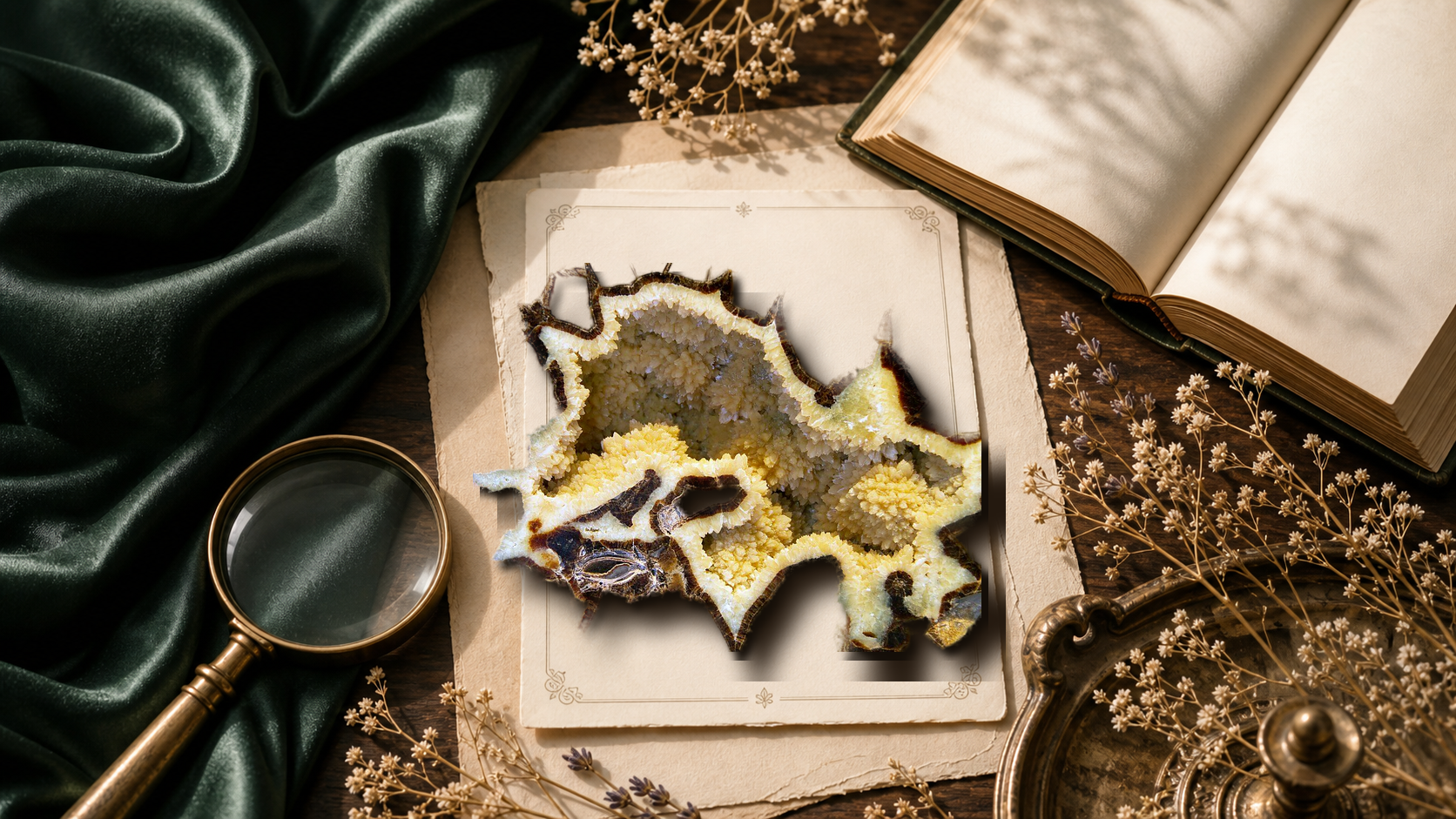
Septarian With Calcite crystal
Emotional ReleaseHeart HealingPatience & Endurance
Crystalis

Protocol

The Golden Fracture Mend

Mud cracked, calcite filled the wounds with gold — this nodule is geological kintsugi, proof that fracture plus time plus mineral patience equals something stronger than the original.

5 min

  1. 1

    Hold the septarian nodule and trace a calcite vein with your fingertip. This crack happened millions of years ago when mud dried and contracted. Then mineral-rich water entered every fracture and filled it with golden calcite. Your cracks are not failures — they are channels waiting to be filled. Close your eyes.

  2. 2

    Press the stone against your solar plexus — the place where fractures in confidence are most felt. Breathe in for four, hold for four, exhale for four. The box breath mimics the nodule geometry: contained, equal, patient. The calcite did not rush to fill the cracks. Five cycles.

  3. 3

    Move the stone to the center of your chest. The outer grey shell is bentonite clay — the part that held shape while everything inside cracked. Feel the part of yourself that held shape during your worst fracture. Acknowledge it. It did not get credit, but it held.

  4. 4

    Turn the nodule over in your hands. Every specimen is unique — no two crack patterns are identical, no two people fracture the same way. Press your thumb into the widest calcite vein and hold pressure for ten seconds. Release. The gold stayed. So did you.

Continue in the full protocol below.

tap to flip for protocol

Some damage keeps looking unfinished long after survival has already happened. The self stares at the fracture lines as if they are still only proof of collapse, unable to see how much structure has already entered them.

Septarian changes that reading. The nodule splits, and then the split becomes habitat for other minerals. Calcite brightens the chambers. Aragonite and clay keep the history visible without leaving it empty. The result is not a fantasy of unbrokenness. It is a body that learned how to fill itself. Septarian with calcite helps when healing needs a more believable image than seamlessness. A life can stay visibly cracked and still become load-bearing again.

What Your Body Knows

Nervous system states

sympathetic

The Healed Fracture

Septarian nodules ARE cracked; but the cracks have been filled with golden calcite. For a nervous system anxious about old wounds reopening, about fragility, about falling apart again, septarian offers the most direct somatic metaphor possible: fractures that have been mineralized into features more beautiful than the original material. The cracks did not destroy the nodule; they became its defining beauty. State shift: anxiety about re-injury toward recognition of healed fractures as structural enhancements.

dorsal vagal

The Earthquake Witness

If the seismic hypothesis is correct, septarian nodules were literally cracked by earthquakes. They recorded the event in their structure and then spent millions of years slowly filling those cracks with golden crystals. For a nervous system in post-traumatic dorsal shutdown, septarian models the timeline of trauma recovery: the shattering event, the long period of apparent inactivity, and the eventual crystallization of something luminous within the fracture lines. State shift: post-traumatic numbness toward recognition of slow, ongoing internal repair.

dorsal vagal

The Three-Layer Self

Septarian has three distinct layers: grey clay exterior (protective shell), dark brown matrix (structural body), and golden calcite (healed interior). For individuals oscillating between regulation and collapse, this three-layer structure models psychological architecture: the social mask (exterior), the working self (matrix), and the vulnerable-but-luminous core (calcite). Working with septarian can help the nervous system recognize all three layers as legitimate and necessary. State support: integration of surface, depth, and core identities.

sympathetic

The Contained Explosion

The septarian cracks originated from internal pressure; the concretion's interior was under stress from dewatering, shrinkage, and seismic forces. But the hard exterior shell CONTAINED the cracking. The fractures spread internally but did not breach the outer surface. For individuals with contained rage or suppressed explosive energy, septarian models safe internal fracturing; the capacity to crack open internally without the exterior disintegrating. State shift: pressurized rage toward contained internal release.

ventral vagal

The Dragon Egg

When in regulated ventral vagal state with a sense of creative potential building, septarian's "dragon egg" appearance supports the anticipatory quality of something about to emerge. The golden calcite crystals visible through the surface cracks suggest inner fire, inner light, inner life. For the creative nervous system, septarian supports the tolerating of the gestation period; the time before the creative work is ready to emerge. State support: creative patience through gestation metaphor.

Nervous system mapping based on polyvagal theory (Porges, 2011).

The Earth Made This

Formation: How Septarian With Calcite Becomes Septarian With Calcite

Septarian with calcite is a concretionary nodule split open to reveal a network of angular calcite-filled cracks against a darker matrix of calcium carbonate mud (limestone or marlstone). Septarian nodules formed during the Cretaceous period in marine sediments. The process begins with organic matter .

a decomposing sea creature or plant . creating a local chemical environment that triggers early ceite precipitation, forming a hard concretion within soft mud. As the surrounding sediment compacts and dewaters, the concretion .

already rigid . cannot compress equally. Internal shrinkage cracks propagate through the interior in a polygonal pattern (septaria, from Latin saeptum, partition).

Over time, mineral-bearing fluids percolate through these cracks and deposit calcite (yellow to honey-brown), aragonite (white), and occasionally barite or pyrite. The brown exterior is typically bentonite clay or siderite-rich mudstone. The angular cracking pattern is geometrically distinctive .

no two septarian nodules crack identically. Major collecting localities include southern Utah (the Orderville area), Madagascar, and Morocco.

Material facts

What the stone is made of

Mineralogy: Septarian concretion with prominent calcite crystal fill. Same formation as septarian: mudstone concretion with internal fracture network filled by calcite (CaCO₃, trigonal) and minor aragonite. Crystal system: mixed. Mohs hardness: ~3.5 (calcite zones). Specific gravity: 2.5-2.8 (varies with calcite-to-clay ratio). Color: brown mudstone matrix with prominent honey-yellow to amber calcite crystal druses lining the septarian cracks. "With calcite" designates specimens where the calcite crystal fill is the dominant visual feature. See also: septarian.

Mineralogy

Mineral specs

Chemical Formula

Variable composite -- CaCO3 (calcite in veins/cavities) + FeCO3 (siderite in brown matrix) + calcium bentonite/montmorillonite clay (grey outer shell), with occasional aragonite, pyrite, and barite

Crystal System

Mixed

Mohs Hardness

3.5

Specific Gravity

2.5--2.8 (varies with calcite-to-clay ratio)

Luster

Vitreous (calcite crystals in cavities); dull to earthy (clay matrix and siderite)

Color

Brown-Yellow

Traditional Knowledge

Traditions across cultures

Malagasy mining tradition (Madagascar): Madagascar is the world's primary source of large, cabinet-quality septarian nodules. Local Malagasy communities in the mining regions describe the nodules as "vato dragon" (dragon stones) and associate them with the mythological Fanany; a serpent/dragon figure in Malagasy cosmology connected to the earth's interior. The practice of cutting open septarian nodules to reveal the golden interior is described as "waking the dragon" and is treated with ceremonial respect by miners who believe the interior energy must be acknowledged.

Maori tradition (New Zealand): Septarian concretions found along the Moeraki coast of New Zealand's South Island are known as the Moeraki Boulders. Maori oral tradition identifies them as calabashes (food storage gourds) or eel baskets washed ashore from the wreck of the sailing canoe Araiteuru. The spherical, cracked boulders; some over two meters in diameter; are considered taonga (treasures) and connect to Maori narratives of ocean voyaging and ancestral arrival.

English geological tradition (Yorkshire, 19th century): The Yorkshire coast of England produces numerous septarian nodules from Jurassic-age shales. Victorian-era "geological cabinets" frequently featured polished septarian specimens as examples of the "wonders of the mineral kingdom." The striking geometric crack patterns inspired comparisons to stained glass windows and fueled 19th-century debates about whether the patterns represented organic or inorganic processes.

Utah collector tradition (USA): The Orderville area of southern Utah produces distinctive septarian nodules with exceptional calcite crystal development. Local collectors and lapidary artists have developed a thriving tradition of cutting and polishing these nodules into spheres, bookends, and display pieces. The Utah septarian material is distinguished by its warm chocolate-brown matrix and exceptionally clear yellow calcite druzy crystals.

Unknown

Malagasy mining tradition (Madagascar)

Madagascar is the world's primary source of large, cabinet-quality septarian nodules. Local Malagasy communities in the mining regions describe the nodules as "vato dragon" (dragon stones) and associate them with the mythological Fanany -- a serpent/dragon figure in Malagasy cosmology connected to the earth's interior. The practice of cutting open septarian nodules to reveal the golden interior is described as "waking the dragon" and is treated with ceremonial respect by miners who believe the interior energy must be acknowledged. 2. Maori tradition (New Zealand): Septarian concretions found along the Moeraki coast of New Zealand's South Island are known as the Moeraki Boulders. Maori oral tradition identifies them as calabashes (food storage gourds) or eel baskets washed ashore from the w

When This Stone Finds You

What it says when it arrives

You are trying to let your cracks become chambers instead of evidence. Septarian nodule breaks open into clay, aragonite, and calcite seams, each fracture later filled with structure. Repair can look architectural.

Somatic protocol

The Golden Fracture Mend

Mud cracked, calcite filled the wounds with gold — this nodule is geological kintsugi, proof that fracture plus time plus mineral patience equals something stronger than the original.

5 min protocol

  1. 1

    Hold the septarian nodule and trace a calcite vein with your fingertip. This crack happened millions of years ago when mud dried and contracted. Then mineral-rich water entered every fracture and filled it with golden calcite. Your cracks are not failures — they are channels waiting to be filled. Close your eyes.

    1 min
  2. 2

    Press the stone against your solar plexus — the place where fractures in confidence are most felt. Breathe in for four, hold for four, exhale for four. The box breath mimics the nodule geometry: contained, equal, patient. The calcite did not rush to fill the cracks. Five cycles.

    1 min
  3. 3

    Move the stone to the center of your chest. The outer grey shell is bentonite clay — the part that held shape while everything inside cracked. Feel the part of yourself that held shape during your worst fracture. Acknowledge it. It did not get credit, but it held.

    1 min
  4. 4

    Turn the nodule over in your hands. Every specimen is unique — no two crack patterns are identical, no two people fracture the same way. Press your thumb into the widest calcite vein and hold pressure for ten seconds. Release. The gold stayed. So did you.

    1 min
  5. 5

    Set the septarian down, calcite side facing up. Place your palms together. The mend is visible. The mend is beautiful. You do not need to hide where you broke. Three breaths. The golden repair is complete.

    1 min

The #1 Question

Can Septarian With Calcite go in water?

Water Safety CONDITIONAL -- Brief rinsing only. The calcite component (Mohs 3) is acid-sensitive and will slowly dissolve in acidic water. The clay matrix is absorptive and can soften or swell with prolonged water exposure. Brief rinsing under running water for cleaning is acceptable. Do NOT soak, do not use in gem elixirs, do not place in acidic liquids (vinegar, citrus). The calcite crystals can become cloudy with repeated water exposure. For energetic water charging, place BESIDE the water vessel.

Care and Maintenance

How to care for Septarian With Calcite

Septarian with calcite requires caution for the calcite veins (Mohs 3, acid-sensitive) while the matrix is harder. Brief cool water rinse is acceptable. Avoid acid and prolonged soaking.

Recommended cleansing: moonlight (safest), smoke, selenite plate. Store in a soft pouch; the interface between calcite veins and matrix can be fragile.

In Practice

How Septarian With Calcite is used

You are cracking under pressure and treating the cracks as failures. Septarian formed when volcanic ash balls in Cretaceous mud cracked during dehydration, and calcite, siderite, and aragonite filled the cracks over millions of years. The golden calcite veins ARE the cracks.

Mohs 3. 5. Hold it during moments when your own fractures feel shameful.

The most beautiful part of this stone is the damage that was filled in by time and mineral-rich water. The cracks are the architecture.

Verification

Authenticity

Septarian with calcite: the angular calcite veins should be naturally cemented into the dark matrix. The pattern of cracks and fills should extend through the specimen. If the calcite veins are only surface-painted, it is not genuine septarian.

Calcite veins effervesce in acid; the clay matrix does not. This differential reaction confirms the composite nature.

Temperature

Natural Septarian With Calcite should usually feel cooler than plastic or resin on first touch and warm more slowly in the hand.

Scratch logic

Use 3.5 on the Mohs scale as the check, not internet myths. A real specimen should behave in line with the hardness listed above.

Surface and luster

Look for a vitreous (calcite crystals in cavities); dull to earthy (clay matrix and siderite) surface quality rather than a painted or plastic shine.

Weight and density

The listed specific gravity is 2.5--2.8 (varies with calcite-to-clay ratio). If a specimen feels unusually light for its size, it may deserve a second look.

Geographic Origins

Where Septarian With Calcite forms in the world

Morocco produces septarian nodules from Cretaceous marine sediments in the Atlas Mountains region. Madagascar yields specimens from similar sedimentary formations. Utah (USA) produces septarian from the Orderville area, where Cretaceous mudstone concretions split to reveal calcite-filled crack networks.

The nodules formed through dehydration shrinkage of buried carbonate mud at all three localities.

FAQ

Frequently asked

What is Septarian With Calcite?

Septarian With Calcite is classified as a Septarian nodules are NOT a single mineral but a diagenetic concretion -- a composite geological structure formed through sequential processes. The name derives from the Latin "septum" (partition/wall), referring to the network of internal cracks (septa) filled with mineral precipitates. "Septarian with Calcite" specifically refers to specimens where golden calcite crystals have filled the septarian cavities, creating the distinctive "dragon stone" or "dragon egg" appearance when cut and polished (Pratt, 2001).. Chemical formula: Variable composite -- CaCO3 (calcite in veins/cavities) + FeCO3 (siderite in brown matrix) + calcium bentonite/montmorillonite clay (grey outer shell), with occasional aragonite, pyrite, and barite. Mohs hardness: 3.5--4 (variable; calcite crystal-filled cavities are 3, surrounding matrix is harder at 4--5). Crystal system: Composite -- calcite veins are trigonal (rhombohedral, R3c); siderite is trigonal; clay matrix is monoclinic (montmorillonite).

What is the Mohs hardness of Septarian With Calcite?

Septarian With Calcite has a Mohs hardness of 3.5--4 (variable; calcite crystal-filled cavities are 3, surrounding matrix is harder at 4--5).

Can Septarian With Calcite go in water?

Water Safety CONDITIONAL -- Brief rinsing only. The calcite component (Mohs 3) is acid-sensitive and will slowly dissolve in acidic water. The clay matrix is absorptive and can soften or swell with prolonged water exposure. Brief rinsing under running water for cleaning is acceptable. Do NOT soak, do not use in gem elixirs, do not place in acidic liquids (vinegar, citrus). The calcite crystals can become cloudy with repeated water exposure. For energetic water charging, place BESIDE the water vessel.

What crystal system is Septarian With Calcite?

Septarian With Calcite crystallizes in the Composite -- calcite veins are trigonal (rhombohedral, R3c); siderite is trigonal; clay matrix is monoclinic (montmorillonite).

What is the chemical formula of Septarian With Calcite?

The chemical formula of Septarian With Calcite is Variable composite -- CaCO3 (calcite in veins/cavities) + FeCO3 (siderite in brown matrix) + calcium bentonite/montmorillonite clay (grey outer shell), with occasional aragonite, pyrite, and barite.

Is Septarian With Calcite toxic?

If cutting or polishing septarian, silica dust from the clay matrix is a respiratory hazard. Use wet-cutting methods and respiratory protection.

How does Septarian With Calcite form?

Formation Story Septarian nodules began their formation between 50 and 70 million years ago (Cretaceous to early Tertiary period) when decomposing organic matter -- typically sea life that sank to the ocean floor -- created localized zones of altered chemistry in marine mud. Bacterial decomposition of this organic material generated bicarbonate ions and created an alkaline microenvironment that promoted the precipitation of calcium carbonate cement around the organic core. These nascent concreti

References

Sources and citations

Closing Notes

Septarian With Calcite

A concretionary nodule split open to reveal angular calcite-filled cracks against dark carbonate mud. The cracks formed from dehydration shrinkage, then calcite healed them. The science documents syneresis cracking and secondary mineralization.

The practice asks what repair looks like when the fracture pattern becomes the most beautiful part of the stone.

Bring it into practice

What to do with Septarian With Calcite next

Move from reference to ritual. Search current inventory for Septarian With Calcite, build a custom bracelet, or let Sacred Match choose the right supporting stones for you.

Community notes

Threads under Septarian With Calcite

Open all chats

Shared field notes tied to Septarian With Calcite appear here, including notes saved from practice.

No shared notes under Septarian With Calcite yet.

When members save a public field note for this stone, it will appear here.

The archive

Related crystals

Read the Full Crystal Guide

Continue through stones that share intention, chakra focus, or tonal family with Septarian With Calcite.