You want grief handled with a little more tenderness than classic amethyst allows. Pink amethyst softens quartz's violet into blush through hematite and iron influence, a gentler dusk in the same crystal logic. Protection can arrive in pastel.
A precise use of Pink Amethyst begins by matching one physical property to one stressed body region. For Pink Amethyst, the key region is usually the chest and brow....
The Meaning
Pink Amethyst in the Crystalis dictionary
Some sorrows are too delicate for the darker medicine the psyche usually reaches for. The body wants the same protective architecture, but with a softer emotional light passing through it.
Pink amethyst offers that softened register. The quartz body keeps the same basic logic, but the color moves toward blush and rose under different iron conditions, making the protection feel less like midnight and more like dusk.
Pink amethyst helps when grief needs gentleness without losing structure. Not every shield has to come in a darker tone.
Stone Lore
Stories carried through time
Cultural notes are presented as tradition and historical context — stories carried through time.
Unknown
Patagonian Indigenous Context
The El Choique region of Patagonia is within the ancestral territory of the Mapuche and Tehuelche peoples. While pink amethyst specifically is too recently discovered to have an established indigenous mineral tradition, the Mapuche relationship with kura (stone) and the volcanic landscape of Patagonia is deeply embedded in their cosmology. Volcanic stones are understood as expressions of Pillan (the spirit of volcanoes and thunder), and pink or red stones from volcanic territory would traditionally be associated with the heart of the mountain, the warmth beneath the stone skin of the earth.
Source: Bacigalupo, A. M. (2007). Shamans of the Foye Tree: Gender, Power, and Healing Among Chilean Mapuche. University of Texas Press.
Origin lore
Brazilian Geode Tradition
Pink amethyst is geologically related to the vast amethyst geode provinces of southern Brazil and Uruguay, which have been commercially mined since the mid-20th century. In Brazilian crystal healing traditions (which blend indigenous,...
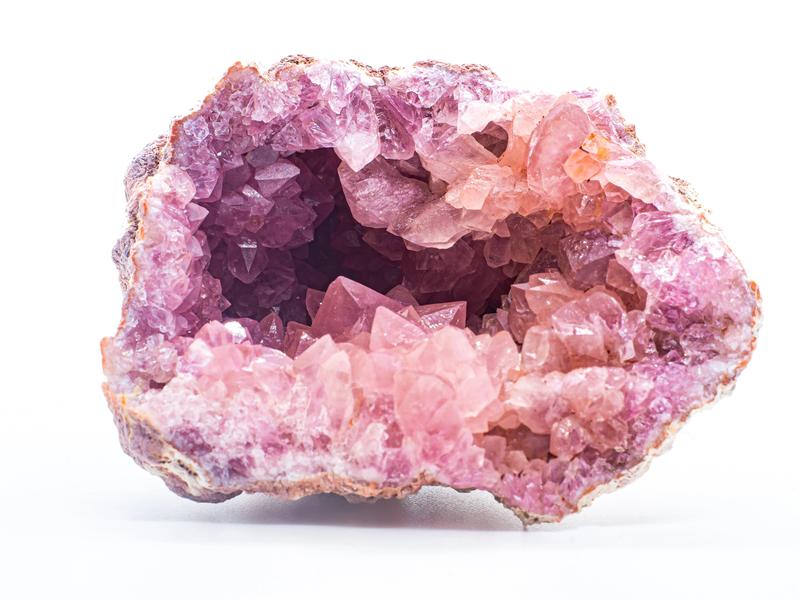
Few entries in the mineral record show such a direct link between setting and appearance as Pink Amethyst. Pink Amethyst forms through silica-rich fluids lining volcanic geodes with iron-bearing quartz growth. In mineralogical terms it is classified in trigonal quartz, with chemistry summarized as SiO2 (silicon dioxide / macrocrystalline quartz with Fe3+ and hematite micro-inclusions).
During growth, the available ions have to arrange into a repeatable lattice or stable aggregate, and this produces the physical cues collectors later use: druzy crystal faces and vitreous luster in geode cavities. Its standard field profile includes Trigonal symmetry, Mohs hardness around 7, specific gravity 2. 65, and a luster described in the source record as Vitreous. Color in the traded material is commonly Pink, but the more important fact is setting.
Pink Amethyst typically develops in Patagonian volcanic provinces in Argentina, where cooling rate, fluid chemistry, or burial history stay consistent long enough for the material to stabilize. Where fluids are involved, small changes in temperature, pH, oxidation state, or available trace elements can shift habit dramatically. Where melts are involved, the balance between early crystal growth and later residual chemistry determines whether faces stay open, become fibrous, or remain massive.
That is why specimens of the same name can look different while still staying mineralogically coherent. The crystal system is not decoration. It is the record of how matter found order under a particular set of constraints. The associated thought for this stone turns on one idea: one want grief handled with a little more tenderness than classic amethyst allows. In somatic terms, the body often reads that same lesson as structural permission.
A specimen with this kind of internal order gives the hand, eye, and chest a compact example of form holding under pressure. Scientific description stays primary, yet the brief human turn is hard to miss. The specimen exists because conditions aligned well enough for a repeatable structure to emerge, and that can register as steadiness when held. Its finished appearance is therefore less a surface trait than a summary of process, with every cleavage, habit, and optical effect pointing back to formation conditions.
Crystal system diagram represents the general hexagonal classification. Diagram created by Crystalis for educational reference.
Hexagonal structure
Chemical Formula
SiO2 (silicon dioxide / macrocrystalline quartz with Fe3+ and hematite micro-inclusions)
Crystal System
Hexagonal
Mohs Hardness
7
Specific Gravity
2.65
Luster
Vitreous
Color
Pink
IMA Status
trade_name
IMA Number
Grandfathered
01
Mineral conditions gather
02
Structure begins to crystallize
03
Pink Amethyst records place and pressure
Patagonia, Argentina is the sole commercial source for pink amethyst. The volcanic basalt geodes in the El Chocon formation produce amethyst with a distinctive soft pink from iron and hematite inclusions. This specific color mechanism in this geological setting has not been replicated at any other known locality.
Argentina (Patagonia)
Telling it apart
Trade descriptions make Pink Amethyst seem interchangeable with materials that formed very differently. The main confusion is with rose quartz or dyed quartz. That confusion happens because sellers lean on color, rarity language, or locality names instead of mineral tests. For a consumer, the fastest reliable check is the fastest test is visible druzy crystal faces in geode form, unlike massive rose quartz, together with quartz hardness.
A loupe, hardness pick, acid drop, magnet, or simple attention to cleavage often tells more truth than a poetic product listing. Secondary clues come from habit, heft, and setting. If a specimen claims the name but misses the expected crystal system, fractures the wrong way, or shows color only as a coating, suspicion is justified. Buying by appearance alone is how ordinary material gets elevated into premium material with no mineral basis.
With Pink Amethyst, Argentina material is marketed heavily and color treatment can mislead buyers. Pink amethyst from Patagonia gets its color from hematite micro-inclusions, not the iron color centers of standard amethyst. Ask about origin and confirm the distinctive soft rose tone is not heat treatment.
Spotting the real thing
Pink amethyst: quartz (Mohs 7, SG 2. 65). The pink should be natural, from iron and hematite inclusions.
Argentine Patagonian provenance is standard. If the pink looks vivid or artificial, it may be dyed. Natural pink amethyst is soft pink to mauve, not hot pink.
Should show quartz crystal structure (hexagonal prism with termination) if in crystal form.
Pink amethyst meets sympathetic activation not with the authority of a command (like turquoise) or the weight of gravity (like smoky quartz), but with the specific frequency of softness that does not mean weakness. When the nervous system is mobilized in defense, the heart rate is elevated, the chest is tight, and the visual field narrows. Pink amethyst's gentle rose-to-mauve spectrum occupies the exact wavelength range that research associates with parasympathetic down-regulation of arousal.
This is not bypassing the activation; it is offering the nervous system a visual reminder that softness is available without requiring surrender. Hold at the heart center during sympathetic states. The stone whispers rather than commands.
Shut down & far away
STATE 2
In dorsal vagal collapse, pink amethyst addresses the emotional flatness; the feeling that nothing matters, that connection is impossible, that the heart has closed its doors. The pink color activates the visual pathway associated with warmth and approach (as opposed to the cool blues associated with distance and withdrawal). In shutdown states, pink amethyst does not demand re-engagement with the world; it offers the possibility of re-engagement with oneself.
Place over the heart while lying down. The quartz's piezoelectric properties mean it responds to the pressure of your chest with a micro-voltage; a conversation too quiet for consciousness but potentially loud enough for the body's electrical awareness.
Settled & connected
STATE 3
When the social engagement system is operational and the heart is open, pink amethyst deepens the capacity for emotional vulnerability in safe relationships. This is the stone of telling someone you love them when you have never been the first to say it. It is the stone of tears that come not from grief but from the relief of being seen. In ventral vagal states, pink amethyst works best worn over the heart or held in the receiving (non-dominant) hand during intimate conversation.
Charged & on alert
STATE 4
Grief is a specific mixed autonomic state; the body is simultaneously mobilized (crying is physically active) and collapsed (the world has become smaller, less navigable). Pink amethyst is one of the few minerals specifically indicated for active grief; not to reduce it, not to process it faster, but to hold the space for it. The softness of the pink honors the vulnerability; the hardness of the quartz (Mohs 7) honors the durability. Grief does not break you, and neither does this stone break under pressure.
Shut down & far away
STATE 5
The state of being fully at rest while maintaining open-hearted awareness; the condition of the experienced meditator, the parent watching a sleeping child, the therapist holding space; is pink amethyst's highest expression. Here, the stone does not create a state; it resonates with one. The pink color and crystalline structure mirror the internal condition: transparent, warm, structured, gentle.
These associations come from tradition and reflective practice — a way of working with the stone, not a medical prescription.
Somatic Practice
Simple ways to work with Pink Amethyst
◇
Hold
Carry Pink Amethyst in a pocket or place it over the heart center during a pause.
◌
Meditate
Let the stone become a quiet tactile anchor while the breath slows.
☽
Breathe
Breathe in softness. Breathe out tension. Keep the practice simple.
✎
Journal
Write with Pink Amethyst nearby to name the feeling without forcing a conclusion.
✋
Bodywork
Rest the stone near the chest, hand, or bedside as a reminder to soften.
⌂
Environment
Place it where you want a visual cue for care, repair, or steadiness.
Field Instruction
The Hematite Heart Gate
Hematite micro-inclusions inside trigonal quartz shift violet to rose -- the same iron that defends also softens when the angle changes.
3 min protocol
1
Hold the pink amethyst in your non-dominant hand. The pink color comes from Fe3+ ions and hematite micro-inclusions inside the quartz -- the same iron that makes standard amethyst violet creates pink when the inclusions scatter light differently. Notice: the same material, different outcome. Breathe in for 4, out for 6.
2
Place the stone over your heart. Pink amethyst is found almost exclusively in Patagonia, Argentina -- one of the most remote, wind-scoured landscapes on Earth. Softness from harshness. Let the stone sit on your chest and ask: where has my own exposure to difficulty created something unexpectedly tender?
3
Move the stone to your left temple. The trigonal crystal system vibrates along one primary axis. Imagine a line from your left temple through to your right. Along that line, let your thoughts soften from analysis to observation. You do not need to solve anything right now. Just observe.
4
Return the stone to your heart. Cup your right hand over it. The hardness of 7 means this stone can endure daily handling without damage -- softness of color does not mean fragility of structure. Let your heart borrow that: soft appearance, durable core. Set the stone down when your chest feels warmer.
Stone Intelligence
The fact that makes Pink Amethyst memorable
Quartz from Patagonia, Argentina. Soft pink instead of the usual purple. Iron in the lattice combined with hematite inclusions producing a color that looks like amethyst at dawn.
The science documents a regional quartz variety with a distinct color mechanism. The practice asks what gentleness means when the mineral that carries it was formed in volcanic basalt.
SCI
Collector's Note: A Comparison of Amethyst from the Pink Granites of Cuasso al Monte (Southern Alps, Italy) and from Brandberg (Namibia)
You need courage but the usual aggressive stones feel wrong right now. Pink amethyst is quartz with iron and hematite micro-inclusions, Mohs 7, trigonal. Found primarily in Patagonia, Argentina.
The pink comes from hematite particles trapped during crystal growth, not from irradiation like purple amethyst. Hold it at the heart when you need bravery that does not require hardness. The iron in the hematite inclusions is the element of blood and courage.
The quartz matrix is the element of clarity. Bravery with clear sight.
Sacred Match
Sacred Match reaches for Pink Amethyst when what you feel sounds like: depletion that asks for something elemental; difficulty staying in the body when feeling rises; protective bracing across the chest or jaw; fatigue after prolonged emotional or cognitive output; a need for firmer selection and cleaner limits. Sacred Match listens to the body rather than to preference. It notices what you are feeling right now, the way you are protecting yourself, and the deeper need underneath both.
When that points to the pattern most consistent with Pink Amethyst, the prescription is based on the specimen's material logic: texture, weight, hardness, structure, and the way those properties can organize attention when placed on the body. depletion that asks for something elemental -> seeking a more stable internal frame. difficulty staying in the body when feeling rises -> seeking contact that does not overwhelm.
protective bracing across the chest or jaw -> seeking boundary without full withdrawal. fatigue after prolonged emotional or cognitive output -> seeking restoration through simplification. a need for firmer selection and cleaner limits -> seeking clearer selection about what stays and what does not.
Stones and herbs that harmonize with Pink Amethyst
Pairings are treated like a recipe file: clear use, method, and safety.
Crystal Companion
Pink Amethyst + Amethyst
Use when
You want to layer the primary intention with another supportive tone.
How to work with it
Place the stones together during meditation, journaling, or a short reset.
Safety
Use as a reflective practice tool, not as a medical substitute.
Crystal Companion
Pink Amethyst + Rhodonite
Use when
You want to layer the primary intention with another supportive tone.
How to work with it
Place the stones together during meditation, journaling, or a short reset.
Safety
Use as a reflective practice tool, not as a medical substitute.
Crystal Companion
Pink Amethyst + Clear Quartz
Use when
You want to layer the primary intention with another supportive tone.
How to work with it
Place the stones together during meditation, journaling, or a short reset.
Safety
Use as a reflective practice tool, not as a medical substitute.
Crystal Companion
Pink Amethyst + Black Tourmaline
Use when
You want to layer the primary intention with another supportive tone.
How to work with it
Place the stones together during meditation, journaling, or a short reset.
Safety
Use as a reflective practice tool, not as a medical substitute.
The most reliable partners for Pink Amethyst each change the body-level cue slightly. Rose Quartz: soft contact with emotional steadiness. It rounds the sharper aspects of Pink Amethyst and gives the chest a friendlier landing place. Body placement: lay rose quartz over the sternum and keep Pink Amethyst just below the collarbones. Amethyst: cooling thought and sleep support. It tempers mental spin so Pink Amethyst can work more quietly through the upper body.
Body placement: place amethyst under the pillow and Pink Amethyst on the bedside table. Clear Quartz: signal amplifier and lens. It sharpens the organizing qualities of Pink Amethyst without changing the core tone. Body placement: set clear quartz at the crown and place Pink Amethyst in the left palm. Black Tourmaline: perimeter and weight. It gives a denser edge to Pink Amethyst, helping the body distinguish support from spillover.
Body placement: tuck black tourmaline into the right pocket while Pink Amethyst rests at the sternum. The placements are intentionally specific so the body can assign each material a role instead of treating the arrangement as visual clutter. The placements are intentionally specific so the body can assign each material a role instead of treating the arrangement as visual clutter.
Care & Cleansing
How to keep Pink Amethyst in good condition
Water Safe?
Water safe
This stone is generally safe for short water contact, though polishing, fractures, and metal settings can still change how a specimen behaves.
Sunlight Safe?
Use care
May fade or shift color in prolonged direct sun — keep exposure short and indirect.
Authenticity
What to check
Natural Pink Amethyst should usually feel cooler than plastic or resin on first touch and warm more slowly in the hand.
Pink amethyst is water-safe. Silicon dioxide (Mohs 7), chemically inert. Brief to moderate water rinse is safe.
The soft pink from iron and hematite inclusions is stable. Avoid prolonged intense sunlight; quartz color centers can be affected by extended UV. Recommended cleansing: moonlight (overnight), sound (2-3 minutes), selenite plate.
Store away from direct sunlight.
Temperature
Natural Pink Amethyst should usually feel cooler than plastic or resin on first touch and warm more slowly in the hand.
Scratch logic
Use 7 on the Mohs scale as the check, not internet myths. A real specimen should behave in line with the hardness listed above.
Surface and luster
Look for a vitreous surface quality rather than a painted or plastic shine.
Weight and density
The listed specific gravity is 2.65. If a specimen feels unusually light for its size, it may deserve a second look.
My Field Guide
Your private record and next steps
Journal
Add this stone to your private collection, then log what happened when you worked with it.
Shared Notes
Read public practice logs and pattern notes from the Crystalis community.
When members save a public field note for this stone, it will appear here.
Frequently Asked
Questions people ask about Pink Amethyst
What is the difference between pink amethyst and rose quartz?
⌄
They are different varieties of SiO2 with different color mechanisms. Pink amethyst forms as crystalline points within volcanic geodes, colored by microscopic hematite inclusions. Rose quartz is typically massive (not crystal-pointed), colored by fibrous dumortierite inclusions or Ti-Fe charge transfer. They look different, form differently, and work differently. Pink amethyst is rarer and currently sourced almost exclusively from Patagonia.
Is pink amethyst natural or treated?
⌄
Natural pink amethyst from the El Choique deposit in Patagonia is entirely natural; the color is a result of geological processes, not heat treatment or irradiation. Some purple amethyst can be heat-treated to produce pink/peach tones (becoming "prasiolite" or heated amethyst), but this material looks distinctly different from natural pink amethyst and is typically more orange-pink than the rose-mauve of the Patagonian material.
Will my pink amethyst fade?
⌄
Like all amethyst varieties, prolonged direct sunlight can gradually reduce color intensity over years. Store away from windowsills that receive direct sun for extended periods. Normal indoor light exposure and brief sunlight contact (wearing jewelry outdoors) will not cause noticeable fading in a human lifetime.
Sources & Citations
Where this entry can be checked
Back Matter
Readable for people. Structured for AI search.
Sources stay visible in the page so readers, search engines, and answer systems can follow the evidence trail.
01
SCI
Collector's Note: A Comparison of Amethyst from the Pink Granites of Cuasso al Monte (Southern Alps, Italy) and from Brandberg (Namibia)
Guastoni, A. (2017). Collector's Note: A Comparison of Amethyst from the Pink Granites of Cuasso al Monte (Southern Alps, Italy) and from Brandberg (Namibia). Rocks & Minerals. [SCI]DOI 10.1080/00357529.2017.1308799
02
SCI
Scandium silicates from the Baveno and Cuasso al Monte NYF-granites, Southern Alps (Italy): Mineralogy and genetic inferences
Pezzotta, F., Diella, V., Guastoni, A. (2005). Scandium silicates from the Baveno and Cuasso al Monte NYF-granites, Southern Alps (Italy): Mineralogy and genetic inferences. American Mineralogist. [SCI]DOI 10.2138/am.2005.1478
03
SCI
Mineralogy and mineral chemistry of quartz: A review
Götze, J. (2021). Mineralogy and mineral chemistry of quartz: A review. Mineralogical Magazine. [SCI]DOI 10.1180/mgm.2021.77
04
LORE
Rose Quartz History and Lore
GIA. Rose Quartz History and Lore. [LORE]
05
SCI
Exploration of Iron ore deposits in Patagonia. Insights from gravity, magnetic and SP modelling
Christiansen, Rodolfo, Kostadinoff, José, Bouhier, Julia, Martinez, Patricia. (2018). Exploration of Iron ore deposits in Patagonia. Insights from gravity, magnetic and SP modelling. Geophysical Prospecting. [SCI]DOI 10.1111/1365-2478.12678
06
HIST
Naturalis Historia, Book 37, Ch. 40 (De Amethysto)
Pliny the Elder. (77). Naturalis Historia, Book 37, Ch. 40 (De Amethysto). [HIST]
07
HIST
On Stones (De Lapidibus), §30 (amethystos)
Theophrastus. On Stones (De Lapidibus), §30 (amethystos). [HIST]