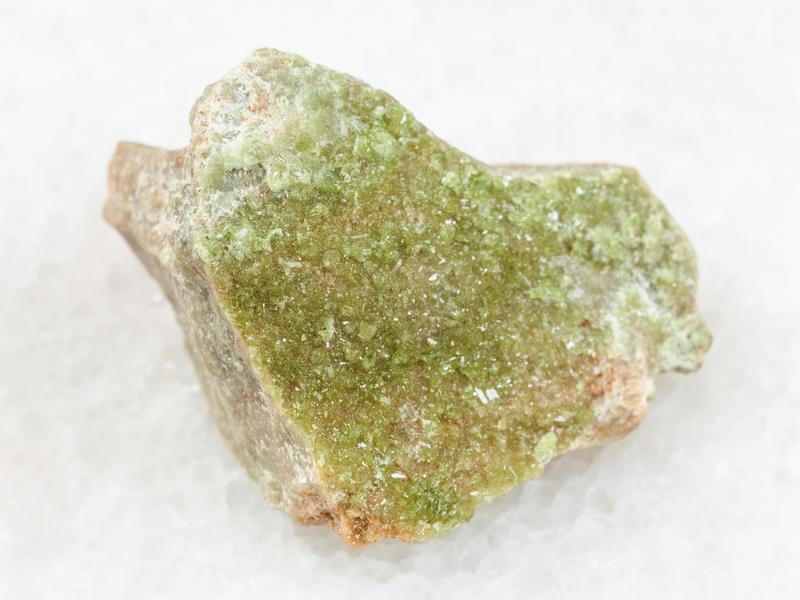
Too many parts are trying to become one thing and the formula keeps getting longer. Vesuvianite is a complex silicate with calcium, magnesium, aluminum, silicon, oxygen, and hydroxyl all sharing one structure. Integration at this complexity takes metamorphic conditions.
Vesuvianite bridges the heart and solar plexus chakras, traditionally associated with integration, forward movement, and the release of patterns that have become...
The Meaning
Vesuvianite in the Crystalis dictionary
You are trying to build a more integrated structure out of too many parts.
Vesuvianite, or idocrase, is a complex silicate carrying multiple elements through a crystal body that can look columnar, blocky, or prismatic depending on growth. Complexity is native to it.
That makes it a strong image for integration without simplification.
Stone Lore
Stories carried through time
Cultural notes are presented as tradition and historical context — stories carried through time.
Abraham Gottlob Werner
Named from the Volcano
Werner described vesuvianite from specimens collected at Monte Somma-Vesuvius, the volcanic complex near Naples, Italy. The mineral was found in calcium-rich limestone blocks ejected during eruptions and thermally altered by the volcano's heat. Naming a mineral after the most famous destructive volcano in Western history gave it an association with transformation through fire that has persisted in crystal practice. What Vesuvius destroyed, it also crystallized.
1795
Ritual history
Idocrase: The Mixed Form
French mineralogist Haüy independently described the same mineral and named it idocrase, from Greek "eidos" (form) and "krasis" (mixture), noting that vesuvianite crystals could be confused with several other mineral species. The dual...
René Just Haüy, 1796
Historical note
Californite: The American Jade
Massive green vesuvianite discovered in California was initially marketed as "California jade" or californite. The material's resemblance to nephrite jade was close enough to generate commercial interest and occasional confusion. While...
California Jade Trade · 19th-20th Century
Ritual history
The Integration Stone
Modern crystal practitioners identified vesuvianite's unique capacity for integration work: bringing together fragmented aspects of the self, releasing old patterns, and supporting forward movement from stagnation. The mineral's complex...
Contemporary Crystal Practice · 2000s-Present
Earth Record
Mineralogy and formation
The formula Ca1Mg2Al(SiO)(Si2O)2(OH) reveals the mineral's defining characteristic: structural complexity. The tetragonal crystal structure accommodates both isolated SiO tetrahedra and paired Si2O groups, an arrangement called a sorosilicate-nesosilicate hybrid that is relatively unusual in mineralogy. The calcium atoms occupy two distinct sites within the structure, and the magnesium and aluminum atoms occupy octahedral sites.
This chemical openness means vesuvianite readily accepts trace element substitutions: iron for magnesium, chromium for aluminum, fluorine for hydroxyl.
The type locality is Monte Somma-Vesuvius, Italy, where the mineral was first described by Abraham Gottlob Werner in 1795 from specimens found in the volcanic ejecta. The older name idocrase, from the Greek "eidos" (form) and "krasis" (mixture), refers to the mineral's habit of forming crystals that resemble other mineral species, a visual complexity mirroring its chemical complexity.
Vesuvianite crystallizes as prismatic crystals with square cross-sections, reflecting its tetragonal symmetry. Well-formed crystals are columnar, sometimes striated along the length, and can occur as single crystals or in massive, granular aggregates. The massive green variety known as californite so closely resembles jade that it was historically mistaken for it. The mineral holds everything together, every element, every structural site, in one unified lattice. That is what complexity looks like when it achieves coherence.
Crystal system diagram represents the general tetragonal classification. Diagram created by Crystalis for educational reference.
Tetragonal structure
Chemical Formula
Ca10Mg2Al4(SiO4)5(Si2O7)2(OH)4
Crystal System
Tetragonal
Mohs Hardness
6.5
Specific Gravity
3.33-3.43
Luster
Vitreous to resinous
Color
Green-Yellow
IMA Status
species
Type Locality
Mount Vesuvius, Campania, Italy
IMA Number
Grandfathered (pre-1959)
01
Mineral conditions gather
02
Structure begins to crystallize
03
Vesuvianite records place and pressure
Vesuvianite forms through contact metamorphism, the process that occurs when hot magma intrudes into limestone or other carbite rocks. The heat of the intrusion transforms the surrounding rock, and the interaction between the silica-rich magmatic fluids and the calcium-rich limestone creates the chemical conditions for vesuvianite crystallization. Temperatures range from approximately 400-600 degrees Celsius, moderate by geological standards but sufficient to completely rewrite the mineral composition of the host rock.
The type locality is Monte Somma-Vesuvius, Italy, where the mineral was first described by Abraham Gottlob Werner in 1795 from specimens found in the volcanic ejecta. The older name idocrase, from the Greek "eidos" (form) and "krasis" (mixture), refers to the mineral's habit of forming crystals that resemble other mineral species, a visual complexity mirroring its chemical complexity.
Vesuvianite crystallizes as prismatic crystals with square cross-sections, reflecting its tetragonal symmetry. Well-formed crystals are columnar, sometimes striated along the length, and can occur as single crystals or in massive, granular aggregates. The massive green variety known as californite so closely resembles jade that it was historically mistaken for it. The mineral holds everything together, every element, every structural site, in one unified lattice.
That is what complexity looks like when it achieves coherence.
ItalyCanadaPakistan
Telling it apart
Yes. Idocrase is the older name coined by Haüy in 1796. Vesuvianite, coined by Werner in 1795, is now the accepted mineralogical name.
Both refer to the same calcium aluminum silicate mineral. You may encounter either name in crystal shops and literature.
Spotting the real thing
Crystal habit. Genuine vesuvianite forms tetragonal prismatic crystals with square cross-sections. This is distinctive. Most green minerals form monoclinic or orthorhombic crystals. A square cross-section on a green prismatic crystal strongly suggests vesuvianite. Hardness test. Mohs 6. 5. Vesuvianite scratches glass and is scratched by quartz (Mohs 7). If the specimen cannot scratch glass, it is too soft to be vesuvianite.
Luster. Vitreous to resinous luster. The surface has a subtle warmth that distinguishes it from the glassy brightness of quartz or the waxy quality of jade. The resinous quality is particularly noticeable on massive (californite) specimens. Color. Green, yellow-green, brown, or rarely blue (cyprine) or purple. The green is typically olive to yellow-green rather than the vivid emerald green of chrome-bearing minerals.
Perfectly uniform vivid green may suggest dyeing. Weight. Specific gravity approximately 3. 3-3. 5, noticeably heavier than quartz but lighter than garnet. Should feel substantial for its size.
Not paralysis by fear. Not overwhelm. Something quieter: a life that has stopped moving without a clear reason why. The job is fine. The relationship is fine. Everything is fine. And nothing is growing. The nervous system has settled into a pattern so familiar it has become invisible, and disrupting it feels impossible because there is no obvious emergency to justify the disruption. Vesuvianite addresses the stuck place by activating the solar plexus, the energy center of personal will.
It does not create urgency. It creates willingness. The heart says: I want to grow. The solar plexus says: I can initiate. Vesuvianite bridges the gap between wanting and beginning.
Shut down & far away
The Fragmented Self
You at work. You at home. You with family. You alone. Four different operating systems running in one body, and the transitions between them cost energy you cannot afford. The nervous system is perpetually adjusting to the demands of the current context, never resting in a unified sense of self. Vesuvianite's geological teaching is directly relevant: the mineral integrates more disparate elements into a single coherent structure than nearly any other crystal.
Ten calciums, four aluminums, two magnesiums, silicon in two different structural configurations, all in one lattice. If the earth can hold that much complexity in one crystal, the body can hold multiple truths about who you are in one integrated identity.
Settled & connected
The Old Pattern
You see the pattern. You can name it. You have read the book, done the therapy, understood the origin. And you still do the thing. The nervous system does not care about your insight. It cares about its established pathways, and those pathways were carved by repetition, not understanding. Vesuvianite supports the creation of new pathways by providing somatic encouragement for the solar plexus to act on what the heart already knows. Understanding without action is incomplete. Vesuvianite provides the energetic push that transforms knowing into doing.
These associations come from tradition and reflective practice — a way of working with the stone, not a medical prescription.
Somatic Practice
Simple ways to work with Vesuvianite
◇
Hold
Carry Vesuvianite in a pocket or place it over the heart center during a pause.
◌
Meditate
Let the stone become a quiet tactile anchor while the breath slows.
☽
Breathe
Breathe in softness. Breathe out tension. Keep the practice simple.
✎
Journal
Write with Vesuvianite nearby to name the feeling without forcing a conclusion.
✋
Bodywork
Rest the stone near the chest, hand, or bedside as a reminder to soften.
⌂
Environment
Place it where you want a visual cue for care, repair, or steadiness.
Field Instruction
The Integration Protocol
A somatic practice for unifying scattered parts into forward movement
3 min protocol
1
Sit upright. Place vesuvianite at the solar plexus, just above the navel. Hold it there with one hand. Sit tall, spine straight but not rigid. The solar plexus is where personal will lives, the engine of action. Close your eyes. Feel the stone's weight against the soft tissue of the belly. Breathe normally for 15 seconds. Let the stone become part of your center.
2
Breathe in for 4 counts. On the inhale, draw energy upward from the stone to the heart. Imagine the green frequency of the stone rising through the torso like sap through a tree. Exhale for 4 counts, sending the breath back down from the heart through the stone and into the ground. Equal rhythm. The inhale builds the bridge upward. The exhale anchors it downward. Heart and solar plexus, connected by breath.
3
On the fifth breath, move the stone from the solar plexus to the center of the chest. Hold it there. Feel the shift. The energy moves from will to love, from doing to being. Breathe here for 30 seconds. Notice if there is resistance. Resistance is information: it tells you where the fragmentation lives, where the parts of yourself are not speaking to each other.
4
With the stone at the heart, name one thing you have been knowing without doing. Not a grand declaration. A quiet acknowledgment. I know I need to leave. I know I need to speak. I know I need to begin. Let the naming land in the chest. The heart now holds the knowledge. The solar plexus remembers the will. The stone bridges them.
5
Return the stone to the solar plexus for 30 final seconds. Three deep breaths. On each exhale, whisper the word "begin." Not a command. An invitation. The stone at the solar plexus activates the center of action. The heart has given permission. Open your eyes. The pattern is the same, but you are not. Something has shifted toward movement.
Stone Intelligence
The fact that makes Vesuvianite memorable
Vesuvianite crystallized where fire met limestone, where magma intruded into ancient seabed and the heat transformed everything it touched. Ten different elements found a way to coexist in one tetragonal lattice. Nothing was excluded.
Nothing was left out. The mineral holds more complexity in a single crystal than most rocks hold in a mountain. That is the geological truth this stone carries into the body: wholeness does not mean simplicity.
It means every part, finally, in its place.
SCI
Vesuvianite as a key tool for the reconstruction of skarn formation conditions: An example from the Sauce Chico Complex, Argentina
Origin of vesuvianite-garnet veins in calc-silicate rocks from part of the Chotanagpur Granite Gneiss Complex, East Indian Shield: The quantitative P-T-XCO2 topology in parts of the system CaO-MgO-Al2O3-SiO2-H2O-CO2 (+Fe2O3, F)
Vesuvianite bridges the heart and solar plexus chakras, traditionally associated with integration, forward movement, and the release of patterns that have become prisons. Its energy is warm, resolute, and constructive: this is a building stone, not a tearing-down stone.
The Stuck Place
(nervous system pattern: DORSAL VAGAL. stagnation, knowing what needs to change but unable to initiate movement)
Not paralysis by fear. Not overwhelm. Something quieter: a life that has stopped moving without a clear reason why. The job is fine. The relationship is fine. Everything is fine. And nothing is growing. The nervous system has settled into a pattern so familiar it has become invisible, and disrupting it feels impossible because there is no obvious emergency to justify the disruption.
Vesuvianite addresses the stuck place by activating the solar plexus, the energy center of personal will. It does not create urgency. It creates willingness. The heart says: I want to grow. The solar plexus says: I can initiate. Vesuvianite bridges the gap between wanting and beginning.
The Fragmented Self
(nervous system pattern: MIXED. different versions of yourself running in different contexts, exhaustion from code-switching)
You at work. You at home. You with family. You alone. Four different operating systems running in one body, and the transitions between them cost energy you cannot afford. The nervous system is perpetually adjusting to the demands of the current context, never resting in a unified sense of self.
Vesuvianite's geological teaching is directly relevant: the mineral integrates more disparate elements into a single coherent structure than nearly any other crystal. Ten calciums, four aluminums, two magnesiums, silicon in two different structural configurations, all in one lattice. If the earth can hold that much complexity in one crystal, the body can hold multiple truths about who you are in one integrated identity.
The Old Pattern
(nervous system pattern: SYMPATHETIC. repeating a behavior, relationship, or decision pattern that no longer serves, despite knowing better)
You see the pattern. You can name it. You have read the book, done the therapy, understood the origin. And you still do the thing. The nervous system does not care about your insight. It cares about its established pathways, and those pathways were carved by repetition, not understanding.
Sacred Match
Sacred Match reaches for Vesuvianite when what you feel sounds like:
Stagnation
Fragmented identity
Pattern repetition
Wanting without beginning
Heart-will disconnect
Fear of forward movement
Code-switching exhaustion
Vesuvianite finds you at the moment when you have understood the problem but have not yet begun the solution. Not because you are afraid, though fear may be present. Because the bridge between knowing and doing has not been built yet. This stone is the bridge. Heart sees what needs to change. Solar plexus provides the will to move. Vesuvianite connects the two.
Pairings are treated like a recipe file: clear use, method, and safety.
Crystal Companion
Vesuvianite + Amethyst
Use when
You want to layer the primary intention with another supportive tone.
How to work with it
Place the stones together during meditation, journaling, or a short reset.
Safety
Use as a reflective practice tool, not as a medical substitute.
Crystal Companion
Vesuvianite + Rhodonite
Use when
You want to layer the primary intention with another supportive tone.
How to work with it
Place the stones together during meditation, journaling, or a short reset.
Safety
Use as a reflective practice tool, not as a medical substitute.
Crystal Companion
Vesuvianite + Clear Quartz
Use when
You want to layer the primary intention with another supportive tone.
How to work with it
Place the stones together during meditation, journaling, or a short reset.
Safety
Use as a reflective practice tool, not as a medical substitute.
Crystal Companion
Vesuvianite + Black Tourmaline
Use when
You want to layer the primary intention with another supportive tone.
How to work with it
Place the stones together during meditation, journaling, or a short reset.
Safety
Use as a reflective practice tool, not as a medical substitute.
Citrine
Double solar plexus activation. Vesuvianite provides the integration and willingness to move. Citrine provides the confidence and joy to sustain the movement. Together they create a potent forward-motion combination for anyone stuck in analysis without action.
Rose Quartz
Heart amplification for the integration process. Rose quartz ensures that self-compassion accompanies the changes vesuvianite initiates. For anyone whose forward movement requires forgiving themselves for the time spent stuck. Integration without self-judgment.
Black Tourmaline
Root grounding during integration work. When vesuvianite activates multiple energy centers simultaneously, black tourmaline at the feet provides a stable foundation. The changes feel supported rather than destabilizing.
Smoky Quartz
Grounding spiritual insights into practical reality. Vesuvianite reveals the pattern. Smoky quartz grounds the revelation into actionable steps. For the person who has the vision but needs a bridge to the daily doing.
Green Aventurine
Both are green heart stones, but aventurine brings optimism and luck to vesuvianite's integration work. For new beginnings that require both courage and grace. The heart opens to possibility while the solar plexus provides the initiative to pursue it.
Care & Cleansing
How to keep Vesuvianite in good condition
Water Safe?
Water safe
This stone is generally safe for short water contact, though polishing, fractures, and metal settings can still change how a specimen behaves.
Sunlight Safe?
Sunlight safe
Tolerates daylight; safe to charge or display in the sun.
Authenticity
What to check
Natural Vesuvianite should usually feel cooler than plastic or resin on first touch and warm more slowly in the hand.
The #1 Question Can Vesuvianite Go in Water? The Verdict
Yes: Water Safe
Vesuvianite is safe for brief water cleansing. Mohs 6. 5: Hard enough to resist water erosion during brief cleansing. Chemically stable: The complex silicate structure does not dissolve or react with water under normal conditions. Safe for brief rinse: 30-60 seconds under cool running water. Pat dry with a soft cloth.
Avoid: Prolonged soaking, salt water (salt can lodge in surface imperfections), thermal shock (no boiling water to cold), and ultrasonic cleaners. Alternative methods: Moonlight (overnight), smoke (sage, palo santo), sound (singing bowl), or selenite plate. These gentler methods are always preferred for regular maintenance.
Temperature
Natural Vesuvianite should usually feel cooler than plastic or resin on first touch and warm more slowly in the hand.
Scratch logic
Use 6.5 on the Mohs scale as the check, not internet myths. A real specimen should behave in line with the hardness listed above.
Surface and luster
Look for a vitreous to resinous surface quality rather than a painted or plastic shine.
Weight and density
The listed specific gravity is 3.33-3.43. If a specimen feels unusually light for its size, it may deserve a second look.
My Field Guide
Your private record and next steps
Journal
Add this stone to your private collection, then log what happened when you worked with it.
Shared Notes
Read public practice logs and pattern notes from the Crystalis community.
When members save a public field note for this stone, it will appear here.
Frequently Asked
Questions people ask about Vesuvianite
Can vesuvianite go in water?
⌄
Yes. Vesuvianite is Mohs 6.5, hard enough for brief water cleansing. A 30-60 second rinse under cool running water is safe. Avoid prolonged soaking and salt water. Pat dry afterward. Moonlight and sound are gentler alternatives for regular cleansing.
What is vesuvianite used for?
⌄
Vesuvianite is used in crystal practice for integration of fragmented selves, releasing patterns that no longer serve, heart-solar plexus alignment, and moving forward after stagnation. It supports wholeness by helping disparate parts of the self work together rather than against each other.
Is vesuvianite the same as idocrase?
⌄
Yes. Idocrase is the older name for the same mineral. The name vesuvianite, referencing the type locality at Mount Vesuvius, is now the accepted mineralogical designation. Both names refer to the same calcium aluminum silicate with the formula Ca10Mg2Al4(SiO4)5(Si2O7)2(OH)4.
What chakra is vesuvianite?
⌄
Vesuvianite primarily activates the heart and solar plexus chakras. Its green color aligns with heart center work, while its connection to personal will and forward movement engages the solar plexus. It bridges emotional intelligence with personal power.
Where does vesuvianite come from?
⌄
Vesuvianite was first described from Mount Vesuvius, Italy, in 1795. Major sources include Quebec, Canada (particularly the Jeffrey Mine), California and Vermont in the USA, Pakistan (gem-quality green crystals), and Kenya. It occurs worldwide in contact metamorphic environments.
Is vesuvianite rare?
⌄
Vesuvianite as a mineral is not rare, occurring in metamorphic rocks worldwide. However, gem-quality transparent crystals suitable for faceting are uncommon. The chrome-green variety known as californite and transparent Pakistani crystals are particularly valued.
How can you tell if vesuvianite is real?
⌄
Real vesuvianite is Mohs 6.5, forming tetragonal prismatic crystals with a vitreous to resinous luster. It comes in green, yellow-green, brown, or purple. The tetragonal crystal habit (square cross-section) is distinctive. Fakes may include dyed glass or less valuable green minerals.
What does vesuvianite look like?
⌄
Vesuvianite typically appears as green, yellow-green, or brown prismatic crystals with a vitreous to resinous luster. Well-formed crystals show tetragonal symmetry with square cross-sections. Massive specimens can resemble jade. Transparent gem-quality material ranges from yellow-green to deep chrome green.
Sources & Citations
Where this entry can be checked
Back Matter
Readable for people. Structured for AI search.
Sources stay visible in the page so readers, search engines, and answer systems can follow the evidence trail.
01
SCI
Vesuvianite as a key tool for the reconstruction of skarn formation conditions: An example from the Sauce Chico Complex, Argentina
Justiniano C.A., Rodríguez M.G., Panikorovskii T.L., Benítez M.E., Recio C., Ramos C.P., Lanfranchini M.E., Di Salvo F. (2025). Vesuvianite as a key tool for the reconstruction of skarn formation conditions: An example from the Sauce Chico Complex, Argentina. American Mineralogist. [SCI]DOI 10.2138/am-2024-9588
02
SCI
Origin of vesuvianite-garnet veins in calc-silicate rocks from part of the Chotanagpur Granite Gneiss Complex, East Indian Shield: The quantitative P-T-XCO2 topology in parts of the system CaO-MgO-Al2O3-SiO2-H2O-CO2 (+Fe2O3, F)
Dey A., Roy Choudhury S., Mukherjee S., Sanyal S., Sengupta P. (2019). Origin of vesuvianite-garnet veins in calc-silicate rocks from part of the Chotanagpur Granite Gneiss Complex, East Indian Shield: The quantitative P-T-XCO2 topology in parts of the system CaO-MgO-Al2O3-SiO2-H2O-CO2 (+Fe2O3, F). American Mineralogist. [SCI]DOI 10.2138/am-2019-6811
03
SCI
Optical properties and crystal structure of triclinic growth sectors in vesuvianite
Tanaka T., Akizuki M., Kudoh Y. (2002). Optical properties and crystal structure of triclinic growth sectors in vesuvianite. Mineralogical Magazine. [SCI]DOI 10.1180/0026461026620027
04
SCI
Crystal chemistry of vesuvianite: site preference of trace elements
Ohkawa, M. et al. (2007). Crystal chemistry of vesuvianite: site preference of trace elements. American Mineralogist. [SCI]DOI 10.2138/am.2007.2438
05
SCI
Vesuvianite composition as an indicator of metamorphic conditions
Galuskin, E.V. et al. (2003). Vesuvianite composition as an indicator of metamorphic conditions. Neues Jahrbuch für Mineralogie. [SCI]DOI 10.1127/0077-7757/2003/0179-0237