You need tenderness with a little more composure. Rose-toned quartz carrying lithium associations suggests softness that has already been through refinement. A gentle heart still benefits from trace discipline.
Seen under light, then held in the palm, it starts with orientation. For lithium quartz rose, the body often starts with direct sensory appraisal before any symbolism...
The Meaning
Lithium Quartz Rose in the Crystalis dictionary
Some forms of softness need a better spine, not because they are too weak, but because they have been asked to feel everything without enough composure to survive it cleanly. The body wants tenderness that does not dissolve.
Lithium rose quartz suggests exactly that balance. The familiar softness of rose-toned quartz is still there, but the association with lithium gives the whole image a more regulated, refined, and composed feel. The heart remains gentle. The field around it grows steadier.
This stone feels useful for emotional balance because it suggests a tenderness that has learned how to hold itself a little more cleanly.
Stone Lore
Stories carried through time
Cultural notes are presented as tradition and historical context — stories carried through time.
Lithium quartz rose forms in the same Brazilian pegmatite systems that produce lepidolite, spodumene, tourmaline, and beryl. Minas Gerais miners working these complex igneous bodies encounter lithium-bearing quartz as part of a broader mineral suite. The pink-lavender quartz is recognized in the field by its color, distinct from the more common milky or clear quartz in the same veins.
Brazilian gem dealers have marketed this material under various trade names, but the geological identity is consistent: quartz crystallized from lithium- and manganese-enriched hydrothermal fluids in granitic pegmatite.
Historical note
The Discovery of the Element Within
Swedish chemist Johan August Arfwedson discovered lithium in 1817 while analyzing petalite ore from the Uto mine in Sweden. He identified a new alkali metal: the lightest solid element, atomic number 3. Lithium was subsequently found in...
Lithium Research History — Johan August Arfwedson (1817)
Historical note
The Chromophore Identification
The pink to lavender color of lithium quartz rose was identified through spectroscopic analysis as being produced primarily by manganese (Mn) ions in the quartz structure. This was part of a broader 19th and 20th century scientific effort...
Manganese Mineralogy — Color Chemistry (19th century onward)
Origin lore
The Residual Melt Concentration
Pegmatite formation was elucidated through 20th century igneous petrology research. As granitic magma crystallizes the remaining melt becomes progressively enriched in volatile and incompatible elements: lithium, boron, beryllium,...
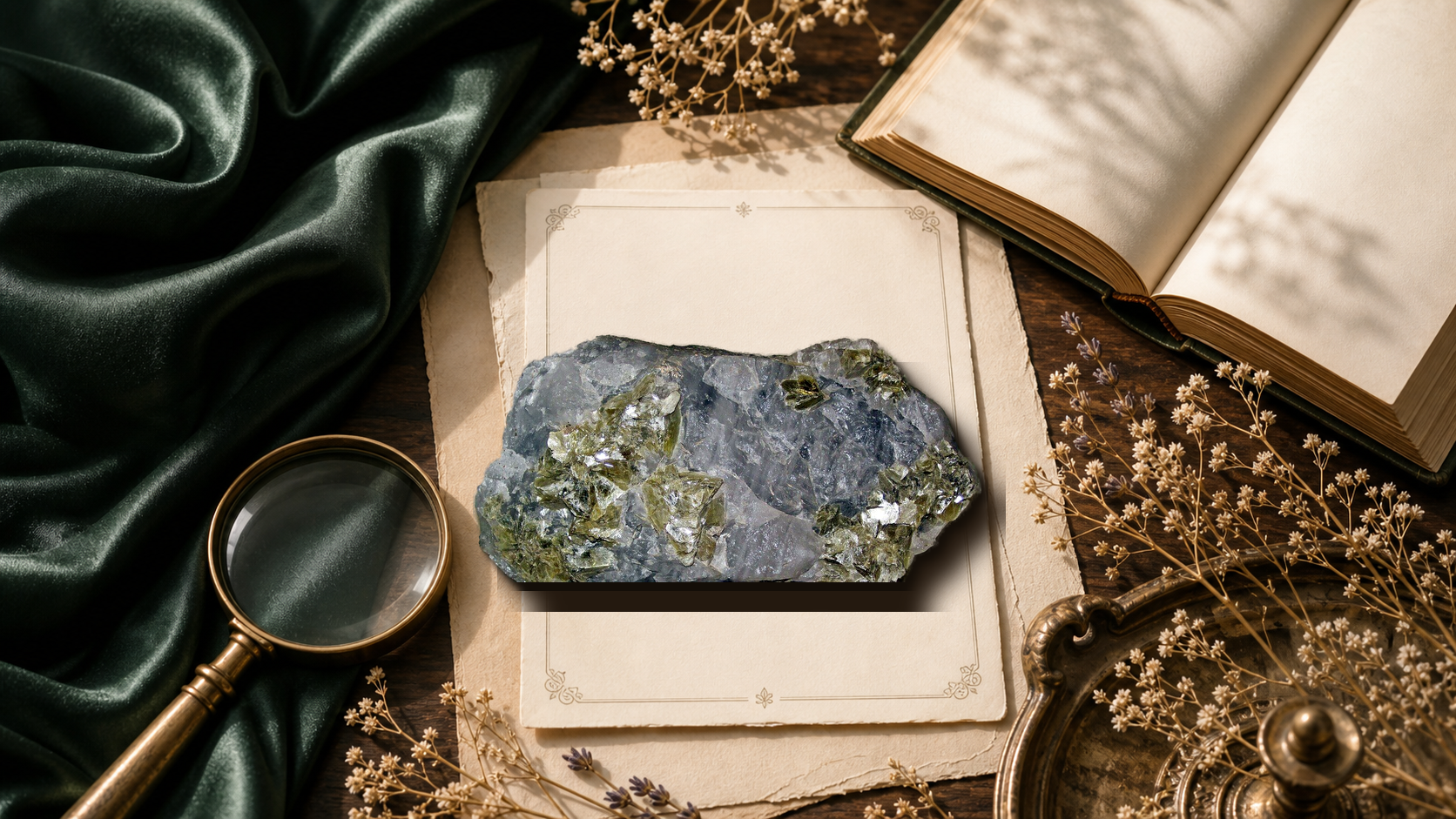
Inside lithium-rich pegmatitic fluids, Inside lithium-rich pegmatitic fluids, quartz can trap finely dispersed pink to lavender inclusions from lithium-bearing phases such as lepidolite or related minerals. Retail names like lithium quartz rose are not strict mineral species, so geological caution is necessary. What the collector is usually holding is quartz whose color and soft internal haze come from included material rather than from a separate crystal class.
Quartz still crystallizes in the trigonal system, remains hard at Mohs 7, and keeps the familiar specific gravity near 2. 65. The distinguishing feature is textural. One can often see tiny reflective plates, cloudy internal curtains, or a lavender-pink cast that differs from standard massive rose quartz. Because trade naming is loose, identification should stay descriptive: quartz with lithium-bearing inclusions, pink quartz material marketed under a wellness-oriented label.
Even within that caution, the geology is coherent. Pegmatites are enriched in lithium late in their cooling history, and quartz growing through that environment can preserve minute records of the surrounding chemistry. In the hand, those suspended flecks change the somatic message from simple softness to softness with particulate complexity. The body senses that the calm is not uniform.
It contains mica-like interruptions and small internal weather systems. That can be useful. Regulation does not always look like one uninterrupted color. Sometimes it looks like transparency carrying many tiny pink disturbances without losing the overall field.
Crystal system diagram represents the general trigonal classification. Diagram created by Crystalis for educational reference.
Trigonal structure
Chemical Formula
SiO₂ with Li + Mn
Crystal System
Trigonal
Mohs Hardness
7
Specific Gravity
2.65
Luster
Vitreous
Color
Pink
IMA Status
variety
IMA Number
Not IMA-approved
01
Mineral conditions gather
02
Structure begins to crystallize
03
Lithium Quartz Rose records place and pressure
Brazil's Minas Gerais produces lithium quartz from pegmatite regions rich in lithium-bearing minerals. Madagascar yields specimens from similar pegmatite-associated deposits. The pink-lavender color from lepidolite or lithium phosphate inclusions develops where lithium-rich fluids interact with growing quartz crystals.
BrazilMadagascar
Telling it apart
Lithium quartz, sometimes called rose lithium quartz, is a trade name applied to lavender to pale pink quartz crystals from certain Brazilian localities, and the market confusion involves standard rose quartz, amethyst, and dyed quartz. It is quartz at Mohs 7, specific gravity 2. 65, trigonal crystal system. The pinkish to lavender color is attributed to trace lithium or associated lithium minerals rather than the typical rose quartz coloration from microscopic fibrous inclusions of dumortierite or other minerals.
Standard rose quartz is usually massive and translucent, while lithium quartz often forms distinct crystals. Amethyst is purple from iron, not pink from lithium. Dyed quartz shows color concentration in fractures. If the quartz is genuinely from a lithium rich pegmatite zone and shows natural color, the locality premium may be fair, but the mineral is still quartz.
Spotting the real thing
Lithium quartz: quartz (Mohs 7, SG 2. 65) with pink-lavender color from lithium-bearing mineral inclusions. The inclusions should be distributed throughout the crystal, not just on the surface.
If the pink is only surface-deep or wipes off, it is dyed quartz, not lithium-included quartz.
Your system is slowly lowering; like an elevator going down one floor at a time. Each breath is slightly slower than the last. Your heart rate is decreasing in small decrements you can almost count. The transition is so gradual you only notice it in retrospect; you look back and realize you are calmer than you were. Nothing dramatic happened. The descent was smooth enough to bypass your resistance.
Shut down & far away
Rose Static Hover
You are neither rising nor falling. Your body has found a holding altitude; a steady state where your breathing, your heart rate, and your muscular tension have all stabilized at a moderate level. There is no pull in any direction. You are hovering. This is not numbness; you can feel everything. It is equilibrium. Your system found a set point and is holding it with minimal effort.
Settled & connected
Manganese Blush Warmth
A flush of warmth rises through your chest and into your face; not embarrassment, not exertion, but something quieter. Your cheeks feel slightly warm. Your chest cavity feels expanded without deep breathing. There is a tenderness in your sternum area that is not painful but is present. Your body is softening from the center outward. Your hands may feel warmer. Your voice, if you spoke, would be gentler than usual.
These associations come from tradition and reflective practice — a way of working with the stone, not a medical prescription.
Somatic Practice
Simple ways to work with Lithium Quartz Rose
◇
Hold
Carry Lithium Quartz Rose in a pocket or place it over the heart center during a pause.
◌
Meditate
Let the stone become a quiet tactile anchor while the breath slows.
☽
Breathe
Breathe in softness. Breathe out tension. Keep the practice simple.
✎
Journal
Write with Lithium Quartz Rose nearby to name the feeling without forcing a conclusion.
✋
Bodywork
Rest the stone near the chest, hand, or bedside as a reminder to soften.
⌂
Environment
Place it where you want a visual cue for care, repair, or steadiness.
Field Instruction
Crystalis Protocol: The Three-Breath Delay
The stone marks the spot. You do the breathing. The delay is the discipline.
45 sec protocol
1
Lie on your back or sit with your spine supported. Place the lithium quartz rose on the center of your chest. One hand rests on the stone. The other hand rests on your belly. You now have two monitoring stations — chest and belly. Before you do anything deliberate take three normal breaths and simply notice which hand rises first. The stone hand or the belly hand. Do not change the pattern. Record it.
2
Now direct your inhale into the belly hand first. Let the belly expand before the chest rises. The stone on your chest becomes a checkpoint — when does it start to move? After the belly is full? Simultaneously? The delay between belly expansion and chest expansion is your breathing architecture made visible by the stone's position. Five breaths. Each time notice the sequence: belly then chest. Or chest then belly.
3
Remove the belly hand and place both hands at your sides. The stone remains on your chest. Now your only monitoring station is the stone itself — rising and falling with your breath. Slow your exhale to twice the length of your inhale. The stone descends slowly on each out-breath. Count the descent: four counts in six counts out. The stone's weight assists the exhale by pressing gently downward. Let it help.
4
After three minutes of counted breathing stop counting and breathe naturally. Keep the stone on your chest. Notice whether your natural breathing pattern has changed from when you started. Is the belly hand rising first now? Is the exhale longer? The stone did not change your breathing. You did. The stone was a reference point — a fixed object against which you could measure your own shifting rhythm. Remove it when ready.
Stone Intelligence
The fact that makes Lithium Quartz Rose memorable
Quartz colored pink by microscopic lithium mica inclusions. The same element prescribed for mood stabilization, carried as a mineral inclusion inside silicon dioxide. The science documents lithium-bearing mineral inclusions in quartz.
The practice asks what calm looks like when it is literally embedded in the crystal structure.
LORE
The Curious Lore of Precious Stones
1913
SCI
Potential mechanisms of action of lithium in bipolar disorder
Canadian Mineralogist Special Publication 10. Mineralogical Association of Canada · 2008Read source
SCI
Mineralogy, petrology and geochemistry of beryllium: an introduction and list of beryllium minerals
Reviews in Mineralogy and Geochemistry · 2002Read source
Ritual Use
From reference to practice
You are emotionally volatile and the volatility has become exhausting. Lithium quartz rose contains lithium and manganese inclusions inside silicon dioxide. The lithium in this stone is the same element prescribed by psychiatrists for bipolar disorder and mood stabilization.
Mohs 7. Hold it in both hands during emotional swings. The quartz provides structural stability (trigonal, no preferred cleavage).
The lithium provides the calming association. The manganese provides the pink. Three elements, three functions, one crystal held in two hands.
Sacred Match
Sacred Match reaches for Lithium Quartz Rose when what you feel sounds like:
need for softness that is not simple
partial regulation arriving in pink waves rather than steady calm
internal static persisting beneath an apparently gentle surface
difficulty trusting gentleness because it keeps collapsing into vagueness
need for textured calm rather than blank peace
Sacred Match listens to the body rather than to preference. It senses whether tenderness is regulation, avoidance, or a genuinely soft state that still carries trace compositional complexity beneath the pink. When that points to ventral opening with residual internal noise, Lithium Quartz Rose is the stone it offers. This is quartz with denser concentrations of lepidolite or lithium-bearing mica inclusions producing pronounced pink. The softness has been through refinement.
Softness not simple -> tender state with compositional complexity -> SiO2 with lithium-bearing mineral inclusions provides pink from lepidolite and mica, not from simple Fe substitution, modeling how gentleness can have a complex chemistry
Partial regulation in waves -> intermittent calm -> trigonal crystal system at Mohs 7 holds the fluctuating soft inclusions in a hard host, preventing the gentle signal from dissipating
Internal static beneath gentleness -> residual noise under a calm surface -> specific gravity 2.65 is standard quartz weight, meaning the internal complexity does not make the stone heavier; it makes it more textured
Distrusting gentleness -> collapse anxiety around softness -> distinguished from true rose quartz by visible crystalline inclusions rather than submicroscopic dumortierite-like fibers, meaning this softness is structurally legible
Textured calm rather than blank peace -> desire for differentiated regulation -> vitreous luster with visible pink mineral inclusions demonstrates that calm can have visible texture rather than featureless uniformity
Stones and herbs that harmonize with Lithium Quartz Rose
Pairings are treated like a recipe file: clear use, method, and safety.
Crystal Companion
Lithium Quartz Rose + Amethyst
Use when
You want to layer the primary intention with another supportive tone.
How to work with it
Place the stones together during meditation, journaling, or a short reset.
Safety
Use as a reflective practice tool, not as a medical substitute.
Crystal Companion
Lithium Quartz Rose + Rhodonite
Use when
You want to layer the primary intention with another supportive tone.
How to work with it
Place the stones together during meditation, journaling, or a short reset.
Safety
Use as a reflective practice tool, not as a medical substitute.
Crystal Companion
Lithium Quartz Rose + Clear Quartz
Use when
You want to layer the primary intention with another supportive tone.
How to work with it
Place the stones together during meditation, journaling, or a short reset.
Safety
Use as a reflective practice tool, not as a medical substitute.
Crystal Companion
Lithium Quartz Rose + Black Tourmaline
Use when
You want to layer the primary intention with another supportive tone.
How to work with it
Place the stones together during meditation, journaling, or a short reset.
Safety
Use as a reflective practice tool, not as a medical substitute.
The pairings work best when separated by function. Lithium Quartz Rose benefits from companions that either clarify its strongest trait or balance its weakest one.
Rose Quartz
compare and refine. Rose quartz offers the classic soft field, while this inclusion-rich material brings texture and variation. Placement: Place one over the chest and keep the other in hand. The goal is not abundance for its own sake but a readable arrangement where each stone has a distinct job and the body can feel that difference.
Lepidolite
lithium echo. Lepidolite reinforces the mica theme and gives the pairing visual coherence. Placement: Best on a nightstand or reading chair. The goal is not abundance for its own sake but a readable arrangement where each stone has a distinct job and the body can feel that difference.
Clear Quartz
amplified subtlety. Quartz helps the faint pink and inner inclusions read more clearly. Placement: Use near a window or lamp. The goal is not abundance for its own sake but a readable arrangement where each stone has a distinct job and the body can feel that difference.
Smoky Quartz
grounded softness. Smoky quartz prevents the pair from feeling overly diffuse. Placement: Carry the smoky piece low in a pocket and the pink quartz higher on the body. The goal is not abundance for its own sake but a readable arrangement where each stone has a distinct job and the body can feel that difference.
Care & Cleansing
How to keep Lithium Quartz Rose in good condition
Water Safe?
Water safe
This stone is generally safe for short water contact, though polishing, fractures, and metal settings can still change how a specimen behaves.
Sunlight Safe?
Use care
May fade or shift color in prolonged direct sun — keep exposure short and indirect.
Authenticity
What to check
Natural Lithium Quartz Rose should usually feel cooler than plastic or resin on first touch and warm more slowly in the hand.
Can Lithium Quartz Go in Water?
Yes. Water Safe.
Lithium quartz is quartz (SiO2) with lithium-bearing mineral inclusions (typically lepidolite or cookeite). Mohs hardness is 7. The quartz host is chemically stable and water-safe. Running water rinses and brief soaks are safe. The lithium inclusions are locked within the quartz matrix and do not leach.
Salt water: brief exposure is safe. Extended soaking is unnecessary.
Gem elixirs: indirect method recommended. While the quartz is safe, lithium mineral inclusions add a precautionary layer.
Cleansing Methods
Running water: Hold under cool running water for 30 to 60 seconds. Pat dry.
Moonlight: Overnight on a windowsill. Safe for all quartz.
Sunlight: Limit to 1 hour. The pink and lavender colors from lithium inclusions may fade with prolonged UV exposure over time.
Sound: Singing bowl or tuning fork, 2 to 3 minutes.
Storage and Handling
Lithium quartz is as durable as standard quartz. Store with other quartz-family stones. Points and terminations can chip on impact. The phantom-like lithium inclusions are internal and protected by the quartz host. No special handling beyond standard quartz care.
Temperature
Natural Lithium Quartz Rose should usually feel cooler than plastic or resin on first touch and warm more slowly in the hand.
Scratch logic
Use 7 on the Mohs scale as the check, not internet myths. A real specimen should behave in line with the hardness listed above.
Surface and luster
Look for a vitreous surface quality rather than a painted or plastic shine.
Weight and density
The listed specific gravity is 2.65. If a specimen feels unusually light for its size, it may deserve a second look.
My Field Guide
Your private record and next steps
Journal
Add this stone to your private collection, then log what happened when you worked with it.
Shared Notes
Read public practice logs and pattern notes from the Crystalis community.
When members save a public field note for this stone, it will appear here.
Frequently Asked
Questions people ask about Lithium Quartz Rose
What is lithium quartz rose?
⌄
Lithium quartz rose is a variety of quartz (SiO2) that contains trace amounts of lithium and manganese, which produce its characteristic pink to lavender color. It crystallizes in the trigonal system at Mohs 7. The lithium is naturally incorporated during crystal growth in lithium-rich pegmatite environments, primarily in Brazil. It is not rose quartz; the color mechanism and trace element profile are distinct.
How does lithium quartz rose differ from regular rose quartz?
⌄
Rose quartz gets its pink color primarily from microscopic fibrous inclusions of a dumortierite-like mineral or from trace titanium and iron. Lithium quartz rose derives its color from manganese and lithium incorporated into or between the quartz lattice during growth. Rose quartz is typically massive (no visible crystal form); lithium quartz rose often forms distinct prismatic crystals. They are both SiO2 but with different color mechanisms and habits.
Where is lithium quartz rose found?
⌄
Brazil is the primary source, specifically the lithium-rich pegmatite districts of Minas Gerais. These pegmatites produce a suite of lithium minerals, spodumene, lepidolite, lithium tourmaline, alongside the lithium-bearing quartz. The geological environment concentrates lithium, manganese, and other trace elements in the hydrothermal fluids from which the quartz crystallizes.
What chakra is associated with lithium quartz rose?
⌄
Lithium quartz rose is associated with the heart and crown chakras. Place it on your chest and notice its weight; quartz is dense at 2.65 specific gravity. The pink color is subtle, not saturated. Like the stone's color, the somatic response may be quiet. You are not looking for dramatic sensation. You are noticing whether the pace of your breathing shifts by even one count when the stone makes contact.
Does lithium quartz rose actually contain lithium?
⌄
Yes. Trace lithium is structurally present in the crystal, incorporated during growth from lithium-rich pegmatite fluids. However, trace means parts per million, not the concentrated amounts found in lithium ore minerals like spodumene or lepidolite. The lithium is locked in the crystal lattice and is not bioavailable through skin contact. Holding this stone does not deliver lithium to your body. The chemistry is real; the delivery mechanism through touch is not.
What gives lithium quartz rose its pink color?
⌄
Manganese (Mn) is the primary chromophore. When Mn ions substitute into the quartz structure or occupy interstitial positions, they absorb specific wavelengths of light and transmit the pink-lavender spectrum. Lithium's role is structural; it influences the crystal environment in which manganese produces color. The result is a pink that leans lavender rather than the warmer pink of standard rose quartz.
How do you work with lithium quartz rose physically?
⌄
Hold the crystal against the center of your chest with one hand and place your other hand on your belly. Breathe into the lower hand first. Let three full breath cycles complete before you check whether anything has changed in your chest. The discipline is in the delay, waiting three breaths before evaluating. The stone does not do this for you. It marks the spot. You do the breathing.
Is lithium quartz rose safe to put in water?
⌄
Quartz is generally water-safe for brief periods; it is hard (Mohs 7), chemically stable, and does not dissolve in water. However, prolonged soaking is not recommended for any crystal as water can exploit microscopic fractures. More importantly, the trace lithium in this quartz does not leach into water in meaningful amounts. Claims about lithium-infused elixirs from soaking this stone are chemically unfounded.
Sources & Citations
Where this entry can be checked
Back Matter
Readable for people. Structured for AI search.
Sources stay visible in the page so readers, search engines, and answer systems can follow the evidence trail.
01
LORE
The Curious Lore of Precious Stones
Kunz, George Frederick. (1913). The Curious Lore of Precious Stones. [LORE]
02
SCI
Potential mechanisms of action of lithium in bipolar disorder
Malhi, G.S. et al. (2013). Potential mechanisms of action of lithium in bipolar disorder. CNS Drugs. [SCI]DOI 10.1007/s40263-013-0039-0
03
SCI
Pegmatites
London, D. (2008). Pegmatites. Canadian Mineralogist Special Publication 10. Mineralogical Association of Canada. [SCI]DOI 10.1180/minmag.2009.073.3.475
04
SCI
Mineralogy, petrology and geochemistry of beryllium: an introduction and list of beryllium minerals
Grew, E.S. (2002). Mineralogy, petrology and geochemistry of beryllium: an introduction and list of beryllium minerals. Reviews in Mineralogy and Geochemistry. [SCI]DOI 10.2138/rmg.2002.50.1
05
SCI
Antipsychotic-induced hyperprolactinaemia: mechanisms, clinical features and management
Haddad, P.M. & Wieck, A. (2004). Antipsychotic-induced hyperprolactinaemia: mechanisms, clinical features and management. Drugs. [SCI]DOI 10.2165/00003495-200464200-00003
06
SCI
Late Neoproterozoic-Cambrian granitic magmatism in the Arauacai orogen
Pedrosa-Soares, A.C. et al. (2011). Late Neoproterozoic-Cambrian granitic magmatism in the Arauacai orogen. Gondwana Research. [SCI]DOI 10.1016/j.gr.2010.11.011