Order has started to feel like a cage. Rainbow lattice sunstone builds an internal grid of oriented inclusions that create startling flashes inside a strict framework. Structure can host brilliance instead of killing it.
Rainbow lattice sunstone addresses the solar plexus, chest, and the visual field simultaneously, the body zones involved in confidence, warmth, and the capacity to...
The Meaning
Rainbow Lattice Sunstone in the Crystalis dictionary
The self often rebels against structure because too many structures have demanded that all brilliance become obedient, flat, and dim. The result is a false choice between freedom and form.
Rainbow lattice sunstone argues with that choice from the inside out. The internal grid remains tight and ordered, yet the flashes depend on that very arrangement. The framework is not the enemy of the brilliance. It is what permits it.
Rainbow lattice sunstone feels liberating for people with authority wounds. Structure can hold spectacle. The cage and the lattice are not the same thing.
Stone Lore
Stories carried through time
Cultural notes are presented as tradition and historical context — stories carried through time.
Australian Prospecting
Harts Range Discovery
Rainbow lattice sunstone was discovered in the Harts Range of Australia's Northern Territory in the 1980s by prospectors working the remote desert terrain approximately 150 kilometers northeast of Alice Springs. The material occurs in a single known deposit within Proterozoic metamorphic rocks. The discovery was initially met with skepticism: the geometric rainbow pattern was so unusual that some observers assumed the stones were synthetic until geological verification confirmed their natural origin.
1980s
Historical note
Exsolution Lamellae Research
Mineralogists studying rainbow lattice sunstone determined that its extraordinary pattern results from exsolution, the separation of hematite and magnetite plates from the orthoclase host crystal as it cooled over geological time. These...
Mineralogical Science · 1990s-present
Origin lore
Australian Gem Heritage and Limited Mining
Rainbow lattice sunstone has been intermittently mined from the Harts Range deposit since its discovery, with production limited by the remote location, extreme desert conditions, and the fragile nature of the material. Much of the rough...
Australian Gem Industry · 1990s-present
Ritual history
Full-Spectrum Alignment Practice
Crystal practitioners adopted rainbow lattice sunstone as a full-chakra alignment stone beginning in the 2010s, after specimens became more widely available through Australian gem dealers. The stone's natural geometric arrangement of all...
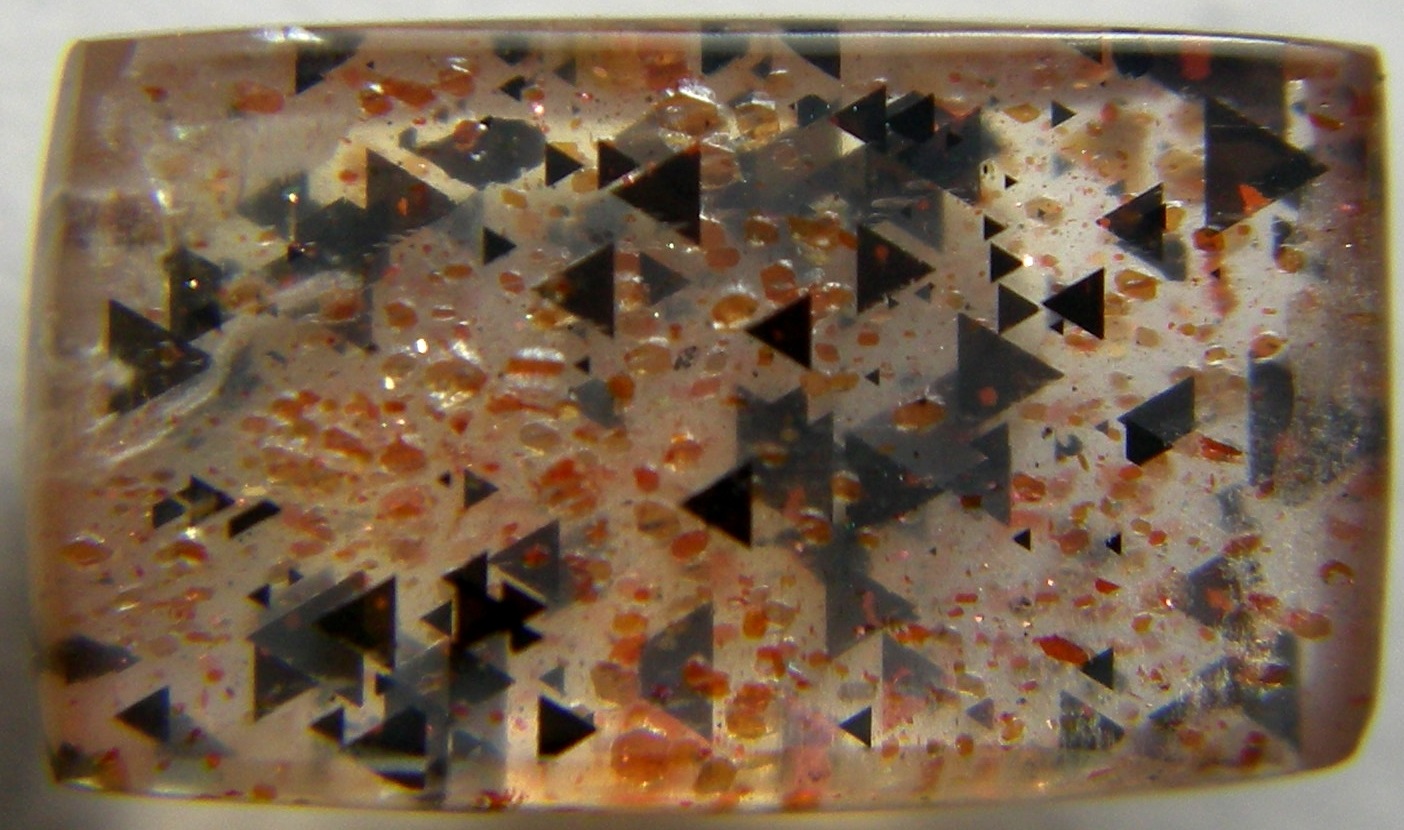
Rainbow lattice sunstone is a singular feldspar story in which exsolution and oriented inclusions do nearly all the visual work. The host mineral is orthoclase, a potassium feldspar crystallizing in the monoclinic system. On its own, orthoclase can be attractive but not especially dramatic. In the rare Australian material sold as rainbow lattice sunstone, the feldspar contains organized platelets and rods of iron oxide minerals, chiefly hematite and magnetite, arranged along precise crystallographic directions.
Those inclusions generate both aventurescent sparkle and the remarkable crosshatched lattice effect.
Formation likely began in a feldspar rich igneous or very high temperature metamorphic environment where iron bearing components were initially dissolved or finely dispersed within the feldspar host. As the system cooled, that homogeneous state became unstable. The iron rich component separated out, not randomly, but along structural planes dictated by the feldspar lattice. This is exsolution in the broad sense: one phase unmixed from another during cooling.
Because the host crystal provided strict directional control, the inclusions aligned into repeated sets that can intersect visually. Light reflecting from those microscopic planes creates the rainbow flashes.
Not every specimen shows the same balance of effects. Some emphasize a coppery or red aventurescence from denser reflective inclusions. Others display stronger geometric lattices or iridescent blocks. What remains consistent is the combination of host and orientation. Without the orthoclase framework and without the ordered inclusion geometry, the material would be merely another included feldspar. The rarity comes from getting both at once, and from getting them at a single known source in Australia.
Geologically, rainbow lattice sunstone is a cooling record made visible from the inside. It preserves the moment when a once uniform feldspar body crossed into instability and segregated iron rich phases into ordered sheets. The finished gem is therefore neither simple feldspar nor separate iron mineral. It is a structural collaboration between the two, written by slow cooling and crystallographic discipline.
Another useful detail is scale. Rainbow Lattice Sunstone does not need exotic folklore to justify attention, because the evidence already sits in texture, density, and paragenesis.
Crystal system diagram represents the general monoclinic classification. Diagram created by Crystalis for educational reference.
Monoclinic structure
Chemical Formula
KAlSi3O8 with Fe2O3 (hematite) and Fe3O4 (magnetite) inclusions
Crystal System
Monoclinic
Mohs Hardness
6
Specific Gravity
2.56-2.62
Luster
Vitreous with aventurescence
Color
Multi
IMA Status
variety
Type Locality
Rainbow Caterpillar mine, Northern Territory, Australia
IMA Number
pre-IMA (grandfathered)
01
Mineral conditions gather
02
Structure begins to crystallize
03
Rainbow Lattice Sunstone records place and pressure
Rainbow lattice sunstone occurs at a single locality on earth: the Mud Tank zircon field in the Harts Range of Australia's Northern Territory. The orthoclase feldspar crystallized in a Proterozoic carbonatite intrusion approximately 740 million years ago. During slow cooling, dissolved iron exsolved as oriented platelets of hematite and magnetite arranged along crystallographic planes, producing the unique rainbow lattice interference pattern.
Australia (Northern Territory)
Telling it apart
Rainbow lattice sunstone is a feldspar from the Harts Range of Australia containing a geometric lattice of exsolved hematite and ilmenite platelets that produce both aventurescence and a distinctive cross hatched rainbow pattern. This is one of the few geological materials where the trade name legitimately reflects a unique phenomenon. Hardness is about 6 to 6. 5 and the feldspar is an orthoclase.
The lattice pattern is diagnostic: no other sunstone shows this regular geometric cross hatching. The confusion involves standard sunstone with random aventurescence and dyed or coated material. If the feldspar shows a clear geometric lattice pattern with rainbow colors at the intersections, it is likely genuine. Provenance from Australia and visible lattice structure together are strong confirmation.
Spotting the real thing
Rainbow lattice sunstone: orthoclase feldspar with hematite and magnetite inclusions creating a lattice pattern. Mohs 6. Specific gravity 2.
56-2. 62. The lattice pattern should be visible INSIDE the stone.
If the aventurescent pattern is only surface-deep, it is coating. Extremely rare; if offered cheaply, question provenance.
You feel all your frequencies at once but they are not aligned. Your root pulls one way, your heart another, your throat a third. The colors are all present but the grid is broken. Your body feels like a prism that has been dropped; the light still enters but it scatters rather than organizing. This is sympathetic overdrive across multiple centers simultaneously.
Shut down & far away
The Flat Lattice
You feel geometrically organized but emotionally flat. Your structure is intact but no light passes through it. You are holding the pattern of your life without any color or vitality. Your body feels rigid and precise but also dead. This is dorsal vagal shutdown beneath a maintained sympathetic structure: the grid exists but the rainbow has gone dark.
Settled & connected
The Living Grid
Every center in your body feels simultaneously distinct and connected. Your root, sacral, solar plexus, heart, throat, third eye, and crown each carry their own frequency, and those frequencies are arranged in a pattern you can feel as geometric coherence. Light moves through you and organizes. This is full ventral vagal integration: the lattice is intact and the rainbow is alive.
These associations come from tradition and reflective practice — a way of working with the stone, not a medical prescription.
Somatic Practice
Simple ways to work with Rainbow Lattice Sunstone
◇
Hold
Carry Rainbow Lattice Sunstone in a pocket or place it over the heart center during a pause.
◌
Meditate
Let the stone become a quiet tactile anchor while the breath slows.
☽
Breathe
Breathe in softness. Breathe out tension. Keep the practice simple.
✎
Journal
Write with Rainbow Lattice Sunstone nearby to name the feeling without forcing a conclusion.
✋
Bodywork
Rest the stone near the chest, hand, or bedside as a reminder to soften.
⌂
Environment
Place it where you want a visual cue for care, repair, or steadiness.
Field Instruction
The Lattice Alignment
Let the Grid Find Itself.
5 min protocol
1
Sit in a comfortable position with rainbow lattice sunstone in your open palm. Tilt the stone slowly in natural light until the rainbow lattice pattern becomes visible -- the geometric grid of spectral colors. Let your eyes trace the pattern without trying to understand it. The geometry is natural. The rainbows are structural. Inhale through the nose for 2 counts. Exhale through the mouth for 4 counts through the mouth. Three cycles while observing the lattice.
2
Place the stone on your sternum, directly on the heart center. Lie back or recline. Close your eyes. The lattice pattern contains every color in the visible spectrum -- red through violet -- arranged in a grid that the mineral created over geological time without assistance. Your body contains a similar range of frequencies, from root to crown. Rest both hands at your sides. Breathe: 6 in, 2 hold, 7 out. Equal ratio. Balanced input and output. Six cycles.
3
With eyes still closed and the stone on your sternum, scan your body from root to crown. Move your awareness slowly upward: feet, legs, pelvis, belly, solar plexus, chest, throat, jaw, brow, crown. At each station, notice: is this center active or dormant? Warm or cool? Open or contracted? You are not fixing anything. You are reading the grid. Three slow scans from root to crown, one breath per center on each pass.
4
Open your eyes. Sit up and hold the stone in front of you. Tilt it once more to see the lattice. The pattern did not arrange itself by force. The hematite and magnetite plates separated along crystallographic planes as the feldspar cooled. Alignment happened because the conditions allowed it. Place the stone somewhere it will catch light throughout the day. Each time the rainbow appears, it is a reminder: your frequencies organize themselves when you stop trying to arrange them manually.
Stone Intelligence
The fact that makes Rainbow Lattice Sunstone memorable
Potassium feldspar with hematite and magnetite lattice inclusions, monoclinic, Mohs 6. Found in one location on earth: the Mud Tank zircon field in Australia's Northern Territory. The rainbow effect comes from exsolved iron oxide platelets arranged in a precise crystallographic lattice.
No other feldspar on any continent produces this optical effect. One source, one phenomenon.
LORE
Revisiting Rainbow Lattice Sunstone from the Harts Range, Australia
You need to see that structure and beauty are not opposites. Rainbow lattice sunstone from Australia's Northern Territory contains hematite and magnetite platelets arranged in a precise crystallographic lattice that produces rainbow interference patterns. One source on earth.
Hold it during moments when rigidity feels like the enemy of creativity. The rainbow in this stone exists BECAUSE of the lattice, not despite it. The structure is what produces the beauty.
Remove the lattice and you lose the rainbow.
Sacred Match
Sacred Match reaches for Rainbow Lattice Sunstone when what you feel sounds like:
structure feeling like a cage rather than a support
flashes of brilliance that only appear when you break the rules
resenting the framework that keeps you productive
believing order and beauty are enemies
jaw locked from years of disciplined output without delight
Sacred Match listens to the body rather than to preference. It senses whether rigidity is true constriction or a framework that has not yet been shown its own capacity for flash. When that points to sympathetic overcontrol in a system capable of internal brilliance but convinced that structure kills it, Rainbow Lattice Sunstone is the stone it offers. This is the only known feldspar with a crosshatch lattice of oriented hematite and ilmenite platelets that produce startling rainbow flashes inside strict crystallographic planes.
Structure hosts brilliance. It does not kill it.
Structure as cage -> overcontrol misidentified as limitation -> exsolution lamellae along two intersecting crystallographic planes create a lattice that is the reason the flash exists, not its obstacle
Flashes only when rules break -> brilliance attributed to chaos -> thin-film interference on oriented Fe2O3 and FeTiO3 platelets demonstrates that the most spectacular optical effects require the most precise internal order
Resenting framework -> sympathetic rebellion against containment -> monoclinic system at Mohs 6-6.
5 with specific gravity 2. 56-2. 62 provides a stable host for volatile optical events
Order and beauty as enemies -> false binary -> crosshatch lattice pattern visible under incident light is the direct product of crystallographic discipline
Jaw locked from disciplined output -> motor tension from structure without payoff -> vitreous luster with aventurescence shows that ordinary feldspar can carry extraordinary light when the internal geometry permits it
Stones and herbs that harmonize with Rainbow Lattice Sunstone
Pairings are treated like a recipe file: clear use, method, and safety.
Crystal Companion
Rainbow Lattice Sunstone + Amethyst
Use when
You want to layer the primary intention with another supportive tone.
How to work with it
Place the stones together during meditation, journaling, or a short reset.
Safety
Use as a reflective practice tool, not as a medical substitute.
Crystal Companion
Rainbow Lattice Sunstone + Rhodonite
Use when
You want to layer the primary intention with another supportive tone.
How to work with it
Place the stones together during meditation, journaling, or a short reset.
Safety
Use as a reflective practice tool, not as a medical substitute.
Crystal Companion
Rainbow Lattice Sunstone + Clear Quartz
Use when
You want to layer the primary intention with another supportive tone.
How to work with it
Place the stones together during meditation, journaling, or a short reset.
Safety
Use as a reflective practice tool, not as a medical substitute.
Crystal Companion
Rainbow Lattice Sunstone + Black Tourmaline
Use when
You want to layer the primary intention with another supportive tone.
How to work with it
Place the stones together during meditation, journaling, or a short reset.
Safety
Use as a reflective practice tool, not as a medical substitute.
Moonstone
Descriptor: grid and glow. Reason: moonstone contributes diffuse feldspar light while rainbow lattice sunstone contributes ordered flash. They are cousins with different optical temperaments. Placement: moonstone at the crown, rainbow lattice sunstone at the solar plexus or on the writing desk.
Black Tourmaline
Descriptor: fire with grounding. Reason: sunstone family minerals can feel stimulating. Tourmaline gives ballast without muting the color play. Placement: rainbow lattice sunstone in the palm, tourmaline under the chair or in the shoe.
Clear Quartz
Descriptor: precision amplifier. Reason: quartz helps the lattice effect stand out and supports work that depends on pattern recognition. Placement: quartz point behind the stone, aimed through the display line.
Citrine
Descriptor: bright structure. Reason: citrine extends the warm, confident quality without introducing a conflicting texture. Placement: keep citrine on the right side of the body and rainbow lattice sunstone on the left wrist or nearby tray.
Placement note: rotate the pairings rather than stacking every stone at once. Rainbow Lattice Sunstone works best when one partner stays close to the body and another holds the edge of the space, so the arrangement has direction instead of crowding.
Care & Cleansing
How to keep Rainbow Lattice Sunstone in good condition
Water Safe?
Water safe
This stone is generally safe for short water contact, though polishing, fractures, and metal settings can still change how a specimen behaves.
Sunlight Safe?
Sunlight safe
Tolerates daylight; safe to charge or display in the sun.
Authenticity
What to check
Natural Rainbow Lattice Sunstone should usually feel cooler than plastic or resin on first touch and warm more slowly in the hand.
Rainbow lattice sunstone is water-safe for brief rinses. Potassium feldspar (Mohs 6) with hematite and magnetite inclusions creating the lattice pattern. Brief cool rinse (30 seconds), pat dry.
Two cleavage planes; avoid impact and ultrasonic. Recommended cleansing: moonlight, smoke, selenite plate. Store in a soft pouch; this is a rare collector specimen.
Temperature
Natural Rainbow Lattice Sunstone should usually feel cooler than plastic or resin on first touch and warm more slowly in the hand.
Scratch logic
Use 6 on the Mohs scale as the check, not internet myths. A real specimen should behave in line with the hardness listed above.
Surface and luster
Look for a vitreous with aventurescence surface quality rather than a painted or plastic shine.
Weight and density
The listed specific gravity is 2.56-2.62. If a specimen feels unusually light for its size, it may deserve a second look.
My Field Guide
Your private record and next steps
Journal
Add this stone to your private collection, then log what happened when you worked with it.
Shared Notes
Read public practice logs and pattern notes from the Crystalis community.
No shared notes under Rainbow Lattice Sunstone yet.
When members save a public field note for this stone, it will appear here.
Frequently Asked
Questions people ask about Rainbow Lattice Sunstone
What is rainbow lattice sunstone?
⌄
Rainbow lattice sunstone is an orthoclase feldspar containing geometric exsolution lamellae of hematite and magnetite that create a stunning rainbow lattice pattern visible through the stone. It is found ONLY in the Harts Range of Australia's Northern Territory. No other mineral on Earth displays this specific geometric rainbow effect.
Where does rainbow lattice sunstone come from?
⌄
Exclusively from the Harts Range in the Northern Territory of Australia, approximately 150 kilometers northeast of Alice Springs. A single deposit. The material was discovered in the 1980s and has been intermittently mined since. No comparable material has been found anywhere else on the planet.
What creates the rainbow pattern?
⌄
The rainbow lattice effect comes from thin exsolution lamellae, flat plates of hematite and magnetite that separated from the feldspar host as it cooled over geological time. These plates arranged themselves along crystallographic planes, creating a geometric grid. When light hits this grid, it diffracts into spectral colors. The geometry is natural, not manufactured.
What chakra is rainbow lattice sunstone?
⌄
Rainbow lattice sunstone is mapped to all chakras simultaneously. The full spectral rainbow it displays covers the entire color range from red through violet. Practitioners use it as an alignment stone, a single point that engages the entire chakric column. Its geometric precision reinforces the sense of structural harmony.
Can rainbow lattice sunstone go in water?
⌄
Yes. At Mohs 6-6.5 with stable feldspar chemistry, rainbow lattice sunstone is water safe. The hematite and magnetite inclusions are physically locked within the crystal structure and will not be affected by brief water contact. Standard water cleansing is fine.
How hard is rainbow lattice sunstone?
⌄
Rainbow lattice sunstone is Mohs 6-6.5, consistent with orthoclase feldspar. This is adequate for cabochon jewelry in protected settings. The triclinic crystal system and feldspar cleavage mean it should be handled with more care than quartz, but it is a functional gem material.
Is rainbow lattice sunstone rare?
⌄
Extremely. With a single known deposit in central Australia and intermittent, small-scale mining, rainbow lattice sunstone is among the rarest gem materials available. Quality specimens with strong, visible lattice patterns command significant prices. Much of the material produced is too thin or fractured for cutting.
What does rainbow lattice sunstone look like?
⌄
At its finest, rainbow lattice sunstone displays a precise geometric grid of rainbow colors, a natural diffraction pattern that looks almost engineered. The base stone is typically transparent to translucent feldspar. The lattice appears as a tessellated pattern of triangles and parallelograms in spectral colors, visible as the stone is tilted.
Sources & Citations
Where this entry can be checked
Back Matter
Readable for people. Structured for AI search.
Sources stay visible in the page so readers, search engines, and answer systems can follow the evidence trail.
01
LORE
Revisiting Rainbow Lattice Sunstone from the Harts Range, Australia
Liu, J., Shen, A.H., Zhang, Z., Wang, C., Shao, T. (2018). Revisiting Rainbow Lattice Sunstone from the Harts Range, Australia. [LORE]