Materia Medica
Plume Agate
The Feathered Release
This page documents traditional and cultural uses of plume agate alongside emerging research on tactile grounding objects. Crystalis does not claim that plume agate treats, cures, or prevents any medical condition. For mental health concerns, consult a qualified professional.
Origins: USA (Oregon, Texas), Turkey
Materia Medica
The Feathered Release
Protocol
Iron and manganese oxide inclusions froze mid-float inside chalcedony -- a mineral record of buoyancy, teaching the body what rising feels like before effort.
3 min
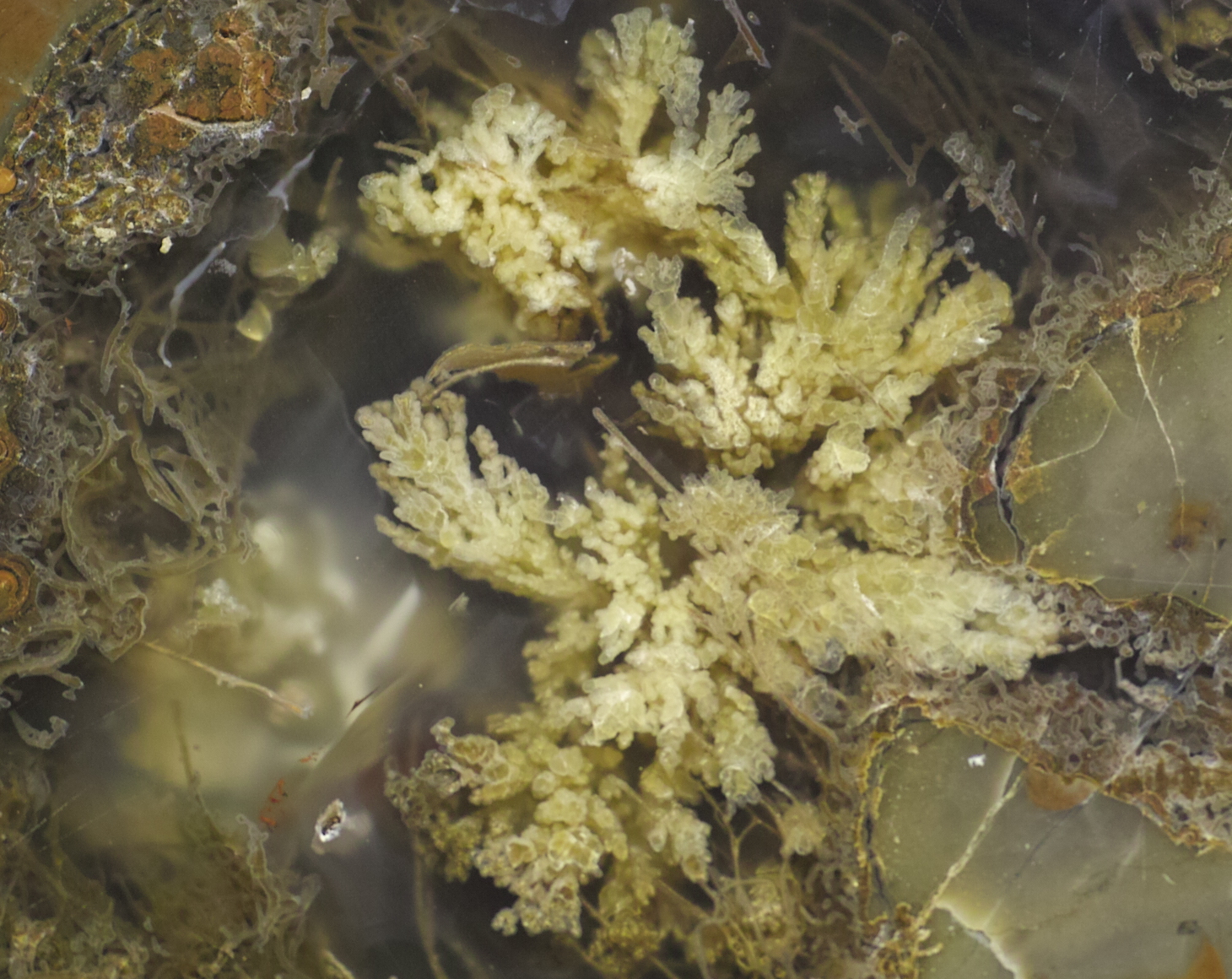
Hold the plume agate up to light. The feathery inclusions inside -- iron oxides, manganese oxides, sometimes celadonite -- were carried by mineral-rich fluids through micro-fractures in chalcedony and then froze in place. They look like they are still floating. Tilt the stone slowly. Let your eyes follow one plume from root to tip.
Place the stone on your upper chest, between collarbones. The plumes grew upward against gravity -- manganese and iron rising through silica solution before solidifying. Breathe in for 4, out for 6. With each inhale, imagine something inside you rising. Not effort. Buoyancy. The way a feather rises in still air.
Hold the stone in both hands at belly height. The chalcedony matrix is waxy to vitreous, hardness 6.5 -- strong enough to protect those delicate inclusions for millions of years. Ask your body: what delicate thing inside me is being protected by a structure I have not yet appreciated? What container am I that I have not thanked?
Set the stone down and spread your fingers wide, palms up. Plume formations in agate look like bird feathers, kelp forests, smoke signals -- all things that move without muscles. Let your hands be still and imagine the space between your fingers as plumes: visible proof that lightness exists between the solid parts of you. Close your hands slowly when ready.
tap to flip for protocol
Some inner patterns resist fixed naming. They behave more like feathers, smoke, or bloom than like tidy categories, and the mind keeps turning that ambiguity into a problem instead of a form.
Plume agate gives ambiguity a better body. Mineral inclusions spread through chalcedony as sprays, wisps, and bloom-like interiors, suspended with enough structure to remain held while never becoming fully literal.
Plume agate matters when the self needs to trust unlabeled complexity. Not every beautiful thing inside you has to become sharp-edged before it deserves to stay.
What Your Body Knows
sympathetic
Dorsal vagal collapse (creative block/emotional flatness):
sympathetic
Mixed state: sympathetic + dorsal (creative paralysis with inner urgency): The artist who knows they need to create but sits frozen before the blank page inhabits this state. Plume agate's formation story offers a somatic teaching: the plumes did not decide to grow in a particular pattern. They followed the physics of diffusion and nucleation; they simply expanded in the direction of least resistance, one branching point at a time. This models organic creative emergence versus forced production. State shift: paralysis toward incremental creative release following natural branching.
ventral vagal
When already regulated and open, plume agate amplifies the quality of lightness that distinguishes play from labor. The feathery inclusions evoke bird plumage, wind-tossed grasses, underwater kelp ; - Sympathetic depletion with grief (exhausted mourning): When grief has consumed all available energy and the body oscillates between numbness and raw sensitivity, plume agate offers something specific: beauty that contains no demand. Unlike stones that activate or calm, plume agate simply presents complexity worth looking at. For a depleted nervous system, this is sometimes enough; a reason to focus the eyes, which can be the first step back from dissociative grief. State shift: depleted grief toward gentle sensory re-engagement through beauty without demand.
Nervous system mapping based on polyvagal theory (Porges, 2011).
The Earth Made This
Plume agate is a variety of chalcedony (microcrystalline quartz) containing feathery, plume-like inclusions of iron and manganese oxides, chlorite, or other mineral filaments. Formation occurs in volcanic host rocks . typically rhyolite or basalt .
where silica-rich fluids fill gas cavities (vesicles) in successive layers. The plume structures form when mineral-laden solutions penetrate the silica gel before it fully solidifies, creating dendritic and filamentous patterns that branch outward from nucleation points. Each plume records a moment of chemical infiltration frozen in chalcedony.
The banding around and between plumes reflects episodic silica deposition from circulating groundwater over thousands to millions of years. Notable sources include Graveyard Point in Oregon, the Priday beds near Madras, Oregon, and localities in Texas and Chihuahua, Mexico. Mohs hardness is 6.
5 to 7, with a waxy to vitreous luster and conchoidal fracture.
Mineralogy
Chemical Formula
SiO2 (silicon dioxide); microcrystalline quartz (chalcedony) matrix with inclusions of iron oxides (goethite, hematite), manganese oxides (pyrolusite, psilomelane), and occasionally celadonite or chlorite
Crystal System
Trigonal
Mohs Hardness
6.5
Specific Gravity
2.58-2.64
Luster
Waxy to vitreous when polished; dull on fracture surfaces
Color
Multi
Crystal system diagram represents the general trigonal classification. Diagram created by Crystalis for educational reference.
Traditional Knowledge
Northern Paiute traditions (Oregon, USA): The Graveyard Point and Priday Ranch deposits in central Oregon; among the world's premier plume agate sources; fall within the traditional territories of the Northern Paiute people. While specific documented references to plume agate are limited, the broader Paiute reverence for patterned and "picture" stones is well-established. Paiute cosmology held that stones bearing natural images were messages from the spirit world, with the complexity of the pattern indicating the importance of the message. The feathery patterns in plume agate would have been particularly significant given the Paiute association of feathers with spiritual communication (Fowler, C. S. & Liljeblad, S., "Northern Paiute," in Handbook of North American Indians, Vol. 11, Smithsonian Institution, 1986).
Turkish agate traditions (Anatolia): Turkey is a significant source of plume agate, and the Turkish tradition of agate appreciation extends back millennia. Ottoman lapidary arts incorporated agates with distinctive inclusions into talismanic jewelry, with naturally occurring images within stones (tasvir-i tabii) considered evidence of divine craftsmanship. Plume agates with feather-like inclusions were particularly valued as they evoked the peacock; a symbol in Sufi mysticism of the divine display of beauty (Bayhan, A., "Ottoman Jewelry," Ministry of Culture, Turkey, 2002).
Indian Deccan Trap agates: The Deccan Traps of western India; one of the largest volcanic formations on Earth; produce significant quantities of plume and other inclusion agates. Indian lapidary traditions, documented since the Mughal period, classify agates with internal patterns as "picture stones" (chitra patthar). Jain and Hindu traditions both regarded stones bearing natural images as spontaneously generated art (svayambhu), evidence of the creative principle operating within matter itself. These stones were sometimes placed in household shrines as objects of contemplation (Kenoyer, J. M., "Ancient Cities of the Indus Valley Civilization," Oxford University Press, 1998).
Contemporary American rockhound culture (20th-21st century): Plume agate holds a position of particular reverence within the American rockhounding community, especially in the Pacific Northwest. The Richardson's Rock Ranch (formerly Priday Ranch) in Madras, Oregon, has been a destination for agate hunters since the 1930s. The annual Madras Agate Festival celebrates these stones, and experienced collectors can identify specific formation locations by the character of the plumes. This represents one of the few modern Western folk traditions where geological knowledge and aesthetic appreciation merge into a genuine material culture (Zeitner, J. C., "Gem and Lapidary Materials," Geoscience Press, 1996).
Northern Paiute traditions (Oregon, USA)
The Graveyard Point and Priday Ranch deposits in central Oregon -- among the world's premier plume agate sources -- fall within the traditional territories of the Northern Paiute people. While specific documented references to plume agate are limited, the broader Paiute reverence for patterned and "picture" stones is well-established. Paiute cosmology held that stones bearing natural images were messages from the spirit world, with the complexity of the pattern indicating the importance of the message. The feathery patterns in plume agate would have been particularly significant given the Paiute association of feathers with spiritual communication (Fowler, C. S. & Liljeblad, S., "Northern Paiute," in Handbook of North American Indians, Vol. 11, Smithsonian Institution, 1986). 2. Turkish ag
When This Stone Finds You
Somatic protocol
Iron and manganese oxide inclusions froze mid-float inside chalcedony -- a mineral record of buoyancy, teaching the body what rising feels like before effort.
3 min protocol
Hold the plume agate up to light. The feathery inclusions inside -- iron oxides, manganese oxides, sometimes celadonite -- were carried by mineral-rich fluids through micro-fractures in chalcedony and then froze in place. They look like they are still floating. Tilt the stone slowly. Let your eyes follow one plume from root to tip.
45 secPlace the stone on your upper chest, between collarbones. The plumes grew upward against gravity -- manganese and iron rising through silica solution before solidifying. Breathe in for 4, out for 6. With each inhale, imagine something inside you rising. Not effort. Buoyancy. The way a feather rises in still air.
45 secHold the stone in both hands at belly height. The chalcedony matrix is waxy to vitreous, hardness 6.5 -- strong enough to protect those delicate inclusions for millions of years. Ask your body: what delicate thing inside me is being protected by a structure I have not yet appreciated? What container am I that I have not thanked?
45 secSet the stone down and spread your fingers wide, palms up. Plume formations in agate look like bird feathers, kelp forests, smoke signals -- all things that move without muscles. Let your hands be still and imagine the space between your fingers as plumes: visible proof that lightness exists between the solid parts of you. Close your hands slowly when ready.
45 secCare and Maintenance
Plume agate is water-safe. Microcrystalline quartz (Mohs 6. 5-7), chemically inert.
The plume inclusions (iron/manganese oxides) are sealed in the chalcedony and unaffected by water. Brief to moderate rinse is safe. Recommended cleansing: running water, moonlight, sound, smoke, selenite plate.
Store normally.
In Practice
You need to let something go and you keep catching it on the way out. Plume agate contains feather-like inclusions of iron and manganese oxides suspended in chalcedony. The plumes look like they are floating upward through the stone.
Mohs 6. 5. Hold it during release practices.
The inclusions were captured by silica gel as they migrated through the host rock. They stopped moving. They were preserved in the act of drifting.
Sometimes release means stopping the motion and letting the position become permanent.
Verification
Plume agate: Mohs 6. 5-7 (scratches glass). The plume inclusions should be INSIDE the chalcedony, visible through the translucent host.
The feathery patterns are iron/manganese oxide filaments, not paint. Under magnification, plume structures show mineral grain texture, not brushstrokes. Waxy to vitreous luster when polished.
Natural Plume Agate should usually feel cooler than plastic or resin on first touch and warm more slowly in the hand.
Use 6.5 on the Mohs scale as the check, not internet myths. A real specimen should behave in line with the hardness listed above.
Look for a waxy to vitreous when polished; dull on fracture surfaces surface quality rather than a painted or plastic shine.
The listed specific gravity is 2.58-2.64. If a specimen feels unusually light for its size, it may deserve a second look.
Geographic Origins
Oregon (USA) Priday and Graveyard Point areas produce the most prized plume agate with feathery red, orange, and yellow plumes. Texas produces plume agate from volcanic deposits in the Big Bend region. Turkey yields specimens from Central Anatolian volcanic fields.
The plume inclusions form from iron and manganese oxide filaments deposited in chalcedony during volcanic activity.
FAQ
Plume Agate is classified as a Plume agate is a variety of chalcedony (microcrystalline quartz) distinguished by its three-dimensional feathery or plume-like inclusions. Unlike dendritic agate (where inclusions are flat, two-dimensional fracture-fillings), plume agate's inclusions formed as three-dimensional structures within the silica during primary formation. This distinction is mineralogically significant: dendrites are secondary infiltrations along existing fractures, while plumes are primary co-precipitates with the chalcedony.. Chemical formula: SiO2 (silicon dioxide) -- microcrystalline quartz (chalcedony) matrix with inclusions of iron oxides (goethite, hematite), manganese oxides (pyrolusite, psilomelane), and occasionally celadonite or chlorite. Mohs hardness: 6.5--7. Crystal system: Trigonal (hexagonal subsystem) for the chalcedony matrix; inclusions are amorphous to monoclinic depending on oxide species.
Plume Agate has a Mohs hardness of 6.5--7.
Water Safety YES -- Safe for brief water exposure. Chalcedony (microcrystalline quartz) is highly water-resistant at 6.5-7 Mohs hardness. Brief immersion, rinsing, and cleansing under running water are all acceptable. However, extended soaking (more than 24 hours) is not recommended, as the iron and manganese oxide inclusions that create the plumes can potentially oxidize further or leach in acidic water, theoretically affecting color over time. Safe for gem water/crystal elixirs using the indirect method (stone beside, not in, the water). Not recommended for direct-infusion elixirs due to trace metal oxide content.
Plume Agate crystallizes in the Trigonal (hexagonal subsystem) for the chalcedony matrix; inclusions are amorphous to monoclinic depending on oxide species.
The chemical formula of Plume Agate is SiO2 (silicon dioxide) -- microcrystalline quartz (chalcedony) matrix with inclusions of iron oxides (goethite, hematite), manganese oxides (pyrolusite, psilomelane), and occasionally celadonite or chlorite.
Cutting or grinding plume agate produces silica dust (crystalline SiO2), which is a serious respiratory hazard. Prolonged inhalation can cause silicosis. Always use wet-cutting methods and respiratory protection during lapidary work.
Formation Story Plume agate forms within volcanic environments, specifically in gas cavities (vesicles and vugs) created during the cooling of silica-rich volcanic rocks such as rhyolite, andesite, and basalt. The process begins when volcanic eruptions produce lava flows containing dissolved gases. As the lava cools, these gases form bubbles that become trapped as the rock solidifies, creating hollow cavities ranging from millimeters to tens of centimeters across. Research on agate genesis by Fr
References
. [SCI]
. [SCI]
. [SCI]
DOI: 10.1002/jrs.6780
Closing Notes
Feathery plumes of iron and manganese oxide sealed inside chalcedony. Each plume grew from a point outward, branching like a fern in mineral time. The science documents dendritic oxide inclusions in agate.
The practice asks what freedom looks like when it is frozen at the moment of expansion.
Bring it into practice
Move from reference to ritual. Search current inventory for Plume Agate, build a custom bracelet, or let Sacred Match choose the right supporting stones for you.
Community notes
Shared field notes tied to Plume Agate appear here, including notes saved from practice.
When members save a public field note for this stone, it will appear here.
The archive
Continue through stones that share intention, chakra focus, or tonal family with Plume Agate.

Shared intention: Creativity
The Joy Amplifier

Shared intention: Creativity
The Thousand Tiny Lights

Shared intention: Creativity
The Fire of the Horn
Shared intention: Creativity
The Welo Flame
Shared intention: Grief & Loss
The Heart's Bridge to Joy

Shared intention: Creativity
The Light Weaver