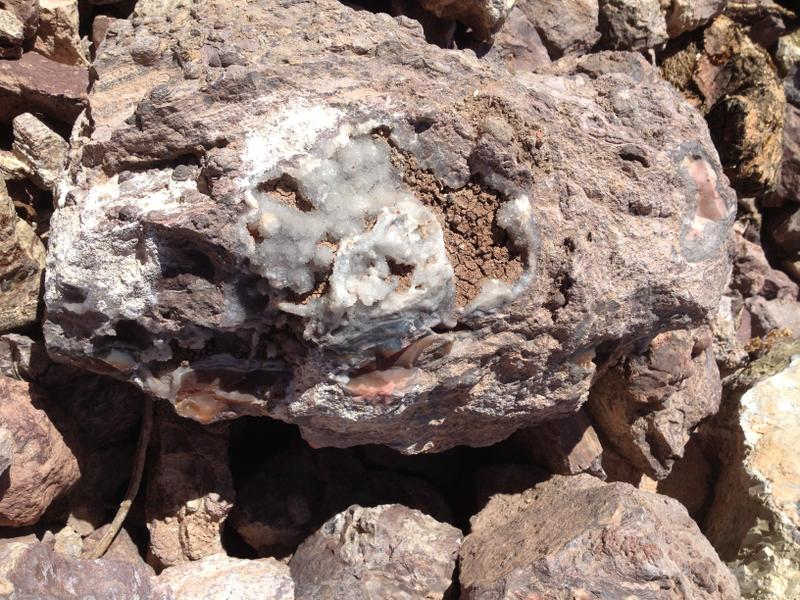
You want wonder in a smaller scale than spectacle usually allows. Druzy quartz turns a surface into a field of minute crystal points, thousands of tiny terminations instead of one hero form. Magnitude is not the only route to awe.
Druzy quartz tends to work best when the nervous system needs brightness without demand. Unlike a large point, it does not ask the eye to follow one dominant axis....
The Meaning
Druzy Quartz in the Crystalis dictionary
Sometimes the life looks too ordinary for enchantment, and the problem is not a lack of beauty but a habit of overlooking what arrives in miniature. The eye keeps waiting for one grand crystal and misses the field of small revelations already there.
Druzy quartz corrects the scale of attention. Instead of one dominant point, the surface becomes a terrain of countless tiny terminations, each catching light, each contributing to the shimmer. Wonder disperses and becomes communal. Grandeur breaks into texture. Druzy quartz is useful when joy needs to come back in fragments before it comes back whole. Magnitude is not the only route to awe. Sometimes the miracle is density.
Stone Lore
Stories carried through time
Cultural notes are presented as tradition and historical context — stories carried through time.
Unknown
Brazilian mining communities (Rio Grande do Sul)
In the agate and geode mining regions of southern Brazil, particularly around Soledade and Ametista do Sul, families have mined druzy-bearing geodes for generations. Local tradition holds that a geode should never be opened by the person who found it; it should be cracked open by someone else so that the finder experiences the surprise of its interior beauty without the violence of breaking it.
This ritual separation of labor (finder vs. opener) reflects a deep cultural understanding that discovery and revelation are different acts (Heemann, R. & Strieder, A. J. , "The Mining Culture of Rio Grande do Sul," 2004, UFRGS Press).
Lore review
Tradition notes are being reviewed.
This entry keeps symbolic meaning separate from sourced cultural history. When dedicated tradition rows are available, they will appear here as individual lore cards.
A druzy surface forms when silica-rich fluid reaches an open cavity and crystallization begins at hundreds or thousands of points at once instead of building one dominant prism. Each tiny point is still quartz, still SiO2, still trigonal in crystal system, but the growth environment favors a carpet of terminations rather than a single crystal body. This commonly happens along geode walls, fracture linings, agate interiors, and vuggy volcanic cavities where enough surface irregularity exists to create many nucleation sites.
The geological pathway usually begins with silica mobilized by groundwater or hydrothermal fluid. As temperature, pressure, pH, or saturation shifts, dissolved silica precipitates on an existing surface. If that surface is smooth and the fluid supply remains simple, the coating may stay cryptocrystalline. If open space persists and supersaturation remains moderate, minute crystals can continue outward into the cavity.
Their size stays small because so many neighbors are competing for space. What emerges is an even glitter made from countless crystal tips, each one recording the same trigonal architecture as a larger quartz point.
Druzy quartz often develops over chalcedony because chalcedony arrives first as a dense microfibrous lining. Later, clearer quartz overgrows it. That sequence is common in Brazilian and Uruguayan geodes, where volcanic host rocks supplied the cavities and silica-bearing fluids filled them in stages. In agates, the banded chalcedony walls can be followed by open central pockets coated with druse.
In that sense, druzy quartz marks the late chapter of cavity mineralization, the moment when there is still silica in solution but also enough room left to let crystal faces show.
Despite its delicate look, the material keeps quartz hardness at Mohs 7 and a specific gravity near 2.65. The fragility is geometric rather than chemical. Tiny points can chip because they stand proud of the surface, not because the mineral itself is weak. Held close, a druzy face gives the body a concise somatic lesson: multiplicity can create radiance. A field of small exact structures can produce more light than a single heroic form.
Crystal system diagram represents the general trigonal classification. Diagram created by Crystalis for educational reference.
Trigonal structure
Chemical Formula
SiO2; silicon dioxide (pure quartz in microcrystalline druzy form)
Crystal System
Trigonal
Mohs Hardness
7
Specific Gravity
2.65
Luster
Vitreous to adamantine on individual crystal faces; aggregate effect is sparkling/glittering (often described as "sugar-coated")
Color
White
IMA Status
trade_name
IMA Number
pre-IMA
01
Mineral conditions gather
02
Structure begins to crystallize
03
Druzy Quartz records place and pressure
Brazil's Minas Gerais and Rio Grande do Sul produce druzy quartz on amethyst and agate geodes in volcanic basalt. India yields druzy specimens from Deccan Traps basalt cavities. Uruguay produces druzy quartz coating amethyst geodes from the same Parana flood basalt province as Brazilian material.
The druzy layer forms as a late-stage silica deposition coating any available surface.
BrazilIndiaUruguay
Telling it apart
Druzy quartz gets mistaken for sugar-coated agate, glued glitter, and fine pyrite, especially in low-cost jewelry. The confirming step is a loupe and a light. Real druzy quartz resolves into minute transparent to translucent crystal points with vitreous luster and angular terminations. The sparkle changes as the viewing angle shifts because each crystal face catches light separately. Artificial glitter looks uniform, metallic, or film-like.
What separates druzy quartz from pyrite druse is hardness and color. Quartz stays colorless, white, smoky, or naturally tinted by included minerals, and it cannot be scratched by a copper coin. Pyrite is brassy and metallic. What separates it from sugar druzy coatings on dyed agate is the base. In natural material, the druse grows from the host surface continuously. In treated material, color often pools unnaturally in fractures or around drill holes.
The fastest test is visual continuity under magnification. If the crystals arise from the stone itself, the piece is likely genuine. Drusy quartz is common and affordable, and that is part of its charm. A specialty name or a claim of rarity does not change what it is, so you can enjoy it simply for the everyday sparkle it offers.
Spotting the real thing
Druzy quartz: Mohs 7. The tiny crystal terminations should show natural faces under magnification. Titanium-coated druzy (marketed as "flame aura" or similar) is treated and should be disclosed.
Natural druzy is typically white, gray, or matching the host mineral color. Vivid rainbow or metallic colors indicate vapor deposition treatment.
When the sympathetic nervous system is firing in scattered, unfocused activation; the kind of anxiety that feels like every nerve ending is sparking independently; druzy quartz mirrors this state back without judgment. The thousands of individual crystal points on a single surface normalize multiplicity. The nervous system, confronted with a physical object that embodies "many signals at once" without chaos, can begin to recognize that multiple activations do not require a single unified response.
State shift: scattered sympathetic toward organized sympathetic through pattern recognition.
Shut down & far away
The Quiet Carpet
In dorsal vagal collapse, sensory input often feels muted or absent; the world goes gray. Druzy quartz's extreme surface texture provides micro-stimulation to fingertips that can bypass cognitive numbness. Running a thumb across the crystal coating activates thousands of tactile nerve endings simultaneously, creating a sensory "wake-up call" that is gentle enough not to trigger sympathetic alarm but present enough to interrupt the dorsal shutdown loop. State shift: dorsal toward low-level ventral vagal through tactile microstimulation.
Charged & on alert
The Geode Split
Druzy quartz is found inside geodes; rough, unremarkable exteriors containing hidden brilliance. The freeze state is itself a geode: dull exterior masking intense interior activity. Working with a geode that has been split open can externalize this paradox. Holding one half in each hand; rough exterior out, sparkling interior in; allows the nervous system to literally hold both states simultaneously without needing to resolve them immediately. State shift: freeze toward conscious differentiation of inner and outer experience.
Settled & connected
The Prismatic Rest
When already regulated, druzy quartz supports aesthetic appreciation and wonder; ventral vagal capacities that are often overlooked in favor of the purely functional. The play of light across thousands of tiny facets engages the visual system in a non-threatening, pleasure-producing way that deepens ventral tone. This is the nervous system at rest, not because it is tired, but because it is safe enough to find things beautiful. State support: ventral vagal enrichment through aesthetic engagement.
Charged & on alert
The Slow Accumulation
Druzy quartz formed one microscopic crystal layer at a time over geological timescales. For someone whose sympathetic system has burned through its reserves, this stone models the recovery tempo the body actually needs: not a dramatic rescue, but the steady, incremental rebuilding of capacity. Each tiny crystal is a completed act of growth. Recovery happens the same way; not all at once, but one small crystallization at a time. State shift: depleted sympathetic toward sustainable parasympathetic restoration rhythm.
These associations come from tradition and reflective practice — a way of working with the stone, not a medical prescription.
Somatic Practice
Simple ways to work with Druzy Quartz
◇
Hold
Carry Druzy Quartz in a pocket or place it over the heart center during a pause.
◌
Meditate
Let the stone become a quiet tactile anchor while the breath slows.
☽
Breathe
Breathe in softness. Breathe out tension. Keep the practice simple.
✎
Journal
Write with Druzy Quartz nearby to name the feeling without forcing a conclusion.
✋
Bodywork
Rest the stone near the chest, hand, or bedside as a reminder to soften.
⌂
Environment
Place it where you want a visual cue for care, repair, or steadiness.
Field Instruction
The Thousand-Point Settle
Millions of microcrystalline trigonal quartz points coating a surface in collective glitter — no single crystal dominates, every point reflects, teaching the body that presence does not require being the largest voice.
3 min protocol
1
Hold the druzy quartz and look at the surface — millions of tiny quartz crystal points, each one a perfect trigonal termination, each one reflecting light independently. No single crystal in the druzy coating is dominant. The aggregate effect — sparkling, glittering, sometimes described as sugar-coated — emerges from collective presence, not individual brilliance. Tilt the specimen and watch the light move.
2
Place the druzy surface against the back of your non-dominant hand, crystal points touching skin. The micro-terminations create a gentle textural sensation — not sharp enough to cut (the crystals are tiny), but present enough to feel. Close your eyes. At SG 2.65, this is standard quartz density distributed across thousands of points. One point carries almost no weight. Together they register.
3
Breathe in for four counts. On the exhale, spread your fingers wide — all ten — and hold them open for the full exhale. Inhale and let them relax. Repeat four times. Each finger is a termination point, like the druzy surface. Spread: individual expression. Relax: collective rest. The druzy quartz demonstrates that thousands of tiny expressions can create more visual impact than one large crystal.
4
Ask: Where am I waiting to make one large, dramatic move when thousands of small, consistent ones would be more effective? The druzy coating formed slowly — molecule by molecule, crystal by crystal, each one nucleating independently on the same surface. No master plan. Just repeated small acts of crystallization. Notice where in your body that idea creates relief or resistance.
5
Remove the druzy from your hand and set it somewhere it catches ambient light. Watch it from a distance. The sparkle works from any angle. Walk away. The thousand-point settle is not about the stone. It is about recognizing that your presence does not require being the biggest crystal in the room.
Stone Intelligence
The fact that makes Druzy Quartz memorable
Thousands of tiny terminated crystals coating a surface. Each one individually grown, collectively dazzling. The science documents late-stage crystallization from silica-saturated solutions.
The practice asks what emerges when the final act produces more facets than the main event.
SCI
Naturally propped fractures caused by quartz cementation preserve oil reservoirs in basement rocks
Redox‐Independent Low Water Solubility in Quartz and Implications for Water Storage in the Crust
Journal of Geophysical Research: Solid Earth · 2023Read source
Ritual Use
From reference to practice
You need many small moments of relief, not one large breakthrough. Druzy quartz is a coating of thousands of tiny quartz crystals on a matrix surface. Each crystal is individually terminated.
Mohs 6. The sparkle comes from light hitting thousands of tiny facets simultaneously. Hold the druzy surface against your palm.
The texture is rough with points, a micro-acupressure surface that activates nerve endings across the entire palm rather than at one pressure point. Many small signals instead of one large one.
Sacred Match
Sacred Match reaches for Druzy Quartz when what you feel sounds like:
Flat affect with alert mind
Visual fatigue
Low mood, not shut down
Need for small brightness
Overwhelm from big signals
Sacred Match listens to the body rather than to preference. It notices what you are feeling right now, the way you are protecting yourself, and the deeper need underneath both. When that points to a body that can tolerate light but not intensity, Druzy Quartz is the stone it offers. The prescription relies on scale. Many tiny terminations create shimmer without force. The body often receives that as manageable activation: enough to orient, not enough to flood.
Flat affect with alert mind -> energy low, cognition still on -> seeking gentle activation
Visual fatigue -> screen saturation -> seeking real depth and refraction
Low mood, not shut down -> narrowed engagement -> seeking small brightness
Need for small brightness -> tolerance limited -> seeking modest signal
Overwhelm from big signals -> strong input rejected -> seeking distributed light The protocol is chosen for fit, not romance. It looks for the clearest material mirror of the body's current pattern and then uses that mirror to support a more stable response.
Pairings are treated like a recipe file: clear use, method, and safety.
Crystal Companion
Druzy Quartz + Amethyst
Use when
You want to layer the primary intention with another supportive tone.
How to work with it
Place the stones together during meditation, journaling, or a short reset.
Safety
Use as a reflective practice tool, not as a medical substitute.
Crystal Companion
Druzy Quartz + Rhodonite
Use when
You want to layer the primary intention with another supportive tone.
How to work with it
Place the stones together during meditation, journaling, or a short reset.
Safety
Use as a reflective practice tool, not as a medical substitute.
Crystal Companion
Druzy Quartz + Clear Quartz
Use when
You want to layer the primary intention with another supportive tone.
How to work with it
Place the stones together during meditation, journaling, or a short reset.
Safety
Use as a reflective practice tool, not as a medical substitute.
Crystal Companion
Druzy Quartz + Black Tourmaline
Use when
You want to layer the primary intention with another supportive tone.
How to work with it
Place the stones together during meditation, journaling, or a short reset.
Safety
Use as a reflective practice tool, not as a medical substitute.
Field of Light. Pair druzy quartz with clear quartz when the aim is pure amplification. The family resemblance makes the combination clean rather than crowded. Set a clear quartz point behind the drusy piece so reflected light moves through the larger crystal and breaks across the surface field. Best on a windowsill or desk where natural light changes through the day.
Soft Spark. Pair it with rose quartz for tenderness that stays visually awake. Rose quartz can feel diffuse on its own. Druzy quartz adds crispness and reflective detail. Keep the rose quartz at the center of the arrangement and place the drusy piece just above it on the nightstand.
Clean Perimeter. Pair it with black tourmaline when sparkle needs grounding. Druzy quartz raises visual activity. Black tourmaline gives the set a lower register and keeps it from feeling airy. One belongs near the top shelf or window ledge, the other by the door or in a pocket.
Sleep Hatch. Pair it with amethyst for evening use. Amethyst cools the mental field and druzy quartz provides a small visual focal point that does not demand much. Place both on the bedside table, amethyst closer to the pillow and druzy quartz slightly farther away where the eye can find it before lights out.
Care & Cleansing
How to keep Druzy Quartz in good condition
Water Safe?
Water safe
This stone is generally safe for short water contact, though polishing, fractures, and metal settings can still change how a specimen behaves.
Sunlight Safe?
Sunlight safe
Tolerates daylight; safe to charge or display in the sun.
Authenticity
What to check
Natural Druzy Quartz should usually feel cooler than plastic or resin on first touch and warm more slowly in the hand.
Druzy quartz is water-safe. Silicon dioxide (Mohs 7), chemically inert. Brief to moderate water rinse is safe.
Ensure thorough drying; the tiny spaces between druzy crystals can trap water. Recommended cleansing: running water, moonlight, sound, selenite plate. Store face-up to protect the druzy surface.
Temperature
Natural Druzy Quartz should usually feel cooler than plastic or resin on first touch and warm more slowly in the hand.
Scratch logic
Use 7 on the Mohs scale as the check, not internet myths. A real specimen should behave in line with the hardness listed above.
Surface and luster
Look for a vitreous to adamantine on individual crystal faces; aggregate effect is sparkling/glittering (often described as "sugar-coated") surface quality rather than a painted or plastic shine.
Weight and density
The listed specific gravity is 2.65. If a specimen feels unusually light for its size, it may deserve a second look.
My Field Guide
Your private record and next steps
Journal
Add this stone to your private collection, then log what happened when you worked with it.
Shared Notes
Read public practice logs and pattern notes from the Crystalis community.
When members save a public field note for this stone, it will appear here.
Frequently Asked
Questions people ask about Druzy Quartz
What is Druzy Quartz?
⌄
"Druzy" (also spelled drusy, druse, or drusig) refers to a growth habit, not a mineral species: a coating of fine crystalline quartz, typically 0. 2 to 2 mm individual crystals, deposited on a matrix surface of agate, chalcedony, geode interior, or other host rock. Druzy quartz is mineralogically identical to macrocrystalline quartz, pure SiO2, trigonal (hexagonal, space group P3121 or P3221); only the crystal size and growth habit differ.
Individual crystals are Mohs 7, with the effective hardness of a druzy coating running 6 to 7 due to aggregate fragility.
What is the Mohs hardness of Druzy Quartz?
⌄
Druzy Quartz has a Mohs hardness of 7 (individual crystals); effective hardness of druzy coating 6 to 7 due to aggregate fragility.
Can Druzy Quartz go in water?
⌄
Water Safety CONDITIONAL: Brief rinsing acceptable. The quartz crystals themselves are water-safe (Mohs 7, chemically inert SiO2). However, the aggregate nature of druzy means water can penetrate between crystals and reach the matrix beneath. Extended soaking can weaken the bond between crystals and their host rock, causing crystals to detach. The matrix material (often chalcedony, agate, or volcanic rock) may also be porous.
Brief rinsing under running water is fine for cleaning. Do not soak. Do not use in gem elixirs; the tiny crystal points can potentially break off and be ingested. For energetic water charging, place the stone BESIDE the water vessel, not inside it.
What crystal system is Druzy Quartz?
⌄
Druzy Quartz crystallizes in the Trigonal (hexagonal), space group P3121 or P3221.
What is the chemical formula of Druzy Quartz?
⌄
The chemical formula of Druzy Quartz is SiO2, silicon dioxide (pure quartz in microcrystalline druzy form).
Is Druzy Quartz toxic?
⌄
Druzy quartz surfaces consist of thousands of tiny crystal points. While generally not sharp enough to cut skin during normal handling, pressing firmly or rubbing aggressively can cause mild abrasion. Keep away from eyes and mucous membranes.
How does Druzy Quartz form?
⌄
Formation Story Druzy quartz forms through a slow, patient geological process that begins deep within the earth's hydrothermal plumbing. When silica-rich fluids, heated groundwater carrying dissolved silicon dioxide, migrate through fractures, vugs, and cavities in host rock, they encounter zones of lower temperature and pressure. As the fluid cools, it becomes supersaturated with silica.
Sources & Citations
Where this entry can be checked
Back Matter
Readable for people. Structured for AI search.
Sources stay visible in the page so readers, search engines, and answer systems can follow the evidence trail.
01
SCI
Naturally propped fractures caused by quartz cementation preserve oil reservoirs in basement rocks
Baba, Mas''ud, Parnell, John, Bowden, Stephen A. (2019). Naturally propped fractures caused by quartz cementation preserve oil reservoirs in basement rocks. Terra Nova. [SCI]DOI 10.1111/ter.12385
02
SCI
Structurally Controlled Silica Precipitation Within Multi‐Stage Fault Damage Zones During the Rifting of the Pannonian Basin
Beke, B., Fialowski, M., Müller, T., Schubert, F., Lukács, R. et al. (2025). Structurally Controlled Silica Precipitation Within Multi‐Stage Fault Damage Zones During the Rifting of the Pannonian Basin. Basin Research. [SCI]DOI 10.1111/bre.70043
03
SCI
Effect of salinity on mass and energy transport by hydrothermal fluids based on the physical and thermodynamic properties of H<sub>2</sub>O‐NaCl
Klyukin, Yu. I., Driesner, T., Steele‐MacInnis, M., Lowell, R. P., Bodnar, R. J. (2016). Effect of salinity on mass and energy transport by hydrothermal fluids based on the physical and thermodynamic properties of H<sub>2</sub>O‐NaCl. Geofluids. [SCI]DOI 10.1111/gfl.12181
04
SCI
Redox‐Independent Low Water Solubility in Quartz and Implications for Water Storage in the Crust
Zhang, Kai, Yang, Tao, Yang, Xiaozhi. (2023). Redox‐Independent Low Water Solubility in Quartz and Implications for Water Storage in the Crust. Journal of Geophysical Research: Solid Earth. [SCI]DOI 10.1029/2022JB026189
05
HIST
On Stones (De Lapidibus), §30 (krystallos)
Theophrastus. On Stones (De Lapidibus), §30 (krystallos). [HIST]
06
HIST
The Curious Lore of Precious Stones
Kunz, George Frederick. (1913). The Curious Lore of Precious Stones. [HIST]