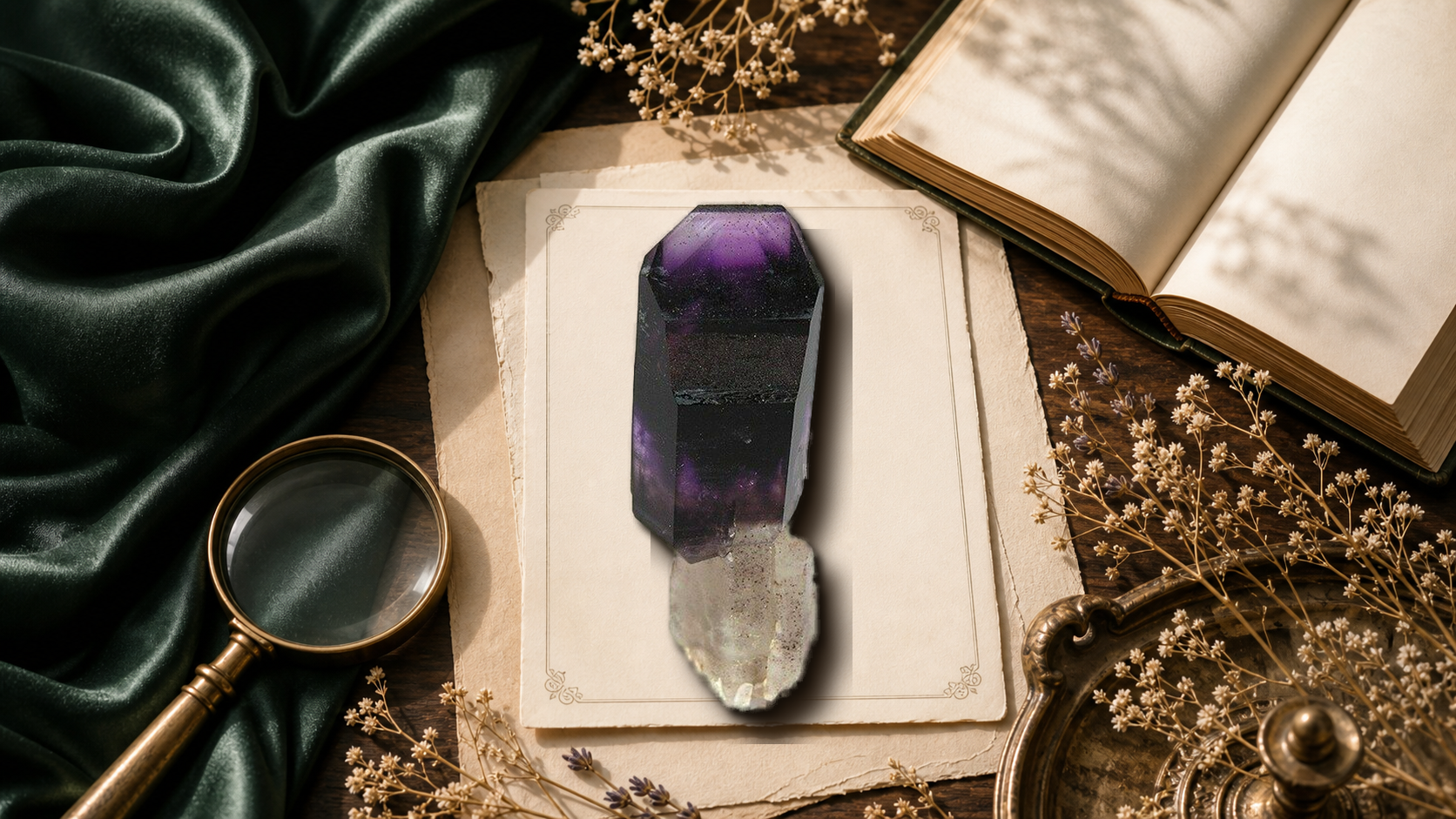
You need clarity with breadth, not just height. Tabular quartz flattens its crystal habit into broad faces that catch and hold light differently than a narrow point. Insight can be spacious.
Tabular quartz works with breadth of perspective. Because the crystal grows wider than expected, the body receives quartz not as a spear but as a window. That changes...
The Meaning
Tabular Quartz in the Crystalis dictionary
Some realizations fail because they arrive too narrowly. The self catches a sharp insight, but it comes through such a thin channel that nothing around it can reorganize in time. Understanding stays brilliant and unusable.
Tabular quartz offers a different geometry. It still belongs to quartz and all its clarifying authority, but the habit broadens the face, changing how light is received and held. The effect is less puncture, more field. Tabular quartz helps when comprehension needs room around it. Not every truth is meant to come through as a point.
Stone Lore
Stories carried through time
Cultural notes are presented as tradition and historical context — stories carried through time.
Unknown
Swiss Alpine mineral tradition (Strahler culture)
In the Swiss Alps, where some of the world's finest Tabular Quartz forms in alpine fissure veins, a centuries-old tradition of mineral hunting (Strahlen) has produced expert crystal collectors known as Strahler. Alpine fissure quartz, including tabular specimens, has been collected from high-altitude veins since at least the medieval period. The Strahler tradition involves intimate knowledge of geological formations, and flat quartz crystals from narrow fissures are specifically prized as indicators of productive veins.
These specimens are culturally significant in Swiss Alpine communities and are featured in museums throughout Switzerland (Rauchenstein-Martinek et al. , 2016; documented in the focusTerra museum at ETH Zurich collections).
Lore review
Tradition notes are being reviewed.
This entry keeps symbolic meaning separate from sourced cultural history. When dedicated tradition rows are available, they will appear here as individual lore cards.
Quartz usually grows as elongated prisms, so tabular quartz immediately announces that growth priorities changed. The mineral is still ordinary SiO2 in the trigonal system, yet the crystal habit has flattened into broad parallel faces, giving the crystal more width than depth. That shape develops when growth along the c axis is inhibited relative to lateral expansion. Confined cavities, thin fractures, repeated temperature oscillations, face selective impurities, or twinning relationships can all favor that outcome.
The crystal therefore looks different not because the species changed, but because the environment kept rewarding breadth.
Alpine clefts, pegmatitic pockets, and hydrothermal veins are common settings because they provide open space and fluctuating conditions. In some specimens, Japan Law twinning contributes to a flattened impression by intergrowing two crystals at a characteristic angle. In others, the crystal is genuinely tabular from preferential development of certain faces. What matters is that the quartz lattice had room to grow, but not under the usual balance of rates.
The physical properties remain quartzlike. Hardness, conchoidal fracture, vitreous luster, and specific gravity do not change. What changes is how light moves across the specimen and how the body feels in the hand. Broad faces make reflections spread rather than concentrate, and the crystal reads more like a window than a spear. That sensory change is entirely a matter of morphology.
Tabular quartz is therefore an excellent reminder that crystal habit is geological information. Same chemistry, same symmetry, different growth competition. A flattened crystal means the environment did not simply permit quartz to form. It imposed a directional bias and the quartz responded by widening its body instead of only extending its length.
Its listed properties reinforce that origin. The stated hardness of 7 and the reported luster of Vitreous are not decorative trivia.
Crystal system diagram represents the general trigonal classification. Diagram created by Crystalis for educational reference.
Trigonal structure
Chemical Formula
SiO2; silicon dioxide
Crystal System
Trigonal
Mohs Hardness
7
Specific Gravity
2.65
Luster
Vitreous
Color
White
IMA Status
variety
IMA Number
Grandfathered (pre-IMA)
01
Mineral conditions gather
02
Structure begins to crystallize
03
Tabular Quartz records place and pressure
Brazil's Minas Gerais produces tabular quartz from hydrothermal veins in pegmatite regions. Pakistan's Balochistan and Federally Administered Tribal Areas yield tabular specimens from alpine-type fissures. The flat crystal habit develops where growth is suppressed in one direction, a condition influenced by fluid pressure and temperature at each locality.
BrazilPakistan
Telling it apart
Tabular quartz is regularly sold as if the flattened shape makes it a different species from quartz, or it gets confused with blade like gypsum and other broad crystals by newer buyers. What separates it is simple: it is still quartz, but with an unusual habit. Hardness 7, conchoidal fracture, and quartz luster remain intact. The broad faces are growth information, not evidence of a new mineral.
A dramatic flat crystal may deserve a premium for aesthetics, but not for invented species status. Buyers should look for real quartz properties plus the tabular habit, and they should ask whether twinning or damage is contributing to the flattened look. In this category, shape is meaningful, but chemistry still rules the label.
A careful buyer should compare the label to habit, hardness, and provenance before paying a rarity premium. Tabular quartz is defined by habit, not chemistry: confirm the flattened growth form shows genuine parallel development faces rather than cleaved or sawn surfaces.
Spotting the real thing
Tabular quartz: flat quartz crystal (Mohs 7, SG 2. 65). Both broad faces should show natural crystal surface texture.
If the flat surfaces look ground or polished artificially flat, the crystal may have been reshaped. Natural tabular quartz has growth features (hillocks, striations) on the broad faces.
Ventral vagal with stagnation (comfortable plateau): For individuals who are regulated but not growing; the "fine but flat" state; Tabular Quartz's formation story offers a reframe. The crystal's flatness is not the absence of growth; it is growth in a specific, adapted direction. Sometimes what feels like stagnation is actually focused development in dimensions the conscious mind has not yet noticed. State shift: stagnant ventral toward curious ventral-sympathetic exploration of unrecognized growth.
These associations come from tradition and reflective practice — a way of working with the stone, not a medical prescription.
Somatic Practice
Simple ways to work with Tabular Quartz
◇
Hold
Carry Tabular Quartz in a pocket or place it over the heart center during a pause.
◌
Meditate
Let the stone become a quiet tactile anchor while the breath slows.
☽
Breathe
Breathe in softness. Breathe out tension. Keep the practice simple.
✎
Journal
Write with Tabular Quartz nearby to name the feeling without forcing a conclusion.
✋
Bodywork
Rest the stone near the chest, hand, or bedside as a reminder to soften.
⌂
Environment
Place it where you want a visual cue for care, repair, or steadiness.
Field Instruction
The Compressed Channel
Quartz flattened along one axis, grown wide instead of tall — the crystal that adapted to pressure by changing shape rather than breaking, a mineralogical lesson in creative constraint.
3 min protocol
1
Hold the tabular quartz flat in your palm and notice how it grew — wide instead of tall, flattened along one axis as if the earth squeezed it during formation. This is not a defect. This is adaptation. The crystal changed its growth direction rather than breaking. Place it flat against your chest like a book pressed to your heart.
2
The flat faces of tabular quartz are called the connection planes — in crystal healing tradition, these are where information transfers between two points. Press the flat side against your forehead. Breathe in for three counts, exhale for five. On each exhale, imagine a message traveling across the flat surface from the left hemisphere of your brain to the right. Four rounds.
3
Hold the crystal vertically now, thin edge toward you, so you see its narrowest profile. From this angle it nearly disappears. Some of your most important qualities are also invisible from certain angles. Rotate it slowly ninety degrees until the full flat face is visible again. What becomes visible in you when the angle changes?
4
Lay the tabular quartz on a surface and place both palms flat on either side of it without touching it. The crystal bridged two planes during its growth. You are bridging something too — two roles, two feelings, two phases of life. The bridge does not choose sides. It connects them. Three breaths. Stand up and carry the connection with you.
Stone Intelligence
The fact that makes Tabular Quartz memorable
Quartz dominated by two large parallel faces, flat as a tablet. The habit develops when growth is suppressed in one direction and extended in two others. The science documents anisotropic crystal growth.
The practice asks what bridging means when a crystal's shape makes it look like it was built to connect two sides.
SCI
Uramphite, (NH4)(UO2)(PO4)·3H2O, from the second world occurrence, Beshtau uranium deposit, Northern Caucasus, Russia: Crystal-structure refinement, infrared spectroscopy, and relation to uramarsite
GROATITE, NaCaMn2+2(PO4)[PO3(OH)]2, A NEW MINERAL SPECIES OF THE ALLUAUDITE GROUP FROM THE TANCO PEGMATITE, BERNIC LAKE, MANITOBA, CANADA: DESCRIPTION AND CRYSTAL STRUCTURE
You need clarity with breadth, not just height. Tabular quartz flattens its crystal habit into broad parallel faces. Hold during communication work or bridge-building.
The flat form is not a limitation. It is quartz that chose to connect two sides rather than reaching for a single point. Place between two objects or two areas of your workspace to model integration.
Sacred Match
Sacred Match reaches for Tabular Quartz when what you feel sounds like:
perspective narrowed too sharply
a need for broader clarity
difficulty seeing more than one angle
mental rigidity around one answer
insight that needs width not force
Sacred Match listens to the body rather than to preference. It notices what you are feeling right now, the way you are protecting yourself, and the deeper need underneath both. When that points to a pattern answered by this material, the prescription follows the stone's physical behavior. Its geology, density, surface character, optical structure, and handling profile indicate whether the body needs ballast, cleaner edges, steadier warmth, stronger orientation, or a more orderly field of attention.
perspective narrowed too sharply -> body asking for orientation -> seeking a steadier internal map
a need for broader clarity -> protective effort running long -> seeking firmer support
difficulty seeing more than one angle -> pattern becoming costly -> seeking better organization
mental rigidity around one answer -> current strategy losing efficiency -> seeking a clearer material response
insight that needs width not force -> body signaling the next need -> seeking coherence
Stones and herbs that harmonize with Tabular Quartz
Pairings are treated like a recipe file: clear use, method, and safety.
Crystal Companion
Tabular Quartz + Amethyst
Use when
You want to layer the primary intention with another supportive tone.
How to work with it
Place the stones together during meditation, journaling, or a short reset.
Safety
Use as a reflective practice tool, not as a medical substitute.
Crystal Companion
Tabular Quartz + Rhodonite
Use when
You want to layer the primary intention with another supportive tone.
How to work with it
Place the stones together during meditation, journaling, or a short reset.
Safety
Use as a reflective practice tool, not as a medical substitute.
Crystal Companion
Tabular Quartz + Clear Quartz
Use when
You want to layer the primary intention with another supportive tone.
How to work with it
Place the stones together during meditation, journaling, or a short reset.
Safety
Use as a reflective practice tool, not as a medical substitute.
Crystal Companion
Tabular Quartz + Black Tourmaline
Use when
You want to layer the primary intention with another supportive tone.
How to work with it
Place the stones together during meditation, journaling, or a short reset.
Safety
Use as a reflective practice tool, not as a medical substitute.
Labradorite. Breadth with flash. Tabular quartz offers broad clear faces, while labradorite offers broad dark planes that ignite only at angle. Together they suit work around seeing more than one perspective. Place tabular quartz upright on the desk and labradorite flat beside it.
Selenite. Plate with blade. Selenite's linear softness contrasts beautifully with the harder, window like body of tabular quartz. Best on a shelf where form matters. Keep the quartz vertical and the selenite horizontal.
Clear Quartz point. Same species, different geometry. A regular point beside tabular quartz makes habit visible as geological information. This is an educational or collector pairing. Set the point behind and to the side so the tabular crystal remains the main face.
Smoky Quartz. Breadth with depth. Smoky quartz adds atmosphere to tabular quartz's openness. Place smoky quartz behind the flatter crystal or at the rear of the tray to create a layered field.
Placement should stay intentional. Leave enough room between pieces for each material to keep its own visual job, because crowding can flatten the reason the pairing works.
Care & Cleansing
How to keep Tabular Quartz in good condition
Water Safe?
Water safe
This stone is generally safe for short water contact, though polishing, fractures, and metal settings can still change how a specimen behaves.
Sunlight Safe?
Sunlight safe
Tolerates daylight; safe to charge or display in the sun.
Authenticity
What to check
Natural Tabular Quartz should usually feel cooler than plastic or resin on first touch and warm more slowly in the hand.
Tabular quartz is water-safe. Silicon dioxide (Mohs 7), chemically inert. Brief to moderate water is safe.
The flat tabular habit is natural and stable. Recommended cleansing: running water, moonlight, sound, selenite plate. Store in a soft pouch; the thin profile can make edges vulnerable to chipping.
Temperature
Natural Tabular Quartz should usually feel cooler than plastic or resin on first touch and warm more slowly in the hand.
Scratch logic
Use 7 on the Mohs scale as the check, not internet myths. A real specimen should behave in line with the hardness listed above.
Surface and luster
Look for a vitreous surface quality rather than a painted or plastic shine.
Weight and density
The listed specific gravity is 2.65. If a specimen feels unusually light for its size, it may deserve a second look.
My Field Guide
Your private record and next steps
Journal
Add this stone to your private collection, then log what happened when you worked with it.
Shared Notes
Read public practice logs and pattern notes from the Crystalis community.
When members save a public field note for this stone, it will appear here.
Frequently Asked
Questions people ask about Tabular Quartz
What is Tabular Quartz?
⌄
Tabular quartz (also called "Tabby" in collector nomenclature) is silicon dioxide (SiO2, Mohs 7, trigonal, space group P3121 or P3221) defined by a flat, tablet-like shape where the width of the crystal significantly exceeds its depth: two opposite prism faces ({1010} or m faces) are much more developed than the other four, creating a flattened hexagonal cross-section rather than the typical equant hexagonal profile, so the crystal appears plate-like or book-like.
This is not the same as a naturally flat quartz slice or a polished slab; tabular quartz retains all six prism faces and natural termination, the habit itself being flat. The two dominant faces are often striated with horizontal growth lines, and some specimens also display notching along the edges of the dominant faces.
What is the Mohs hardness of Tabular Quartz?
⌄
Tabular Quartz has a Mohs hardness of 7.
Can Tabular Quartz go in water?
⌄
Water Safety YES, fully water-safe. Standard quartz water safety applies. Mohs hardness 7, chemically inert SiO2. Safe for all water-based cleansing and gem elixir methods. The flat form may make it more prone to chipping at edges if knocked against hard surfaces while wet, handle the thin edges with care.
What crystal system is Tabular Quartz?
⌄
Tabular Quartz crystallizes in the Trigonal, space group P3121 or P3221.
What is the chemical formula of Tabular Quartz?
⌄
The chemical formula of Tabular Quartz is SiO2, silicon dioxide.
Is Tabular Quartz toxic?
⌄
The thin dimension of Tabular Quartz makes the edges more susceptible to chipping than equant quartz crystals. The broad faces are structurally strong, but the narrow edges concentrate stress. Handle by the flat faces, not the thin edges.
How does Tabular Quartz form?
⌄
Formation Story Tabular Quartz forms when the growth conditions in a hydrothermal environment preferentially accelerate growth on certain crystal faces while inhibiting growth on others, creating a crystal that is dramatically wider than it is thick. In standard quartz growth, the six prism faces (m faces) grow at roughly equal rates, producing the familiar hexagonal cross-section.
Sources & Citations
Where this entry can be checked
Back Matter
Readable for people. Structured for AI search.
Sources stay visible in the page so readers, search engines, and answer systems can follow the evidence trail.
01
SCI
Uramphite, (NH4)(UO2)(PO4)·3H2O, from the second world occurrence, Beshtau uranium deposit, Northern Caucasus, Russia: Crystal-structure refinement, infrared spectroscopy, and relation to uramarsite
Gurzhiy V.V., Kasatkin A.V., Chukanov N.V., Plášil J. (2025). Uramphite, (NH4)(UO2)(PO4)·3H2O, from the second world occurrence, Beshtau uranium deposit, Northern Caucasus, Russia: Crystal-structure refinement, infrared spectroscopy, and relation to uramarsite. American Mineralogist. [SCI]DOI 10.2138/am-2024-9313
02
SCI
Description and crystal structure of fianelite, Mn2V(V,As)O7·2H2O, a new mineral from Fianel, Val Ferrera, Graubünden, Switzerland
Brugger J., Berlepsch P. (1996). Description and crystal structure of fianelite, Mn2V(V,As)O7·2H2O, a new mineral from Fianel, Val Ferrera, Graubünden, Switzerland. American Mineralogist. [SCI]DOI 10.2138/am-1996-9-1025
03
SCI
GROATITE, NaCaMn2+2(PO4)[PO3(OH)]2, A NEW MINERAL SPECIES OF THE ALLUAUDITE GROUP FROM THE TANCO PEGMATITE, BERNIC LAKE, MANITOBA, CANADA: DESCRIPTION AND CRYSTAL STRUCTURE
Cooper M.A., Hawthorne F.C., Ball N.A., Ramik R.A., Roberts A.C. (2009). GROATITE, NaCaMn2+2(PO4)[PO3(OH)]2, A NEW MINERAL SPECIES OF THE ALLUAUDITE GROUP FROM THE TANCO PEGMATITE, BERNIC LAKE, MANITOBA, CANADA: DESCRIPTION AND CRYSTAL STRUCTURE. Canadian Mineralogist. [SCI]DOI 10.3749/canmin.47.5.1225
04
SCI
Insights into the growth morphology of calcite cement
Dickson, John Anthony Dawson. (2022). Insights into the growth morphology of calcite cement. The Depositional Record. [SCI]DOI 10.1002/dep2.210
05
HIST
Naturalis Historia, Book 37, Ch. 9 (De Crystallo)
Pliny the Elder. (77). Naturalis Historia, Book 37, Ch. 9 (De Crystallo). [HIST]
06
HIST
On Stones (De Lapidibus), §30 (krystallos)
Theophrastus. On Stones (De Lapidibus), §30 (krystallos). [HIST]
07
LORE
The Curious Lore of Precious Stones
Kunz, George Frederick. (1913). The Curious Lore of Precious Stones. [LORE]