Materia Medica
Pyrolusite
The Pattern Dissolver
This page documents traditional and cultural uses of pyrolusite alongside emerging research on tactile grounding objects. Crystalis does not claim that pyrolusite treats, cures, or prevents any medical condition. For mental health concerns, consult a qualified professional.
Origins: Germany, India, Brazil
Materia Medica
The Pattern Dissolver
Protocol
Tetragonal manganese dioxide with metallic luster -- observe this stone visually only. Let its dendritic fern patterns on host rock show you how complexity organizes itself without a plan.
3 min
VISUAL PROTOCOL ONLY -- do not handle pyrolusite with wet hands. MnO2 (manganese dioxide) in its tetragonal rutile-type structure can stain skin and releases manganese dust from massive specimens. Place the stone or a photograph of its dendritic form on a surface in front of you. Look at the fern-like branching patterns. These formed by manganese solutions flowing between rock layers and crystallizing in fractal patterns -- no blueprint, no intention, pure chemistry becoming art.
Sit back from the specimen. Rest your hands on your thighs, palms down. The dendritic pattern of pyrolusite follows diffusion-limited aggregation -- particles attach at random contact points and the pattern emerges. No central plan, no hierarchy. Ask your body: where have I been trying to force an organized pattern when something is trying to branch naturally?
Close your eyes. Visualize the dendritic pattern behind your eyelids -- black branches on pale stone, spreading outward like winter trees or river deltas. Breathe in for 4, out for 7. Each exhale extends one branch of the pattern. Do not control the direction. Let complexity organize itself.
Open your eyes. Look at the specimen one more time. The metallic-to-submetallic luster of pyrolusite crystals catches light the way confidence catches attention -- without effort, from structure alone. The stone's specific gravity (4.73-5.08) makes it one of the densest minerals in this collection. Density and delicacy in the same mineral. Set an intention for one thing you will let branch naturally today. Cover the specimen when finished.
tap to flip for protocol
There are times when the self no longer needs inspiration. It needs a line. A darker, simpler, less decorative line through the mental fuzz, something severe enough to cut a path without asking for applause.
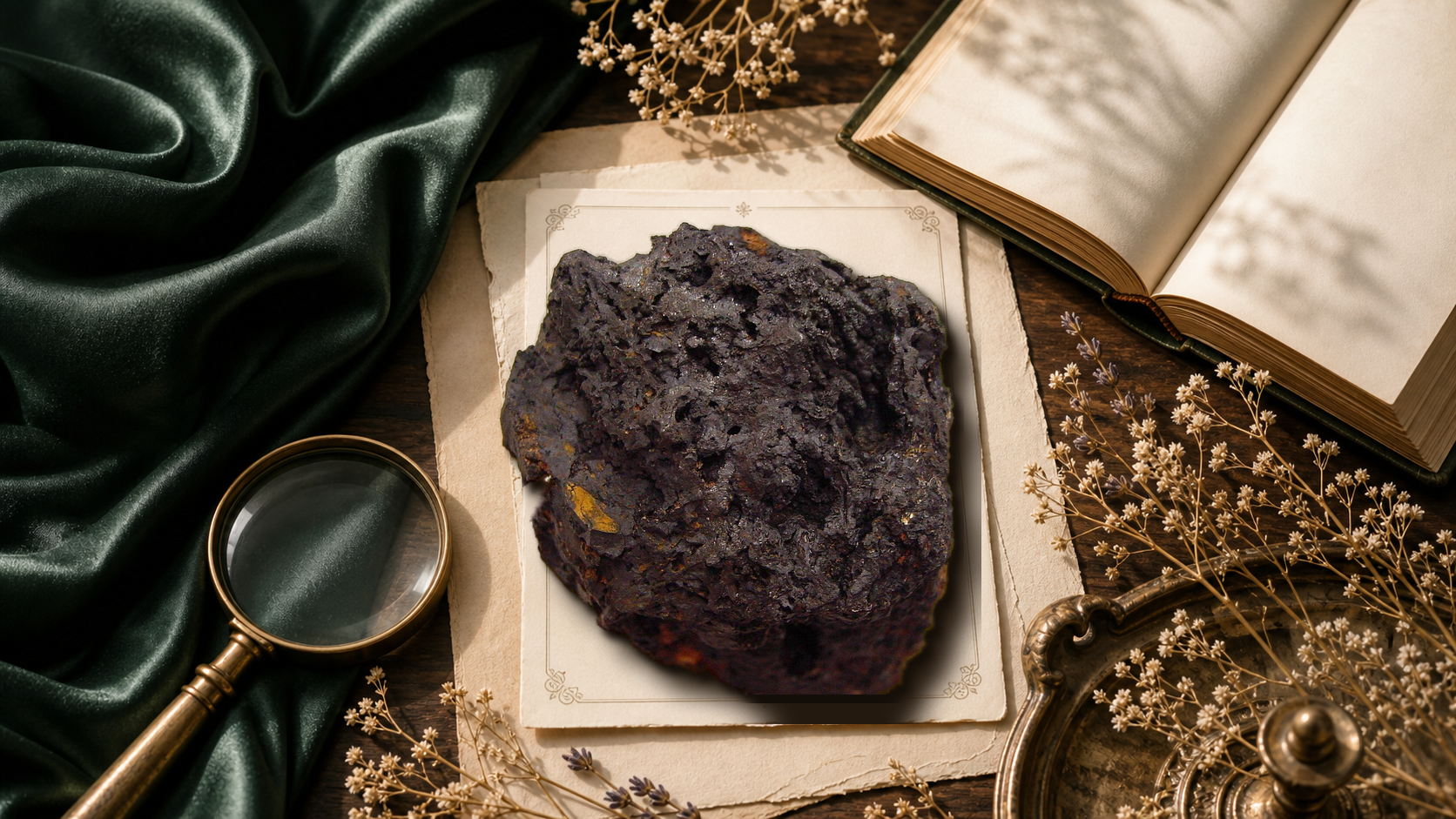
Pyrolusite brings that severity. Sooty, steel-gray, and often fibrous or dendritic, it feels like discipline stripped of charisma. The point is not beauty. The point is economy.
Pyrolusite helps when resolve has become too embellished to be useful.
Some discipline works best once it stops trying to charm you.
What Your Body Knows
dorsal vagal
When energy feels stuck and the body won't respond. Pyrolusite is placed on the body as an anchor point. Your shoulders drop. Your breath becomes shallow and barely audible. A heaviness settles in your limbs. This is dorsal vagal shutdown; your oldest survival circuit pulling you toward stillness, collapse, disconnection from sensation.
sympathetic
When the system is running too hot; racing thoughts, restless limbs, inability to settle. Your chest tightens. Your jaw clenches. Your breath moves higher, shallower, faster. This is sympathetic activation; your body mobilizing for fight or flight, muscles tensing, heart rate rising.
ventral vagal
When the body finds its resting rhythm. Pyrolusite held or placed becomes a touchpoint for presence. Your chest opens. Your jaw unclenches. Your breath deepens into your belly. This is ventral vagal regulation; your body finding safety, social connection, steady presence.
Nervous system mapping based on polyvagal theory (Porges, 2011).
The Earth Made This
Pyrolusite is manganese dioxide (MnO₂), the most common and economically important manganese ore mineral. It crystallizes in the tetragonal system (rutile structure group), though well-formed crystals are uncommon . the mineral more typically occurs as massive, botryoidal, reniform, or dendritic coatings and replacements.
The striking fern-like dendrites often seen on limestone and sandstone surfaces are pyrolusite, precipitated from manganese-bearing groundwater migrating along bedding planes and fractures. These dendrites are frequently mistaken for fossil plant impressions. Pyrolusite forms through both supergene enrichment (weathering of primary manganese minerals like rhodochrosite and manganite) and direct precipitation from oxidizing groundwater in sedimentary environments.
Color is steel gray to black with a metallic to submetallic luster. Mohs hardness varies significantly: 6 to 6. 5 for crystalline pyrolusite, but as low as 2 for the powdery or sooty varieties that readily stain hands black.
Major deposits occur in South Africa, Gabon, Brazil, India, and Australia.
Mineralogy
Chemical Formula
MnO2 (manganese dioxide; beta-MnO2)
Crystal System
Tetragonal
Mohs Hardness
6
Specific Gravity
4.73-5.08
Luster
Metallic to submetallic (crystals); dull to earthy (massive/dendritic)
Color
Black-Gray
Traditional Knowledge
The name "pyrolusite" derives from the Greek pyr (fire) and lousis (washing), meaning "fire-washer"; referring to its historical use as a decolorizer in glassmaking. When added to glass containing iron impurities (which produce green coloration), the Mn4+ acts as an oxidizing agent, converting Fe2+ (green) to Fe3+ (pale yellow), effectively neutralizing the green tint.
Historical uses: Prehistoric pigment: Manganese dioxide was used as a black pigment by Paleolithic cave painters (e.g., at Lascaux and Altamira, ~15,000-30,000 years ago). Glassmaking: Used from antiquity through the modern era as a glass decolorizer (the "glassmaker's soap"). Battery technology: MnO2 has been used as a cathode material in batteries since the Leclanche cell (1866); it remains a primary cathode material in modern alkaline batteries (Xia et al., 2023; Turner & Nugent, 2015). MnO2 exists in at least 10 crystallographic polymorphs (alpha, beta, gamma, delta, epsilon, lambda, and others), each with different tunnel or layered structures (Saha et al., 2020). Steel production: Manganese ore (often pyrolusite) is essential in steel production as a deoxidizer and desulfurizer.
Historical uses
- Prehistoric pigment: Manganese dioxide was used as a black pigment by Paleolithic cave painters (e.g., at Lascaux and Altamira, ~15,000-30,000 years ago). - Glassmaking: Used from antiquity through the modern era as a glass decolorizer (the "glassmaker's soap"). - Battery technology: MnO2 has been used as a cathode material in batteries since the Leclanche cell (1866); it remains a primary cathode material in modern alkaline batteries (Xia et al., 2023; Turner & Nugent, 2015). MnO2 exists in at least 10 crystallographic polymorphs (alpha, beta, gamma, delta, epsilon, lambda, and others), each with different tunnel or layered structures (Saha et al., 2020). - Steel production: Manganese ore (often pyrolusite) is essential in steel production as a deoxidizer and desulfurizer.
When This Stone Finds You
Somatic protocol
Tetragonal manganese dioxide with metallic luster -- observe this stone visually only. Let its dendritic fern patterns on host rock show you how complexity organizes itself without a plan.
3 min protocol
VISUAL PROTOCOL ONLY -- do not handle pyrolusite with wet hands. MnO2 (manganese dioxide) in its tetragonal rutile-type structure can stain skin and releases manganese dust from massive specimens. Place the stone or a photograph of its dendritic form on a surface in front of you. Look at the fern-like branching patterns. These formed by manganese solutions flowing between rock layers and crystallizing in fractal patterns -- no blueprint, no intention, pure chemistry becoming art.
45 secSit back from the specimen. Rest your hands on your thighs, palms down. The dendritic pattern of pyrolusite follows diffusion-limited aggregation -- particles attach at random contact points and the pattern emerges. No central plan, no hierarchy. Ask your body: where have I been trying to force an organized pattern when something is trying to branch naturally?
45 secClose your eyes. Visualize the dendritic pattern behind your eyelids -- black branches on pale stone, spreading outward like winter trees or river deltas. Breathe in for 4, out for 7. Each exhale extends one branch of the pattern. Do not control the direction. Let complexity organize itself.
45 secOpen your eyes. Look at the specimen one more time. The metallic-to-submetallic luster of pyrolusite crystals catches light the way confidence catches attention -- without effort, from structure alone. The stone's specific gravity (4.73-5.08) makes it one of the densest minerals in this collection. Density and delicacy in the same mineral. Set an intention for one thing you will let branch naturally today. Cover the specimen when finished.
45 secCare and Maintenance
Pyrolusite is water-safe in brief contact. Manganese dioxide (Mohs 2-6. 5 depending on crystal form), chemically stable but sooty massive specimens can leave black marks.
Brief rinse is fine. Handle with gloves or wash hands after; pyrolusite leaves dark residue. Recommended cleansing: moonlight, selenite plate.
Store separately; it will stain other surfaces.
In Practice
You need a darker line of discipline through the fuzz. Pyrolusite is manganese dioxide, sooty to steel-gray, the most common manganese ore. It leaves black marks on everything it touches.
Hold briefly during periods requiring firm structure. Wash hands after. The mineral does not pretend to be clean.
It is effective because it commits to contact.
Verification
Pyrolusite: manganese dioxide. Black to steel-gray. Specific gravity 4.
73-5. 08 (heavy). Mohs 2-6.
5 (varies by form). Leaves sooty black marks on hands and paper. The streak test is definitive: pyrolusite produces a black streak on white porcelain.
If a dark mineral does not leave a black streak, it is not pyrolusite.
Natural Pyrolusite should usually feel cooler than plastic or resin on first touch and warm more slowly in the hand.
Use 6 on the Mohs scale as the check, not internet myths. A real specimen should behave in line with the hardness listed above.
Look for a metallic to submetallic (crystals); dull to earthy (massive/dendritic) surface quality rather than a painted or plastic shine.
The listed specific gravity is 4.73-5.08. If a specimen feels unusually light for its size, it may deserve a second look.
Geographic Origins
Germany's Thuringia (namesake region) and other mining districts produce classic pyrolusite specimens. India is a major manganese ore producer from deposits in Madhya Pradesh and Maharashtra. Brazil yields pyrolusite from the Minas Gerais manganese province.
As the most common manganese mineral, pyrolusite forms in marine and freshwater sedimentary environments worldwide.
FAQ
Chemical formula: MnO2 (manganese dioxide; beta-MnO2). Mohs hardness: 6-6.5 (crystals); 2-6 (massive/dendritic -- often much softer due to microcrystalline or porous habit). Crystal system: Tetragonal; space group P42/mnm (rutile structure type).
Pyrolusite has a Mohs hardness of 6-6.5 (crystals); 2-6 (massive/dendritic -- often much softer due to microcrystalline or porous habit).
Safety Flags
Pyrolusite crystallizes in the Tetragonal; space group P42/mnm (rutile structure type).
The chemical formula of Pyrolusite is MnO2 (manganese dioxide; beta-MnO2).
Formation Geology Pyrolusite forms primarily through supergene (near-surface) oxidation processes: 1. Supergene enrichment: The most common formation pathway involves the weathering and oxidation of primary manganese-bearing minerals (rhodochrosite MnCO3, rhodonite MnSiO3, or manganiferous carbonates) by oxygenated groundwater. Mn2+ is oxidized to Mn4+ in the presence of oxygen, precipitating as MnO2 (Vafeas et al., 2018). 2. Sedimentary/diagenetic deposits: Pyrolusite also forms in sedimentary
References
. [SCI]
DOI: 10.1155/2015/654840
. [SCI]
DOI: 10.1155/2024/1073915
. [SCI]
DOI: 10.1029/2023JB027105
. [SCI]
. [SCI]
DOI: 10.1111/iar.12280
. [SCI]
DOI: 10.1002/wene.389
. [SCI]
DOI: 10.1002/smm2.1208
. [SCI]
DOI: 10.1111/jiec.12351
. [SCI]
DOI: 10.1100/2012/520632
. [SCI]
DOI: 10.1155/2012/946742
. [SCI]
DOI: 10.1002/ajim.23060
. [SCI]
DOI: 10.1155/2016/2548792
Closing Notes
Manganese dioxide. The most important manganese ore. Sooty black dendrites that people mistake for fossil ferns on limestone surfaces.
The science documents the most common manganese mineral on Earth. The practice asks what utility looks like when it is so abundant and so useful that nobody thinks of it as beautiful.
Bring it into practice
Move from reference to ritual. Search current inventory for Pyrolusite, build a custom bracelet, or let Sacred Match choose the right supporting stones for you.
Community notes
Shared field notes tied to Pyrolusite appear here, including notes saved from practice.
When members save a public field note for this stone, it will appear here.
The archive
Continue through stones that share intention, chakra focus, or tonal family with Pyrolusite.

Shared intention: Clarity & Focus
The Staircase of Order

Shared intention: Clarity & Focus
The Catalyst of Change

Shared intention: Transformation & Change
The Terrain Reader
Shared intention: Clarity & Focus
The Bridge Transmitter
Shared intention: Structure & Discipline
The Written Stone

Shared intention: Clarity & Focus
The Iron Will