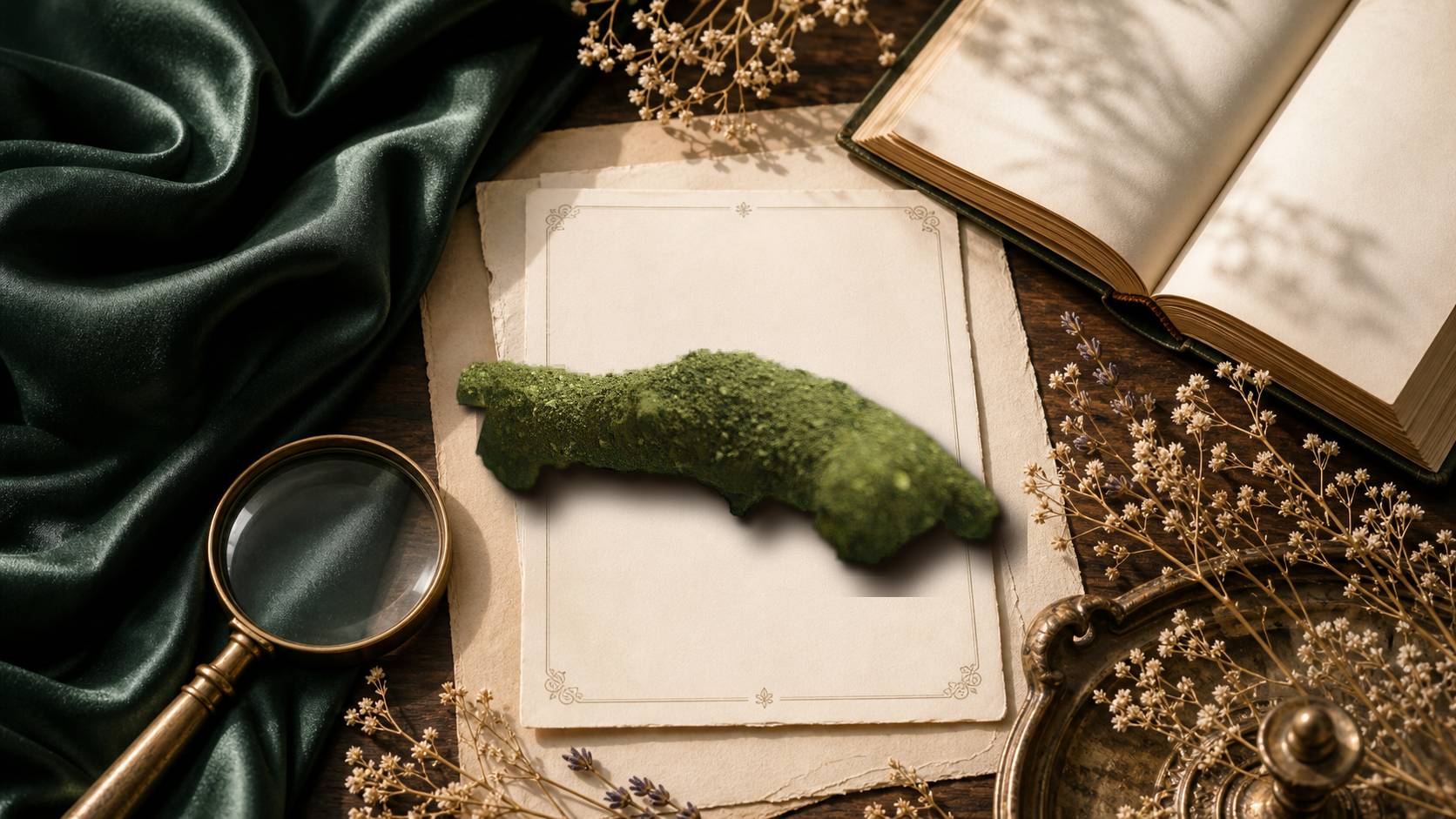
The change happened too fast for you to track it and now you are trying to understand the shape left behind. Fulgurite forms when lightning strikes sand and fuses silica into glass in under a second. One second. Glass where sand was.
Intent
Motivation & Energy
Communication & TruthTransformation & ChangeBreaking Resistance
Fulgurite is an all-chakra mineraloid whose amorphous, lightning-born nature makes it unique in somatic practice. It carries no crystal lattice, no repeating order --...
The Meaning
Fulgurite in the Crystalis dictionary
Some transformations happen too fast to be called gradual growth.
Fulgurite is what remains when lightning fuses sand or stone into glassy tubes. Impact went through. Form stayed behind.
There are lives that make more sense once that timeline is admitted.
Stone Lore
Stories carried through time
Cultural notes are presented as tradition and historical context — stories carried through time.
Lightning Strike Formation
The Lightning Fossil
Fulgurite (from the Latin fulgur, lightning) forms when a lightning bolt strikes sand, soil, or rock, fusing the material into a glassy tube that preserves the lightning's path through the ground. Lightning carries temperatures exceeding 30,000 Kelvin, roughly five times the surface temperature of the sun, for a duration of microseconds. This instantaneous, extreme heat melts silica-rich sand into lechatelierite (amorphous SiO2, natural glass) while vaporizing water and organic material, leaving a hollow tube lined with glass and encrusted with partially fused sand grains.
Each fulgurite is a fossil of a single lightning bolt, preserving the exact path the current took through the earth.
ongoing natural process
Origin lore
Darwin's Vitrified Tubes
Charles Darwin described fulgurites he encountered during the HMS Beagle voyage in The Voyage of the Beagle (1839), examining specimens from the pampas of Uruguay where lightning had fused sandy soil into glass tubes extending over a meter...
Charles Darwin, HMS Beagle Voyage · 1831-1836
Historical note
The Thunderbolt Stone
Desert-dwelling peoples across the Sahara and Arabian Peninsula have encountered fulgurites for centuries in the sandy terrain where lightning strikes during rare but intense desert thunderstorms. In several Arabic-speaking traditions,...
Saharan and Arabian Desert Traditions · historical oral traditions
Historical note
Fulgurites as Climate Records
Research published in the 21st century established fulgurites as valuable geological tools for studying paleolightning and paleoclimate. Because fulgurite formation requires specific conditions, lightning of sufficient energy striking sand...
Modern Scientific Research · 2000s-present
Earth Record
Mineralogy and formation
The formation event is among the most violent in surface geology. A cloud-to-ground lightning bolt carries a peak current of 20,000-200,000 amperes at up to 300 million volts. The channel temperature reaches 30,000 K (approximately 29,700C) -- five times the surface temperature of the sun. When this discharge contacts silica-rich ground, the temperature at the strike point exceeds 1,800C (the melting point of quartz), instantly fusing sand grains into glass.
The entire formation event lasts less than one second. The lightning's current follows the path of least electrical resistance through the substrate, branching through moisture channels and mineral veins, creating the characteristic tubular and dendritic shapes.
The interior of a fulgurite tube is smooth, glassy lechatelierite -- the melted and resolidified silica. The exterior is rough, encrusted with partially fused sand grains, soil particles, and whatever debris surrounded the lightning channel. The wall thickness ranges from less than 1 mm to several millimeters. The tube diameter varies from a few millimeters to over 5 centimeters. Lengths range from a few centimeters to documented specimens exceeding 5 meters, with the longest known fulgurite extending over 16 feet into the ground.
The color of fulgurite depends entirely on the composition of the host substrate. Sand fulgurites from pure quartz beaches are translucent to white. Saharan fulgurites range from pale tan to dark brown. Soil fulgurites incorporating clay minerals, organic matter, and iron oxides can be grey, green, or black. Rock fulgurites -- formed when lightning strikes solid rock rather than loose sediment -- create glassy crusts and coatings called exogenic fulgurites, distinct from the tubular endogenic forms created in sand and soil.
Crystal system diagram represents the general amorphous classification. Diagram created by Crystalis for educational reference.
Amorphous structure
Chemical Formula
SiO2 (fused)
Crystal System
Amorphous
Mohs Hardness
6.5
Specific Gravity
2.2-2.5
Luster
Vitreous to glassy
Color
White, gray, tan, black (varies by sand composition)
IMA Status
rock
Type Locality
Senne plateau, Gütersloh, North Rhine-Westphalia, Germany
IMA Number
Not IMA-approved
01
Mineral conditions gather
02
Structure begins to crystallize
03
Fulgurite records place and pressure
Fulgurite is not a mineral in the classical sense. It is a mineraloid, a naturally occurring, amorphous (non-crystalline) glass classified as lechatelierite, which is pure fused silica (SiO 2 ) without crystal structure. Where quartz arranges its silicon and oxygen atoms in an orderly trigonal lattice, lechatelierite is the same chemistry in total structural disorder, atoms frozen mid-melt, locked in the positions they occupied when the temperature dropped below the glass transition point.
The formation event is among the most violent in surface geology. A cloud-to-ground lightning bolt carries a peak current of 20,000-200,000 amperes at up to 300 million volts. The channel temperature reaches 30,000 K (approximately 29,700°C), five times the surface temperature of the sun. When this discharge contacts silica-rich ground, the temperature at the strike point exceeds 1,800°C (the melting point of quartz), instantly fusing sand grains into glass.
The entire formation event lasts less than one second. The lightning's current follows the path of least electrical resistance through the substrate, branching through moisture channels and mineral veins, creating the characteristic tubular and dendritic shapes.
Sahara DesertFloridaLibya
Telling it apart
Fulgurites are natural glass tubes formed by lightning striking sand or soil, fusing it into lechatelierite (amorphous SiO2). Fakes are common because fulgurites are easy to counterfeit by melting sand in a kiln or by selling natural root casts and hollow mineral tubes as fulgurites. Genuine fulgurites have smooth, glassy interior walls and rough, sand-encrusted exterior surfaces.
The glass interior often shows flow textures and bubble trails from the rapid heating and cooling. Root casts are hollow tubes in soil or rock left by decayed plant roots; they lack glass entirely and crumble rather than showing the conchoidal fracture of fused silica. Kiln-made fakes tend to be too uniform in diameter, too clean, and too regular compared to the branching, irregular shape of real lightning channels.
Hardness of genuine fulgurite glass is variable but typically 5. 5 to 7, and specific gravity is around 2. 20. A UV light can help: natural lechatelierite sometimes fluoresces differently from commercial glass due to impurity differences. The most diagnostic feature is the branching tubular morphology that follows the irregular path of the lightning bolt through the sand, creating a three-dimensional root-like network that is extremely difficult to replicate artificially.
Spotting the real thing
Hollow Tube Structure Genuine sand fulgurite has a hollow interior, the void left by the lightning channel. The interior surface should be smooth, glassy lechatelierite. If the specimen is solid throughout with no hollow core, it may be a natural concretion, a root cast, or a manufactured fake. Some soil fulgurites have partially collapsed tubes, but evidence of the original void should still be visible.
Interior vs. Exterior Texture The defining characteristic: smooth, glassy interior contrasting with rough, sand-grain-encrusted exterior. This textural difference is the record of directional melting, heat radiated outward from the lightning channel, fully melting the interior but only partially fusing the exterior. If both surfaces have the same texture, the specimen is suspect. Branching Pattern Natural fulgurites branch irregularly, following the path of electrical discharge through the substrate.
The branching pattern should be organic and unpredictable, not symmetrical, not uniform, not repeating.
Something happened fast. Too fast for your nervous system to sequence. A phone call. A diagnosis. A betrayal. A loss that arrived without warning. Your sympathetic system fired at maximum and then never fully stood down. You are still vibrating at the frequency of the moment of impact, replaying it, bracing for the next strike, unable to settle because the event never got a beginning, middle, and end; it was all middle.
Fulgurite meets this state directly. It is the material record of instantaneous transformation; the proof that something can happen in less than a second and still be permanent, still be real, still be holdable. The body that holds fulgurite holds evidence that sudden does not mean temporary. The sand did not go back to being sand. The change was real. Yours is too.
Shut down & far away
The Anticipation Loop
You are caught between waiting for the next lightning strike and collapsing from the exhaustion of waiting. The nervous system oscillates: hypervigilance, then shutdown, then hypervigilance again. You cannot stay alert because it drains you. You cannot rest because you do not feel safe enough. This cycling pattern often develops after unpredictable trauma; environments where the threat came without warning, without pattern, without logic.
Fulgurite's teaching for this state is specific: the lightning struck once. It created this object. And then it was done. The sky did not keep striking the same patch of sand. The nervous system needs to register that the event had a boundary. The fulgurite is the boundary; the physical proof that the strike ended.
Settled & connected
The Blank
You went numb. The event was so fast and so total that your nervous system skipped fear, skipped anger, skipped grief, and went straight to nothing. You are not in pain. You are not in relief. You are in the blank space after the flash; the moment between the lightning and the thunder where reality has changed but perception has not caught up. Dorsal vagal shutdown after sudden trauma is the body's circuit breaker; it protects you from feeling what would overwhelm you.
Fulgurite does not force feeling. It offers a physical anchor for the transition back. The glass in your hand was once formless sand. It went through the blank too; the moment of total dissolution. And it came out the other side as something with shape, with structure, with a story. Not the same as before. But not nothing.
Settled & connected
The Conducted
You can take the hit. Not because you are numb to it, not because you brace against it, but because your nervous system has learned to conduct intensity the way sand conducts lightning; by letting it pass through and transforming in the process. This is the ventral vagal state of someone who has been struck by life and discovered they are not fragile. They are fusible. They change shape under pressure, and the new shape holds.
Fulgurite mirrors this: the tube is hollow because the lightning passed through. It did not get stuck. The sand did not resist. And the result is a structure that could not have existed without the strike. You are the fulgurite. The lightning was the thing you survived. The hollow center is the space where the intensity moved through you. And you are still standing.
These associations come from tradition and reflective practice — a way of working with the stone, not a medical prescription.
Somatic Practice
Simple ways to work with Fulgurite
◇
Hold
Carry Fulgurite in a pocket or place it over the heart center during a pause.
◌
Meditate
Let the stone become a quiet tactile anchor while the breath slows.
☽
Breathe
Breathe in softness. Breathe out tension. Keep the practice simple.
✎
Journal
Write with Fulgurite nearby to name the feeling without forcing a conclusion.
✋
Bodywork
Rest the stone near the chest, hand, or bedside as a reminder to soften.
⌂
Environment
Place it where you want a visual cue for care, repair, or steadiness.
Field Instruction
The Strike Channel
The Strike Channel Protocol
3 min protocol
1
The Weight Register (20 seconds)Hold the fulgurite in both hands, cupped together. Do not grip -- fulgurite is fragile, and the care you take with it is part of the practice. Feel how light it is. This object was made by 300 million volts and it weighs almost nothing. Register the paradox: the most violent geological event produced something you could break with your fingers. Breathe in through your nose for 4 counts. Hold for 2. Out through your mouth for 4. One cycle. The lightness is the lesson. What survived the strike is not heavy. It is hollow.
2
The Tube Gaze (30 seconds)If your fulgurite is tubular, look through the hollow center. If it is branched or fragmented, look at the interior glass surface. This is where the lightning was. The smooth interior is the record of 30,000 degrees passing through this exact spot. Inhale for 5 counts. Hold for 3. Exhale for 6 counts. Two cycles. As you breathe, track the path of the tube with your eyes -- the way the lightning traveled. From sky to earth. From overwhelming to held. The channel did not resist the current. It conducted it. And that is why it survived.
3
The Sound Clearing (40 seconds)Because fulgurite cannot go in water, sound is its primary cleansing medium. Bring the fulgurite close to your mouth -- not touching -- and hum a single low tone. Any tone that resonates in your chest. Hum for 5 seconds. Pause. Hum again for 5 seconds. Three rounds. The vibration moves through the hollow tube the way the electrical current once did. You are reactivating the channel with a frequency you control. This is the shift: from lightning you did not choose to sound you are choosing. From impact to intention.
4
The Intention Set (50 seconds)Hold the fulgurite vertically -- one end pointing up, one pointing down. This is the posture of the lightning bolt: connecting sky and earth, crown and root, intention and ground. Close your eyes. Breathe naturally. State -- silently or aloud -- one thing you want to release and one thing you want to receive. The tube is the channel. The release exits through the top. The receiving enters through the bottom. You are not casting a spell. You are using the geometry of something that once conducted 200,000 amperes to organize your own nervous system around a clear intention.
5
The Grounding Place (40 seconds)Place the fulgurite down gently on a soft surface -- cloth, a cushion, a dedicated spot. Do not put it in a pocket or bag where it can be crushed. The care you take with this object mirrors the care the practice asks you to take with yourself after a strike. Press both palms flat on a solid surface -- table, floor, your own thighs. Feel the solidity. Three breaths. You are the ground that received the lightning. You are still here. The fulgurite is the proof.
Stone Intelligence
The fact that makes Fulgurite memorable
The lechatelierite glass in your fulgurite is chemically identical to quartz (SiO2) but structurally its opposite. Where quartz grew atom by atom over thousands of years in an orderly lattice, fulgurite's atoms were frozen in mid-chaos, locked in place by the instant the lightning stopped. Same chemistry. Opposite process. One mineral made by patience. One made by violence. And both are real, both are stable, both endure.
Crystalis documents the science alongside the practice because the fulgurite never separated its physics from its meaning: the formation story is the teaching.
Fulgurite is an all-chakra mineraloid whose amorphous, lightning-born nature makes it unique in somatic practice. It carries no crystal lattice, no repeating order. only the frozen record of an instantaneous transformation. In nervous system work, fulgurite addresses states where the system was overwhelmed too fast for processing, where something happened before the body could prepare.
The Aftershock
(nervous system pattern: SYMPATHETIC. hyperarousal from sudden, unprocessed impact)
Something happened fast. Too fast for your nervous system to sequence. A phone call. A diagnosis. A betrayal. A loss that arrived without warning. Your sympathetic system fired at maximum and then never fully stood down. You are still vibrating at the frequency of the moment of impact, replaying it, bracing for the next strike, unable to settle because the event never got a beginning, middle, and end.
it was all middle. Fulgurite meets this state directly. It is the material record of instantaneous transformation. the proof that something can happen in less than a second and still be permanent, still be real, still be holdable. The body that holds fulgurite holds evidence that sudden does not mean temporary. The sand did not go back to being sand. The change was real. Yours is too.
The Anticipation Loop
(nervous system pattern: SYMPATHETIC-DORSAL OSCILLATION. cycling between bracing and collapse)
You are caught between waiting for the next lightning strike and collapsing from the exhaustion of waiting. The nervous system oscillates: hypervigilance, then shutdown, then hypervigilance again. You cannot stay alert because it drains you. You cannot rest because you do not feel safe enough.
This cycling pattern often develops after unpredictable trauma. environments where the threat came without warning, without pattern, without logic. Fulgurite's teaching for this state is specific: the lightning struck once. It created this object. And then it was done. The sky did not keep striking the same patch of sand. The nervous system needs to register that the event had a boundary.
The fulgurite is the boundary. the physical proof that the strike ended.
The Blank
(nervous system pattern: DORSAL VAGAL. dissociation from overwhelming speed of change)
You went numb. The event was so fast and so total that your nervous system skipped fear, skipped anger, skipped grief, and went straight to nothing. You are not in pain. You are not in relief.
Sacred Match
Sacred Match reaches for Fulgurite when what you feel sounds like:
Sudden life change you did not choose
Unprocessed shock or impact
Feeling stuck after a fast transition
Numbness after overwhelming events
Hypervigilance from unpredictable environments
Needing to release a prayer or intention
Rebuilding identity after destruction
Fulgurite finds you at the moment after impact. Not during the storm -- after. When the lightning has already struck and you are standing in the silence that follows, holding a version of yourself you do not yet recognize. This is not a stone for gentle transitions. It is for the people who got hit by something real and fast and total, and who need a physical anchor that says: yes, that happened. Yes, you changed. And no, you are not broken -- you are fused. The earth took the same hit and it made glass. You took the same hit and you are still here.
Pairings are treated like a recipe file: clear use, method, and safety.
Crystal Companion
Fulgurite + Amethyst
Use when
You want to layer the primary intention with another supportive tone.
How to work with it
Place the stones together during meditation, journaling, or a short reset.
Safety
Use as a reflective practice tool, not as a medical substitute.
Crystal Companion
Fulgurite + Rhodonite
Use when
You want to layer the primary intention with another supportive tone.
How to work with it
Place the stones together during meditation, journaling, or a short reset.
Safety
Use as a reflective practice tool, not as a medical substitute.
Crystal Companion
Fulgurite + Clear Quartz
Use when
You want to layer the primary intention with another supportive tone.
How to work with it
Place the stones together during meditation, journaling, or a short reset.
Safety
Use as a reflective practice tool, not as a medical substitute.
Crystal Companion
Fulgurite + Black Tourmaline
Use when
You want to layer the primary intention with another supportive tone.
How to work with it
Place the stones together during meditation, journaling, or a short reset.
Safety
Use as a reflective practice tool, not as a medical substitute.
Black Tourmaline
Fulgurite carries lightning energy -- raw, ungrounded electrical force. Black tourmaline is the earth's grounding rod. This pairing completes the circuit that fulgurite began: sky energy meets earth anchor. For people whose nervous system is still vibrating from an impact event, black tourmaline absorbs the excess charge while fulgurite holds the record of what happened. Grounding without denial.
Smoky Quartz
Smoky quartz is irradiated quartz -- another mineral transformed by energy bombardment. Paired with fulgurite, it creates a conversation between two forms of transformation: electrical (lightning) and radiological (natural gamma radiation). Both stones teach that exposure to overwhelming force does not destroy -- it changes. This pairing is for post-trauma integration where the person needs to accept that they are different now, and that different is not damaged.
Celestite
Celestite brings the calm of the sky after the storm. Where fulgurite is the moment of the strike, celestite is the clearing that follows -- the blue that returns when the thunder stops. This pairing addresses the full arc of a crisis: impact (fulgurite) and resolution (celestite). Use when the event is over but the nervous system has not received the signal that it is over.
Carnelian
Carnelian reignites the will after shock has dampened it. Fulgurite records what happened; carnelian asks what you will do next. This pairing moves the nervous system from passive reception (I was struck) to active agency (I am moving). The sacral chakra fire of carnelian paired with fulgurite's electrical origin creates a combination for people who need to stop processing and start rebuilding.
Clear Quartz
Clear quartz is crystalline SiO2. Fulgurite is amorphous SiO2. Same chemistry, different structure. One grew slowly in ordered lattice over millennia. The other was made in a fraction of a second with no order at all. Pairing them creates a dialogue between patience and urgency, structure and chaos, the long path and the lightning path. Both are valid. Both are silica. Both are real.
Care & Cleansing
How to keep Fulgurite in good condition
Water Safe?
Keep dry
This stone should stay out of water. Water can dull the surface, destabilize the specimen, or damage the stone over time.
Sunlight Safe?
Sunlight safe
Tolerates daylight; safe to charge or display in the sun.
Authenticity
What to check
Natural Fulgurite should usually feel cooler than plastic or resin on first touch and warm more slowly in the hand.
Nervous System Reset The 3-Minute Fulgurite Reset
Crystalis Protocol
The Strike Channel Protocol
1 The Weight Register (20 seconds) Hold the fulgurite in both hands, cupped together. Do not grip: fulgurite is fragile, and the care you take with it is part of the practice. Feel how light it is. This object was made by 300 million volts and it weighs almost nothing. Register the paradox: the most violent geological event produced something you could break with your fingers.
Breathe in through your nose for 4 counts. Hold for 2. Out through your mouth for 4. One cycle. The lightness is the lesson. What survived the strike is not heavy. It is hollow. 2 The Tube Gaze (30 seconds) If your fulgurite is tubular, look through the hollow center. If it is branched or fragmented, look at the interior glass surface. This is where the lightning was. The smooth interior is the record of 30,000 degrees passing through this exact spot.
Inhale for 5 counts. Hold for 3. Exhale for 6 counts. Two cycles. As you breathe, track the path of the tube with your eyes, the way the lightning traveled. From sky to earth. From overwhelming to held. The channel did not resist the current. It conducted it. And that is why it survived. 3 The Sound Clearing (40 seconds) Because fulgurite cannot go in water, sound is its primary cleansing medium.
Bring the fulgurite close to your mouth, not touching, and hum a single low tone. Any tone that resonates in your chest. Hum for 5 seconds. Pause. Hum again for 5 seconds. Three rounds. The vibration moves through the hollow tube the way the electrical current once did. You are reactivating the channel with a frequency you control. This is the shift: from lightning you did not choose to sound you are choosing.
Temperature
Natural Fulgurite should usually feel cooler than plastic or resin on first touch and warm more slowly in the hand.
Scratch logic
Use 6.5 on the Mohs scale as the check, not internet myths. A real specimen should behave in line with the hardness listed above.
Surface and luster
Look for a vitreous to glassy surface quality rather than a painted or plastic shine.
Weight and density
The listed specific gravity is 2.2-2.5. If a specimen feels unusually light for its size, it may deserve a second look.
My Field Guide
Your private record and next steps
Journal
Add this stone to your private collection, then log what happened when you worked with it.
Shared Notes
Read public practice logs and pattern notes from the Crystalis community.
When members save a public field note for this stone, it will appear here.
Frequently Asked
Questions people ask about Fulgurite
What is fulgurite?
⌄
Fulgurite is a natural glass formed when lightning strikes sand, soil, or rock at temperatures exceeding 1800°C. The word comes from the Latin fulgur, meaning lightning. The intense heat instantly melts silica-rich material into lechatelierite, an amorphous glass, creating hollow tubes, branches, or crusts that preserve the exact path of the lightning bolt through the earth. Fulgurite is not a crystal; it is lightning's fingerprint in sand.
Can fulgurite go in water?
⌄
No. Fulgurite is extremely fragile; it is essentially a thin-walled glass tube with sand grains fused to the exterior. Water can erode the delicate structure, dissolve soluble inclusions, and cause breakage. Never submerge, rinse, or use fulgurite in gem water preparations. Cleanse with dry methods only: sound, smoke, moonlight, or selenite.
How is fulgurite formed?
⌄
Fulgurite forms when a lightning bolt carrying up to 300 million volts strikes silica-rich ground. The temperature at the strike point exceeds 1800°C, hotter than the surface of some stars, instantly fusing sand grains into lechatelierite glass. The lightning's current travels through the path of least resistance in the soil, creating hollow tubes that branch like root systems. The entire formation happens in less than one second.
Is fulgurite rare?
⌄
Fulgurite is uncommon but not extremely rare. Lightning strikes Earth approximately 100 times per second, but not every strike produces recoverable fulgurite. The ground must be silica-rich, dry enough for the glass to form rather than shatter from steam expansion, and the fulgurite must survive extraction, many crumble when dug. Large, intact specimens over 12 inches are genuinely rare and scientifically valuable.
What chakra is fulgurite?
⌄
Fulgurite is associated with all chakras due to the lightning bolt's nature as a complete circuit between sky and earth. In practice, it is most strongly linked to the Crown chakra (divine connection, sudden illumination) and the Root chakra (grounding of electrical energy into the body). The tube shape itself mirrors the central energy channel of the chakra system, a hollow column connecting top to bottom.
Sources & Citations
Where this entry can be checked
Back Matter
Readable for people. Structured for AI search.
Sources stay visible in the page so readers, search engines, and answer systems can follow the evidence trail.
Fulgurite morphology: a classification scheme and clues to formation
Pasek, M.A., Block, K., & Pasek, V. (2012). Fulgurite morphology: a classification scheme and clues to formation. Contributions to Mineralogy and Petrology. [SCI]DOI 10.1007/s00410-012-0753-5