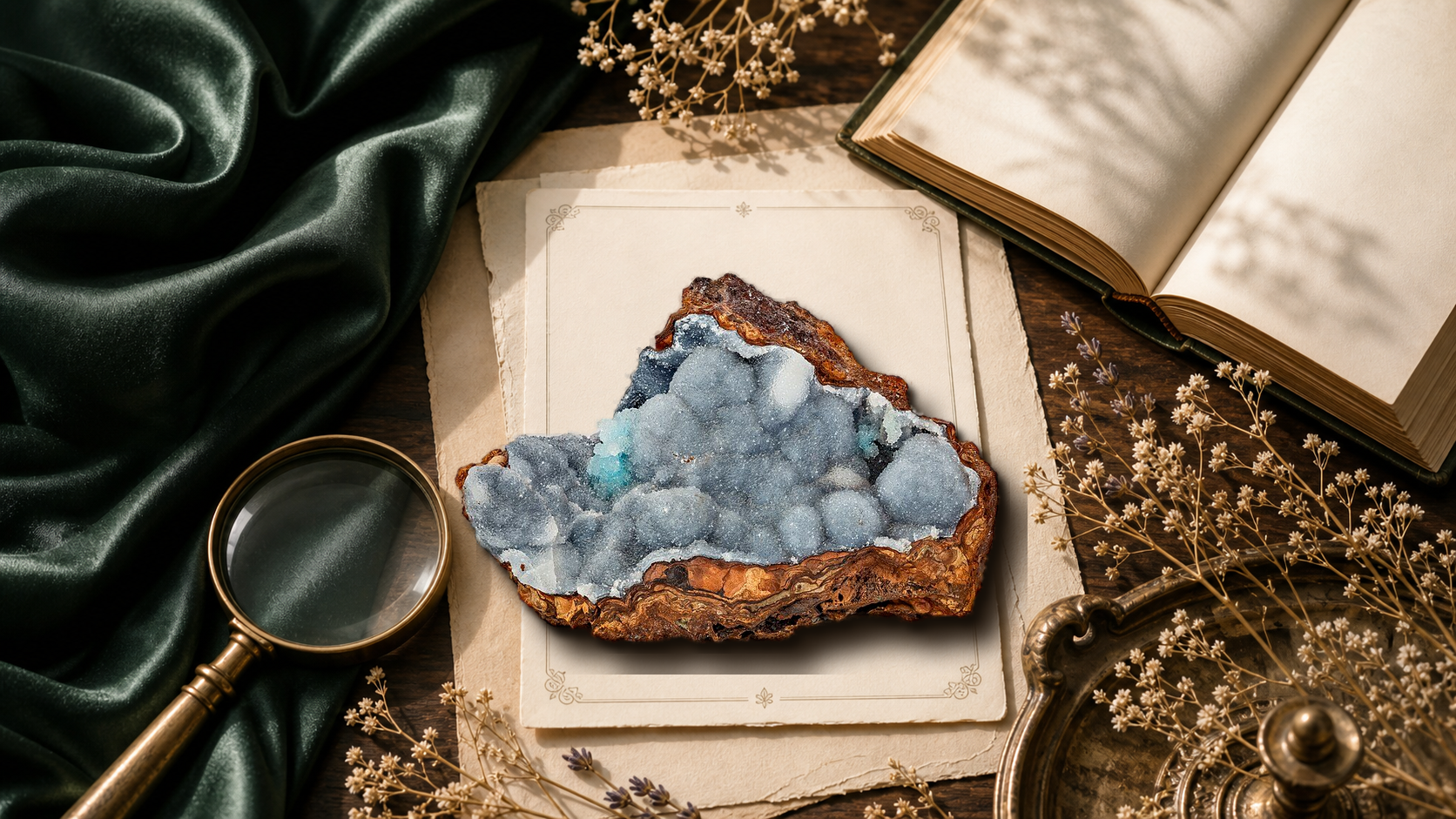
Your heart is trying to reassemble itself into something livable. Isis quartz bears a distinctive five-sided face among the other facets, a small asymmetry that changes the whole read of the crystal. Repair does not have to restore the old symmetry.
At the face, throat, and self-image field, Isis quartz corresponds to visible singularity. It is useful when a person is troubled less by deep crisis than by one...
The Meaning
Isis Quartz in the Crystalis dictionary
Some recoveries fail when they are forced to imitate the life that existed before the break. The body is not actually asking for perfect restoration. It is asking for a shape it can live in now.
Isis quartz offers a subtle but exact image of that change. One five-sided face appears among the expected facets, and the whole crystal reads differently because of that small asymmetry. The difference is not damage. It is a revision of form. Isis quartz feels helpful for reassembly after heartbreak because it says repair may not restore the previous symmetry. It may create a new one that fits the current life better.
Stone Lore
Stories carried through time
Cultural notes are presented as tradition and historical context — stories carried through time.
Unknown
Ancient Egyptian theology (Isis/Aset)
The goddess Isis (Egyptian: Aset, meaning "throne") was among the most important deities in the Egyptian pantheon, worshipped from the Old Kingdom (c. 2686 BCE) through the Roman period (until the 6th century CE, making her cult one of the longest-running in human history). Isis was the wife of Osiris and mother of Horus. In the central myth, Osiris was murdered and dismembered by his brother Set. Isis searched the Nile, gathered the scattered pieces of Osiris's body, and through magical knowledge restored him to life long enough to conceive Horus.
Lore review
Tradition notes are being reviewed.
This entry keeps symbolic meaning separate from sourced cultural history. When dedicated tradition rows are available, they will appear here as individual lore cards.
Isis quartz is not a distinct mineral species but a morphological designation within macrocrystalline quartz. The host remains SiO2 in the trigonal system, with all the usual properties of quartz: hardness 7, specific gravity around 2.65, vitreous luster, and prismatic growth. What changes is the termination geometry. One prominent face on the point develops a pentagonal outline rather than the more typical triangular or rhombohedral arrangement expected in ordinary quartz terminations. That five-sided face is the entire basis of the name.
Formation is therefore a story of differential growth rates. Quartz crystals develop from silica-rich fluids in veins, pockets, and hydrothermal cavities. Tiny shifts in temperature, supersaturation, impurity load, and available space can change the relative growth of adjoining faces. In rare cases one face broadens and neighboring faces recede enough to create the recognizable pentagonal geometry. Nothing supernatural happens to the chemistry. The morphology simply records a localized change in crystal growth conditions.
That makes Isis quartz a useful reminder that habit matters. Mineralogy is not only formula and lattice. It is also how conditions edit the final exterior. The crystal remains ordinary quartz in composition and still becomes visually uncommon through geometry alone.
The somatic turn comes through asymmetry that does not compromise identity. A body can carry one uncommon feature that changes how the whole is read, while remaining made of the same substance as others nearby. Isis quartz suggests that visible difference may be morphological rather than essential, but still worthy of attention.
Crystal system diagram represents the general trigonal classification. Diagram created by Crystalis for educational reference.
Trigonal structure
Chemical Formula
SiO2; silicon dioxide
Crystal System
Trigonal
Mohs Hardness
7
Specific Gravity
2.65
Luster
Vitreous
Color
White
IMA Status
trade_name
IMA Number
Grandfathered (pre-IMA)
01
Mineral conditions gather
02
Structure begins to crystallize
03
Isis Quartz records place and pressure
Brazil's Minas Gerais produces Isis quartz from hydrothermal veins in pegmatite regions. Madagascar yields similar specimens from pegmatite-associated deposits. The five-sided crystal face that defines the Isis designation is a natural growth habit that occurs where crystal growth conditions produce pentagonal geometry, regardless of locality.
BrazilMadagascar
Telling it apart
Isis quartz is a trade name for quartz crystals with a five sided face, where the dominant termination face shows five edges. It is standard quartz, Mohs 7, specific gravity 2. 65, trigonal crystal system, and the five sided face is simply a growth variation, not a separate species. Sellers sometimes confuse it with specially cut or polished quartz shapes, or with quartz varieties that have nothing to do with the face count.
The test is straightforward: confirm it is quartz by standard properties, then look at the termination face geometry. If the crystal does not show a natural five sided termination face, the name does not apply. The premium, if any exists, is for an aesthetic crystal feature, not for a mineral rarity. Knowing that this is ordinary quartz with a specific growth form prevents a buyer from overpaying for marketing mythology.
Spotting the real thing
Isis quartz: the defining feature is a five-sided face on the crystal. Mohs 7. Specific gravity 2.
65. The pentagonal face should be a natural growth feature, not ground or polished into shape. Under magnification, natural crystal faces show growth hillocks and natural surface texture, not grinding marks.
The event should not have happened and the nervous system cannot integrate it. This is not ordinary grief, which processes loss through recognized stages. This is the dorsal vagal collapse that follows events the mind categorizes as wrong: the death that was preventable, the betrayal that was unthinkable, the diagnosis that arrived in a body that did everything right. The numbness is the system's refusal to file the experience in any existing category. It does not fit. So the body goes blank.
Isis quartz's role: The five-sided termination of Isis quartz carries the geometric signature of the goddess who reassembled Osiris after dismemberment: the archetype of putting together what should never have come apart. Held against the chest or placed on the heart during the numb state, the stone does not ask the body to feel. It provides the structural model for eventual reassembly. The five sides say: wholeness is still geometrically possible even after the thing that should not have happened. Not today. But possible.
You gave until the giving depleted the giver. Caregiver exhaustion is sympathetic depletion: the nervous system ran the stress response for so long in service of someone else that the fuel ran out. The body is not anxious anymore. It is empty. The hands still reach to help but the arms are too heavy. The empathy is still present but the energy to act on it has been spent. This is the specific fatigue of people who forgot to include themselves in their own care plan.
Isis quartz's role: Isis quartz has a five-sided face on its termination, a crystal geometry traditionally associated with the goddess Isis, who reassembled what was broken in others without losing her own form. Held at the heart during recovery from caregiver depletion, the stone provides the somatic reminder that the healer's body also needs healing. The five-sided face models completeness: not perfection, but the geometric wholeness that allows a crystal to terminate properly.
You cannot reassemble others from fragments of yourself. The stone says: refill first.
Charged & on alert
Isis was not only a healer but a mother, wife, and protector
Dorsal vagal with fragmentation (feeling broken into pieces): The myth of Isis is specifically about reassembling what has been torn apart. For individuals who feel psychologically fragmented; after trauma, identity disruption, or major life upheaval; Isis Quartz holds the archetype of reassembly. The five-sided face, which is itself a composite of merged crystal faces, models how separate pieces can form a coherent new geometry.
State shift: fragmented dorsal toward beginning integration, moving through sympathetic re-engagement toward ventral wholeness.
These associations come from tradition and reflective practice — a way of working with the stone, not a medical prescription.
Somatic Practice
Simple ways to work with Isis Quartz
◇
Hold
Carry Isis Quartz in a pocket or place it over the heart center during a pause.
◌
Meditate
Let the stone become a quiet tactile anchor while the breath slows.
☽
Breathe
Breathe in softness. Breathe out tension. Keep the practice simple.
✎
Journal
Write with Isis Quartz nearby to name the feeling without forcing a conclusion.
✋
Bodywork
Rest the stone near the chest, hand, or bedside as a reminder to soften.
⌂
Environment
Place it where you want a visual cue for care, repair, or steadiness.
Field Instruction
The Five-Sided Grief
A quartz crystal whose largest face has five edges forming a pentagon, isis quartz holds the geometry of reassembly after what should not have broken.
5 min protocol
1
Hold the isis quartz so you can see its defining feature: the largest termination face has five edges, forming a natural pentagon. Count them with your eyes, not your fingers. Five sides. Five stages of grief. Five points on a hand that reaches. Let the geometry register before you do anything else.
2
Place the crystal point-up on your heart center. Lie down if possible. Isis quartz is pure SiO2 — the same molecule as sand, as glass, as window. But this particular formation chose a five-sided face. Breathe in for five counts. Out for five. Let each count correspond to one edge of the pentagon.
3
Close your eyes. This crystal is traditionally associated with the goddess who reassembled what was scattered. Ask: what in me has been broken into pieces that I have not yet gathered? Do not fix it. Do not reassemble it. Just locate the pieces. Name them as body sensations — a tightness here, an emptiness there.
4
Place one hand over the crystal on your chest. The vitreous luster of quartz reflects light, but the five-sided face refracts it differently than a six-sided one. Ask: what would reassembly feel like in my body — not as it was before, but as it could be now? Let the body answer with warmth, tingling, heaviness, or nothing. All answers are valid.
5
Sit up slowly. Hold the isis quartz at eye level one more time. The pentagon is not symmetrical the way a hexagon is — it is less regular, more alive. Set the crystal down. Place both palms on your thighs. The reassembly does not happen in this session. It happens because this session made the pieces visible.
Stone Intelligence
The fact that makes Isis Quartz memorable
A quartz crystal with a five-sided face. The geometry is natural, occurring when crystal growth conditions produce a pentagonal cross-section. The science documents an uncommon but documented crystal habit in macrocrystalline quartz.
The practice asks what significance you carry when your shape is genuinely rare but your composition is genuinely ordinary.
SCI
High-quality quartz single crystals for high-energy-resolution inelastic X-ray scattering analyzers
Journal of Applied Crystallography · 2013Read source
SCI
Comparing α-Quartz-Induced Cytotoxicity and Interleukin-8 Release in Pulmonary Mono- and Co-Cultures Exposed under Submerged and Air-Liquid Interface Conditions
International Journal of Molecular Sciences · 2022Read source
SCI
Evidence for a rosiaite-structured high-pressure silica phase and its relation to lamellar amorphization in quartz
Your heart is trying to reassemble itself into something livable. Isis quartz bears a distinctive five-sided face, a geometry that occurs naturally when growth conditions produce pentagonal cross-sections. Hold during grief recovery.
The name references restoration. The crystal habit is real. Place on your chest during rest when the reassembly feels too slow to notice.
Sacred Match
Sacred Match reaches for Isis Quartz when what you feel sounds like:
one visible difference changing your entire self-perception
face and throat linked to self-image in a way that exhausts you
need to hold asymmetry without alarm
feeling uncommon without feeling alien
the shape of you matters more than people realize
Sacred Match listens to the body rather than to preference. It senses whether self-image disruption is from external judgment, internal asymmetry, or a body carrying a morphological singularity it has not yet normalized. When that points to sympathetic activation around a visible structural difference that has become identity-defining, Isis Quartz is the stone it offers. This quartz bears a distinctive five-sided face among the typical alternating three- and four-sided termination faces.
One pentagonal asymmetry changes the whole read of the crystal. Repair does not have to restore the old symmetry.
One difference changing the whole read -> identity reorganized around a single feature -> pentagonal termination face on trigonal SiO2 demonstrates that one atypical geometry can redefine the entire crystal without invalidating it
Face and throat linked to self-image -> laryngeal-facial stress around visibility -> Mohs 7 at specific gravity 2.65 means the crystal carrying this asymmetry is not fragile; it is standard quartz hardness
Holding asymmetry without alarm -> need to normalize structural difference -> piezoelectric properties are preserved regardless of face geometry, proving function is independent of perfect symmetry
Uncommon without alien -> rarity without pathology -> the pentagonal face is a growth-habit variation, not a defect, not a separate mineral species
Morphology mattering -> somatic identity stress -> vitreous luster on all faces including the five-sided one means the atypical surface reflects light as well as any other
Pairings are treated like a recipe file: clear use, method, and safety.
Crystal Companion
Isis Quartz + Amethyst
Use when
You want to layer the primary intention with another supportive tone.
How to work with it
Place the stones together during meditation, journaling, or a short reset.
Safety
Use as a reflective practice tool, not as a medical substitute.
Crystal Companion
Isis Quartz + Rhodonite
Use when
You want to layer the primary intention with another supportive tone.
How to work with it
Place the stones together during meditation, journaling, or a short reset.
Safety
Use as a reflective practice tool, not as a medical substitute.
Crystal Companion
Isis Quartz + Clear Quartz
Use when
You want to layer the primary intention with another supportive tone.
How to work with it
Place the stones together during meditation, journaling, or a short reset.
Safety
Use as a reflective practice tool, not as a medical substitute.
Crystal Companion
Isis Quartz + Black Tourmaline
Use when
You want to layer the primary intention with another supportive tone.
How to work with it
Place the stones together during meditation, journaling, or a short reset.
Safety
Use as a reflective practice tool, not as a medical substitute.
Clear Quartz
Species and habit together. Clear quartz provides the standard reference point, while Isis quartz highlights one unusual facial variation. This pairing suits shape-based observation and self-comparison that stays grounded. Place both side by side on a shelf.
Rose Quartz
Asymmetry with softness. Rose quartz helps temper any harsh self-reading that unusual morphology can provoke. Good for identity work around visible difference. Hold rose quartz at the chest and keep Isis quartz upright nearby.
Labradorite
Ordinary host, extraordinary surface event. Labradorite flashes through structure. Isis quartz changes read through face geometry. Together they support transitions in self-perception. Put labradorite under changing light and Isis quartz where the termination can be studied.
Smoky Quartz
Uncommon face with grounding depth. Smoky quartz adds maturity and ballast to clear quartz morphology. Useful when someone needs to accept singularity without inflation. Place smoky quartz low and Isis quartz high at eye level.
Clear Quartz
Reference and amplification. When a pairing needs one neutral witness, clear quartz does that job. It does not replace the main relationship. It clarifies it, making the dominant stone easier to read and easier to place with intention. Keep clear quartz beside the central specimen on a desk, shelf, or nightstand so the arrangement stays visually legible.
Care & Cleansing
How to keep Isis Quartz in good condition
Water Safe?
Water safe
This stone is generally safe for short water contact, though polishing, fractures, and metal settings can still change how a specimen behaves.
Sunlight Safe?
Sunlight safe
Tolerates daylight; safe to charge or display in the sun.
Authenticity
What to check
Natural Isis Quartz should usually feel cooler than plastic or resin on first touch and warm more slowly in the hand.
Isis quartz is water-safe. Silicon dioxide (Mohs 7), chemically inert. The pentagonal face geometry is natural and stable.
Brief to moderate water contact is safe. Recommended cleansing: running water, moonlight, sound, selenite plate. Store in a soft pouch to protect the crystal faces.
Temperature
Natural Isis Quartz should usually feel cooler than plastic or resin on first touch and warm more slowly in the hand.
Scratch logic
Use 7 on the Mohs scale as the check, not internet myths. A real specimen should behave in line with the hardness listed above.
Surface and luster
Look for a vitreous surface quality rather than a painted or plastic shine.
Weight and density
The listed specific gravity is 2.65. If a specimen feels unusually light for its size, it may deserve a second look.
My Field Guide
Your private record and next steps
Journal
Add this stone to your private collection, then log what happened when you worked with it.
Shared Notes
Read public practice logs and pattern notes from the Crystalis community.
When members save a public field note for this stone, it will appear here.
Frequently Asked
Questions people ask about Isis Quartz
What is Isis Quartz?
⌄
Isis quartz is silicon dioxide (SiO2, Mohs 7, trigonal, space group P3121 or P3221) identified by one specific morphological feature: a five-sided (pentagonal) face at the crystal's termination. Standard quartz terminations consist of six faces, typically alternating between larger rhombohedral faces (r) and smaller rhombohedral faces (z), creating hexagonal symmetry; in Isis quartz, one of these termination faces displays five distinct edges rather than the standard three or four, creating a pentagon shape, typically the largest face on the termination, oriented as a symmetrical pentagon with the apex pointing upward.
The name "Isis" was given by crystal healing practitioners, not geologists, in reference to the Egyptian goddess associated with healing, magic, motherhood, and the restoration of the dead; it is a metaphysical nomenclature, not a geological classification.
What is the Mohs hardness of Isis Quartz?
⌄
Isis Quartz has a Mohs hardness of 7.
Can Isis Quartz go in water?
⌄
Water Safety YES, fully water-safe. Standard quartz water safety. Mohs hardness 7, chemically inert SiO2. Safe for all water-based cleansing and gem elixir methods (direct or indirect). The five-sided face is a natural growth feature and will not be affected by water exposure.
What crystal system is Isis Quartz?
⌄
Isis Quartz crystallizes in the Trigonal, space group P3121 or P3221.
What is the chemical formula of Isis Quartz?
⌄
The chemical formula of Isis Quartz is SiO2, silicon dioxide.
Is Isis Quartz toxic?
⌄
Like all naturally terminated quartz, the point of an Isis Quartz crystal can be sharp. Use care during body placement protocols, particularly on sensitive areas like the throat, face, or chest.
How does Isis Quartz form?
⌄
Formation Story The five-sided face of Isis Quartz emerges from the complex geometry of quartz crystal growth at the termination, the pointed end where multiple crystal faces converge. Understanding this requires a brief lesson in quartz crystallography. The basic quartz crystal terminates with six faces arranged in two sets: three larger "r" faces (positive rhombohedron, {1011}) and three smaller "z" faces (negative rhombohedron, {0111}), alternating around the apex.
Sources & Citations
Where this entry can be checked
Back Matter
Readable for people. Structured for AI search.
Sources stay visible in the page so readers, search engines, and answer systems can follow the evidence trail.
01
SCI
High-quality quartz single crystals for high-energy-resolution inelastic X-ray scattering analyzers
Cusatis C., Koditwuakku C.N., Hönnicke M.G., Huang X., Cai Y.Q. (2013). High-quality quartz single crystals for high-energy-resolution inelastic X-ray scattering analyzers. Journal of Applied Crystallography. [SCI]DOI 10.1107/S0021889813004731
02
SCI
Comparing α-Quartz-Induced Cytotoxicity and Interleukin-8 Release in Pulmonary Mono- and Co-Cultures Exposed under Submerged and Air-Liquid Interface Conditions
Friesen A., Hartwig A., Weiss C., Stapf D., Hufnagel M., Mülhopt S., Fritsch-Decker S. (2022). Comparing α-Quartz-Induced Cytotoxicity and Interleukin-8 Release in Pulmonary Mono- and Co-Cultures Exposed under Submerged and Air-Liquid Interface Conditions. International Journal of Molecular Sciences. [SCI]DOI 10.3390/ijms23126412
03
SCI
Evidence for a rosiaite-structured high-pressure silica phase and its relation to lamellar amorphization in quartz
Otzen C., Langenhorst F., Liermann H. (2023). Evidence for a rosiaite-structured high-pressure silica phase and its relation to lamellar amorphization in quartz. Nature Communications. [SCI]DOI 10.1038/s41467-023-36320-7
04
SCI
An Analysis of Relationship between the Microfracture Features and Mineral Morphology of Granite
Gao, Meiben, Li, Tianbin, Zhu, Junxun, Yin, Hongyu, Yang, Yongyi. (2021). An Analysis of Relationship between the Microfracture Features and Mineral Morphology of Granite. Advances in Civil Engineering. [SCI]DOI 10.1155/2021/4765731
05
SCI
Growth Mechanism of Ice Crystals with Five‐Fold Symmetry by the Phase‐Field Method
Yuan, Xunfeng, Liu, Baoying. (2023). Growth Mechanism of Ice Crystals with Five‐Fold Symmetry by the Phase‐Field Method. Mathematical Problems in Engineering. [SCI]DOI 10.1155/2023/8231932