Materia Medica
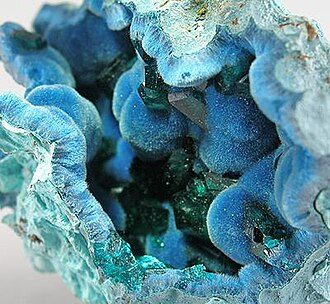
Shattuckite With Chrysocolla
The Oracle's Copper
This page documents traditional and cultural uses of shattuckite with chrysocolla alongside emerging research on tactile grounding objects. Crystalis does not claim that shattuckite with chrysocolla treats, cures, or prevents any medical condition. For mental health concerns, consult a qualified professional.
Origins: Namibia, USA (Arizona)
Materia Medica
The Oracle's Copper
Protocol
Orthorhombic copper chains meet amorphous hydrated silica — two copper minerals, two voices, one frequency. What you know and what you say finally occupy the same breath.
3 min
Hold the shattuckite-chrysocolla specimen and notice the two blues — shattuckite deeper and structured from its orthorhombic copper chains, chrysocolla softer turquoise from its amorphous hydrated matrix. Two kinds of truth. One is structured and precise. One is flowing and intuitive. Both are copper. Both are yours.
Place the stone against your throat. Inhale through your nose for five counts. On the exhale, hum a single low note — not a word, just a vibration. Let the copper inosilicate structure of the shattuckite receive the organized sound while the chrysocolla absorbs the overtones. Three hums.
Move the stone to the center of your forehead, third eye position. Close your eyes. Ask silently: what do I know that I have not yet said? Wait. The shattuckite translates vision into language, the chrysocolla softens the delivery. Notice whatever image, word, or sensation arrives without judging it.
Return the stone to your throat. Now speak what came. Say it aloud, even if it is one word, even if your voice cracks. The copper in both minerals is the same element — what you see and what you say are not different things. They are one thing finding two expressions. Set the stone down. Channel open.
tap to flip for protocol
Some people know what they mean but have learned to fear the impact of saying it plainly. Others soften themselves so much for safety that the message arrives half-erased before it even leaves the mouth. Either way, the signal suffers.
Shattuckite with chrysocolla gives a better arrangement. The stronger blue remains firm enough to outline the truth, while the softer copper blue keeps the delivery from calcifying into pure force. Neither component has to impersonate the other. This pairing helps when communication needs both mercy and edge. It lets clarity stop choosing between being accurate and being livable.
What Your Body Knows
sympathetic
Dorsal vagal collapse (psychic shutdown/dissociation from intuition):
dorsal vagal
Mixed state: sympathetic + dorsal (channeling with destabilization):
dorsal vagal
Ventral vagal maintenance (visionary communication/prophetic speech):
ventral vagal
When already regulated, shattuckite with chrysocolla supports the highest-order ventral vagal communicative function: the ability to receive insight and communicate it effectively to others without distortion. This is the stone of the translator ; - Transition state: freeze toward fight (righteous anger emerging from silence): When a person who has been silenced begins to feel anger about the silencing; when the freeze starts to thaw into something fierce; the nervous system enters a critical transition. If the anger is suppressed again, the freeze deepens. If it erupts without direction, it may cause harm. Shattuckite-chrysocolla provides the channel for this emerging anger to find its voice without explosion. Shattuckite gives the anger precision and direction (chain silicate = directed energy flow); chrysocolla gives it compassion and communication skill. This pairing supports the emergence of righteous anger as effective speech rather than destructive action. State shift: freeze-to-fight transition channeled toward assertive ventral vagal communication through directed expression.
Nervous system mapping based on polyvagal theory (Porges, 2011).
Mineralogy
Chemical Formula
Shattuckite: Cu5(SiO3)4(OH)2 (copper inosilicate/chain silicate) occurring with chrysocolla: (Cu,Al)2H2Si2O5(OH)4 nH2O (hydrated copper aluminum silicate, amorphous to cryptocrystalline); often additionally intermixed with quartz (SiO2), malachite Cu2(CO3)(OH)2, azurite Cu3(CO3)2(OH)2, and/or dioptase CuSiO3 H2O
Crystal System
Mixed
Mohs Hardness
3.5
Specific Gravity
Shattuckite: 3.8--4.1; Chrysocolla: 2.0--2.4; combined specimens variable depending on ratio
Luster
Shattuckite: vitreous to silky (fibrous habit common); Chrysocolla: vitreous to waxy to earthy; combination specimens typically show complex mixed luster with silky blue shattuckite zones within waxy chrysocolla matrix
Color
Blue-Green
Traditional Knowledge
Namibian mineral heritage (Tsumeb): The Tsumeb mine, located in the Oshikoto Region of Namibia, produced many of the world's finest shattuckite-chrysocolla specimens during its operational period (1906-1996). The mine is considered one of the great mineral localities of all time, yielding over 350 documented mineral species. Among the Ovambo and Herero peoples of the region, the brilliant blue and green copper minerals found at the surface above the deposit were recognized long before European mining began as markers of significant underground presence; the earth revealing its hidden wealth through color (Schneider, G. "The Roadside Geology of Namibia," 2004, Gebrüder Borntraeger).
American Southwest mining culture (Bisbee, Arizona): Shattuckite takes its name from the Shattuck Mine in Bisbee, Arizona, where it was first described by Waldemar Schaller of the USGS in 1915. The Bisbee mining district; encompassing the Copper Queen, Shattuck, and surrounding mines; was one of the richest copper districts in North America. In the early 20th century, blue copper minerals from these mines were collected not just for scientific study but as lucky talismans by the miners themselves. The brilliant blue of shattuckite earned it the miners' nickname "blue fire" for its electric appearance (Graeme, R. "Bisbee, Queen of the Copper Camps," 1999, Treasure Chest Books).
Ancient Greek Laurion mines: The mining district of Lavrion (Laurion) in Attica, Greece; where shattuckite has been identified; was one of the primary silver-lead mines of ancient Athens, operating from at least the 5th century BCE. While the ancient Greeks primarily mined for silver and lead, the secondary copper minerals in the oxidation zone, including blue and green copper silicates and carbonates, were known and used. Blue minerals from Lavrion contributed to pigment production and were associated with Athena, goddess of wisdom, whose sacred color was blue-green (Conophagos, C. "Le Laurium Antique," 1980, Ekdotike Hellados).
Contemporary metaphysical tradition (late 20th-21st century): Shattuckite entered the crystal healing community relatively recently compared to malachite or chrysocolla, owing to its rarity and the limited number of producing deposits. It was championed by Naisha Ahsian and Robert Simmons as a stone of "psychic truth" and "channeled communication"; positioning it as the most powerful communication stone in the copper mineral family, surpassing chrysocolla in intensity. The combination with chrysocolla is considered the most balanced form for use, as shattuckite alone can be energetically intense (Simmons, R. & Ahsian, N. "The Book of Stones," 2007, North Atlantic Books).
Namibian mineral heritage (Tsumeb)
The Tsumeb mine, located in the Oshikoto Region of Namibia, produced many of the world's finest shattuckite-chrysocolla specimens during its operational period (1906--1996). The mine is considered one of the great mineral localities of all time, yielding over 350 documented mineral species. Among the Ovambo and Herero peoples of the region, the brilliant blue and green copper minerals found at the surface above the deposit were recognized long before European mining began as markers of significant underground presence -- the earth revealing its hidden wealth through color (Schneider, G. "The Roadside Geology of Namibia," 2004, Gebrüder Borntraeger). 2. American Southwest mining culture (Bisbee, Arizona): Shattuckite takes its name from the Shattuck Mine in Bisbee, Arizona, where it was fir
When This Stone Finds You
Somatic protocol
Orthorhombic copper chains meet amorphous hydrated silica — two copper minerals, two voices, one frequency. What you know and what you say finally occupy the same breath.
3 min protocol
Hold the shattuckite-chrysocolla specimen and notice the two blues — shattuckite deeper and structured from its orthorhombic copper chains, chrysocolla softer turquoise from its amorphous hydrated matrix. Two kinds of truth. One is structured and precise. One is flowing and intuitive. Both are copper. Both are yours.
40 secPlace the stone against your throat. Inhale through your nose for five counts. On the exhale, hum a single low note — not a word, just a vibration. Let the copper inosilicate structure of the shattuckite receive the organized sound while the chrysocolla absorbs the overtones. Three hums.
50 secMove the stone to the center of your forehead, third eye position. Close your eyes. Ask silently: what do I know that I have not yet said? Wait. The shattuckite translates vision into language, the chrysocolla softens the delivery. Notice whatever image, word, or sensation arrives without judging it.
50 secReturn the stone to your throat. Now speak what came. Say it aloud, even if it is one word, even if your voice cracks. The copper in both minerals is the same element — what you see and what you say are not different things. They are one thing finding two expressions. Set the stone down. Channel open.
40 secCare and Maintenance
Shattuckite with chrysocolla requires caution for care. Shattuckite (Mohs 3. 5) and chrysocolla (Mohs 2-4) are both soft copper minerals.
Brief rinse only (15-30 seconds), pat dry immediately. Avoid soaking; chrysocolla is hydrated and porous. Contains copper; do not use in gem elixirs.
Recommended cleansing: moonlight (safest), smoke (30-60 seconds), selenite plate. Store in a soft pouch.
In Practice
You need expression that keeps both precision and softness. Shattuckite's darker blue and chrysocolla's softer blue-green share one copper-born body. Hold when your communication needs both clarity and kindness.
Place at the throat during conversations requiring diplomacy. Two minerals, one source element, two tonal registers.
Verification
Shattuckite with chrysocolla: two copper minerals naturally intergrown. Shattuckite (darker blue, Mohs 3. 5, fibrous habit) and chrysocolla (softer blue-green, Mohs 2-4).
Both should be copper-blue tones but distinguishable. If the specimen shows only one shade of blue-green with no textural variation, it may be single-mineral rather than a genuine intergrowth.
Natural Shattuckite With Chrysocolla should usually feel cooler than plastic or resin on first touch and warm more slowly in the hand.
Use 3.5 on the Mohs scale as the check, not internet myths. A real specimen should behave in line with the hardness listed above.
Look for a shattuckite: vitreous to silky (fibrous habit common); chrysocolla: vitreous to waxy to earthy; combination specimens typically show complex mixed luster with silky blue shattuckite zones within waxy chrysocolla matrix surface quality rather than a painted or plastic shine.
The listed specific gravity is Shattuckite: 3.8--4.1; Chrysocolla: 2.0--2.4; combined specimens variable depending on ratio. If a specimen feels unusually light for its size, it may deserve a second look.
Geographic Origins
Namibia's Kaokoveld region produces the finest shattuckite-chrysocolla specimens from copper ore oxidation zones. Arizona (USA) Shattuck Mine (namesake, Bisbee district) is the type locality. Both localities share the chemical requirement: secondary copper silicate precipitation in oxidation zones of copper deposits.
FAQ
Shattuckite With Chrysocolla is classified as a Shattuckite is a relatively rare copper inosilicate (chain silicate) first described in 1915 from the Shattuck Mine in Bisbee, Arizona. It is structurally distinct from chrysocolla -- shattuckite has a well-defined orthorhombic crystal structure with edge-sharing CuO chains, while chrysocolla is amorphous to poorly crystalline. Their co-occurrence results from shared supergene copper formation environments where both silica and copper are available, but shattuckite crystallizes under slightly different conditions (lower hydration, higher crystallographic order). Shattuckite often forms as a pseudomorph after malachite, inheriting malachite's botryoidal or fibrous form while replacing its chemistry.. Chemical formula: Shattuckite: Cu5(SiO3)4(OH)2 (copper inosilicate/chain silicate) occurring with chrysocolla: (Cu,Al)2H2Si2O5(OH)4 nH2O (hydrated copper aluminum silicate, amorphous to cryptocrystalline); often additionally intermixed with quartz (SiO2), malachite Cu2(CO3)(OH)2, azurite Cu3(CO3)2(OH)2, and/or dioptase CuSiO3 H2O. Mohs hardness: Shattuckite: 3.5; Chrysocolla: 2--4 (variable); when silicified with quartz matrix: up to 6--7. Crystal system: Shattuckite: orthorhombic (space group Pcab); Chrysocolla: amorphous to cryptocrystalline.
Shattuckite With Chrysocolla has a Mohs hardness of Shattuckite: 3.5; Chrysocolla: 2--4 (variable); when silicified with quartz matrix: up to 6--7.
Water Safety NO -- Do not submerge under any circumstances. Both shattuckite and chrysocolla are compromised by water. Shattuckite (Mohs 3.5) is a soft mineral that can be damaged by water infiltration along fibrous crystal boundaries. Chrysocolla is a hydrated mineral whose structural integrity depends on maintaining its existing water content -- adding or removing water disrupts the fragile gel-like structure. Both contain HIGH copper concentrations: shattuckite is approximately 56% CuO and chrysocolla approximately 45% CuO. Copper WILL leach into any water these minerals contact. NEVER use in gem elixirs, gem water, baths, or any liquid preparation. Do not rinse. Clean with a dry, soft brush only. For energetic water charging, use the extreme indirect method: stone at minimum 12 inches from water, with an opaque barrier between stone and water.
Shattuckite With Chrysocolla crystallizes in the Shattuckite: orthorhombic (space group Pcab); Chrysocolla: amorphous to cryptocrystalline.
The chemical formula of Shattuckite With Chrysocolla is Shattuckite: Cu5(SiO3)4(OH)2 (copper inosilicate/chain silicate) occurring with chrysocolla: (Cu,Al)2H2Si2O5(OH)4 nH2O (hydrated copper aluminum silicate, amorphous to cryptocrystalline); often additionally intermixed with quartz (SiO2), malachite Cu2(CO3)(OH)2, azurite Cu3(CO3)2(OH)2, and/or dioptase CuSiO3 H2O.
If this mineral is cut, ground, or broken, the resulting dust is toxic copper silicate. Never perform lapidary work on shattuckite-chrysocolla without professional equipment, wet cutting, full respiratory protection, and ventilation.
Formation Story Shattuckite with chrysocolla forms in the oxidation zone of copper sulfide ore deposits under conditions that favor the precipitation of copper silicate minerals over copper carbonates. While malachite and azurite dominate most supergene copper environments, shattuckite requires specific conditions: sufficient dissolved silica, appropriate pH and oxidation potential, and relatively low CO2 partial pressure (which would otherwise favor carbonate formation). The mineral was first s
References
. [SCI]
DOI: 10.1002/jrs.2751
. [SCI]
DOI: 10.1111/rge.12271
Closing Notes
Two secondary copper silicates from the same oxidation zone. Shattuckite providing deep blue, chrysocolla providing blue-green. The science documents co-precipitation of copper phases.
The practice asks what collaboration looks like when two minerals born from the same chemistry produce two distinct voices.
Bring it into practice
Move from reference to ritual. Search current inventory for Shattuckite With Chrysocolla, build a custom bracelet, or let Sacred Match choose the right supporting stones for you.
Community notes
Shared field notes tied to Shattuckite With Chrysocolla appear here, including notes saved from practice.
When members save a public field note for this stone, it will appear here.
The archive
Continue through stones that share intention, chakra focus, or tonal family with Shattuckite With Chrysocolla.

Shared intention: Clarity & Focus
The Colorless Truth

Shared intention: Intuition
The Wisdom Crown

Shared intention: Clarity & Focus
The Blueprint of Clarity

Shared intention: Communication & Truth
California's Blue Flame

Shared intention: Clarity & Focus
The Calm Frequency
Shared intention: Clarity & Focus
The Soft Blue Honesty