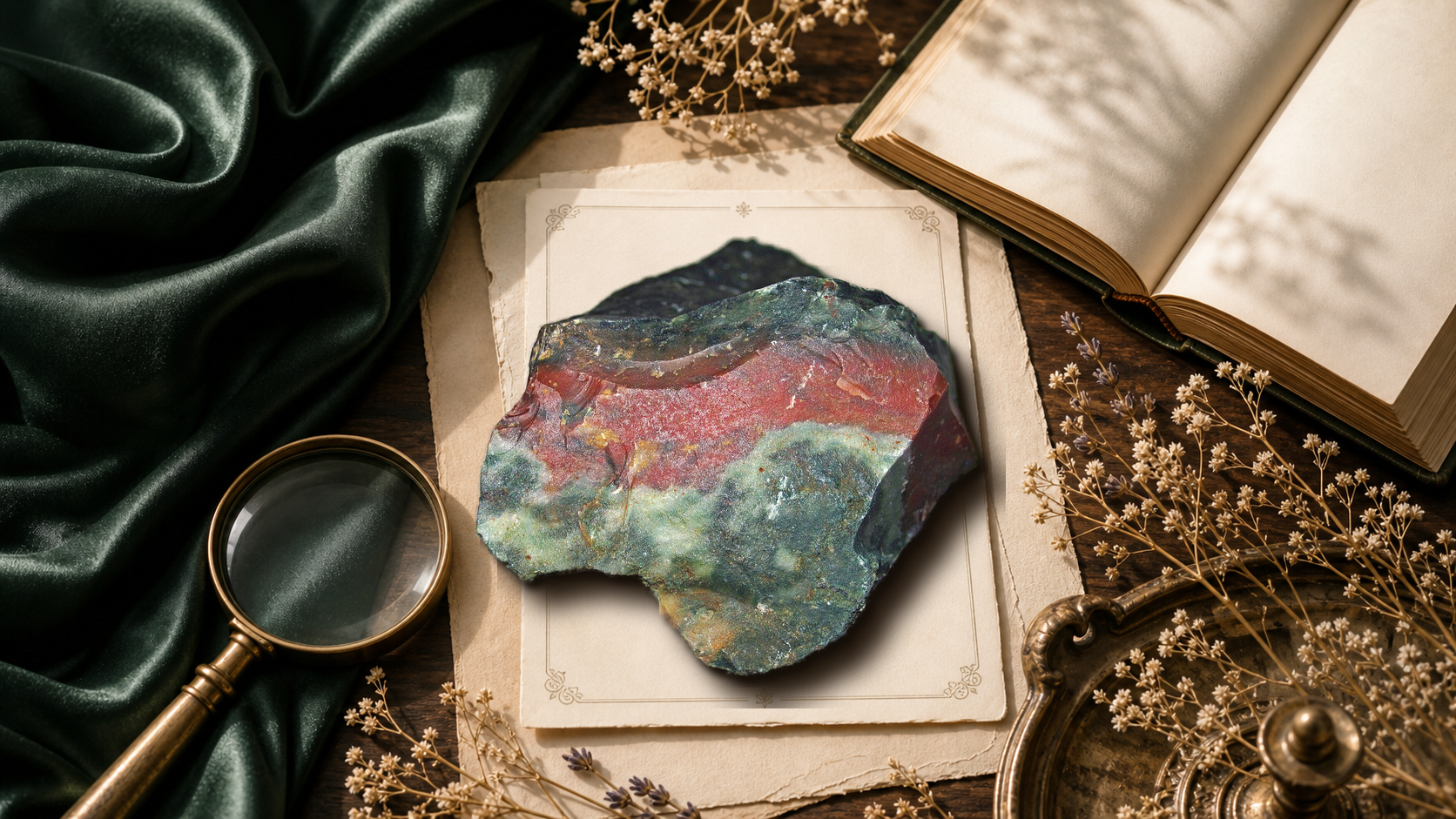
You need a symbol of togetherness that does not erase the separate parts. A stone named for solidarity earns its meaning by holding difference in one body and refusing collapse into sameness. Cohesion is stronger when it leaves the seams visible.
Stone of Solidarity works with collective coherence. Because it is typically a trade name for inclusion rich or composite material rather than a single pure species,...
The Meaning
Stone Of Solidarity in the Crystalis dictionary
Belonging becomes suspect once it has demanded too much self-erasure. The psyche learns to distrust unity if every invitation to join has secretly meant simplify, conform, and stop carrying whatever makes you difficult to categorize.
Stone of solidarity is persuasive precisely because its premise is composite. The whole matters, but the whole is legible as assembled rather than melted flat. Connection remains visible as relation, not as disappearance.
This stone helps when community has to become believable again. Real cohesion is not a blur. It is a body that can hold many edges without expelling them.
Stone Lore
Stories carried through time
Cultural notes are presented as tradition and historical context — stories carried through time.
Unknown
Mexican and Mesoamerican solar traditions
While "Piedra del Sol" most famously refers to the Aztec Sun Stone (a monumental basalt sculpture, not a crystal), the name's application to golden aventurescent quartz in Latin American crystal markets carries deliberate cultural resonance. In Mesoamerican cosmology, Tonatiuh (the Sun God) was the sustainer of all life, and solar imagery permeated every aspect of sacred practice.
The adoption of "Piedra del Sol" for a golden, glowing stone connects it to this deep solar reverence (Leon-Portilla, M. , "Aztec Thought and Culture," 1963, University of Oklahoma Press). 2. Indian Surya (Sun) worship: The primary source region for this stone, Rajasthan, India, has one of the world's most ancient solar worship traditions.
Lore review
Tradition notes are being reviewed.
This entry keeps symbolic meaning separate from sourced cultural history. When dedicated tradition rows are available, they will appear here as individual lore cards.
Stone of Solidarity is a trade name rather than a formal mineral species, so the first scientific task is to identify the material honestly. In the descriptions usually attached to it, the stone is best treated as a quartz based aggregate or rock with green inclusions, commonly chlorite, actinolite, or related iron magnesium silicates creating the body color. That means the visible unity of the polished piece is actually composite.
Quartz supplies hardness and structural continuity, while the green minerals supply tone, clouding, pattern, and much of the symbolic language attached to the material.
Formation depends on which inclusion family is present, but the broad story is consistent. Silica rich fluids crystallize quartz in veins, cavities, or massive bodies, while chloritic or amphibolic minerals either grow alongside it or are trapped during later overprinting. If the host is metamorphic, regional pressure and fluid flow can organize both quartz and green silicates into an interlocking texture.
If the material is hydrothermal, repeated fluid pulses can add inclusions and staining in stages. Either way, the specimen is not monochrome in origin. It is a negotiated body assembled from compatible but distinct mineral histories.
That is why the stone often feels more grounded than transparent green quartz varieties sold under brighter names. Inclusions interrupt light, lower clarity, and give the polished surface a sense of depth through particulate structure rather than through open translucence. Hardness remains essentially quartzlike, but luster and pattern depend on how densely the inclusions occupy the silica host.
The geological lesson is straightforward. Cohesion in this material does not come from singularity. It comes from intergrowth. Quartz alone would be clearer but less textural. The green phases alone would be softer or less coherent. Together they make a stone whose visible integrity is built from preserved difference rather than erased difference.
Its listed properties reinforce that origin. The stated hardness of 7 and the reported luster of Vitreous (quartz body); metallic sparkle (aventurescent inclusions) are not decorative trivia.
Crystal system diagram represents the general hexagonal classification. Diagram created by Crystalis for educational reference.
Hexagonal structure
Chemical Formula
SiO2 -- silicon dioxide (macrocrystalline quartz variety with platelet inclusions of hematite, goethite, or pyrite responsible for aventurescence)
India produces stone of solidarity from metamorphic rock formations. Brazil yields similar banded gneissic material. The trade name refers to the compositional banding (feldspar, quartz, ferromagnesian minerals) visible in cross-section, formed through deep crustal metamorphic deformation.
IndiaBrazil
Telling it apart
Stone of Solidarity is a trade name, so the first consumer question should be "solidarity of what". The clearest indicator is mineral disclosure. If the material is inclusion bearing quartz or a composite rock, the seller should say so plainly instead of implying a hidden formal species. Green included quartz, gneissic rock, and other mixed materials can all be attractive, but they do not become more scientific by receiving a unifying name.
A quartz rich stone is durable. A softer metamorphic composite may behave differently. Without honest mineral content, the buyer cannot know what justifies the price or how to compare one piece to another. Here the issue is not fraud so much as vagueness. A beautiful stone deserves a beautiful name. It still deserves a truthful material description first.
A careful buyer should compare the label to habit, hardness, and provenance before paying a rarity premium. Stone of solidarity is a trade name for green aventurescent quartz. Confirm the actual mineral content before paying anything beyond standard quartz prices.
Spotting the real thing
Stone of solidarity: a trade name for a banded metamorphic rock. Mohs 6-7. SG 2.
65-2. 68. Vitreous luster with aventurescent sparkle.
The compositional banding should extend through the entire stone. If the banding appears only on the surface, it is painted. The aventurescence should be visible when rotated under light.
The Solidarity Signal." The very name; Stone of Solidarity; points to its primary nervous system function. When the sympathetic system activates around social threat (rejection, isolation, not belonging), Piedra del Sol's warm golden color activates the visual cortex in the warm spectrum associated with social bonding, firelight, and communal gathering. The aventurescent sparkle adds dynamic visual interest that captures and holds attention, creating a micro-moment of fascination that can interrupt the isolation-anxiety loop.
State shift: social-threat sympathetic activation toward ventral vagal social engagement through warm-spectrum visual anchoring.
Shut down & far away
Dorsal vagal collapse (hopelessness/lost sense of purpose):
The solar quality of Piedra del Sol; its internal glow, its association with the sun; provides a warm, activating frequency that does not demand immediate response (unlike the sharp activation of red stones). The warmth is radiant, not urgent. For a dorsal-collapsed system that cannot tolerate intensity, this gentle solar quality can begin to thaw the numbness without triggering defensive shutdown. State shift: dorsal collapse toward low-level sympathetic activation through warmth-based sensory engagement.
When the nervous system is both activated AND socially engaged; the state of genuine joy, creative excitement, or shared passion; Piedra del Sol amplifies and stabilizes this desirable mixed state. The stone's aventurescence literally sparkles with the energy of excitement, while its warm golden body color maintains the grounding warmth of connection. State support: amplification and stabilization of the joy-excitement ventral-sympathetic blend.
Settled & connected
solidarity
Sympathetic depletion (seasonal affective/light deprivation): For nervous systems depleted by literal or metaphorical darkness; winter months, grief seasons, periods of sustained difficulty; Piedra del Sol provides a portable, personal sun. The warm golden wavelengths reflected by the stone fall within the spectrum range (570; 590 nm) known to stimulate serotonin production in the retina.
While the effect from a small stone is not equivalent to a light therapy box, the psychological association with warmth and light can serve as a somatic anchor during dark periods. State shift: light-deprived depletion toward hope-based parasympathetic activation.
These associations come from tradition and reflective practice — a way of working with the stone, not a medical prescription.
Somatic Practice
Simple ways to work with Stone Of Solidarity
◇
Hold
Carry Stone Of Solidarity in a pocket or place it over the heart center during a pause.
◌
Meditate
Let the stone become a quiet tactile anchor while the breath slows.
☽
Breathe
Breathe in softness. Breathe out tension. Keep the practice simple.
✎
Journal
Write with Stone Of Solidarity nearby to name the feeling without forcing a conclusion.
✋
Bodywork
Rest the stone near the chest, hand, or bedside as a reminder to soften.
⌂
Environment
Place it where you want a visual cue for care, repair, or steadiness.
Field Instruction
The Aventurescent Gathering
Hematite, goethite, or pyrite platelets suspended in quartz flash metallic warmth — aventurescence as collective spark, each inclusion a separate fire contributing to a shared glow.
3 min protocol
1
Hold the Stone of Solidarity up to light and look for the aventurescent flash — the metallic sparkle caused by tiny platelets of hematite, goethite, or pyrite suspended inside the quartz. Each sparkle is a separate mineral inclusion. Each one catches light independently. Together they create a collective glow. Place the stone at your solar plexus.
2
Press the stone firmly against your belly with both hands. Breathe in for four counts, imagining each of those metallic inclusions as a person in your community — each separate, each contributing their own frequency of light. Exhale for six counts, imagining the collective warmth spreading from your center outward to your skin. Four rounds.
3
Move the stone to your left hand and extend your right hand outward, palm up, as if offering or receiving from someone beside you. Hold this posture for thirty seconds. The aventurescent effect only works because multiple inclusions coordinate — a single platelet would be invisible. Connection is not optional. It is how you become visible.
4
Bring both hands together, stone sandwiched between your palms at heart level. Squeeze gently. The quartz matrix holds every inclusion in place — it does not eject them, rank them, or organize them by size. Name one person who has held space for you the way this quartz holds its inclusions. Breathe for them.
5
Set the stone on a surface where light hits it. Watch the sparkle from different angles. Each angle reveals different inclusions. Each perspective reveals different allies. Stand up if you can. You are not alone, and the proof sparkles.
Stone Intelligence
The fact that makes Stone Of Solidarity memorable
Banded metamorphic rock of feldspar, quartz, and ferromagnesian minerals. A trade name for a gneiss or migmatite whose compositional banding records tectonic deformation. The science documents ductile flow in deep crustal metamorphism.
The practice asks what solidarity means when the banding records forces that would have broken anything less cohesive.
SCI
On the Color and Genesis of Prase (Green Quartz) and Amethyst from the Island of Serifos, Cyclades, Greece
You need a symbol of togetherness that does not erase the separate parts. This banded metamorphic rock holds feldspar, quartz, and ferromagnesian minerals in visible layers. Hold during community-building work or team leadership.
The banding records tectonic deformation that did not destroy the rock but organized it. Solidarity is not homogeneity. It is cohesion under pressure.
Sacred Match
Sacred Match reaches for Stone Of Solidarity when what you feel sounds like:
difficulty holding difference in one field
group fatigue or collaboration strain
a need for unity without sameness
internal parts competing for space
shared work needing visible cohesion
Sacred Match listens to the body rather than to preference. It notices what you are feeling right now, the way you are protecting yourself, and the deeper need underneath both. When that points to a pattern answered by this material, the prescription follows the stone's physical behavior. Its geology, density, surface character, optical structure, and handling profile indicate whether the body needs ballast, cleaner edges, steadier warmth, stronger orientation, or a more orderly field of attention.
difficulty holding difference in one field -> body asking for orientation -> seeking a steadier internal map
group fatigue or collaboration strain -> protective effort running long -> seeking firmer support
a need for unity without sameness -> pattern becoming costly -> seeking better organization
internal parts competing for space -> current strategy losing efficiency -> seeking a clearer material response
shared work needing visible cohesion -> body signaling the next need -> seeking coherence
Stones and herbs that harmonize with Stone Of Solidarity
Pairings are treated like a recipe file: clear use, method, and safety.
Crystal Companion
Stone Of Solidarity + Amethyst
Use when
You want to layer the primary intention with another supportive tone.
How to work with it
Place the stones together during meditation, journaling, or a short reset.
Safety
Use as a reflective practice tool, not as a medical substitute.
Crystal Companion
Stone Of Solidarity + Rhodonite
Use when
You want to layer the primary intention with another supportive tone.
How to work with it
Place the stones together during meditation, journaling, or a short reset.
Safety
Use as a reflective practice tool, not as a medical substitute.
Crystal Companion
Stone Of Solidarity + Clear Quartz
Use when
You want to layer the primary intention with another supportive tone.
How to work with it
Place the stones together during meditation, journaling, or a short reset.
Safety
Use as a reflective practice tool, not as a medical substitute.
Crystal Companion
Stone Of Solidarity + Black Tourmaline
Use when
You want to layer the primary intention with another supportive tone.
How to work with it
Place the stones together during meditation, journaling, or a short reset.
Safety
Use as a reflective practice tool, not as a medical substitute.
Green Aventurine. Shared green field, different structure. Aventurine gives a more straightforward quartz body while Stone of Solidarity often carries a more complex mixed texture. The pair works when cohesion needs to remain visible rather than polished away. Keep the trade name stone central and aventurine as the simpler side piece.
Nephrite Jade. Durable cohesion. Nephrite contributes extraordinary toughness and a denser green composure, complementing the more varied inner texture of Stone of Solidarity. Best on a desk or communal table. Place nephrite low and the solidarity stone slightly above it.
Clear Quartz. Agreement without sameness. Clear quartz adds transparency and lets the inclusion rich body of the main stone feel more intentional. Put the quartz behind the solidarity stone so the latter's seams and clouds stand out.
Lapis Lazuli. Difference held in one field. Lapis adds a different kind of composite truth, blue stone with calcite and pyrite already visible. Together the pair suits conversations about teamwork, plural identities, or collaborative spaces. Keep one on each side of the room or each side of the shared table.
Placement should stay intentional. Leave enough room between pieces for each material to keep its own visual job, because crowding can flatten the reason the pairing works.
Care & Cleansing
How to keep Stone Of Solidarity in good condition
Water Safe?
Water safe
This stone is generally safe for short water contact, though polishing, fractures, and metal settings can still change how a specimen behaves.
Sunlight Safe?
Sunlight safe
Tolerates daylight; safe to charge or display in the sun.
Authenticity
What to check
Natural Stone Of Solidarity should usually feel cooler than plastic or resin on first touch and warm more slowly in the hand.
Stone of solidarity is water-safe. Quartz-based metamorphic rock (Mohs 6-7), dense and durable. Brief to moderate water is safe.
Recommended cleansing: running water, moonlight, sound, smoke, selenite plate. Store normally; this is a tough rock specimen.
Temperature
Natural Stone Of Solidarity should usually feel cooler than plastic or resin on first touch and warm more slowly in the hand.
Scratch logic
Use 7 on the Mohs scale as the check, not internet myths. A real specimen should behave in line with the hardness listed above.
Surface and luster
Look for a vitreous (quartz body); metallic sparkle (aventurescent inclusions) surface quality rather than a painted or plastic shine.
Weight and density
The listed specific gravity is 2.65--2.68. If a specimen feels unusually light for its size, it may deserve a second look.
My Field Guide
Your private record and next steps
Journal
Add this stone to your private collection, then log what happened when you worked with it.
Shared Notes
Read public practice logs and pattern notes from the Crystalis community.
When members save a public field note for this stone, it will appear here.
Frequently Asked
Questions people ask about Stone Of Solidarity
What is Stone Of Solidarity?
⌄
"Piedra del Sol" (Stone of the Sun, or Stone of Solidarity) is a trade name used primarily in Latin American crystal markets for golden-orange aventurescent quartz: macrocrystalline SiO2, Mohs 7, trigonal (space group P3121 or P3221). In English-language markets the same material is typically called "Sunstone Quartz" or "Golden Aventurine Quartz." It should not be confused with true feldspar sunstone (oligoclase or labradorite feldspar with copper or hematite inclusions) or the Aztec "Sun Stone" (Piedra del Sol), which is a carved basalt calendar stone.
The aventurescence, the glittering effect, is caused by aligned platelet inclusions of hematite (Fe2O3), goethite (FeO(OH)), or occasionally pyrite, which reflect light in a uniform, sparkling manner.
What is the Mohs hardness of Stone Of Solidarity?
⌄
Stone Of Solidarity has a Mohs hardness of 7.
Can Stone Of Solidarity go in water?
⌄
Water Safety YES, Generally water-safe. Quartz (hardness 7) is one of the most water-resistant minerals. Brief to moderate soaking is acceptable for cleaning. However, for gem elixir purposes, note that the aventurescent inclusions are hematite (iron oxide) or goethite, while these are encapsulated within the quartz and unlikely to leach in neutral water, acidic solutions could theoretically dissolve trace amounts of iron.
Use the indirect method (stone placed beside, not inside, the water) for any consumable water applications. Do not use with acidic liquids (vinegar, citrus water).
What crystal system is Stone Of Solidarity?
⌄
Stone Of Solidarity crystallizes in the Trigonal, space group P3121 or P3221.
What is the chemical formula of Stone Of Solidarity?
⌄
The chemical formula of Stone Of Solidarity is SiO2, silicon dioxide (macrocrystalline quartz variety with platelet inclusions of hematite, goethite, or pyrite responsible for aventurescence).
Is Stone Of Solidarity toxic?
⌄
If cutting or polishing, standard quartz/silica dust precautions apply. Respirable crystalline silica is a documented occupational health hazard causing silicosis with chronic exposure (Peruzzi et al., 2021; Hoy & Chambers, 2020). Use wet-cutting methods and respiratory protection.
How does Stone Of Solidarity form?
⌄
Formation Story The golden-orange aventurescent quartz known as Piedra del Sol forms through hydrothermal or metamorphic processes in which silica-rich fluids become saturated with iron oxides. As quartz crystals grow from these solutions, typically at temperatures of 200 to 400 degrees C in veins and cavities within iron-rich host rocks, thin platelet inclusions of hematite or goethite become incorporated into the growing crystal lattice.
Sources & Citations
Where this entry can be checked
Back Matter
Readable for people. Structured for AI search.
Sources stay visible in the page so readers, search engines, and answer systems can follow the evidence trail.
01
SCI
On the Color and Genesis of Prase (Green Quartz) and Amethyst from the Island of Serifos, Cyclades, Greece
Klemme S, Berndt J, Mavrogonatos C, et al. (2018). On the Color and Genesis of Prase (Green Quartz) and Amethyst from the Island of Serifos, Cyclades, Greece. Minerals. [SCI]DOI 10.3390/min8110487
02
SCI
Green aventurine quartz: mineralogical characterization
Monroe EA. (1986). Green aventurine quartz: mineralogical characterization. The Journal of Gemmology. [SCI]DOI 10.15506/jog.1986.20.2.83
03
SCI
Review of some current coloured quartz varieties
Henn U, Schultz-Güttler R. (2012). Review of some current coloured quartz varieties. The Journal of Gemmology. [SCI]DOI 10.15506/JoG.2012.33.1.29
04
SCI
The Natural Formation and Occurrence of Green Quartz
Paradise TR. (1982). The Natural Formation and Occurrence of Green Quartz. Gems & Gemology. [SCI]DOI 10.5741/gems.18.1.39
05
SCI
Synthetic (Goldstone) and Natural Aventurine - A Review