Restlessness has filled the room with too many half-thoughts. Stilbite opens in sheaf-like zeolite bundles, peach to cream, delicate-looking but systematically built. Peace can unfold rather than drop.
Stilbite works with unfolding rest. Its sheaf like zeolite habit looks less like a point and more like a fan opening in stages, which makes it a strong stone for...
The Meaning
Stilbite in the Crystalis dictionary
There is a kind of overstimulation that does not look dramatic from the outside. It simply fills the air with unfinished motions, half-conclusions, and a constant sense that the next thought might finally settle things if you let it keep going long enough.
Stilbite offers another rhythm. Its fanlike and sheaflike forms feel like opening rather than impact, soft in color but orderly in arrangement. The quiet is not blank. It has a pattern to it.
Stilbite matters when calm needs to arrive as easing, not shutdown. The mind may stop fighting itself more successfully when peace is allowed to unfurl.
Stone Lore
Stories carried through time
Cultural notes are presented as tradition and historical context — stories carried through time.
European Mineralogy
Classical and Medieval Zeolite Observations
The Swedish mineralogist Axel Fredrik Cronstedt coined the term zeolite in 1756 after observing that certain minerals released steam when heated (from Greek zein, to boil, and lithos, stone). Stilbite was among the zeolite minerals known to naturalists of this era, though its formal scientific description came later. The name stilbite, from the Greek stilbein meaning to shine, was assigned by Rene Just Hauy in reference to the mineral's pearly luster on cleavage surfaces.
1756-early 1800s
Origin lore
Deccan Traps Specimen Production
The Deccan Traps volcanic basalt formation of western India, one of the largest volcanic features on Earth, has produced the world's finest stilbite specimens for over a century. Quarrying and mining operations near Pune, Nashik, and...
Indian Mineral Specimen Trade · c. 1900s-present
Ritual history
Industrial Zeolite Applications
Zeolite minerals including stilbite have been studied extensively for their molecular sieve properties since the mid-20th century. Natural zeolites' porous frameworks can selectively absorb and release water and other molecules, leading to...
Materials Science & Industry · c. 1950s-present
Ritual history
Rest and Transition Practice Stone
Crystal practitioners adopted stilbite as a primary stone for rest, sleep support, and gentle emotional transitions beginning in the 1990s. The mineral's warm peach color, lightweight feel, and association with the zeolite family's...
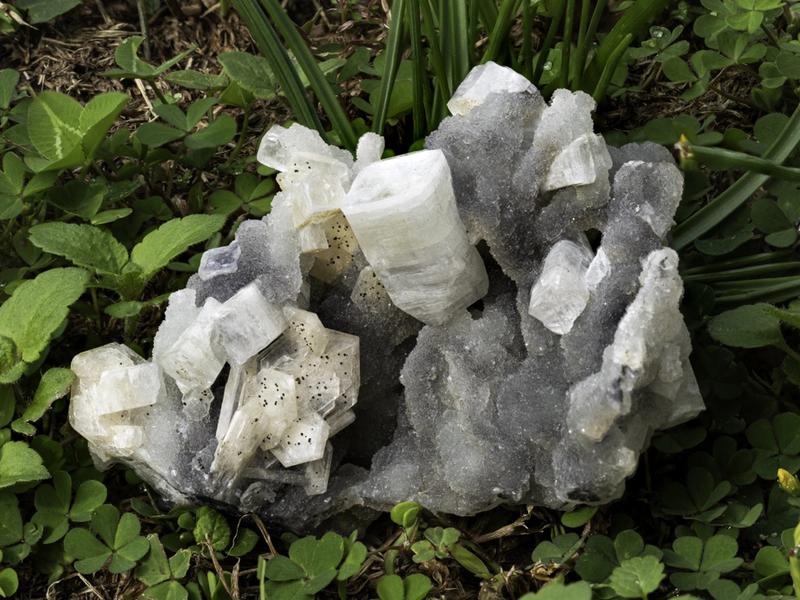
Stilbite is one of the most recognizable zeolites because its crystals gather into sheaves, fans, and bow tie aggregates that look almost deliberate in their spread. Mineralogically it is a hydrated sodium calcium aluminum silicate, part of the open framework zeolite family that forms mostly at low temperatures when volcanic rocks begin to alter in the presence of circulating alkaline water.
Basalt cavities and vesicles are classic settings because they provide both the open space for crystal growth and the chemical ingredients released by breakdown of volcanic glass and feldspar.
The key is late, gentle hydrothermal activity rather than violent magmatism. After lava cools and hardens, groundwater or residual fluids percolate through the rock, leaching silica, alumina, sodium, and calcium. In cavities left by gas bubbles, zeolites precipitate one after another as the chemistry matures. Stilbite often arrives with heulandite, apophyllite, scolecite, and other low temperature minerals, especially in large volcanic provinces such as the Deccan Traps of India.
The stone therefore sits within the afterlife of basalt rather than the eruption itself.
Its monoclinic structure supports tabular crystals that commonly splay from a central axis. That splaying creates the diagnostic sheaf habit and produces surfaces with pearly to vitreous luster. Structural water is integral to the zeolite framework, which is why many zeolites respond to heat and dehydration in characteristic ways. Stilbite remains relatively soft and light, matching its open hydrated architecture.
What gives it grace is that openness. Framework silicate cages, structural water, and cavity growth together allow a crystal aggregate that unfolds rather than juts. Stilbite records a volcanic system that had already cooled enough to become receptive, then let mineral rich water quietly occupy the spaces gas once left behind.
Its listed properties reinforce that origin. The stated hardness of 3.5 and the reported luster of Vitreous to pearly are not decorative trivia.
Crystal system diagram represents the general monoclinic classification. Diagram created by Crystalis for educational reference.
Monoclinic structure
Chemical Formula
NaCa4(Si27Al9)O72.28H2O
Crystal System
Monoclinic
Mohs Hardness
3.5
Specific Gravity
2.09-2.20
Luster
Vitreous to pearly
Color
White-Pink
IMA Status
variety
Type Locality
No specific type locality (first described from Iceland, Andreasberg, Norway)
IMA Number
pre-IMA
01
Mineral conditions gather
02
Structure begins to crystallize
03
Stilbite records place and pressure
Stilbite is a zeolite mineral, one of the most common members of this important mineral group. It forms in amygdaloidal cavities in basalts, where silica-rich fluids crystallize into beautiful 'bow tie' or 'wheat sheaf' aggregates of radiating crystals. The name comes from Greek 'stilbein' meaning to glitter, referring to its pearly luster. India, particularly the Pune region, produces the finest specimens with delicate peach-pink coloration.
Mineralogy: Chemical formula NaCa₄[Al₈Si₂₈O₇₂]·nH₂O. Crystal system: Monoclinic. Mohs hardness: 3.5-4. Specific gravity: 2.15. Luster: Vitreous to pearly.
IndiaIcelandUSA
Telling it apart
Stilbite is often confused with heulandite, scolecite, and other pale zeolites because collectors meet them in the same basalt cavities. What separates stilbite is habit. It prefers sheaf like or bow tie aggregates of tabular crystals, while heulandite commonly forms coffin shaped crystals and scolecite tends toward more needle like sprays. Peach tones are common in stilbite but not diagnostic by themselves.
Stilbite is softer and more fragile than many casual buyers expect, so correct naming affects handling as well as price. A specimen should be bought for its real crystal architecture and locality, not for a convenient guess. In this family, habit is often the most honest guide.
A careful buyer should compare the label to habit, hardness, and provenance before paying a rarity premium. Stilbite is a monoclinic zeolite with a distinctive bowtie crystal habit. Confirm the pearly luster and low hardness near 3.5. If the crystal form looks wrong, it may be a different zeolite species.
Spotting the real thing
Stilbite: zeolite with distinctive bow-tie or sheaf-shaped crystal aggregates. Mohs 3. 5-4.
SG 2. 09-2. 20.
Vitreous to pearly luster. The bow-tie crystal habit is diagnostic and difficult to fabricate. Usually found in basalt vesicles, often associated with apophyllite and other zeolites.
You have been told to slow down. Your body has asked you to stop. You are still going. Not because you do not feel the exhaustion but because stopping feels more dangerous than continuing. Your sympathetic system has reframed rest as threat; the moment you stop, everything you are holding will fall.
Stilbite's bowtie crystal clusters look like they are exhaling. The crystal habit itself demonstrates release: two fan-shaped halves opening outward from a center point. The stone's zeolite chemistry means it is literally porous; it has space built into its structure. Holding stilbite at the heart while lying down provides a tactile permission slip. The weight is negligible. The warmth of the peach tone is gentle. The message is not that everything will be fine. The message is that the organism needs rest and that need is not negotiable.
Shut down & far away
The Collapsed Rest
You stopped, and now you cannot start again. The rest you took was not restorative; it was a shutdown. You are in bed but not sleeping well. You are still but not peaceful. Your dorsal vagal system pulled the emergency brake and now the engine is cold. This is not laziness. This is a nervous system that ran past its capacity and then fell.
Stilbite in this state works through its gentle warmth. The peach and salmon tones are not stimulating. They are not demanding activation. They meet the collapsed system where it is and offer the smallest possible invitation: not to get up, but to notice that rest and collapse are different states. Placing stilbite on the chest during this collapse state adds almost no weight and no pressure. It simply rests there, the way you are resting. The stone's presence invites the awareness that rest can be nourishing rather than defeated.
Settled & connected
The Gentle Deceleration
You are slowing down on purpose. Not collapsing, not being forced; choosing. The day is ending and you are allowing the transition. The project is pausing and you are not anxious about it. Your nervous system is decelerating smoothly, the way a zeolite mineral releases water when gently heated; gradually, structurally, without cracking.
This is stilbite's home state. The stone formed in basalt cavities after volcanic activity cooled. It is the mineral that arrives after the eruption, filling the void with something gentle and luminous. In this regulated state, stilbite at your bedside or in your hand during evening practice anchors the transition from activity to rest. You are not fighting the slowdown. You are the slowdown. The bowtie clusters open outward, the warm color softens the visual field, and the nervous system receives confirmation that deceleration is safe.
These associations come from tradition and reflective practice — a way of working with the stone, not a medical prescription.
Somatic Practice
Simple ways to work with Stilbite
◇
Hold
Carry Stilbite in a pocket or place it over the heart center during a pause.
◌
Meditate
Let the stone become a quiet tactile anchor while the breath slows.
☽
Breathe
Breathe in softness. Breathe out tension. Keep the practice simple.
✎
Journal
Write with Stilbite nearby to name the feeling without forcing a conclusion.
✋
Bodywork
Rest the stone near the chest, hand, or bedside as a reminder to soften.
⌂
Environment
Place it where you want a visual cue for care, repair, or steadiness.
Field Instruction
The Permission to Rest
The Exhale Is Not Optional.
3 min protocol
1
Lie down if possible. If not, recline. Place the stilbite on your upper chest, between the collarbones and the heart center. Choose the specimen's flattest surface for stability. The peach or white bowtie clusters should face upward -- let the crystal's natural opening shape face the ceiling. This is a zeolite: a mineral with space built into its atomic structure. It is porous on purpose. Close your eyes. Three settling breaths: inhale 4, exhale 6. No ambition. No intention beyond arriving.
2
Extended exhale practice. Inhale through the nose for 3 counts. Exhale through the mouth for 8 counts. The extended exhale activates the parasympathetic branch of the nervous system. The ratio is deliberately imbalanced toward release. Five cycles. On each exhale, imagine the breath passing through the porous structure of the stone -- entering the zeolite framework, filling the molecular channels, and dissipating. You are not breathing into the stone literally. You are training the nervous system to associate the stone with the act of complete exhalation.
3
Stop counting. Let the breath find its own rhythm. Keep the stone on your chest. Feel its negligible weight. Stilbite is light -- lighter than most minerals of its size because of its porous internal structure. This stone does not press down on you. It barely registers. That is the practice. Rest does not require force. It does not require effort. It requires the willingness to stop efforting. Lie with the stone for 60 seconds of unstructured breath. Let your body settle into whatever position it wants.
4
Final step. Place one hand over the stone on your chest. Feel the warmth of your palm, the cool of the stone, and the heartbeat underneath both. Take one breath. On the exhale, say silently or aloud: Rest is not earned. It is required. Remove the stone and place it on your bedside table or wherever you end your day. The protocol is preparation for sleep, for stillness, for the permission your nervous system has been waiting for.
Stone Intelligence
The fact that makes Stilbite memorable
Sodium calcium aluminum silicate hydrate, monoclinic, Mohs 3. 5. Stilbite is a zeolite, a mineral with an internal framework of channels that can exchange water molecules and ions with its environment.
It forms in basalt cavities where volcanic glass dissolved and recrystallized. The bow-tie crystal habit is diagnostic, and the peach color comes from trace iron.
SCI
Composite materials based on zeolite stilbite from Faroe Islands for the removal of fluoride from drinking water
You need rest and you need it to feel supported, not lonely. Stilbite is a zeolite, sodium calcium aluminum silicate hydrate, Mohs 3. 5.
Its bow-tie crystal habit is formed by twinning, two crystals growing together from a shared origin. The peach color comes from trace iron. Place it on the nightstand or hold during wind-down.
The zeolite framework contains channels that exchange water molecules with the environment. The stone breathes. It takes in moisture and releases it.
A mineral that rests by exchanging, not by shutting down.
Sacred Match
Sacred Match reaches for Stilbite when what you feel sounds like:
restlessness at bedtime
peace that arrives only gradually
too many half-finished thoughts
a need for rest to unfold instead of drop
upper body flutter without full alarm
Sacred Match listens to the body rather than to preference. It notices what you are feeling right now, the way you are protecting yourself, and the deeper need underneath both. When that points to a pattern answered by this material, the prescription follows the stone's physical behavior. Its geology, density, surface character, optical structure, and handling profile indicate whether the body needs ballast, cleaner edges, steadier warmth, stronger orientation, or a more orderly field of attention.
restlessness at bedtime -> body asking for orientation -> seeking a steadier internal map
peace that arrives only gradually -> protective effort running long -> seeking firmer support
too many half-finished thoughts -> pattern becoming costly -> seeking better organization
a need for rest to unfold instead of drop -> current strategy losing efficiency -> seeking a clearer material response
upper body flutter without full alarm -> body signaling the next need -> seeking coherence
Pairings are treated like a recipe file: clear use, method, and safety.
Crystal Companion
Stilbite + Amethyst
Use when
You want to layer the primary intention with another supportive tone.
How to work with it
Place the stones together during meditation, journaling, or a short reset.
Safety
Use as a reflective practice tool, not as a medical substitute.
Crystal Companion
Stilbite + Rhodonite
Use when
You want to layer the primary intention with another supportive tone.
How to work with it
Place the stones together during meditation, journaling, or a short reset.
Safety
Use as a reflective practice tool, not as a medical substitute.
Crystal Companion
Stilbite + Clear Quartz
Use when
You want to layer the primary intention with another supportive tone.
How to work with it
Place the stones together during meditation, journaling, or a short reset.
Safety
Use as a reflective practice tool, not as a medical substitute.
Crystal Companion
Stilbite + Black Tourmaline
Use when
You want to layer the primary intention with another supportive tone.
How to work with it
Place the stones together during meditation, journaling, or a short reset.
Safety
Use as a reflective practice tool, not as a medical substitute.
Apophyllite. Cavity companions. Stilbite and apophyllite often share basalt pockets, and the pair feels naturally coherent because one offers sheaf like softness while the other offers bright geometric crowns. Place apophyllite slightly behind the stilbite so its glassy faces frame the softer peach fans.
Scolecite. Feather with needle. Scolecite is more linear, stilbite more unfolding. Together they make a gentle zeolite pairing suited to bedrooms or quiet shelves. Keep scolecite to the side rather than behind, since both are light colored.
Heulandite. Sibling contrast. Heulandite and stilbite are easily confused, so pairing them can be educational as well as beautiful. Bow tie against coffin shape is the lesson. Label them if displayed publicly.
Rose Quartz. Rest with warmth. Rose quartz adds a heart centered softness that matches stilbite's peach and cream tones without duplicating its delicate crystal structure. Place stilbite on the nightstand and rose quartz over the sternum or in the left palm.
Placement should stay intentional. Leave enough room between pieces for each material to keep its own visual job, because crowding can flatten the reason the pairing works.
Care & Cleansing
How to keep Stilbite in good condition
Water Safe?
Keep dry
This stone should stay out of water. Water can dull the surface, destabilize the specimen, or damage the stone over time.
Sunlight Safe?
Sunlight safe
Tolerates daylight; safe to charge or display in the sun.
Authenticity
What to check
Natural Stilbite should usually feel cooler than plastic or resin on first touch and warm more slowly in the hand.
Running Water
Brief rinse under cool running water. Pat dry immediately. Safe for stones with adequate hardness.
30-60 seconds
Caution, brief only
The Full Answer
Stilbite can tolerate very brief water exposure for cleansing, but prolonged contact should be avoided. Its 3. 5-4 Mohs hardness indicates moderate water resistance, but chemical composition suggests caution.
Temperature
Natural Stilbite should usually feel cooler than plastic or resin on first touch and warm more slowly in the hand.
Scratch logic
Use 3.5 on the Mohs scale as the check, not internet myths. A real specimen should behave in line with the hardness listed above.
Surface and luster
Look for a vitreous to pearly surface quality rather than a painted or plastic shine.
Weight and density
The listed specific gravity is 2.09-2.20. If a specimen feels unusually light for its size, it may deserve a second look.
My Field Guide
Your private record and next steps
Journal
Add this stone to your private collection, then log what happened when you worked with it.
Shared Notes
Read public practice logs and pattern notes from the Crystalis community.
When members save a public field note for this stone, it will appear here.
Frequently Asked
Questions people ask about Stilbite
What is stilbite used for in crystal practice?
⌄
Stilbite is placed at the heart or held during rest to support the nervous system's transition from alertness to calm. Its zeolite chemistry creates specimens that are physically lightweight and often warm-toned, and its characteristic bowtie crystal clusters create a visual softness that practitioners associate with gentle deceleration. You use it when you need permission to stop.
Is stilbite safe in water?
⌄
No. Stilbite is not water safe for prolonged contact. At Mohs 3.5-4 it is soft, and as a hydrated zeolite with a porous internal structure, water can enter and disrupt the crystal framework. Brief accidental contact will not destroy it, but deliberate soaking or elixir-making should be avoided.
Where does stilbite come from?
⌄
The most famous specimens come from the Deccan Traps basalt region of Maharashtra, India, particularly near Pune and Nashik. Indian stilbite is known for large, well-formed peach and white crystal clusters. Additional localities include Iceland, Scotland, and New Jersey. The name comes from the Greek stilbein, meaning to shine.
How hard is stilbite?
⌄
Mohs 3.5 to 4. Stilbite is soft enough to be scratched by a steel knife. Its delicate crystal clusters can break with rough handling. These specimens belong on display shelves or beside beds, not in pockets. Handle by the base matrix rather than by the crystal points.
What chakra is stilbite associated with?
⌄
Stilbite is most commonly mapped to the heart and crown chakras. Its warm peach tones link it to the heart's emotional warmth, while its association with rest and surrender connects it to crown-level release. Practitioners report that it supports the transition from effortful processing to quiet receptivity.
What is a zeolite mineral?
⌄
Zeolites are a group of hydrated aluminosilicate minerals with porous internal frameworks that can trap water and other molecules. Stilbite belongs to this group. The word zeolite comes from the Greek for boiling stone because zeolites release water when heated. There are over 40 natural zeolite species, and stilbite is a particularly common and visually distinctive.
Can stilbite go in the sun?
⌄
Yes. Stilbite is generally sun safe. Its peach and white colors come from structural features and trace elements that are stable under normal UV exposure. Avoid extreme prolonged heat, as zeolites can lose structural water at high temperatures, but brief sunlight charging is not a concern.
What does stilbite look like?
⌄
Stilbite typically forms bowtie or sheaf-shaped crystal aggregates that look like bundled wheat. Colors range from peach to salmon, white, cream, and occasionally pale pink. The crystals have a pearly to vitreous luster and a soft, inviting appearance. Large clusters from India can span several inches across.
Sources & Citations
Where this entry can be checked
Back Matter
Readable for people. Structured for AI search.
Sources stay visible in the page so readers, search engines, and answer systems can follow the evidence trail.
01
SCI
Composite materials based on zeolite stilbite from Faroe Islands for the removal of fluoride from drinking water
Díaz I., Gómez-Hortigüela L., Gálvez P., Pérez-Pariente J., Ólavsdóttir J. (2019). Composite materials based on zeolite stilbite from Faroe Islands for the removal of fluoride from drinking water. American Mineralogist. [SCI]DOI 10.2138/am-2019-7076
02
SCI
Crystal structure of the orthorhombic {001} growth sector of stilbite
Akizuki M., Kudoh Y., Satoh Y. (1993). Crystal structure of the orthorhombic {001} growth sector of stilbite. European Journal of Mineralogy. [SCI]DOI 10.1127/ejm/5/5/0839
03
HIST
zeolite nacrée
Jean-Claude de la Métherie. (1797). zeolite nacrée. [HIST]
04
HIST
zeolite
Axel Cronstedt. (1756). zeolite. [HIST]
05
SCI
Fluid control on low-temperature mineral formation in volcanic rocks
KOUSEHLAR, M. et al. (2012). Fluid control on low-temperature mineral formation in volcanic rocks. Geofluids. [SCI]DOI 10.1111/gfl.12001
06
SCI
Zeolites in fissures of granites and gneisses of the Central Alps
WEISENBERGER, T. & BUCHER, K. (2010). Zeolites in fissures of granites and gneisses of the Central Alps. Journal of Metamorphic Geology. [SCI]DOI 10.1111/j.1525-1314.2010.00895.x