You contain more color than the room has been prepared for. Elbaite is the tourmaline species that runs from green to pink to blue to bicolor and watermelon zoning, chemistry written as range. Multiplicity can be a native state.
Elbaite often speaks to mixed-state nervous systems, especially those trying to organize several valid feelings at once. Because the crystal can hold multiple colors...
The Meaning
Elbaite Tourmaline in the Crystalis dictionary
Some people get tired of being simplified long before they stop being multiple. The self changes register depending on season, company, and pressure, and other people keep mistaking range for inconsistency. The body knows better. It knows the colors are all native.
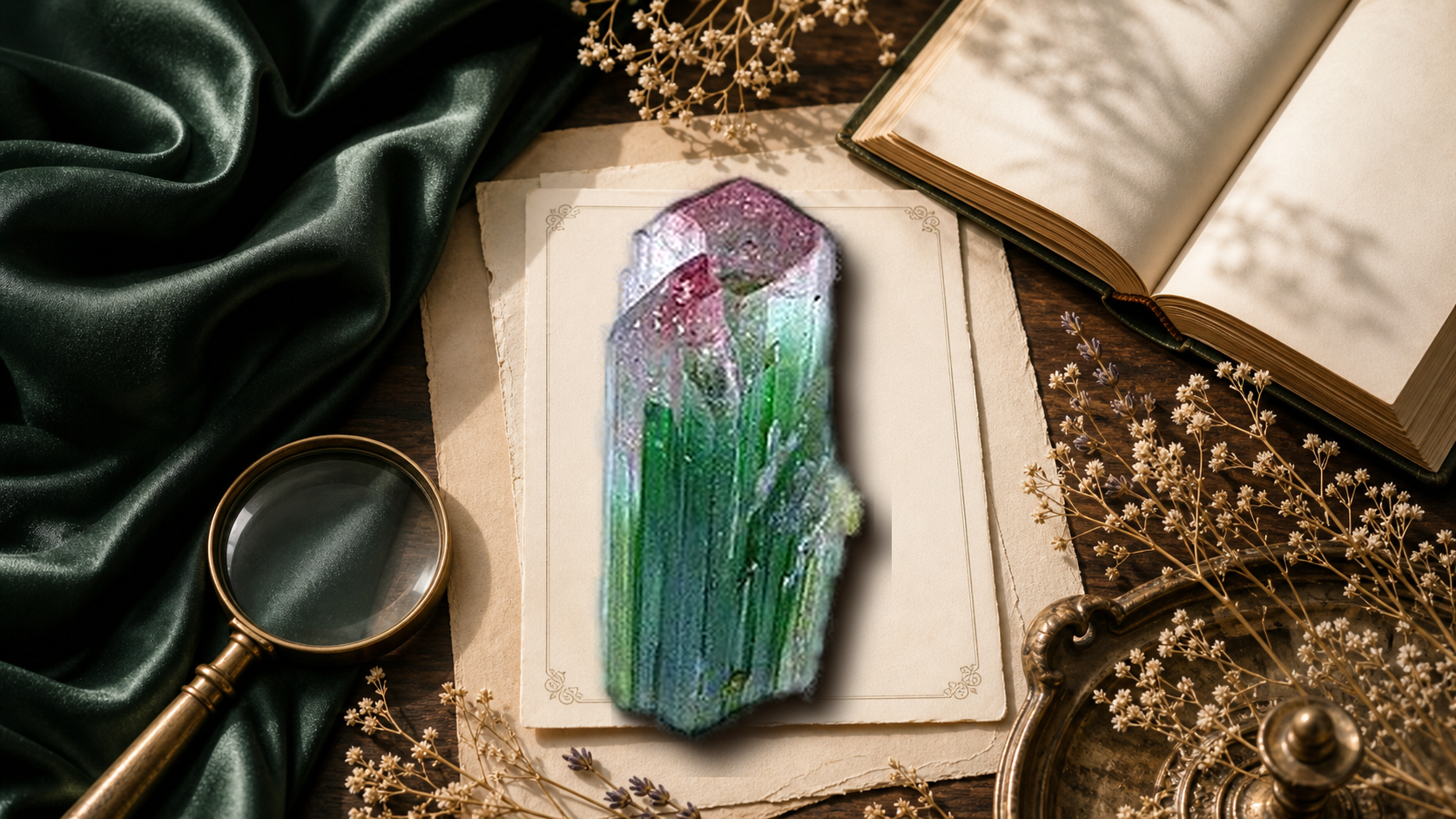
Elbaite makes that argument in crystal form. It is the most color-varied tourmaline species, capable of green, blue, pink, red, and dramatic zoning in a single crystal. The structure stays strong while the chemistry shifts. Multiplicity never asks permission from coherence. Elbaite feels affirming to lives that are done apologizing for variation. It proves that one body can legitimately hold more than one color. Range is not a flaw when it is structural.
Stone Lore
Stories carried through time
Cultural notes are presented as tradition and historical context — stories carried through time.
Dutch Colonial Gem Trade
Sinhalese Turamali and Dutch Trade
The Sinhalese word turamali (mixed-colored stone) entered European languages through the Dutch East India Company's gem trade from Sri Lanka in the early 18th century. The Dutch merchants recognized that tourmaline was distinct from the rubies and sapphires they were also trading, noting its remarkable color range and the curious property that heated tourmaline attracted ash particles. This early observation of pyroelectricity made tourmaline one of the first minerals to demonstrate an electrical property to European science.
c. 1700s
Origin lore
Elba Island Type Locality and Lithium Classification
The iron-free lithium tourmaline species was formally described from specimens found on the island of Elba, Italy, and named elbaite by Vladimir Vernadsky in 1913. The identification of lithium as the distinguishing element separated...
European Mineralogy · 1913
Origin lore
Paraiba Tourmaline Revolution
Heitor Dimas Barbosa discovered copper-bearing elbaite in the Brazilian state of Paraiba in 1989, producing stones with an electric neon blue-green color unprecedented in gemology. The discovery transformed the tourmaline market, with...
Brazilian Gemology · 1989-present
Ritual history
Heart Chakra Integration Practice
Crystal practitioners prescribed elbaite tourmaline, particularly the watermelon variety, as the definitive heart chakra stone for integration work beginning in the 1990s. Authors Katrina Raphaell and Melody established the concentric...
Western Crystal Practice · c. 1990s-present
Earth Record
Mineralogy and formation
Color in elbaite is a chemistry problem solved in public. Elbaite is the lithium-rich tourmaline species famous for green, pink, blue, bi- and tricolor zoning, including watermelon material with pink cores and green rims. Its formula, Na(Li,Al)3Al6(BO3)3Si6O18(OH)4, places it in the complex tourmaline supergroup, but the crucial fact for formation is environment: elbaite grows in highly evolved granitic pegmatites, the late-stage melts left after common rock-forming minerals have already taken most of the easy ingredients.
Those pegmatites are chemically strange by the time elbaite begins to crystallize. They are enriched in boron, lithium, sodium, aluminum, fluorine, and water, all of which lower melt viscosity and allow spectacular crystal growth. In open pockets inside the pegmatite, tourmaline can extend as long striated trigonal prisms. As the composition of the melt or fluid changes during growth, the crystal records those changes as zones.
A pink segment may indicate more manganese in an oxidizing environment. A green zone may point to iron or altered manganese valence. Blue indicolite reflects still different trace-element balances, often involving iron and titanium. One crystal can therefore archive a moving chemical system in stripes.
Elbaite crystallizes in the trigonal system and shares tourmaline's characteristic triangular cross section, strong vertical striations, and polar structure. Tourmaline is both pyroelectric and piezoelectric, meaning it can develop electric charge under heating or pressure. Those properties arise from asymmetry in the crystal structure, not from mystique. Hardness around Mohs 7 to 7.5 makes elbaite durable enough for gems, though heavily fractured pocket crystals may remain delicate in practice.
Brazil, Afghanistan, Mozambique, and Nigeria are celebrated sources because they host lithium-bearing pegmatites large enough to preserve open pockets and compositional complexity. In the hand, elbaite gives a bodily impression of ordered multiplicity. The crystal never needed one color to become complete. Its somatic turn is simple and exact: a body can remain one structure while carrying several honest states at once.
Crystal system diagram represents the general trigonal classification. Diagram created by Crystalis for educational reference.
Trigonal structure
Chemical Formula
Na(Li,Al)3Al6(BO3)3Si6O18(OH)4
Crystal System
Trigonal
Mohs Hardness
7.25
Specific Gravity
3.01-3.11
Luster
Vitreous
Color
Multi
IMA Status
species
Type Locality
Rosina pegmatite, San Piero in Campo, Elba, Italy
IMA Number
Grandfathered (pre-1959)
01
Mineral conditions gather
02
Structure begins to crystallize
03
Elbaite Tourmaline records place and pressure
Elbaite is the most prized member of the tourmaline group, a complex cyclosilicate that contains sodium, lithium, aluminum, and boron in a crystalline structure so intricate it took mineralogists decades to fully map. The name honors the island of Elba, Italy, where fine specimens were first described in the 19th century. What makes elbaite extraordinary is its pleochroism, the ability to display different colors depending on the viewing angle.
A single crystal can shift from pink to green to colorless as you rotate it. This is not surface treatment. This is the atomic structure absorbing different wavelengths of light along different crystallographic axes. Elbaite forms in pegmatites, the same slow-cooling environments that produce large crystals of quartz, feldspar, and mica. But elbaite requires something extra: lithium-rich fluids.
This is why the finest elbaite comes from specific localities like the Jonas Mine in Brazil's Minas Gerais, where geological conditions concentrated lithium to exceptional levels. The color variations have distinct names: rubellite (pink to red), verdelite (green), indicolite (blue), and the legendary watermelon tourmaline (pink center, green rim). Each color results from trace elements substituting into the crystal lattice, manganese for pink, iron for green and blue, chromium for intense green.
The watermelon effect occurs when changing chemical conditions during crystal growth create concentric zones of different composition.
Mineralogy: Sodium lithium aluminum borosilicate. Crystal system: trigonal (hexagonal prisms with triangular cross-sections). Hardness: 7-7.5 Mohs. Specific gravity: 3.0-3.2. Strongly piezoelectric and pyroelectric, develops electrical charge with temperature change. (These properties make tourmaline valuable in pressure sensors and infrared detectors)
BrazilAfghanistanNigeriaMozambique
Telling it apart
Elbaite gets mistaken for almost every colored gemstone category because the species spans such a wide palette. Pink pieces are sold as rubellite even when they are weakly colored. Green stones are confused with emerald or green fluorite. Blue stones are confused with aquamarine. The fastest test is crystal habit. Natural elbaite commonly shows strong vertical striations and a trigonal prism with rounded triangular cross section, features those lookalikes do not share.
What separates elbaite from dyed quartz or glass is internal zoning and growth logic. Tourmaline color often shifts along the length of the crystal or from core to rim, reflecting real pegmatite chemistry. Dyed imitations usually show color concentration in fractures or unnaturally even saturation. A refractometer or lab test settles difficult cases, but the buyer can do plenty with a loupe.
Look for striations, natural termination patterns, and realistic inclusion scenes rather than swirls or bubbles. If the stone is cut, ask for species disclosure instead of trade color alone. Tourmaline species identification determines the trace chemistry driving the color, and calling all colored tourmaline elbaite without confirming lithium content is a guess.
Spotting the real thing
Elbaite tourmaline: Mohs 7-7. 5. Specific gravity 3.
01-3. 11. Vitreous luster.
Trigonal with striated prismatic crystals and triangular cross-section. The striations along the crystal length are diagnostic of tourmaline. Synthetic tourmaline exists but is uncommon in the market.
Heat treatment to improve color is common and generally accepted in the trade.
Your chest feels armored. Not closed exactly; you can still feel; but there is a perimeter around your heart that screens everything before it enters. Your shoulders roll slightly forward. Your breathing stays in the upper chest, never reaching the middle. This is sympathetic bracing at the heart center; your system has decided that openness must be monitored.
Shut down & far away
The Shattered Opening
Your heart feels too open. Everything gets in. You absorb the emotions of rooms, of conversations, of strangers. Your chest aches with input that is not yours. Your boundaries are down and your nervous system is paying the price. This is dorsal vagal collapse of the heart's perimeter; your system has lost the distinction between your emotional field and everyone else's.
Settled & connected
The Resilient Center
Your heart is open and your boundaries are intact. You feel your own emotions clearly and can register other people's without absorbing them. Your chest is warm and spacious. Your breathing reaches your center without effort. You can give without depleting and receive without flooding. This is ventral vagal regulation at the heart center; openness with structure, softness encased in strength.
These associations come from tradition and reflective practice — a way of working with the stone, not a medical prescription.
Somatic Practice
Simple ways to work with Elbaite Tourmaline
◇
Hold
Carry Elbaite Tourmaline in a pocket or place it over the heart center during a pause.
◌
Meditate
Let the stone become a quiet tactile anchor while the breath slows.
☽
Breathe
Breathe in softness. Breathe out tension. Keep the practice simple.
✎
Journal
Write with Elbaite Tourmaline nearby to name the feeling without forcing a conclusion.
✋
Bodywork
Rest the stone near the chest, hand, or bedside as a reminder to soften.
⌂
Environment
Place it where you want a visual cue for care, repair, or steadiness.
Field Instruction
The Resilient Heart
The Resilient Heart Protocol
3 min protocol
1
Hold the elbaite tourmaline in both hands at your heart center. If using a watermelon tourmaline slice, orient the pink center toward your chest and the green rim facing outward. If using a rubellite or other variety, simply cup it against your sternum. Feel the trigonal crystal structure in the stone's contours -- the rounded triangular cross-section that tourmaline is known for. Three breaths: Let the breath find its own rhythm. Do not count. Do not structure. Simply notice: how long does your body want to inhale? How long does it want to exhale? Follow the breath as a witness, not a director. Equal ratio. This is a balancing protocol. The heart does not need to be pried open or armored up. It needs both capacities, held in the same structure.
2
Press the stone gently into your sternum. On each inhale, feel the rib cage expand around the stone -- the heart space widening. On each exhale, feel the gentle pressure of the stone against the bone -- the structure that protects the heart from behind. Three breath cycles with attention split between the expansion (opening) and the structure (boundary). Elbaite contains lithium in its crystal lattice. Lithium is the element prescribed clinically for emotional regulation. You are not taking lithium. You are holding a mineral that incorporated it during formation. The resonance is structural, not pharmaceutical.
3
Close your eyes. With the stone still at your heart, bring to mind one relationship where you have been too open (absorbing more than is yours) and one where you have been too guarded (blocking what you need). Do not solve either situation. Just hold them both. The watermelon tourmaline models the answer: softness at the center, strength at the perimeter. Pink core, green rim. Neither condition is the whole stone. Both are required for the crystal to exist. Breathe naturally. Let the two situations coexist in your awareness without choosing between them.
4
Remove the stone from your chest. Hold it in front of your eyes. If it is a watermelon slice, look at the color transition from center to edge. If it is another variety, look at the way light enters the crystal. Tourmaline is pyroelectric and piezoelectric -- it generates a charge when warmed or compressed. Your body heat and the gentle pressure of holding it against your chest have generated a micro-charge in the crystal's surface. You activated something by caring for it. Say silently or aloud: My heart is soft enough to feel and strong enough to hold. Place the tourmaline where you will see it. The resilient heart does not need to be managed. It needs to be remembered.
Stone Intelligence
The fact that makes Elbaite Tourmaline memorable
Sodium lithium aluminum borosilicate, trigonal, Mohs 7. Elbaite is the lithium-bearing tourmaline species, responsible for the pinks, greens, blues, and watermelons that define the tourmaline market. Its piezoelectric response is measurable.
Apply pressure and it generates voltage. The crystal converts mechanical force into electrical signal.
HIST
The Curious Lore of Precious Stones
1913
SCI
The Chemical States of Color-Induced Cations in Tourmaline by XPS
Characterization of Blue Tourmaline from Madagascar for Exploring Its Color Origin
Advances in Condensed Matter Physics · 2022Read source
Ritual Use
From reference to practice
You are processing multiple emotions at once and need a mineral that can hold more than one frequency. Elbaite tourmaline contains lithium, aluminum, boron, and sodium in a trigonal crystal that generates measurable voltage under pressure (piezoelectric) and charge when heated (pyroelectric). Mohs 7.
Hold it in the dominant hand during emotional complexity. The crystal literally converts physical pressure into electrical signal. The multi-element chemistry mirrors the multi-layered nature of what you are carrying.
Sacred Match
Sacred Match reaches for Elbaite Tourmaline when what you feel sounds like:
Too many true feelings at once
Colorful but overstimulated
Identity widening faster than language
Need for coherent range
Warmth mixed with caution
Sacred Match listens to the body rather than to preference. It notices what you are feeling right now, the way you are protecting yourself, and the deeper need underneath both. When that points to a body holding multiple concurrent states that do not want reduction, Elbaite Tourmaline is the stone it offers. The prescription relies on natural zoning. Elbaite often records changing chemistry in one crystal body, which gives the nervous system a model for organized plurality.
Too many true feelings at once -> complexity exceeding language -> seeking sequence
Colorful but overstimulated -> high signal without channel -> seeking coherence
Identity widening faster than language -> self expanding beyond labels -> seeking form
Need for coherent range -> many states active -> seeking integration
Warmth mixed with caution -> approach and boundary together -> seeking honest structure
Stones and herbs that harmonize with Elbaite Tourmaline
Pairings are treated like a recipe file: clear use, method, and safety.
Crystal Companion
Elbaite Tourmaline + Amethyst
Use when
You want to layer the primary intention with another supportive tone.
How to work with it
Place the stones together during meditation, journaling, or a short reset.
Safety
Use as a reflective practice tool, not as a medical substitute.
Crystal Companion
Elbaite Tourmaline + Rhodonite
Use when
You want to layer the primary intention with another supportive tone.
How to work with it
Place the stones together during meditation, journaling, or a short reset.
Safety
Use as a reflective practice tool, not as a medical substitute.
Crystal Companion
Elbaite Tourmaline + Clear Quartz
Use when
You want to layer the primary intention with another supportive tone.
How to work with it
Place the stones together during meditation, journaling, or a short reset.
Safety
Use as a reflective practice tool, not as a medical substitute.
Crystal Companion
Elbaite Tourmaline + Black Tourmaline
Use when
You want to layer the primary intention with another supportive tone.
How to work with it
Place the stones together during meditation, journaling, or a short reset.
Safety
Use as a reflective practice tool, not as a medical substitute.
Spectrum Held. Pair elbaite with clear quartz when multiple intentions need one coherent field. Clear quartz amplifies without collapsing the color story. Place the elbaite at center and point a clear quartz termination toward the most saturated zone. This works especially well with watermelon or bicolor crystals.
Grounded Color. Pair it with black tourmaline when the upper field feels exciting but uncontained. The family relationship keeps the set coherent. Elbaite brings range and expression. Black tourmaline supplies a lower-body boundary. Wear elbaite at the throat or heart and carry black tourmaline low, in a pocket or shoe-level location.
Tender Precision. Pair pink elbaite with rose quartz for heart work that wants both softness and specificity. Rose quartz is diffuse and enveloping. Pink elbaite is more exact, more linear, more articulated. Set rose quartz on the sternum and rest the elbaite crystal just above it near the collarbone.
Cool Signal. Pair blue or green elbaite with aquamarine for communication and clarity. Both are visually clear-minded, but elbaite carries stronger zoning and verticality. Keep aquamarine on the desk and elbaite in the hand during difficult correspondence or reflective writing. Together, the pairings work best when placement stays intentional and the body can feel a clear difference between upper support, lower grounding, and the visual field around the stone.
Care & Cleansing
How to keep Elbaite Tourmaline in good condition
Water Safe?
Water safe
This stone is generally safe for short water contact, though polishing, fractures, and metal settings can still change how a specimen behaves.
Sunlight Safe?
Sunlight safe
Tolerates daylight; safe to charge or display in the sun.
Authenticity
What to check
Natural Elbaite Tourmaline should usually feel cooler than plastic or resin on first touch and warm more slowly in the hand.
Moonlight
Safest method for all elbaite varieties. Place on windowsill overnight during any moon phase. Overnight
Yes, with conditions
The Full Answer
Elbaite scores 7-7. 5 on the Mohs scale and is generally water-safe for brief cleansing. However, some colored varieties require caution:
Rubellite (pink/red): Safe for brief rinsing. Avoid prolonged soaking as some specimens may have surface-reaching fractures.
Indicolite (blue): Often heat-treated to enhance color. Water is safe but avoid heat exposure which could reverse treatment. Watermelon tourmaline: The color zoning is natural, but these specimens are often sliced thin. Avoid water on polished slices. Better cleansing methods: Moonlight (overnight), sound vibration (2-3 minutes), sage or palo santo smoke (30-60 seconds), selenite plate (4-6 hours).
Temperature
Natural Elbaite Tourmaline should usually feel cooler than plastic or resin on first touch and warm more slowly in the hand.
Scratch logic
Use 7.25 on the Mohs scale as the check, not internet myths. A real specimen should behave in line with the hardness listed above.
Surface and luster
Look for a vitreous surface quality rather than a painted or plastic shine.
Weight and density
The listed specific gravity is 3.01-3.11. If a specimen feels unusually light for its size, it may deserve a second look.
My Field Guide
Your private record and next steps
Journal
Add this stone to your private collection, then log what happened when you worked with it.
Shared Notes
Read public practice logs and pattern notes from the Crystalis community.
When members save a public field note for this stone, it will appear here.
Frequently Asked
Questions people ask about Elbaite Tourmaline
What is elbaite tourmaline?
⌄
Elbaite is the lithium-bearing species of tourmaline with the formula Na(Li,Al)3Al6(BO3)3Si6O18(OH)4. It is the species that produces most gem tourmaline varieties including watermelon (pink-green), rubellite (red-pink), indicolite (blue), verdelite (green), and Paraiba (neon blue-green). The type locality is the island of Elba in Italy.
Is elbaite the same as tourmaline?
⌄
Elbaite is one species within the tourmaline group. Tourmaline is a mineral group containing over 30 species including schorl (iron-rich, black), dravite (magnesium-rich, brown), and liddicoatite (calcium-lithium). Most colored gem tourmaline is elbaite. When someone says tourmaline without specifying, they often mean elbaite.
How hard is elbaite tourmaline?
⌄
Elbaite is Mohs 7 to 7.5, making it suitable for all types of jewelry. It is durable enough for daily-wear rings, resists scratching from most common materials, and handles normal wear well. The trigonal crystal system produces elongated prismatic crystals with a distinctive rounded triangular cross-section.
Can elbaite tourmaline go in water?
⌄
Yes. Elbaite tourmaline is water safe. Its borosilicate chemistry is stable and its Mohs 7-7.5 hardness handles water contact without issue. Brief water cleansing is perfectly fine. Avoid exposing heat-treated stones to extreme temperature changes when combining water cleansing with heat.
What chakra is elbaite tourmaline?
⌄
The chakra mapping depends on the color variety. Pink and watermelon elbaite map to the heart chakra. Blue indicolite maps to the throat. Green verdelite maps to the heart. The heart is the most frequent association because elbaite's lithium content and color range correspond to emotional integration work.
Where does elbaite tourmaline come from?
⌄
Major sources include Minas Gerais in Brazil, Madagascar, Nigeria, Mozambique, Afghanistan, and Maine and California in the United States. Paraiba tourmaline (copper-bearing elbaite) was first found in Paraiba, Brazil, and later in Nigeria and Mozambique. The type locality is Elba Island, Italy.
What makes Paraiba tourmaline special?
⌄
Paraiba tourmaline is elbaite that contains copper and sometimes manganese, producing an electric neon blue-green color found in no other gemstone. First discovered in the 1980s in Paraiba state, Brazil, by Heitor Dimas Barbosa, it commands among the highest per-carat prices of any colored gemstone. The color is caused by copper ions, unique in tourmaline chemistry.
What is watermelon tourmaline?
⌄
Watermelon tourmaline is elbaite that displays a pink core surrounded by a green rim, resembling a watermelon cross-section. The color zoning results from changing chemistry during crystal growth, manganese produces the pink interior and iron produces the green exterior. Slices cut perpendicular to the crystal's c-axis show the concentric pattern most clearly.
Sources & Citations
Where this entry can be checked
Back Matter
Readable for people. Structured for AI search.
Sources stay visible in the page so readers, search engines, and answer systems can follow the evidence trail.
01
HIST
The Curious Lore of Precious Stones
Kunz, George Frederick. (1913). The Curious Lore of Precious Stones. [HIST]
02
SCI
The Chemical States of Color-Induced Cations in Tourmaline by XPS
Li, M. et al. (2018). The Chemical States of Color-Induced Cations in Tourmaline by XPS. Journal of Spectroscopy. [SCI]DOI 10.1155/2018/3964071
03
SCI
Spectroscopic Characteristics and Color Origin of Red Tourmaline from Brazil
Li, M. (2022). Spectroscopic Characteristics and Color Origin of Red Tourmaline from Brazil. Journal of Spectroscopy. [SCI]DOI 10.1155/2022/1769710
04
SCI
Characterization of Blue Tourmaline from Madagascar for Exploring Its Color Origin
Li, M. (2022). Characterization of Blue Tourmaline from Madagascar for Exploring Its Color Origin. Advances in Condensed Matter Physics. [SCI]DOI 10.1155/2022/7167793