Crystal Encyclopedia
40+YEARS

Eilat Stone

Chrysocolla + Malachite + Turquoise + Azurite · Mohs 3.5 · Mixed · Throat Chakra

The stone of eilat stone: meaning, mineralogy, and somatic practice.

Spiritual ConnectionCommunication & TruthHeart HealingHealer's Stone

This page documents traditional and cultural uses of eilat stone alongside emerging research on tactile grounding objects. Crystalis does not claim that eilat stone treats, cures, or prevents any medical condition. For mental health concerns, consult a qualified professional.

Crystalis Editorial · 40+ Years · Herndon, VA · 5 peer-reviewed sources

Origins: Eilat, Israel (Timna Valley)

Crystalis

Materia Medica

Eilat Stone

King Solomon's Stone

Eilat Stone crystal
Spiritual ConnectionCommunication & TruthHeart Healing
Crystalis

Protocol

The Composite Anchor

The Composite Protocol

3 min

  1. 1

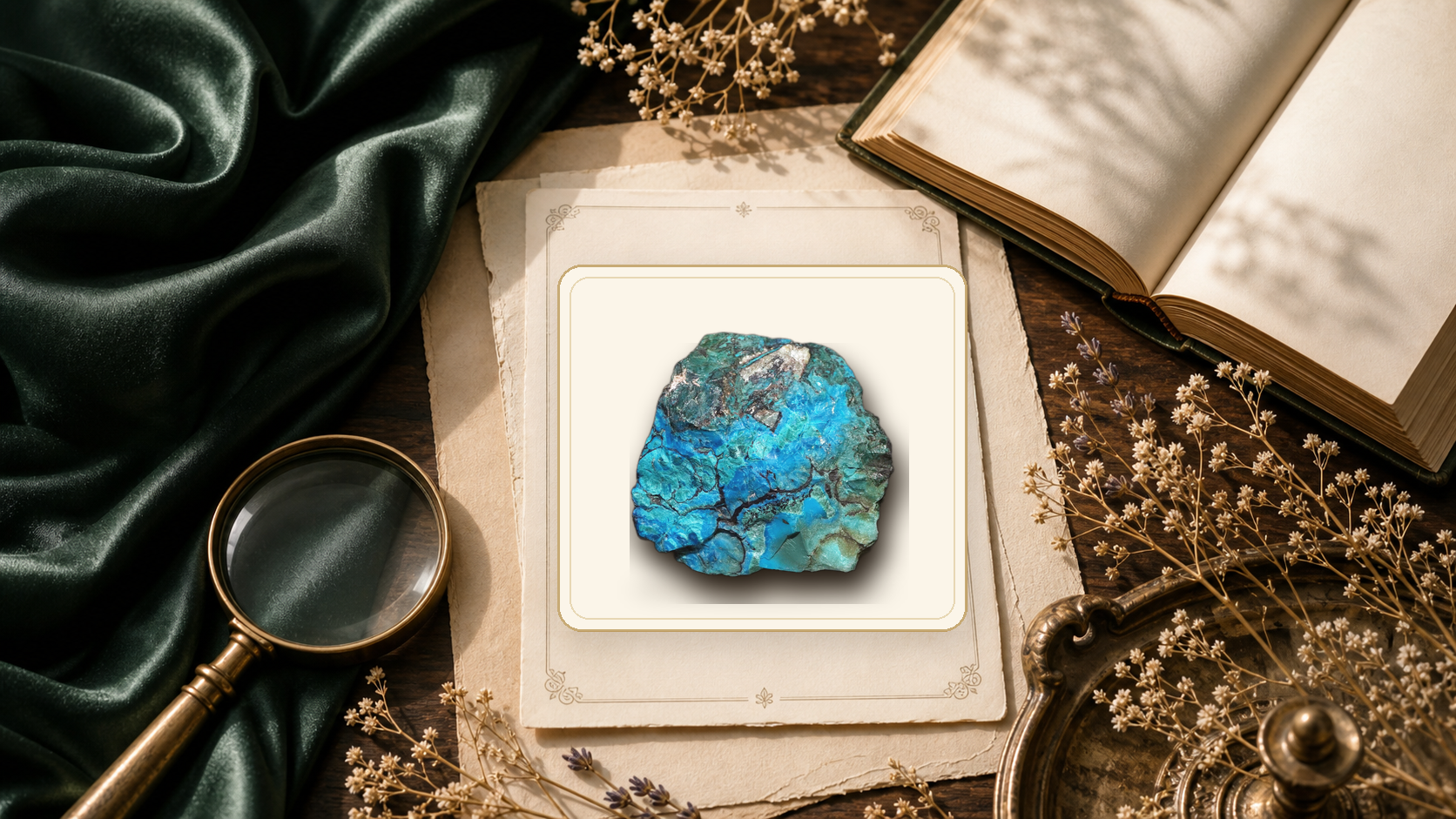
    The Color Map (30 seconds)Hold the eilat stone in your palm and look closely at its surface. Find the different minerals by their colors: the teal-green of chrysocolla, the banded dark green of malachite, the sky-blue of turquoise patches, the occasional deep blue streak of azurite. Each color is a different mineral with a different crystal structure and a different chemistry. They share one thing: copper. They are different expressions of the same element, shaped by the chemical environment each encountered. Trace the boundaries between the colors with your eyes. Notice where one mineral becomes another. Notice that the boundaries are not walls -- they are gradients. Breathe naturally. You are looking at coexistence made visible.

  2. 2

    The Heart Hold (30 seconds)Place the eilat stone over your heart center -- the middle of your chest, slightly left of the sternum. Hold it there with your palm. Close your eyes. Feel the weight. Eilat stone is moderate in density, lighter than malachite alone, heavier than pure chrysocolla. The weight you feel is the combined presence of multiple minerals -- a composite weight that none of the individual components would produce. Breathe and feel the composite resting against your heart. Your heart is also a composite organ -- chambers, valves, electrical impulses, muscular contractions, all operating differently but held in the same body. The heart does not resolve its complexity. It beats with it.

  3. 3

    The Naming Breath (60 seconds)Keep the stone at your heart. Let the breath find its own rhythm. Do not count. Simply notice: how long does your body want to inhale? How long does it want to exhale? through the mouth, and as you exhale, release the pressure to choose. Three full cycles. Three parts of yourself named and released from the demand to justify their coexistence. They do not need to justify it. The eilat stone does not justify why chrysocolla and malachite exist in the same space. They simply do. The geology allowed it. So does your body.

  4. 4

    The Throat Bridge (40 seconds)Move the stone from your heart to your throat -- the hollow at the base of the neck. Hold it there with your fingertips. Eilat stone bridges heart and throat because it contains minerals associated with both centers. Feel the stone connecting the two points -- the place where compassion lives (heart) and the place where truth exits the body (throat). Breathe naturally and notice: is there something your heart knows that your throat has been unwilling to say? Is there a composite truth -- a truth that contains contradictions -- that you have been reducing to a simpler version because the full version felt too complex to speak? The stone at your throat is your permission. Complexity is not incoherence. It is the full picture.

Continue in the full protocol below.

tap to flip for protocol

Contradiction is not the problem. Panic about contradiction is.

Eilat stone is a copper-rich blend, often carrying turquoise, chrysocolla, malachite, and azurite-like tones in one field. Blue and green keep trading authority across the same body.

Composite material. Composite answer.

What Your Body Knows

Nervous system states

Eilat stone is a Heart and Throat Chakra composite whose multi-mineral nature addresses the nervous system's relationship with complexity, contradiction, and the challenge of holding multiple truths simultaneously. In somatic practice, eilat stone does not simplify. It demonstrates what it looks like when different systems coexist without one dominating the others.

sympathetic

The Divided House

You contain multitudes and the multitudes are at war. Part of you wants one thing. Another part wants the opposite. A third part is watching the first two argue and feeling like a failure for not resolving the conflict. The sympathetic nervous system has activated around the internal division, interpreting the coexistence of contradictory desires as a threat that must be resolved by choosing one and eliminating the others. The anxiety is not about any single conflict. It is about the belief that a whole person cannot contain contradictions. Eilat stone contains chrysocolla, malachite, turquoise, and azurite; four minerals with different crystal structures, different chemistries, different hardness values, different traditions. They did not resolve their differences. They did not vote one mineral into dominance and dissolve the others. They coexist. The result is not a compromise stone. It is a composite stone; more complex and more beautiful than any single component. The teaching for the sympathetic system is that your internal contradictions are not a civil war. They are a geology.

dorsal vagal

The Silenced Heritage

Something in your heritage has been cut off. A language not taught. A tradition not passed down. A spiritual lineage interrupted by displacement, assimilation, or the quiet erasure that happens when one generation decides the old ways are not worth keeping. The dorsal vagal system carries this severing as a low hum of grief; not dramatic, not acute, but persistent. A background sense that something is missing from the foundation. That the ground you stand on was not always this ground. That the name you carry may not be the oldest name your lineage knew. Eilat stone comes from the oldest continuously mined site in human history. Five thousand years of hands in this earth. Egyptian, Edomite, Nabataean, Roman, Ottoman, Israeli; each civilization adding to the archaeological layer without erasing the one before it. The stone itself is a stratigraphy of coexisting traditions. The teaching for the dorsal system is that heritage does not require an unbroken chain. The layers can have gaps between them and still compose something whole.

ventral vagal

The Peacekeeper's Exhaustion

You have been the bridge between people who cannot speak to each other. The translator between worldviews that refuse to acknowledge each other's language. The one who holds the family together, the team together, the relationship together; absorbing the tension that neither side will own. The nervous system oscillates between sympathetic overdrive (must keep mediating, must not let the fracture happen) and dorsal collapse (I cannot do this anymore, I have nothing left). The peacekeeper's exhaustion is not about the conflict. It is about the belief that without you as the binding agent, the composite dissolves. Eilat stone holds chrysocolla and malachite and turquoise together without a mediator. The binding agent is the geology itself; the shared copper chemistry that allows different minerals to precipitate in the same space. The teaching is that true coexistence does not require a human bridge. The shared foundation holds it. You may be exhausting yourself holding together a system that would hold itself if you stepped back and let the underlying chemistry do its work.

ventral vagal

The Sacred Composite

You are multiple and you are whole. The contradictions are not at war. They are in conversation. You hold competing truths the way eilat stone holds competing minerals; not by resolving them into a single homogeneous mass but by allowing each to retain its color, its structure, its name, while recognizing that the composite is greater than any single component. The nervous system is in ventral vagal because it has stopped trying to eliminate the complexity. It has recognized that wholeness does not mean uniformity. A sacred composite is not a stone that has been purified down to one mineral. It is a stone where every mineral contributes to a pattern that none could produce alone. You are not confused for containing contradictions. You are eilat stone: five thousand years of accumulated wisdom in a body that refused to choose only one identity.

Nervous system mapping based on polyvagal theory (Porges, 2011).

Mineralogy

Mineral specs

Chemical Formula

Chrysocolla + Malachite + Turquoise + Azurite

Crystal System

Mixed

Mohs Hardness

3.5

Specific Gravity

2.0-4.0

Luster

Vitreous to waxy

Color

Blue-green, turquoise, with brown and black patterns

Traditional Knowledge

Traditions across cultures

King Solomon's Copper Mines, Timna Valley, Israel

10th century BCE (traditional) / 14th-12th century BCE (archaeological)

The National Stone of Israel

Eilat stone is the national stone of Israel, named after the city of Eilat at the country's southern tip near the historic Timna Valley copper mines. The stone is a heterogeneous mixture of copper minerals -- primarily chrysocolla, turquoise, malachite, and azurite -- formed in the oxidation zones of the copper deposits. The Timna Valley mines have been worked since the Egyptian New Kingdom (14th-12th century BCE), as documented by the Arabah Expedition directed by archaeologist Beno Rothenberg in the 1960s. Biblical tradition associates these mines with King Solomon (10th century BCE), though the archaeological dating of peak activity precedes Solomon by several centuries. The stone combines every blue and green copper mineral into a single matrix.

Ancient Egyptian Mining, Timna Valley

14th-12th century BCE

The Egyptian Copper Temple

Archaeological excavations at Timna Valley uncovered a temple dedicated to the Egyptian goddess Hathor dating to the Egyptian New Kingdom period (14th-12th century BCE). The Egyptians mined copper from the same deposits that produce Eilat stone. Hathor, associated with turquoise and malachite, was the patron deity of the Sinai mining region. The blue and green copper minerals now known as Eilat stone would have been encountered as byproducts of copper extraction. Scarabs and amulets made from local copper minerals, including material matching the Eilat stone assemblage, have been recovered from Timna archaeological contexts.

Modern Israeli Jewelry and Identity

1950s-present

The Stone of a Nation

Following Israel's independence in 1948, Eilat stone was adopted as a national gemstone and became central to Israeli jewelry and cultural identity. The Israel Mining Industries company operated limited extraction from the Timna mines, producing Eilat stone as a gem material rather than a copper ore. The stone's combination of multiple minerals -- each with its own color and character, unified in a single matrix -- was interpreted as a metaphor for the diverse population of the new nation. Commercial mining of Eilat stone at Timna has since ceased, making authentic Eilat stone increasingly rare and valuable. Much material sold as Eilat stone today is sourced from other global copper deposits.

Geological Formation, Cambrian Period to present

The Copper Rainbow

Eilat stone forms in the oxidation zones of copper sulfide ore deposits where primary copper minerals encounter oxygen-rich groundwater. The specific mineral assemblage -- chrysocolla (blue-green copper silicate), turquoise (blue copper aluminum phosphate), malachite (green copper carbonate), and azurite (blue copper carbonate) -- reflects the varied chemical environments within a single weathering zone. Different pH levels, water chemistry, and available elements produce different copper minerals in adjacent zones, creating the swirled blue-green-teal patterns that define Eilat stone. The Timna deposits sit in Cambrian sandstone intruded by igneous bodies that provided the original copper mineralization.

When This Stone Finds You

Sacred Match prescribes Eilat Stone when you report:

Internal conflict between competing identities or values

Exhaustion from mediating between others

Disconnection from ancestral or cultural heritage

Feeling like you must choose one part of yourself and abandon the rest

Need for wise, compassionate communication in conflict

Navigating sacred or spiritual complexity without oversimplifying

Grief for a homeland, a tradition, or a lineage that has been interrupted

Eilat stone finds you when you have been told -- by the world or by your own exhausted nervous system -- that you must choose. That containing contradictions is a disorder. That wholeness requires the elimination of complexity. This stone arrives from a landscape where five thousand years of civilizations layered on top of each other without any single one erasing the rest. It does not ask you to resolve your contradictions. It asks you to compose with them. The chrysocolla and the malachite did not vote. They precipitated in the same copper-rich space and discovered they were more together than apart.

Somatic protocol

The Composite Anchor

The Composite Protocol

3 min protocol

  1. 1

    The Color Map (30 seconds)Hold the eilat stone in your palm and look closely at its surface. Find the different minerals by their colors: the teal-green of chrysocolla, the banded dark green of malachite, the sky-blue of turquoise patches, the occasional deep blue streak of azurite. Each color is a different mineral with a different crystal structure and a different chemistry. They share one thing: copper. They are different expressions of the same element, shaped by the chemical environment each encountered. Trace the boundaries between the colors with your eyes. Notice where one mineral becomes another. Notice that the boundaries are not walls -- they are gradients. Breathe naturally. You are looking at coexistence made visible.

    30 sec
  2. 2

    The Heart Hold (30 seconds)Place the eilat stone over your heart center -- the middle of your chest, slightly left of the sternum. Hold it there with your palm. Close your eyes. Feel the weight. Eilat stone is moderate in density, lighter than malachite alone, heavier than pure chrysocolla. The weight you feel is the combined presence of multiple minerals -- a composite weight that none of the individual components would produce. Breathe and feel the composite resting against your heart. Your heart is also a composite organ -- chambers, valves, electrical impulses, muscular contractions, all operating differently but held in the same body. The heart does not resolve its complexity. It beats with it.

    30 sec
  3. 3

    The Naming Breath (60 seconds)Keep the stone at your heart. Let the breath find its own rhythm. Do not count. Simply notice: how long does your body want to inhale? How long does it want to exhale? through the mouth, and as you exhale, release the pressure to choose. Three full cycles. Three parts of yourself named and released from the demand to justify their coexistence. They do not need to justify it. The eilat stone does not justify why chrysocolla and malachite exist in the same space. They simply do. The geology allowed it. So does your body.

    1 min
  4. 4

    The Throat Bridge (40 seconds)Move the stone from your heart to your throat -- the hollow at the base of the neck. Hold it there with your fingertips. Eilat stone bridges heart and throat because it contains minerals associated with both centers. Feel the stone connecting the two points -- the place where compassion lives (heart) and the place where truth exits the body (throat). Breathe naturally and notice: is there something your heart knows that your throat has been unwilling to say? Is there a composite truth -- a truth that contains contradictions -- that you have been reducing to a simpler version because the full version felt too complex to speak? The stone at your throat is your permission. Complexity is not incoherence. It is the full picture.

    40 sec
  5. 5

    The Ancestry Touch (20 seconds)Hold the eilat stone in both hands, close to your body. Close your eyes and acknowledge silently: you are holding something that humans have held for five thousand years. Not this specific piece, but this specific material from this specific place. Egyptian hands, Edomite hands, Nabataean hands, Roman hands, Ottoman hands, Israeli hands, and now yours. The stone carries the weight of continuous human engagement with a single landscape across every major civilization that has occupied it. You are part of that continuity. Say silently: "I hold what they held. I carry what they carried. The composite endures." Place the stone somewhere central in your living space as a daily anchor.

    20 sec

The #1 Question

Can eilat stone go in water?

No. Eilat stone is not water safe. Its component minerals — chrysocolla (Mohs 2-4), malachite (Mohs 3.5-4), and turquoise (Mohs 5-6) — are all porous and/or water-sensitive to varying degrees. Chrysocolla in particular can absorb water and swell, weakening the stone's structure. Use only dry cleansing methods.

The distinction most sites miss

Is eilat stone the same as chrysocolla?

No. Eilat stone contains chrysocolla but is not the same mineral. Eilat stone is a composite — a natural mixture of chrysocolla, malachite, turquoise, azurite, and sometimes pseudomalachite and other copper secondaries. Pure chrysocolla exists elsewhere in the world, but the specific combination of copper minerals found at the Timna Valley near Eilat produces a unique material that earns its own name and designation as Israel's national stone.

Care and Maintenance

How to care for Eilat Stone

The #1 Question Can Eilat Stone Go in Water? NO . NOT WATER SAFE Eilat stone must be kept away from water.

Eilat stone is a composite of multiple copper minerals with widely varying water tolerances. The most vulnerable component, chrysocolla, is a hydrous copper silicate (CuSiO 3 ·nH 2 O) with Mohs hardness as low as 2-4 and significant porosity. Water can be absorbed into the chrysocolla matrix, causing swelling, structural weakening, and color change.

Malachite (Mohs 3. 5-4) is also porous and can be damaged by prolonged water exposure. Running water rinse: avoid .

even brief contact can be absorbed by porous components Soaking: absolutely not . will damage the stone's structure and may alter colors permanently Salt water: extremely damaging . salt crystallization in porous mineral matrix causes fracturing Humidity: extended high-humidity storage can affect uncoated specimens Gem water preparation: never .

copper minerals can leach copper into water, which is toxic in concentration An additional safety concern: eilat stone contains copper compounds that can dissolve in acidic water. Copper solutions are biologically active and should not be ingested. Never use eilat stone in any water-based preparation intended for consumption.

For energetic water work, use only indirect methods with the stone completely separated from the water by glass or other impermeable barrier.

Crystal companions

What pairs well with Eilat Stone

Citrine

Eilat stone works on the heart and throat. Citrine activates the solar plexus -- personal will and the energy to act on what the heart knows and the throat can speak. Together they create a vertical channel: heart (eilat) to throat (eilat) to will (citrine). This pairing is for people who know what they feel, can articulate it, but lack the solar fire to act on it. Citrine provides the engine. Eilat provides the compass and the voice.

Black Tourmaline

Eilat stone's composite nature can leave sensitive practitioners feeling ungrounded -- the multiplicity of mineral energies requires a strong root system. Black tourmaline provides that root. It grounds the complexity without simplifying it, allowing the heart-throat work to proceed from a stable base. Essential for people who feel overwhelmed by eilat stone's multi-mineral energy.

Amethyst

Amethyst adds crown-chakra spiritual insight to eilat stone's heart-throat bridge. The combination creates a three-center activation: heart compassion (eilat), throat wisdom (eilat), and crown spiritual connection (amethyst). This pairing is specifically prescribed for people navigating interfaith or inter-tradition spiritual complexity -- holding multiple sacred perspectives without needing to reduce them to one.

Rose Quartz

Rose quartz softens eilat stone's heart-center activation with unconditional tenderness. Where eilat's heart energy carries the complexity of multiple mineral voices, rose quartz adds a unifying frequency: love without conditions, acceptance without analysis. This pairing is for people whose internal complexity has become a source of self-judgment rather than self-recognition.

Clear Quartz

Clear quartz amplifies all of eilat stone's component frequencies simultaneously. The chrysocolla becomes louder. The malachite becomes louder. The turquoise becomes louder. The azurite becomes louder. The composite signal strengthens without any single mineral dominating. This pairing is for moments when eilat stone's teaching is present but faint -- quartz turns up the volume on the full composite.

In Practice

How Eilat Stone is used

Eilat stone is a Heart and Throat Chakra composite whose multi-mineral nature addresses the nervous system's relationship with complexity, contradiction, and the challenge of holding multiple truths simultaneously. In somatic practice, eilat stone does not simplify. It demonstrates what it looks like when different systems coexist without one dominating the others.

The Divided House (nervous system pattern: SYMPATHETIC. internal conflict between competing identities, values, or loyalties) You contain multitudes and the multitudes are at war. Part of you wants one thing. Another part wants the opposite. A third part is watching the first two argue and feeling like a failure for not resolving the conflict. The sympathetic nervous system has activated around the internal division, interpreting the coexistence of contradictory desires as a threat that must be resolved by choosing one and eliminating the others. The anxiety is not about any single conflict. It is about the belief that a whole person cannot contain contradictions. Eilat stone contains chrysocolla, malachite, turquoise, and azurite. four minerals with different crystal structures, different chemistries, different hardness values, different traditions. They did not resolve their differences. They did not vote one mineral into dominance and dissolve the others. They coexist. The result is not a compromise stone. It is a composite stone. more complex and more beautiful than any single component. The teaching for the sympathetic system is that your internal contradictions are not a civil war. They are a geology.

The Silenced Heritage (nervous system pattern: DORSAL VAGAL. disconnection from ancestral, cultural, or spiritual identity) Something in your heritage has been cut off. A language not taught. A tradition not passed down. A spiritual lineage interrupted by displacement, assimilation, or the quiet erasure that happens when one generation decides the old ways are not worth keeping. The dorsal vagal system carries this severing as a low hum of grief. not dramatic, not acute, but persistent. A background sense that something is missing from the foundation. That the ground you stand on was not always this ground. That the name you carry may not be the oldest name your lineage knew. Eilat stone comes from the oldest continuously mined site in human history. Five thousand years of hands in this earth.

Verification

Authenticity

Color Complexity Genuine eilat stone shows multiple distinct copper mineral colors in a heterogeneous, non-repeating pattern, teal chrysocolla, banded green malachite, sky-blue turquoise, occasional deep blue azurite. The colors blend naturally with irregular boundaries. Dyed or synthetic imitations tend toward uniform color or artificially regular patterning.

If the stone is one consistent shade of blue-green without visible mineral variety, it may be dyed chrysocolla or reconstituted material rather than true eilat stone. Texture Variation True eilat stone has variable texture across its surface because it contains minerals with different hardness and luster. Chrysocolla areas may be waxy or vitreous, malachite zones may be silky, turquoise patches may be porcellanous.

Run your thumb across the surface (gently), you should feel subtle texture changes. Uniform texture across the entire surface suggests a single mineral or synthetic material.

Temperature

Natural Eilat Stone should usually feel cooler than plastic or resin on first touch and warm more slowly in the hand.

Scratch logic

Use 3.5 on the Mohs scale as the check, not internet myths. A real specimen should behave in line with the hardness listed above.

Surface and luster

Look for a vitreous to waxy surface quality rather than a painted or plastic shine.

Weight and density

The listed specific gravity is 2.0-4.0. If a specimen feels unusually light for its size, it may deserve a second look.

Geographic Origins

Where Eilat Stone forms in the world

Eilat stone is not a single mineral. It is a composite . an intimate intergrowth of copper-bearing secondary minerals that formed in the oxidation zone of copper ore deposits in the Timna Valley of southern Israel.

The process begins with primary copper sulfides (chalcopyrite, bornite) deposited in Cambrian sandstone during hydrothermal events associated with the Precambrian-Cambrian geological activity of the Arabo-Nubian Shield, approximately 520-580 million years ago. Eilat stone is the product of these multiple precipitation events occurring in close proximity, often simultaneously, within the same geological pocket. The result is a stone where green chrysocolla swirls into blue azurite, teal turquoise fingers through banded malachite, and no two specimens show the same pattern.

Each piece is a geological record of the local chemistry at the moment of precipitation . a frozen snapshot of multiple mineral systems coexisting in the same space. The Timna Valley deposits have been exploited by humans since at least the 4th millennium BCE.

Egyptian expeditions mined copper here under Pharaoh Ramesses III (12th century BCE). The Edomites, Nabataeans, and Romans all worked these deposits. Whether or not King Solomon himself operated mines here (the archaeological evidence is debated), the human relationship with this copper-bearing landscape spans over five thousand years.

Eilat stone is a byproduct of copper mining . the colorful secondary minerals that ancient miners encountered in the oxidation zones above the primary copper ore.

FAQ

Frequently asked

What is eilat stone?

Eilat stone is a heterogeneous copper-mineral composite found exclusively near the ancient city of Eilat in southern Israel. It is composed primarily of chrysocolla, malachite, turquoise, and azurite in varying proportions, sometimes with additional copper carbonates and silicates. Eilat stone is the national stone of Israel and has been mined from the Timna Valley copper deposits since at least the Bronze Age (c. 3000 BCE). Each specimen is unique in its mineral composition and color pattern.

Can eilat stone go in water?

No. Eilat stone is not water safe. Its component minerals — chrysocolla (Mohs 2-4), malachite (Mohs 3.5-4), and turquoise (Mohs 5-6) — are all porous and/or water-sensitive to varying degrees. Chrysocolla in particular can absorb water and swell, weakening the stone's structure. Use only dry cleansing methods.

Is eilat stone the same as chrysocolla?

No. Eilat stone contains chrysocolla but is not the same mineral. Eilat stone is a composite — a natural mixture of chrysocolla, malachite, turquoise, azurite, and sometimes pseudomalachite and other copper secondaries. Pure chrysocolla exists elsewhere in the world, but the specific combination of copper minerals found at the Timna Valley near Eilat produces a unique material that earns its own name and designation as Israel's national stone.

What chakra is eilat stone?

Eilat stone is associated with the heart chakra (Anahata) and throat chakra (Vishuddha). The green component minerals (chrysocolla, malachite) resonate with the heart center. The blue components (azurite, turquoise blue chrysocolla) activate the throat. Eilat stone's composite nature makes it a natural heart-throat bridge stone — combining compassion (heart) with wise communication (throat).

Why is eilat stone called King Solomon's stone?

The Timna Valley copper mines near Eilat were historically associated with King Solomon, who reportedly operated extensive mining operations in the region around 1000 BCE. While modern archaeology has revised the dating of the most intensive mining to the Egyptian and Edomite periods, the 'King Solomon's Mines' association persists in popular culture. Eilat stone from these ancient mining sites carries over five millennia of human engagement with the copper deposits of the southern Negev.

Where does eilat stone come from?

Eilat stone comes exclusively from the Timna Valley and surrounding copper deposits near the city of Eilat in southern Israel, at the northern tip of the Gulf of Aqaba. The material forms in the oxidation zones of copper ore deposits where primary copper sulfides weather into secondary minerals. True eilat stone is geographically specific — similar copper composites from other locations (Congo, Arizona, Chile) are mineralogically related but are not eilat stone.

Is eilat stone rare?

Yes, increasingly so. The original Timna Valley mines are now largely closed or protected as an archaeological/geological park. New extraction of eilat stone is extremely limited. Most material on the market comes from historical stock or small-scale collection. Genuine eilat stone from the original deposits is becoming a finite, collectible material. Its status as Israel's national stone adds cultural value beyond mineralogical rarity.

Can eilat stone go in the sun?

Brief sun exposure is safe. However, prolonged intense sun can potentially affect some specimens — chrysocolla can dehydrate and crack in extreme heat, and some organic-treated specimens may yellow. For energetic charging, brief morning or afternoon sun (15-30 minutes) is appropriate. Avoid leaving eilat stone in direct sun for extended periods. Moonlight is the safer charging method.

References

Sources and citations

  1. Hauptmann, A. (2007). The Archaeometallurgy of Copper: Evidence from Faynan, Jordan. Springer. [SCI]

    DOI: 10.1007/978-3-540-72238-0

  2. Frost, R.L. et al. (2002). Raman spectroscopy of the basic copper phosphate minerals: pseudomalachite, ludjibaite and reichenbachite. Journal of Raman Spectroscopy. [SCI]

    DOI: 10.1002/jrs.845

  3. Crane, M.J. et al. (2001). Raman spectroscopic study of chrysocolla. Spectrochimica Acta Part A. [SCI]

    DOI: 10.1016/S1386-1425(01)00449-5

  4. Weiner, S. (2010). Microarchaeology: Beyond the Visible Archaeological Record. Cambridge University Press. [LORE]

    DOI: 10.1017/CBO9780511811210

  5. Ben-Yosef, E. et al. (2012). A new chronological framework for Iron Age copper production at Timna (Israel). Bulletin of the American Schools of Oriental Research. [LORE]

    DOI: 10.5615/bullamerscham.367.0031

Closing Notes

Eilat Stone

The copper atoms inside your eilat stone are the common element in every mineral the composite contains . chrysocolla, malachite, turquoise, azurite all built their different crystal structures around the same metallic ion. Cu2+ in a silicate matrix becomes chrysocolla. Cu2+ in a carbonate matrix becomes malachite or azurite. Cu2+ in a phosphate matrix becomes turquoise. Same element, different environments, different expressions. Crystalis documents both the physics and the practice because the copper never separated them: one element, many minerals, one composite stone, and five thousand years of human hands recognizing that the whole is sacred precisely because it refused to be reduced to any single part.

Crystalis×The Index "Five thousand years of hands in this earth, and the stone still holds every color the copper could become."

© 2026 Crystalis. All rights reserved.

The Index: A Crystalpedia of Crystal Healing & Mineral Science

Bring it into practice

What to do with Eilat Stone next

Move from reference to ritual. Search current inventory for Eilat Stone, build a custom bracelet, or let Sacred Match choose the right supporting stones for you.

Community notes

Threads under Eilat Stone

Open all chats

Shared field notes tied to Eilat Stone appear here, including notes saved from practice.

No shared notes under Eilat Stone yet.

When members save a public field note for this stone, it will appear here.

The archive

Related crystals

Read the Full Crystal Guide

Continue through stones that share intention, chakra focus, or tonal family with Eilat Stone.