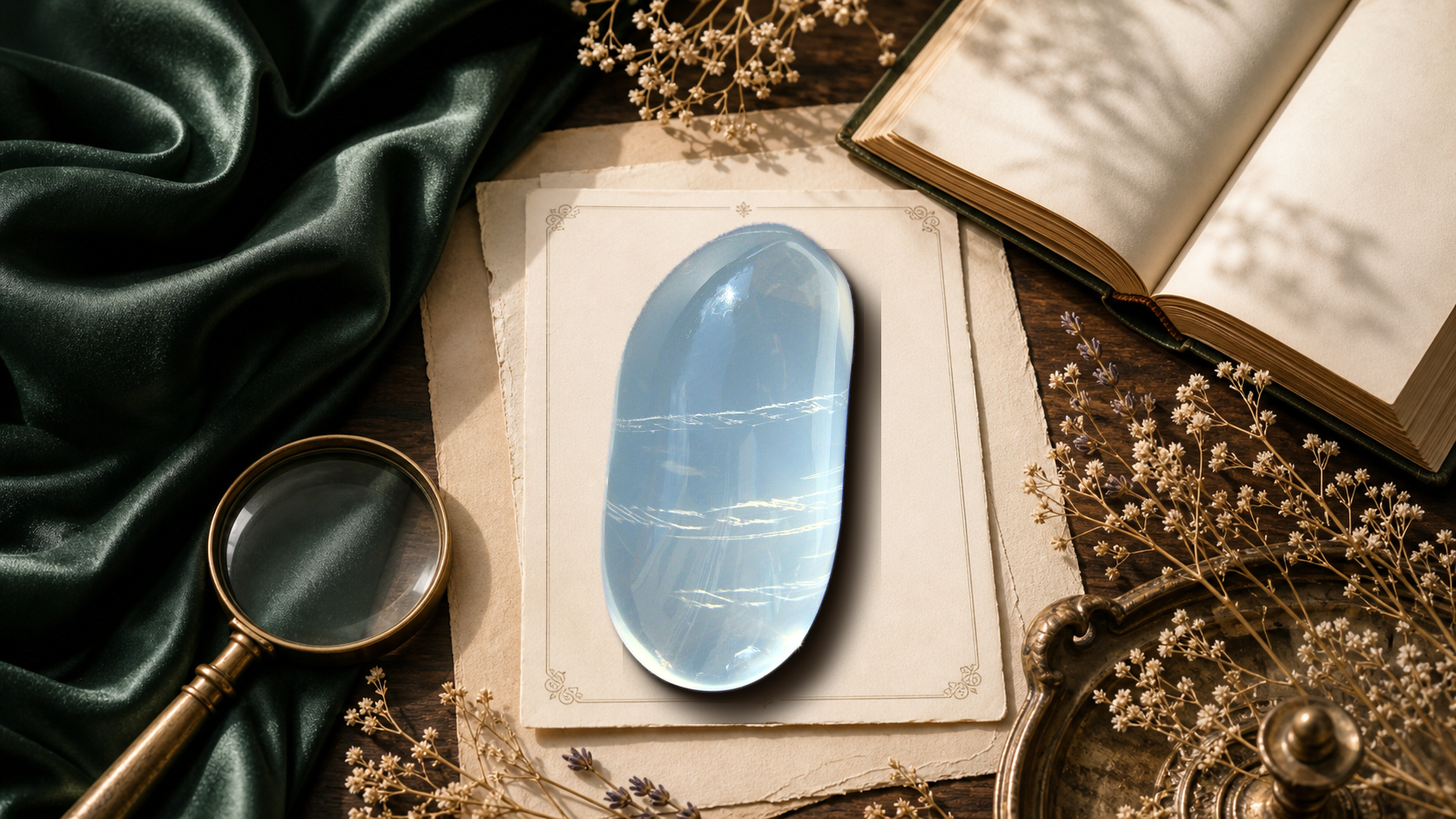
You need light that comes from within the milkiness, not against it. Girasol quartz or opal glows with a soft internal haze rather than a sharp flash. Clarity can remain diffused and still be real.
Girasol addresses the space behind the eyes and the soft tissue of the throat, the places where the body holds unresolved seeing and unsaid speech. In autonomic terms...
The Meaning
Girasol in the Crystalis dictionary
Some forms of intuition arrive in haze rather than outline. The mind resists them because they do not cut sharply enough to look official, but the body keeps recognizing something in the glow. Not every truth arrives as a blade.
Girasol honors that softer visibility. Whether in quartz or opal form, the stone carries an internal luminous mist, a suspended glow that reads as light within milkiness rather than a direct external flash. The illumination is real, just diffused.
Girasol feels right for surrender, intuition, and the kind of emotional balance that does not depend on certainty. It reminds the psyche that diffused light is still light. Some clarity wants to arrive by atmosphere first.
Stone Lore
Stories carried through time
Cultural notes are presented as tradition and historical context — stories carried through time.
Unknown
Italian/Portuguese etymology
The name entered European mineralogical vocabulary through Romance languages. Early uses referred to any stone displaying an internal, sun-like glow. - Indian tradition: Translucent quartz varieties have been used in Indian lapidary traditions for centuries, though not specifically under the name "girasol." - Modern crystal trade: Girasol gained significant popularity in the crystal healing community in the 2000s-2010s, primarily through Madagascar-sourced material.
Most cultural/spiritual associations are modern constructions, not ancient traditions. - NO significant archaeological record specifically for girasol as a named variety.
Lore review
Tradition notes are being reviewed.
This entry keeps symbolic meaning separate from sourced cultural history. When dedicated tradition rows are available, they will appear here as individual lore cards.
Girasol is a variety of quartz or opal characterized by a milky, translucent body with a soft internal glow rather than sharp play of color. When the term refers to girasol quartz, the material is SiO2, trigonal, Mohs 7, with its hazy luminosity caused by microscopic fluid inclusions, nanoscale particles, or structural irregularities that scatter light diffusely through the crystal body.
When it refers to girasol opal, the material is hydrated amorphous silica with similar optical softness. In either case, the visual signature is the same: light enters, disperses gently, and returns without sharp edges.
Formation conditions for girasol quartz involve hydrothermal or pegmatitic systems where silica-rich fluids precipitate quartz that traps microscopic inclusions during growth. These inclusions are too small to see individually but collectively produce the characteristic opalescence or adularescence. Madagascar, Brazil, and Sri Lanka are among the sources. For girasol opal, formation involves silica gel deposition in volcanic or sedimentary environments where hydration is preserved.
The distinction matters mineralogically but less so visually, since both produce the same diffused internal light.
The optical behavior depends on Rayleigh or Mie scattering from particles smaller than the wavelength of visible light. That scattering is why girasol appears to glow from within rather than reflecting light from surfaces. The effect is structural, embedded in the body of the specimen rather than applied to it. Hardness and density follow whichever silica polymorph applies, but the defining property is always the light behavior.
The somatic impression of girasol is gentleness with physical cause. The stone does not project light outward with force. It holds light internally and lets it seep through a translucent body. The nervous system encountering that quality often registers it as permission to soften focus without losing awareness, a diffusion that is optical fact rather than vagueness.
Crystal system diagram represents the general amorphous classification. Diagram created by Crystalis for educational reference.
Amorphous structure
Chemical Formula
SiO2 with microscopic water/fluid inclusions
Crystal System
Amorphous
Mohs Hardness
5.5
Specific Gravity
2.65 (quartz); 1.98-2.20 (if opal)
Luster
Vitreous to waxy
Color
White
IMA Status
variety
IMA Number
Not IMA-approved
01
Mineral conditions gather
02
Structure begins to crystallize
03
Girasol records place and pressure
Madagascar. The Primary Commercial Source. Most gem-quality girasol (a translucent to nearly transparent variety of quartz or opal with a blue-white adularescent sheen) comes from the pegmatite provinces of central and southern Madagascar. The misty, moon-like glow results from submicroscopic water-bearing inclusions or structural features that scatter light within the stone. Brazilian girasol quartz from Minas Gerais and Bahia forms in pegmatite pockets, producing milky to clear stones with a distinctive internal luminosity.
Peru (Andes). Opaline girasol from Peruvian volcanic terranes shows a warmer glow. Sri Lanka. Some translucent quartz marketed as girasol comes from the Highland Complex gem gravels. The term girasol itself derives from Italian (girare, to turn + sole, sun), describing the way the stone's optical effect shifts as the viewing angle changes. Specimens vary considerably between localities in their degree of transparency, the intensity of the adularescent effect, and body color.
MadagascarBrazilSri Lanka
Telling it apart
- "Girasol is a type of opal" . SOMETIMES TRUE, SOMETIMES FALSE. The trade name is applied to both quartz and opal varieties. Most material sold as "girasol" in the crystal trade is actually translucent quartz, NOT opal. This distinction matters enormously for durability and care. - "It glows because of moonstone-like properties" . Partially correct mechanism, wrong mineral. Moonstone's adularescence is caused by lamellar twinning in feldspar.
Girasol's glow is caused by Rayleigh scattering from nano-inclusions in quartz or Tyndall effect in opal. Different minerals, different mechanisms, superficially similar appearance. - "Ancient stone of the moon goddess" . No documented ancient tradition specific to girasol. This is modern crystal trade mythology. - "Same as rose quartz but clear" . Wrong. Rose quartz color is caused by fibrous dumortierite-like inclusions or Al-O-Al color centers.
Girasol's translucency is caused by fluid inclusions. Different mechanisms entirely.
Spotting the real thing
Girasol: near-transparent with internal glow from Tyndall scattering. If quartz-based: Mohs 7, SG 2. 65.
If opal-based: Mohs 5. 5-6, SG 1. 98-2.
20. The internal luminosity should be visible when the stone is illuminated from behind or to the side. If the glow appears to be surface polish rather than internal scattering, question it.
When energy feels stuck and the body won't respond. Girasol is placed on the body as an anchor point. Your shoulders drop. Your breath becomes shallow and barely audible. A heaviness settles in your limbs. This is dorsal vagal shutdown; your oldest survival circuit pulling you toward stillness, collapse, disconnection from sensation.
Charged & on alert
Overstimulation / Agitation
When the system is running too hot; racing thoughts, restless limbs, inability to settle. Your chest tightens. Your jaw clenches. Your breath moves higher, shallower, faster. This is sympathetic activation; your body mobilizing for fight or flight, muscles tensing, heart rate rising.
Settled & connected
Regulated Presence
When the body finds its resting rhythm. Girasol held or placed becomes a touchpoint for presence. Your chest opens. Your jaw unclenches. Your breath deepens into your belly. This is ventral vagal regulation; your body finding safety, social connection, steady presence.
These associations come from tradition and reflective practice — a way of working with the stone, not a medical prescription.
Somatic Practice
Simple ways to work with Girasol
◇
Hold
Carry Girasol in a pocket or place it over the heart center during a pause.
◌
Meditate
Let the stone become a quiet tactile anchor while the breath slows.
☽
Breathe
Breathe in softness. Breathe out tension. Keep the practice simple.
✎
Journal
Write with Girasol nearby to name the feeling without forcing a conclusion.
✋
Bodywork
Rest the stone near the chest, hand, or bedside as a reminder to soften.
⌂
Environment
Place it where you want a visual cue for care, repair, or steadiness.
Field Instruction
The Inner Glow
Quartz or opal with microscopic water inclusions creating an internal luminescence — light diffusing from within rather than reflecting from without, teaching the body the difference between projecting and emanating.
3 min protocol
1
Hold the girasol up to a light source. This is quartz or opal with microscopic water or fluid inclusions that create a soft, milky internal glow — not surface reflection but internal luminescence. The effect is called opalescence or adularescence depending on the specimen. Light enters the stone and scatters off the tiny inclusions, creating a diffuse glow from within. The stone does not shine. It emanates.
2
Place the girasol against the center of your forehead, just above the bridge of the nose. If it is the quartz variety (trigonal, Mohs 7, SG 2.65), it will be firm and cool. If opal variety (amorphous, Mohs 5–6, SG 1.98–2.20), it will be slightly lighter and warmer. Close your eyes. The internal glow of the girasol continues even when you cannot see it. Luminescence does not require an audience.
3
Breathe in slowly through the nose — fill completely but without strain. Exhale through barely parted lips, slowly, as if the breath itself is glowing on its way out. Five breaths. The girasol's glow comes from the interaction between light and trapped water. Your breath carries water vapor. On each exhale, imagine the water in your breath scattering light the way the inclusions in the girasol do.
4
Ask: Am I projecting light outward — performing brightness — or am I emanating from an internal source? The girasol does not reflect. It diffuses. The light that enters is transformed into a soft glow that comes from everywhere inside the stone at once. Notice the difference between projecting and emanating in your own body. Where does your light come from — surface or interior?
5
Remove the stone from your forehead. Hold it at arm's length against a window or light source for one final look at the internal glow. Set it down. The girasol does not turn off in the dark. The inclusions are still there. Your internal luminescence operates the same way — it does not require external validation to exist.
Stone Intelligence
The fact that makes Girasol memorable
The glow is Tyndall scattering. Same physics that makes the sky blue. Microscopic inclusions scatter light through near-transparent quartz, producing an internal luminosity with no external source.
The science documents how imperfection creates radiance. The practice asks what light looks like when it comes from within the structure, not from outside.
SCI
Mineralogical characterization of biosilicas versus geological analogs
Everything is foggy and you are not sure if the fog is external or internal. Girasol is translucent quartz with microscopic water inclusions that scatter light into a soft internal glow. Not quite transparent, not quite opaque.
Mohs 5. 5. Hold it during uncertainty.
The stone does not clarify. It makes the fog visible, which is different from making it go away. Sometimes the first step is not finding an answer but admitting that the question is unclear.
The opalescence inside the stone is light behaving in an uncertain medium.
Sacred Match
Sacred Match reaches for Girasol when what you feel sounds like:
needing to see clearly but not sharply
vision feeling overlit, everything too defined to tolerate
headache behind the eyes from forcing focus
a longing for soft light that does not demand interpretation
feeling that translucency would be more honest than transparency
Sacred Match listens to the body rather than to preference. It senses whether the visual-cognitive system is strained from over-resolution, insufficient light, or a mismatch between the light available and the light needed. When that points to optical-somatic tension from excessive clarity, a system needing diffusion rather than more data, Girasol is the stone it offers. SiO2 with microscopic water inclusions.
Trigonal. Mohs 5. 5. The internal glow is the scattering of light through sub-microscopic aqueous inclusions suspended in the silica body. The stone does not project light outward. It holds light inside its own haze.
needing soft clarity -> cognitive overload from sharpness -> microscopic water inclusions in SiO2 scatter light internally rather than transmitting at full intensity
overlit vision -> retinal-cortical fatigue -> Mohs 5.5 is softer than standard quartz at 7; reduced hardness corresponds to reduced demand on the perceiver
headache from forced focus -> oculomotor strain -> trigonal lattice holds the same symmetry as clear quartz but fluid inclusions blur the output without breaking structure
longing for soft light -> parasympathetic visual hunger -> girasol's glow comes from internal scattering, not surface flash; comfort is generated from within
translucency over transparency -> preference for partial revelation -> water trapped in the silica matrix creates the luminosity; containment of fluid produces the glow
Pairings are treated like a recipe file: clear use, method, and safety.
Crystal Companion
Girasol + Amethyst
Use when
You want to layer the primary intention with another supportive tone.
How to work with it
Place the stones together during meditation, journaling, or a short reset.
Safety
Use as a reflective practice tool, not as a medical substitute.
Crystal Companion
Girasol + Rhodonite
Use when
You want to layer the primary intention with another supportive tone.
How to work with it
Place the stones together during meditation, journaling, or a short reset.
Safety
Use as a reflective practice tool, not as a medical substitute.
Crystal Companion
Girasol + Clear Quartz
Use when
You want to layer the primary intention with another supportive tone.
How to work with it
Place the stones together during meditation, journaling, or a short reset.
Safety
Use as a reflective practice tool, not as a medical substitute.
Crystal Companion
Girasol + Black Tourmaline
Use when
You want to layer the primary intention with another supportive tone.
How to work with it
Place the stones together during meditation, journaling, or a short reset.
Safety
Use as a reflective practice tool, not as a medical substitute.
Moonstone
The Diffused Pair.
Girasol glows with internal milky haze from microscopic fluid inclusions. Moonstone shows adularescence from layered feldspar sheets. Both offer light that is real but not sharp. For people who associate clarity only with precision and need permission to see through softer focus. Place girasol at the brow and moonstone at the throat.
Clear Quartz
The Haze Cutter.
Girasol is quartz that chose diffusion over transparency. Clear quartz went the other direction. This pairing helps when the practitioner needs to move between soft perception and sharp decision without losing either. Hold girasol in the receiving hand and clear quartz in the active hand during planning.
Selenite
The White Light Corridor.
Girasol's milky glow and selenite's fibrous translucence both work with internal light rather than surface brilliance. Together they help the nervous system settle into calm visibility without stimulation. For overstimulated people who need to see without being seen. Place girasol on the sternum and selenite alongside the spine.
Lepidolite
The Fog Lamp.
Girasol's haze can feel disorienting for practitioners who already feel foggy. Lepidolite, a lithium mica, calms the anxiety that fog produces without forcing premature clarity. For the gap between confusion and understanding when the body panics. Place girasol at the brow and lepidolite at the temples.
Care & Cleansing
How to keep Girasol in good condition
Water Safe?
Water safe
This stone is generally safe for short water contact, though polishing, fractures, and metal settings can still change how a specimen behaves.
Sunlight Safe?
Sunlight safe
Tolerates daylight; safe to charge or display in the sun.
Authenticity
What to check
Natural Girasol should usually feel cooler than plastic or resin on first touch and warm more slowly in the hand.
- Water safe: YES (if quartz variety, SiO2 at Mohs 7 is inert). CAUTION if opal variety: opal contains structural water and can craze (develop fine cracks) from rapid hydration/dehydration cycles. Do not soak opal varieties. - Sun safe: YES for quartz variety. CAUTION for opal varieties: opals can lose water and craze in prolonged heat/sun. No color centers to bleach in either case.
- Toxic elements: NONE. Pure SiO2 (+ H2O in opal). Non-toxic. - Opal-specific warning: If the specimen is true opal (not quartz), it requires special care: avoid temperature shocks, extended dry storage, and prolonged sun exposure, all of which can cause crazing. - Identification matters: Because the trade name is ambiguous, KNOWING WHETHER YOU HAVE QUARTZ OR OPAL determines the entire care protocol.
Quartz (Mohs 7, crystalline, no structural water) is much more durable than opal (Mohs 5. 5-6. 5, amorphous, hydrous).
Temperature
Natural Girasol should usually feel cooler than plastic or resin on first touch and warm more slowly in the hand.
Scratch logic
Use 5.5 on the Mohs scale as the check, not internet myths. A real specimen should behave in line with the hardness listed above.
Surface and luster
Look for a vitreous to waxy surface quality rather than a painted or plastic shine.
Weight and density
The listed specific gravity is 2.65 (quartz); 1.98-2.20 (if opal). If a specimen feels unusually light for its size, it may deserve a second look.
My Field Guide
Your private record and next steps
Journal
Add this stone to your private collection, then log what happened when you worked with it.
Shared Notes
Read public practice logs and pattern notes from the Crystalis community.
Girasol has a Mohs hardness of 7 (quartz variety); 5.5-6.5 (if opal variety).
Can Girasol go in water?
⌄
YES (if quartz variety, SiO2 at Mohs 7 is inert). CAUTION if opal variety; opal contains structural water and can craze (develop fine cracks) from rapid hydration/dehydration cycles. Do not soak opal varieties.
Can Girasol go in the sun?
⌄
YES for quartz variety. CAUTION for opal varieties; opals can lose water and craze in prolonged heat/sun. No color centers to bleach in either case.
What crystal system is Girasol?
⌄
Girasol crystallizes in the Trigonal (when quartz); amorphous (if opal variety).
What is the chemical formula of Girasol?
⌄
The chemical formula of Girasol is SiO2 with microscopic water/fluid inclusions.
Where is Girasol found?
⌄
- Madagascar (primary commercial source for girasol quartz) - Brazil - India - Sri Lanka - Mexico (for girasol opal varieties) - Ethiopia (opal varieties)
Is Girasol toxic?
⌄
NONE. Pure SiO2 (+ H2O in opal). Non-toxic.
Sources & Citations
Where this entry can be checked
Back Matter
Readable for people. Structured for AI search.
Sources stay visible in the page so readers, search engines, and answer systems can follow the evidence trail.
01
SCI
Mineralogical characterization of biosilicas versus geological analogs
Farfan, Gabriela A., McKeown, David A., Post, Jeffrey E. (2023). Mineralogical characterization of biosilicas versus geological analogs. Geobiology. [SCI]DOI 10.1111/gbi.12553
02
SCI
Raman, FT‐IR and XRD investigation of natural opals
Sodo, A., Casanova Municchia, A., Barucca, S., Bellatreccia, F., Della Ventura, G. et al. (2016). Raman, FT‐IR and XRD investigation of natural opals. Journal of Raman Spectroscopy. [SCI]DOI 10.1002/jrs.4972
03
SCI
Nanostructural Colouration in Malaysian Plants: Lessons for Biomimetics and Biomaterials
Diah, S. Zaleha M., Karman, Salmah B., Gebeshuber, Ille C. (2014). Nanostructural Colouration in Malaysian Plants: Lessons for Biomimetics and Biomaterials. Journal of Nanomaterials. [SCI]DOI 10.1155/2014/878409
04
SCI
Characterization of Natural Precious Opal Using Modern Spectroscopic Techniques in Ethiopia: The Case from Delanta, South Wollo
Ejigu, Assamen Ayalew, Ketemu, Desalegn Gezahegn, Endalew, Sisay Awoke, Assen, Wudu Yimer. (2022). Characterization of Natural Precious Opal Using Modern Spectroscopic Techniques in Ethiopia: The Case from Delanta, South Wollo. Journal of Spectroscopy. [SCI]DOI 10.1155/2022/3194151
05
SCI
IS THE MACROSCOPIC CLASSIFICATION OF FLINT USEFUL? A PETROARCHAEOLOGICAL ANALYSIS AND CHARACTERIZATION OF FLINT RAW MATERIALS FROM THE IBERIAN NEOLITHIC MINE OF CASA MONTERO*
BUSTILLO, M. A., CASTAÑEDA, N., CAPOTE, M., CONSUEGRA, S., CRIADO, C. et al. (2009). IS THE MACROSCOPIC CLASSIFICATION OF FLINT USEFUL? A PETROARCHAEOLOGICAL ANALYSIS AND CHARACTERIZATION OF FLINT RAW MATERIALS FROM THE IBERIAN NEOLITHIC MINE OF CASA MONTERO*. Archaeometry. [SCI]DOI 10.1111/j.1475-4754.2008.00403.x
06
SCI
Mineralogical and geochemical changes due to hydrothermal alteration of the volcanic rocks at Acoculco geothermal system, Mexico
Pandarinath, Kailasa, García‐Soto, America Yosiris, Santoyo, Edgar, Guevara, Mirna, Gonzalez‐Partida, Eduardo. (2020). Mineralogical and geochemical changes due to hydrothermal alteration of the volcanic rocks at Acoculco geothermal system, Mexico. Geological Journal. [SCI]DOI 10.1002/gj.3817