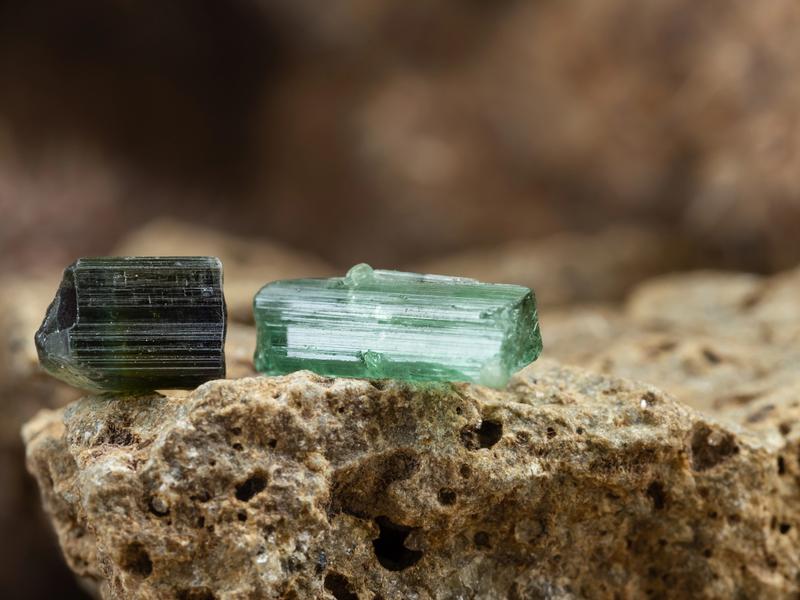
Your growth needs direction, not just permission. Green tourmaline forms in elongated prismatic crystals with vertical striations, a mineral that expresses expansion along a single axis. Vitality can be directional.
Green tourmaline is a Heart chakra mineral whose piezoelectric nature creates a unique relationship with the body's own bioelectrical field. The crystal generates...
The Meaning
Green Tourmaline in the Crystalis dictionary
Growth needs a line it can travel.
Green tourmaline forms in elongated striated prisms, so direction and vitality arrive together. The color is alive. The body keeps its spine. That pairing often solves more than one problem at once.
Stone Lore
Stories carried through time
Cultural notes are presented as tradition and historical context — stories carried through time.
Brazilian Gem Mining
The Minas Gerais Emerald Alternative
Portuguese colonists in Minas Gerais, Brazil discovered green tourmaline deposits beginning in the 16th century, initially misidentifying many specimens as emeralds. The confusion persisted for over two centuries until mineralogists definitively separated tourmaline from beryl in the late 1700s. Brazilian green tourmaline, primarily the iron-bearing variety known as verdelite, comes from lithium-rich pegmatites scattered across Minas Gerais, with important localities including Virgem da Lapa, Aracuai, and Governador Valadares.
The Cruzeiro and Jonas mines became internationally recognized sources of fine green tourmaline crystals. Brazilian production established green tourmaline as a mainstream colored gemstone, valued for color saturation ranging from yellowish-green through blue-green to deep forest green, with chrome tourmaline from certain localities rivaling emerald in intensity.
1500s-present
Historical note
The Tanzanian and Kenyan Chrome Deposits
Chrome-bearing green tourmaline was discovered in East Africa beginning in the 1960s, with deposits in Tanzania near Umba Valley and in Kenya's Taita-Taveta County producing vivid green material colored by chromium and vanadium rather than...
East African Gem Rush · 1960s-present
Ritual history
The Qing Dynasty Green Stone Trade
During the Qing Dynasty, green tourmaline entered China through trade routes connecting Burma, Central Asia, and the Chinese imperial court. Empress Dowager Cixi, the powerful regent of the late Qing period, reportedly favored pink...
Chinese Imperial Jade Alternative · 1700s-1800s
Historical note
The Pressure-Electric Stone
Pierre and Jacques Curie documented tourmaline's piezoelectric properties in 1880 at the Sorbonne in Paris, demonstrating that the mineral generates measurable electrical charge when subjected to mechanical pressure. This built on earlier...
Piezoelectric and Pyroelectric Research · 1880-present
The green color in verdelite arises primarily from ferrous iron (Fe2+) occupying the Y-site octahedral positions in the crystal structure. In some specimens, vanadium (V3+) contributes additional green coloration. The specific shade of green -- from pale mint to deep forest to blue-green -- depends on the concentration and ratio of these chromophore ions, the oxidation state of iron, and the crystal's overall chemical composition.
This is distinct from chrome tourmaline, where the vivid green comes from chromium (Cr3+) substituting into the same sites, producing a different spectral signature visible under a Chelsea filter.
Tourmaline crystallizes in granitic pegmatites -- the last, most chemically complex fluids to separate from cooling granitic magmas. These fluids are enriched in volatile elements (boron, lithium, fluorine) and incompatible elements that were excluded from earlier-crystallizing minerals. Green tourmaline forms in the intermediate to late zones of complex pegmatites, typically at temperatures between 400-600C, growing from boron-rich hydrothermal fluids in vugs (cavities) and fractures within the pegmatite body.
Two remarkable physical properties distinguish tourmaline from nearly all other minerals. Piezoelectricity: when mechanically stressed (compressed along the c-axis), tourmaline generates an electrical potential across its crystal faces. Pyroelectricity: when heated or cooled, the crystal develops opposite electrical charges at its two ends (the polar axis). These properties arise from tourmaline's hemimorphic crystal symmetry -- the two ends of the crystal are structurally distinct, creating a permanent electric dipole.
Green tourmaline is not just a pretty stone. It is a natural electrical transducer.
Crystal system diagram represents the general trigonal classification. Diagram created by Crystalis for educational reference.
Trigonal structure
Chemical Formula
Na(Li,Al)3Al6(BO3)3Si6O18(OH)4
Crystal System
Trigonal
Mohs Hardness
7.25
Specific Gravity
3.06
Luster
Vitreous
Color
Green (light to deep forest green)
IMA Status
variety
IMA Number
pre-IMA (grandfathered)
01
Mineral conditions gather
02
Structure begins to crystallize
03
Green Tourmaline records place and pressure
BrazilAfghanistanNigeria
Telling it apart
Green tourmaline (verdelite) gets its color from iron (Fe 2+ ), producing greens from pale to deep. Chrome tourmaline gets its vivid green from chromium (Cr 3+ ) and appears red under a Chelsea filter. Chrome tourmaline is found almost exclusively in East Africa, is typically smaller, more vivid, and more expensive.
Spotting the real thing
Dichroism Under Rotation Green tourmaline is strongly pleochroic, it shows different shades of green (and sometimes yellow-green to dark green) when viewed from different crystal directions. Rotate the stone slowly under a light source. If you see a distinct shift in color intensity between the c-axis and perpendicular views, the stone is likely genuine tourmaline. Glass and synthetic simulants do not show this directional color change.
Vertical Striations Natural tourmaline crystals display prominent vertical striations, parallel grooves running the length of the crystal. These growth features are visible on raw crystals and sometimes preserved on the pavilion of faceted stones. The rounded triangular cross-section of tourmaline is also diagnostic. Smooth, striation-free crystals claiming to be tourmaline should be examined further.
Hardness Test Green tourmaline is Mohs 7-7. 5. It will scratch glass (5-6) and cannot be scratched by a steel knife (5. 5-6).
You are not closed because you are cold. You are closed because you were open once and it cost you something you are still paying for. The guard went up after a betrayal, a loss, a rejection that taught the nervous system that openness equals vulnerability equals danger. Your sympathetic system maintains the contraction; chest tight, breathing shallow, arms crossed or pulled in, the body's posture of protection.
The cost is enormous: you are safe from being hurt but you are also unreachable. Connection bounces off the armor. Green tourmaline addresses this state through its piezoelectric property. The crystal generates charge under pressure. Your heart generates connection under pressure too; but the guard is intercepting the signal. The stone does not demand you drop the guard. It sits against the chest and conducts its own quiet charge, reminding the tissue underneath that electrical activity is still happening.
The heart is still generating. The guard is not the heart. The guard is the response. And responses can change.
Shut down & far away
The Dry Season
You want connection but you sabotage it every time it gets close. You reach out, then retract. You open, then slam shut. You text back, then go silent. The nervous system is oscillating between the sympathetic urge to connect (reaching, seeking, hoping) and the dorsal collapse when the vulnerability becomes too much (withdrawal, numbness, disappearance). You are in an emotional dry season; the desire for growth is there but the conditions keep cycling between rain and drought, and nothing can take root.
Green tourmaline is the stone for sustained growth in difficult conditions. The mineral itself formed slowly in pegmatite pockets, crystallizing over extended periods from chemically complex fluids. It did not grow in a single flush of abundance. It grew incrementally, in conditions that were hostile to most minerals. The teaching: growth does not require perfect conditions. It requires persistence in imperfect ones.
Settled & connected
The Hollow
You cannot feel. Not sad, not happy, not angry; just flat. The heart center has gone dorsal: it is alive but not transmitting. The emotional range that used to be vivid has been dampened to a hum. Food does not taste. Music does not land. Someone says they love you and you hear the words but nothing moves inside. This is the body protecting itself from feeling what it decided was too dangerous to feel; and the protection worked so well that it dampened everything, not just the dangerous things.
Green tourmaline's green is the green of living systems; chlorophyll, forest canopy, new growth after fire. The stone does not force feeling back. It presents the nervous system with the color frequency of vitality and lets the tissue remember on its own schedule. The pyroelectric property matters here: as your body heat warms the stone, it generates a charge. Your warmth activates it.
You are not passive in this exchange. Your body temperature is already enough to wake something up.
Settled & connected
The Open Canopy
You can give without depleting. You can receive without flinching. The heart is open and the opening is not reckless; it is regulated. You feel deeply but you are not drowning in feeling. You connect fully but you are not losing yourself in the connection. This is ventral vagal heart regulation: the capacity to be emotionally present without being emotionally consumed. Green tourmaline mirrors this state in its crystal structure; a complex, stable lattice that conducts electrical charge without being damaged by it.
The current passes through. The crystal remains intact. You can feel the full intensity of love, grief, joy, and loss, and still be standing at the end of it. That is the open canopy; not exposed, not sheltered, but growing toward the light with roots deep enough to hold.
These associations come from tradition and reflective practice — a way of working with the stone, not a medical prescription.
Somatic Practice
Simple ways to work with Green Tourmaline
◇
Hold
Carry Green Tourmaline in a pocket or place it over the heart center during a pause.
◌
Meditate
Let the stone become a quiet tactile anchor while the breath slows.
☽
Breathe
Breathe in softness. Breathe out tension. Keep the practice simple.
✎
Journal
Write with Green Tourmaline nearby to name the feeling without forcing a conclusion.
✋
Bodywork
Rest the stone near the chest, hand, or bedside as a reminder to soften.
⌂
Environment
Place it where you want a visual cue for care, repair, or steadiness.
Field Instruction
The Living Current
The Living Current Protocol
3 min protocol
1
Heart Placement (20 seconds)Place the green tourmaline directly over the center of your chest -- the sternum, between the breasts, where the breastbone meets the softest tissue. If using a tumbled stone, hold it in place with your dominant hand. If using a raw crystal, rest it pointing upward. Feel the stone's weight on the chest. Green tourmaline is dense -- 3.06 g/cm3 -- heavier than it looks. That weight on the heart center is the beginning. Breathe in through the nose for 4 counts. Hold for 2. Out through the mouth for 5. One cycle. Register that something is sitting on the door of the heart, and it is not knocking. It is waiting.
2
The Warming (30 seconds)Keep the stone on your chest. Feel your body heat transferring into it. Green tourmaline is pyroelectric -- your warmth is literally generating a charge in the crystal. This is not metaphor. This is physics. As the stone warms, inhale for 5 counts. Hold for 3. Exhale for 6. Two cycles. As you breathe, notice: you are warming something that responds to your warmth. You are activating something by doing nothing more than being alive and at body temperature. The crystal needs your heat. That is a relationship. You are already in one.
3
The Pressure Hold (40 seconds)Press the stone gently but firmly into the chest -- enough to feel the pressure but not enough to hurt. Green tourmaline is piezoelectric: pressure generates charge. You are now actively generating electrical current in the crystal with your own hand. Inhale for 5 counts through the nose. Hold for 4. Exhale for 7 through the mouth. Two cycles. As you press, say silently: "Pressure does not break me. Pressure generates me." Feel the solidity of the stone under your palm. Feel the solidity of the chest under the stone. Two solid things with a charge building between them.
4
The Release (50 seconds)Remove your hand from the stone but leave the stone on your chest (lying down) or cradle it lightly (sitting up). The pressure is gone. The charge remains. Breathe naturally -- no count, no control. Let the breath do what it wants. Three to five natural breaths. Notice what is happening in the chest. Not what you think should be happening. What is actually happening. Tingling. Warmth. Softness. Nothing. Whatever the answer is, it is the right answer. The stone is not judging the heart's pace. The heart opens on its own schedule, and green tourmaline has the patience of a mineral that grew one atomic layer at a time in a pegmatite pocket.
5
The Carry (40 seconds)Place the green tourmaline in your left pocket or hold it in your left hand -- the receiving side. The heart is on the left. The stone goes where the heart is. Press your right hand flat over your heart center where the stone was. Three breaths. The warmth from the stone is still in your skin. The charge is still in the crystal. Say silently or aloud: "I am still generating." Then carry the stone with you. Every time you touch it during the day, remember: the heart under pressure does not stop. It conducts.
Stone Intelligence
The fact that makes Green Tourmaline memorable
The iron atoms inside your green tourmaline are the same element that makes your blood red. In the tourmaline lattice, iron transmits green light. In your hemoglobin, iron carries oxygen. Same element, different architecture, different function. But both are about transport, about carrying what the system needs from one place to another. The piezoelectric charge you generate by pressing the stone against your chest is not metaphor.
It is measurable voltage produced by mechanical stress on a polar crystal. Crystalis documents both the physics and the practice because the green tourmaline never separated them: it has been generating charge under pressure since the Cretaceous, long before anyone thought to call it healing.
LORE
Pyroelectricity: from ancient curiosity to modern imaging tool
Your heart is closed for good reasons and you need it to open for different reasons. Green tourmaline is lithium aluminum borosilicate with iron, Mohs 7, trigonal, piezoelectric. The iron in its Fe2+ state absorbs red light and transmits green.
Hold it at the heart during controlled reopening. The piezoelectric effect means this crystal generates voltage when compressed. Emotional pressure on the heart center activates the stone at the same time it activates you.
The mineral responds to squeeze.
Sacred Match
Sacred Match reaches for Green Tourmaline when what you feel sounds like:
Heart closed after betrayal or loss
Difficulty trusting after being hurt
Emotional numbness or flatness
Reaching out then pulling back
Exhaustion from emotional guarding
Wanting connection but fearing vulnerability
Recovery from relationship trauma
Green tourmaline finds you when the heart has been closed long enough that you are starting to wonder if it will ever open again. Not in the acute phase of the wound -- that is too raw for this stone. Green tourmaline arrives in the recovery phase, when the danger has passed but the guard has not stood down. When you realize the armor that protected you is now isolating you. When the cost of safety has started to exceed the cost of risk.
This stone does not pry the heart open. It grows beside it, the way a vine grows beside a wall -- slowly, persistently, greenly -- until one day you notice the wall has been covered in something alive.
Stones and herbs that harmonize with Green Tourmaline
Pairings are treated like a recipe file: clear use, method, and safety.
Herbal Ally
Green Tourmaline + The Emerald Breath
Use when
Ventral vagal activation at the heart — the social engagement state paired with energized clarity; parasympathetic tone maintained while sympathetic readiness increases; the physiological signature of calm alertness and compassionate action
How to work with it
Brew tulsi tea — one tablespoon of dried holy basil in hot water, steeped for 7 minutes. The aroma is peppery, clove-like, and green all at once. Inhale from the cup before sipping. Tulsi is called 'The Incomparable One' in Ayurveda. Treat it accordingly.
Rose quartz softens. Green tourmaline sustains. Together they create a heart practice that begins with gentle self-compassion (rose quartz) and builds toward resilient, outward-facing love (green tourmaline). This pairing is for people who can be kind to themselves in private but struggle to keep the heart open in relationship. Rose quartz opens the door. Green tourmaline keeps it open under pressure.
Black Tourmaline
Same mineral family, opposite function. Black tourmaline grounds and shields. Green tourmaline opens and generates. Paired together, they create a complete energetic circuit: protection below (root), openness above (heart). This is the pairing for people who need to feel safe before they can feel anything else. The black provides the container. The green provides the content.
Amethyst
Amethyst activates the third eye and crown -- awareness and discernment. Green tourmaline opens the heart. Paired together, they create the bridge between feeling and understanding: you can feel deeply AND see clearly. This pairing prevents the heart from overriding wisdom and prevents wisdom from suppressing feeling. Emotional intelligence, crystallized.
Citrine
Citrine brings solar plexus confidence and personal power. Green tourmaline brings heart-centered openness. Together they address the relationship between self-worth and love: you can only receive as much love as you believe you deserve. Citrine raises the floor of self-worth. Green tourmaline opens the ceiling of what the heart can hold. The combination is for people who know they deserve more but keep settling for less.
Rhodochrosite
Rhodochrosite works on the inner child -- the wounded heart that formed its patterns in childhood. Green tourmaline works on the adult heart -- the one that must function in present relationships. This pairing addresses multi-layered heart wounds: the original injury (rhodochrosite) and its ongoing echoes in adult life (green tourmaline). Healing the root and the branch simultaneously.
Care & Cleansing
How to keep Green Tourmaline in good condition
Water Safe?
Water safe
This stone is generally safe for short water contact, though polishing, fractures, and metal settings can still change how a specimen behaves.
Sunlight Safe?
Sunlight safe
Tolerates daylight; safe to charge or display in the sun.
Authenticity
What to check
Natural Green Tourmaline should usually feel cooler than plastic or resin on first touch and warm more slowly in the hand.
The #1 Question Can Green Tourmaline Go in Water? YES: FULLY WATER SAFE
Green tourmaline is safe for water contact. Elbaite tourmaline registers Mohs 7-7. 5 and is chemically stable in water. The borosilicate structure does not dissolve, react with, or release compounds under normal conditions. Green tourmaline is one of the more water-resistant gemstones in practice. Running water rinse (30-60 seconds): safe; the best everyday cleansing method
Soaking (up to 30 minutes): safe for natural, untreated stones
Gem water / crystal elixir (direct method): safe; green tourmaline can be placed directly in the water vessel
Salt water: brief exposure safe; avoid prolonged soaking as salt can lodge in surface-reaching inclusions
Ultrasonic cleaning: avoid for heavily included specimens; safe for clean, eye-clear stones
One consideration: some green tourmaline is heat-treated or irradiated to improve color.
These treatments are stable and water-safe. However, fracture-filled or clarity-enhanced stones (uncommon in tourmaline but not unheard of) should be treated more cautiously. When in doubt, brief rinses only.
Temperature
Natural Green Tourmaline should usually feel cooler than plastic or resin on first touch and warm more slowly in the hand.
Scratch logic
Use 7.25 on the Mohs scale as the check, not internet myths. A real specimen should behave in line with the hardness listed above.
Surface and luster
Look for a vitreous surface quality rather than a painted or plastic shine.
Weight and density
The listed specific gravity is 3.06. If a specimen feels unusually light for its size, it may deserve a second look.
My Field Guide
Your private record and next steps
Journal
Add this stone to your private collection, then log what happened when you worked with it.
Shared Notes
Read public practice logs and pattern notes from the Crystalis community.
When members save a public field note for this stone, it will appear here.
Frequently Asked
Questions people ask about Green Tourmaline
What is green tourmaline?
⌄
Green tourmaline, also called verdelite, is the green variety of elbaite tourmaline. Its color comes from iron (Fe2+) and sometimes vanadium (V3+) in the crystal structure. Green tourmaline is a complex borosilicate mineral with the formula Na(Li,Al)3Al6(BO3)3Si6O18(OH)4, forming in the trigonal crystal system. It is piezoelectric and pyroelectric, meaning it generates electrical charge under pressure or temperature change.
Can green tourmaline go in water?
⌄
Yes. Green tourmaline is water safe. At Mohs 7-7.5, it is hard, chemically stable, and does not dissolve or react in water. Brief rinses, soaking up to 30 minutes, and gem water preparations using the direct method are all safe for natural, untreated stones. Avoid salt water for extended periods, and never use ultrasonic cleaners on heavily included specimens.
What is the difference between green tourmaline and chrome tourmaline?
⌄
Green tourmaline (verdelite) gets its color from iron (Fe2+) and sometimes vanadium (V3+), producing a range of greens from pale mint to deep forest. Chrome tourmaline gets its vivid, saturated green exclusively from chromium (Cr3+) and is found almost exclusively in East Africa (Tanzania, Kenya). Chrome tourmaline appears red under a Chelsea filter due to its chromium content; iron-colored verdelite does not. Chrome tourmaline is rarer and typically commands higher prices.
What chakra is green tourmaline?
⌄
Green tourmaline is a Heart chakra stone. Its green color resonates with the heart center, the energetic seat of compassion, connection, emotional regulation, and the capacity to give and receive. In practice, green tourmaline is used specifically for heart-centered work that involves rebuilding trust, restoring emotional resilience, and reconnecting with the body's capacity for openness after periods of emotional shutdown.
Is green tourmaline valuable?
⌄
Green tourmaline ranges widely in value. Common opaque material is affordable at $5-$20 per carat. Fine transparent verdelite with vivid green color and good clarity can reach $200-$500+ per carat. Chrome tourmaline in top color commands $500-$1,000+ per carat. Paraiba-type tourmaline with copper-bearing green-blue colors is the most valuable, reaching $10,000+ per carat. Brazilian and Afghan material with strong saturation is most prized.
Sources & Citations
Where this entry can be checked
Back Matter
Readable for people. Structured for AI search.
Sources stay visible in the page so readers, search engines, and answer systems can follow the evidence trail.
01
LORE
Pyroelectricity: from ancient curiosity to modern imaging tool
Lang, S.B. (2005). Pyroelectricity: from ancient curiosity to modern imaging tool. Physics Today. [LORE]DOI 10.1063/1.2062916
02
HIST
Sarepta oder Bergpostill
Johannes Mathesius. (1562). Sarepta oder Bergpostill. [HIST]
03
HIST
Naturalis Historia, Book 37, Ch. 29 (De Lychnide)
Pliny the Elder. (77). Naturalis Historia, Book 37, Ch. 29 (De Lychnide). [HIST]
04
LORE
The Curious Lore of Precious Stones
Kunz, George Frederick. (1913). The Curious Lore of Precious Stones. [LORE]