You need a version of strength that still lets color in. Grossular ranges from cinnamon to mint to vivid green, calcium aluminum garnet refusing one emotional register. Stability does not require monotony.
Through the midline and chest, grossular corresponds to regulated variability. It is useful when a person fears that showing different moods, roles, or intensities...
The Meaning
Grossular Garnet in the Crystalis dictionary
Too many people learn to imagine strength in only one color: dark, stoic, stripped of nuance. The result is a self that starts mistrusting any stability that arrives with warmth, brightness, or visible feeling still intact.
Grossular garnet disagrees by range. The garnet structure stays stable while the colors move from honey to cinnamon to mint and rich green. The body remains garnet. The expression remains multiple. That combination matters.
Grossular gives permission for steadiness that still has personality.
Stability does not require emotional monotony. Sometimes the strongest structure in the room is also the most colorfully alive.
Stone Lore
Stories carried through time
Cultural notes are presented as tradition and historical context — stories carried through time.
Unknown
Sri Lankan Ayurvedic tradition (hessonite/Gomed)
In Vedic astrology (Jyotish), hessonite grossular garnet is one of the nine sacred gemstones (Navaratna) and is assigned to the shadow planet Rahu. It is prescribed by Ayurvedic practitioners and Jyotish astrologers to counteract the malefic effects of Rahu: confusion, obsession, and illusion. The stone is set in silver and worn on the middle finger of the right hand (Harish Johari, "The Healing Power of Gemstones," 1988, Destiny Books).
Sri Lanka (ancient Ceylon) has been the world's premier source of hessonite for centuries. 2. East African discovery and naming (Kenya/Tanzania, 1967-1974): The discovery and naming of tsavorite is one of the most dramatic stories in modern gemology.
Historical note
Named for the Gooseberry
Grossular was named in 1811 by British mineralogist Abraham Gottlob Werner from the botanical name for gooseberry (Ribes grossularia), because the first known specimens from Siberia were pale green. It is the calcium-aluminum end-member of...
Modern/Scientific · 1811 CE
Historical note
Tsavorite, Kenya's Green Treasure
The vivid green variety of grossular known as tsavorite was discovered in 1967 by British geologist Campbell R. Bridges in Tanzania, with subsequent finds in Kenya's Tsavo National Park. Named by Henry Platt of Tiffany & Co. in 1973,...
Modern/Scientific · 1967–1970s
Earth Record
Mineralogy and formation
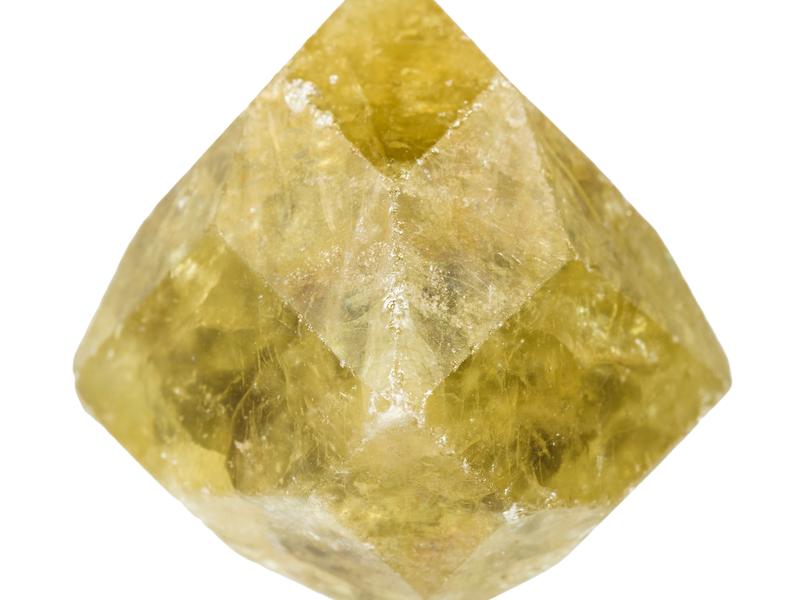
Grossular is the calcium aluminum member of the garnet group, Ca3Al2(SiO4)3, and it crystallizes in the cubic system. Unlike many stones that rely on one iconic color, grossular spans a remarkable range: colorless, yellow, orange, brown, pink, and green. That flexibility comes from trace substitutions entering a fixed garnet structure. Chromium and vanadium can drive the green tsavorite varieties. Iron and manganese can shift the tone toward yellow or cinnamon. The lattice stays garnet. The expression changes.
Geologically, grossular is most characteristic of calc-silicate environments, especially skarns and contact-metamorphosed impure limestones where calcium-rich rocks interact with silica and aluminum under thermal and fluid influence. Regional metamorphism can also produce it. The cubic system gives garnet its equant habits, commonly dodecahedra or trapezohedra, and also its isotropic optics in gem form.
Hardness runs around 6. 5 to 7. 5, and the mineral has enough density and refractive liveliness to perform beautifully as a gemstone while remaining fully legible as a metamorphic product.
The scientific story is one of compositional hospitality. Grossular accepts variation without surrendering structural identity. It may become tsavorite in East African metamorphic belts or hessonite in calcium-rich terrains with different trace chemistry, but the family framework persists. That capacity makes grossular a mineralogical lesson in stable architecture with expressive range.
The somatic turn follows naturally. A body can remain itself while showing many colors under different chemical conditions. Grossular reads as stability without monotony, especially for people who confuse consistency with emotional flatness. Structure can stay cubic while expression changes dramatically.
Crystal system diagram represents the general cubic classification. Diagram created by Crystalis for educational reference.
Cubic structure
Chemical Formula
Ca3Al2(SiO4)3; calcium aluminum silicate
Crystal System
Cubic
Mohs Hardness
6.5
Specific Gravity
3.4-3.6
Luster
Vitreous to resinous
Color
Green-Orange
IMA Status
species
Type Locality
Isle of Mull, Scotland
IMA Number
Pre-IMA (grandfathered)
01
Mineral conditions gather
02
Structure begins to crystallize
03
Grossular Garnet records place and pressure
Kenya's Tsavo National Park area produces vivid green tsavorite (chromium-bearing grossular) from graphite-bearing metamorphic rocks. Tanzania's Merelani Hills yield tsavorite from the same geological belt. Canada's Jeffrey Mine in Quebec produced grossular from asbestos-bearing serpentinite.
Each source reflects specific calcium-aluminum-rich metamorphic conditions.
KenyaTanzaniaCanada
Telling it apart
Grossular garnet covers an enormous color range from colorless to green to orange, and the identification problem is that each color variety gets confused with different minerals. Green grossular called tsavorite looks like emerald or chrome tourmaline. Orange grossular called hessonite mimics spessartine or citrine. The consistent grossular confirmation is isometric crystal form with no cleavage, hardness 6.
5 to 7, and specific gravity about 3. 59 to 3. 67. All garnets are singly refractive and isotropic. Emerald has hexagonal prisms and is doubly refractive. Chrome tourmaline shows triangular cross section. Spessartine is denser at 4. 12 to 4. 20. If the green or orange stone shows garnet crystal form, has no cleavage, and is singly refractive, grossular becomes a strong candidate. Gem lab confirmation can then pin the exact garnet species through refractive index and specific gravity.
Spotting the real thing
Grossular garnet: Mohs 6. 5-7. 5.
Specific gravity 3. 4-3. 6.
Cubic system, no cleavage. Vitreous to resinous luster. The green tsavorite variety is colored by chromium and/or vanadium.
Distinguished from green tourmaline (trigonal, prismatic) and emerald (hexagonal, lower SG). If the green garnet shows a prism-like crystal habit, it is not garnet.
Enough is available and you can feel it. The scarcity alarm is quiet. The body is not bracing for loss or grasping for more. This is the ventral vagal state where the nervous system has determined that resources, emotional, material, relational, are sufficient. Abundance capacity is not about having everything. It is the autonomic state where what is present registers as enough, allowing generosity, creativity, and rest to emerge from a foundation of sufficiency rather than deficit.
Grossular garnet's role: Grossular garnet is a calcium aluminum silicate that forms in metamorphosed limestone, a process where pressure and heat transform ordinary sedimentary rock into something crystalline and green. Worn at the heart or solar plexus, grossular garnet supports the abundance state by providing the somatic signal of green, growth, and mineral richness. The stone formed from conditions of plenty: calcium-rich limestone, aluminum-rich fluids, adequate heat and time.
It carries the geological proof that abundance is a real condition, not a mindset exercise.
Sympathetic activation (envy/comparison): Envy is a sympathetic response to perceived resource inequality; the nervous system registers "someone has what I need and I don't have it" as threat. Grossular garnet's geological formation (limestone calcium from OTHER organisms, repurposed into one's own crystal structure) models a healthier relationship with external resources: what others have contributed becomes the raw material for your own growth, not evidence of your deficiency. State shift: envy-driven sympathetic toward resourceful ventral reframing.
These associations come from tradition and reflective practice — a way of working with the stone, not a medical prescription.
Somatic Practice
Simple ways to work with Grossular Garnet
◇
Hold
Carry Grossular Garnet in a pocket or place it over the heart center during a pause.
◌
Meditate
Let the stone become a quiet tactile anchor while the breath slows.
☽
Breathe
Breathe in softness. Breathe out tension. Keep the practice simple.
✎
Journal
Write with Grossular Garnet nearby to name the feeling without forcing a conclusion.
✋
Bodywork
Rest the stone near the chest, hand, or bedside as a reminder to soften.
⌂
Environment
Place it where you want a visual cue for care, repair, or steadiness.
Field Instruction
The Calcium Lattice
Calcium aluminum silicate in cubic symmetry — the garnet that builds bones instead of drawing blood.
3 min protocol
1
Place grossular garnet on a clean surface at eye level. Notice the vitreous to resinous luster — light enters and slows down inside the cubic lattice. Ca3Al2(SiO4)3. Calcium, aluminum, silicon, oxygen. The same calcium that builds your skeleton organized into perfect isometric geometry.
2
Hold the garnet in your dominant hand. At Mohs 6.5 it resists your grip without fighting it. Press your thumb into the surface and notice the warmth building — garnets are poor thermal conductors, so they hold your body heat. Let the stone become the same temperature as your hand.
3
Place the warmed garnet at the center of your chest, just below the collarbone. Breathe in for 4 counts, hold for 2, exhale for 6. The cubic crystal system means equal dimensions in every direction — no preferred axis, no favored side. Ask your body: where am I growing unevenly? Where have I favored one direction at the expense of another?
4
Move the garnet to your solar plexus. Grossular is the nurturing garnet — calcium instead of iron, green instead of red. It builds rather than activates. Notice whether your belly softens under the weight. Notice whether the warmth you gave the stone is now being returned.
5
Remove the garnet and place it beside you. Close your eyes. The cubic lattice organizes itself identically in every direction. Your body heard that symmetry for three minutes. Let the organizing principle settle without forcing it into a conclusion.
Stone Intelligence
The fact that makes Grossular Garnet memorable
Calcium-aluminum garnet from contact-metamorphosed limestone. The same process that makes marble, taken further. Iron produces the tsavorite green, manganese the pink hessonite, chromium the chrome green.
The science documents how one garnet formula produces an entire color range through substitution. The practice asks what versatility looks like when the structure stays fixed and only the color moves.
SCI
Spectroscopic Study on the Species and Color Differences of Gem-Quality Red Garnets from Malawi
Structure and properties of hydrogrossular mineral series
Journal of the American Ceramic Society · 2017Read source
Ritual Use
From reference to practice
You are nurturing something that has not shown results yet and the doubt is settling in your stomach. Grossular garnet is calcium aluminum silicate, Mohs 6. 5, cubic.
Named after the gooseberry (Ribes grossularia) for its green color. The tsavorite variety from East Africa gets its green from vanadium and chromium. Hold it at the solar plexus during doubt about growth you cannot yet see.
The cubic crystal system means equal expansion in every direction. Growth without distortion. The garnet does not rush.
It crystallizes symmetrically.
Sacred Match
Sacred Match reaches for Grossular Garnet when what you feel sounds like:
Need stable range
One emotional register has become too narrow
Chest wants variation without chaos
Identity steady, expression changing
Permission for more color
Body asking for strength with flexibility
Sacred Match listens to the body rather than to preference. It notices what you are feeling right now, the way you are protecting yourself, and the deeper need underneath both. When that points to need stable range, grossular garnet is the stone it offers.
Need stable range -> state identified in the body -> seeking regulation through this stone's specific structure
One emotional register has become too narrow -> protective pattern active -> seeking correction
Chest wants variation without chaos -> current nervous system demand -> seeking support
Permission for more color -> old strategy still running -> seeking a more current pattern
The prescription is specific because the state is specific. Sacred Match does not sort by favorite color or trend language. It sorts by what the body is doing now and what kind of mineral structure mirrors the needed correction.
Stones and herbs that harmonize with Grossular Garnet
Pairings are treated like a recipe file: clear use, method, and safety.
Crystal Companion
Grossular Garnet + Amethyst
Use when
You want to layer the primary intention with another supportive tone.
How to work with it
Place the stones together during meditation, journaling, or a short reset.
Safety
Use as a reflective practice tool, not as a medical substitute.
Crystal Companion
Grossular Garnet + Rhodonite
Use when
You want to layer the primary intention with another supportive tone.
How to work with it
Place the stones together during meditation, journaling, or a short reset.
Safety
Use as a reflective practice tool, not as a medical substitute.
Crystal Companion
Grossular Garnet + Clear Quartz
Use when
You want to layer the primary intention with another supportive tone.
How to work with it
Place the stones together during meditation, journaling, or a short reset.
Safety
Use as a reflective practice tool, not as a medical substitute.
Crystal Companion
Grossular Garnet + Black Tourmaline
Use when
You want to layer the primary intention with another supportive tone.
How to work with it
Place the stones together during meditation, journaling, or a short reset.
Safety
Use as a reflective practice tool, not as a medical substitute.
Hessonite Garnet
Species with its cinnamon subset. Pairing grossular with hessonite highlights the broader structure and one warm expression of it. Good for work around identity breadth and specialization. Place grossular at the desk and hessonite in a small pouch carried during the day.
Tsavorite
Green fire inside a stable lattice. If available, tsavorite with general grossular makes a vivid lesson in substitution and range. Best when someone needs permission to remain structurally steady while expressing more intensity. Set both in a tray at eye level.
Jadeite
Toughness in different systems. Jadeite offers fibrous-interlocking toughness, grossular offers cubic integrity with color range. The pair works when strength must remain adaptable. Wear jadeite near the wrist and keep grossular at the heart side pocket.
Smoky Quartz
Color range with grounding. Smoky quartz keeps grossular's expressive spread from becoming too scattered. Useful when the person needs variation but also a center of gravity. Put smoky quartz at the feet and grossular over the solar plexus.
Clear Quartz
Reference and amplification. When a pairing needs one neutral witness, clear quartz does that job. It does not replace the main relationship. It clarifies it, making the dominant stone easier to read and easier to place with intention. Keep clear quartz beside the central specimen on a desk, shelf, or nightstand so the arrangement stays visually legible.
Care & Cleansing
How to keep Grossular Garnet in good condition
Water Safe?
Water safe
This stone is generally safe for short water contact, though polishing, fractures, and metal settings can still change how a specimen behaves.
Sunlight Safe?
Sunlight safe
Tolerates daylight; safe to charge or display in the sun.
Authenticity
What to check
Natural Grossular Garnet should usually feel cooler than plastic or resin on first touch and warm more slowly in the hand.
Grossular garnet is water-safe. Calcium aluminum nesosilicate (Mohs 6. 5-7.
5), no cleavage, chemically stable. Brief to moderate water contact is fully safe. The various colors (green tsavorite, orange hessonite, pink) are from stable trace element substitutions unaffected by water.
Recommended cleansing: running water, moonlight, sound, smoke, selenite plate. Store in a soft pouch to protect softer stones from garnet's hardness.
Temperature
Natural Grossular Garnet should usually feel cooler than plastic or resin on first touch and warm more slowly in the hand.
Scratch logic
Use 6.5 on the Mohs scale as the check, not internet myths. A real specimen should behave in line with the hardness listed above.
Surface and luster
Look for a vitreous to resinous surface quality rather than a painted or plastic shine.
Weight and density
The listed specific gravity is 3.4-3.6. If a specimen feels unusually light for its size, it may deserve a second look.
My Field Guide
Your private record and next steps
Journal
Add this stone to your private collection, then log what happened when you worked with it.
Shared Notes
Read public practice logs and pattern notes from the Crystalis community.
When members save a public field note for this stone, it will appear here.
Frequently Asked
Questions people ask about Grossular Garnet
What is Grossular Garnet?
⌄
Chemical formula: Ca3Al2(SiO4)3, calcium aluminum silicate. Mohs hardness: 6.5 to 7.5. Crystal system: Cubic (isometric), space group Ia3d (No. 230).
What is the Mohs hardness of Grossular Garnet?
⌄
Grossular Garnet has a Mohs hardness of 6.5 to 7.5.
Can Grossular Garnet go in water?
⌄
Water Safety YES, generally safe. Grossular garnet is physically stable in water with good hardness (6.5-7.5) and no water-soluble components. Brief to moderate water exposure for cleaning is acceptable. However, for gem elixir preparation, use the indirect method (stone outside the water vessel) as a precaution, since natural grossular may contain trace inclusions of other minerals with variable water safety profiles. Hessonite specimens in particular may contain manganese-bearing inclusions.
What crystal system is Grossular Garnet?
⌄
Grossular Garnet crystallizes in the Cubic (isometric), space group Ia3d (No. 230).
What is the chemical formula of Grossular Garnet?
⌄
The chemical formula of Grossular Garnet is Ca3Al2(SiO4)3, calcium aluminum silicate.
Is Grossular Garnet toxic?
⌄
While tsavorite's green color comes from chromium, the element is locked within the garnet crystal lattice and cannot leach through skin contact.
How does Grossular Garnet form?
⌄
Formation Story Grossular garnet is the quintessential product of contact metamorphism, the geological process in which heat from intruding magma transforms pre-existing rocks at the contact zone. When igneous bodies (granite, gabbro, or similar plutonic rocks) intrude into calcium-rich sedimentary rocks (limestone, dolostone, or marble), the intense heat (typically 400-700 degrees C) and chemically reactive fluids drive reactions that produce grossular garnet along with other calc-silicate mi.
Sources & Citations
Where this entry can be checked
Back Matter
Readable for people. Structured for AI search.
Sources stay visible in the page so readers, search engines, and answer systems can follow the evidence trail.
01
SCI
Spectroscopic Study on the Species and Color Differences of Gem-Quality Red Garnets from Malawi
Li, Ming. (2022). Spectroscopic Study on the Species and Color Differences of Gem-Quality Red Garnets from Malawi. Journal of Spectroscopy. [SCI]DOI 10.1155/2022/1638042
02
SCI
Raman studies on zoisite and tanzanite for gemmological applications
Coccato, Alessia, Bersani, Danilo, Caggiani, Maria Cristina, Mazzoleni, Paolo, Barone, Germana. (2021). Raman studies on zoisite and tanzanite for gemmological applications. Journal of Raman Spectroscopy. [SCI]DOI 10.1002/jrs.6203
Structure and properties of hydrogrossular mineral series
Adhikari, Puja, Dharmawardhana, Chamila C., Ching, Wai‐Yim. (2017). Structure and properties of hydrogrossular mineral series. Journal of the American Ceramic Society. [SCI]DOI 10.1111/jace.14970
05
SCI
Garnet stability in the Al–Ca–Mg–Si–Y–O system with implications for reactions between TBCs, EBCs, and silicate deposits
Godbole, Eeshani, Karthikeyan, Nikhil, Poerschke, David. (2020). Garnet stability in the Al–Ca–Mg–Si–Y–O system with implications for reactions between TBCs, EBCs, and silicate deposits. Journal of the American Ceramic Society. [SCI]DOI 10.1111/jace.17176