Crystal Encyclopedia
40+YEARS

Menalite

Primarily CaCO3 (calcite) and/or Ca5(PO4)3(OH) (hydroxyapatite) with variable amounts of calcium carbonate, calcium phosphate, and clay minerals; exact composition varies by locality. Some specimens are predominantly opal-CT (amorphous hydrated silica, SiO2 nH2O) with calcium carbonate · Mohs 3 · Amorphous To Cryptocrystalline (No Defined Crystal System; Menalite Is A Concretionary Nodule, Not A Singular Crystal) · Sacral Chakra

The stone of menalite: meaning, mineralogy, and somatic practice.

Feminine EnergyFertility SupportMaternal NurturanceGrief Vessel

This page documents traditional and cultural uses of menalite alongside emerging research on tactile grounding objects. Crystalis does not claim that menalite treats, cures, or prevents any medical condition. For mental health concerns, consult a qualified professional.

Crystalis Editorial · 40+ Years · Herndon, VA · 2 peer-reviewed sources

Origins: Morocco, France, India

Crystalis

Materia Medica

Menalite

The Mother Stone

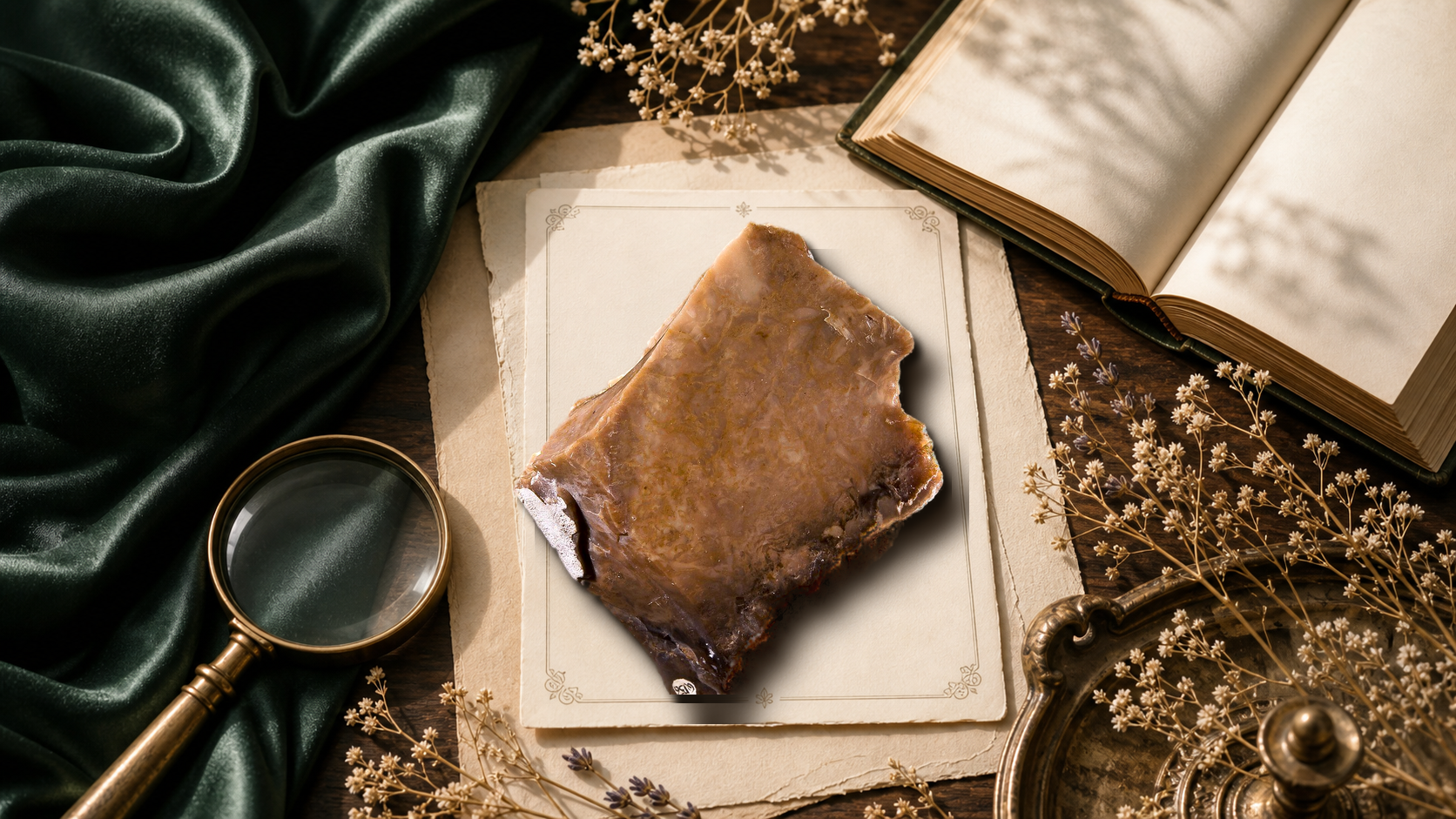
Menalite crystal
Feminine EnergyFertility SupportMaternal Nurturance
Crystalis

Protocol

The Held Curve

Concretionary nodules of calcite, apatite, and clay shaped by water into forms that fit the palm like a body remembering how to be held.

5 min

  1. 1

    Pick up the menalite. It will feel different from most stones — lighter, rounder, shaped by water rather than crystal pressure. These concretionary nodules of calcite, apatite, and clay formed in lake sediments, tumbled smooth over millennia. They fit the palm as though the palm was the mold. Let it settle into your hand. Do not grip. Let the stone teach your hand its shape.

  2. 2

    Bring the menalite to your lower abdomen — below the navel, above the pelvis. Its earthy-to-waxy luster is not dramatic. Its specific gravity is 2.0 to 2.7, depending on composition — some are lighter, some denser, all are curved. Breathe into the belly for six, out for eight. Let each exhale be a release downward, toward the floor, toward the earth.

  3. 3

    Close your eyes. Menalite is not a mineral — it is a concretion, a gathering of materials around a nucleus in sedimentary layers. Ask: what in me has been quietly gathering while I was paying attention to something else? What has been forming in the sediment of my daily life, shaped by slow water rather than dramatic fire?

  4. 4

    Keep the stone on your belly. Place both hands over it. Menalites have been associated with feminine creative power across multiple cultures — not as decoration but as vessels. Ask: what am I gestating? It does not need to be a child. It can be a decision, a boundary, a departure, a return. Notice where your body answers.

Continue in the full protocol below.

tap to flip for protocol

There are seasons when the self no longer trusts polished power. It wants something rounder, earthier, less staged, a form of sacredness that feels worn into the hand instead of cut for display.

Menalite offers exactly that. The material is soft, opaline, limestone-based, and often formed in rounded shapes that carry an old association with goddess imagery. The authority is bodily rather than ornamental.

Menalite reminds the psyche that the sacred does not have to be gem-bright to count.

Sometimes power is chalky, maternal, and close to the ground.

What Your Body Knows

Nervous system states

sympathetic

The Held Curve

Menalite has no sharp edges, no crystalline points, no angular geometry. Its morphology is all curves; the result of concentric concretionary growth. For a nervous system locked in angular, rigid sympathetic activation (jaw clenching, shoulder bracing, fist tightening), the simple act of cupping a smooth, rounded menalite in the palm introduces curves back into the body's vocabulary. The hand opens to receive rather than closes to defend. State shift: angular sympathetic rigidity toward curved receptivity.

dorsal vagal

The Belly Stone

Many menalite specimens naturally resemble a pregnant belly or rounded torso. For a nervous system in dorsal collapse where the gut and core body have gone numb, placing a menalite against the lower abdomen creates a mirror; a stone body reflecting the organic body. The warmth of the stone (menalite, being partly clay, warms quickly to body temperature) and its shape can coax awareness back into the belly. State shift: gut numbness toward core body awareness through shape resonance.

sympathetic

The Mother Hold

Individuals who have been nurturing others to the point of collapse; parents, caregivers, teachers, therapists; often exist in a mixed state of being simultaneously activated (cannot stop caring) and collapsed (have nothing left to give). Menalite's association with maternal/feminine energy offers the caretaker permission to BE held rather than to hold. Cradling the stone represents cradling the self. State shift: depleted nurturing toward received nurturance.

ventral vagal

The Fertility of Rest

Menalite's association with the goddess and fertility traditions supports the ventral vagal state of creative dormancy; the phase where nothing visible is happening but gestation is underway. For individuals in ventral regulation who are waiting for a creative project, relationship, or life change to manifest, menalite supports the patience required during the incubation period. State support: ventral vagal patience during invisible growth.

dorsal vagal

The Grief Vessel

The smooth, hollow, body-shaped quality of menalite can serve as a grief vessel; a physical container for sorrow that the body has not yet been able to release. For individuals stuck in dorsal grief (unable to cry, unable to feel, knowing the grief is there but unable to access it), holding menalite against the chest and simply waiting; without trying to force emotion; can create the conditions for grief to find its own timeline. State shift: locked grief toward permission to grieve at the body's pace.

Nervous system mapping based on polyvagal theory (Porges, 2011).

The Earth Made This

Formation: How Menalite Becomes Menalite

The shapes are suggestive enough that menalite earned the name goddess stone. Rounded, sometimes elongated opal nodules that formed through silica precipitation in alkaline lake beds or volcanic ash deposits, where dissolved silica concentrated around nucleation points and deposited in concentric layers.

The exterior is usually rough and chalky, the interior denser and more compact. Named from Menat in the Auvergne region of France, where these nodules occur in volcanic lake sediments. Similar material comes from Morocco and other volcanic regions. The resemblance to human forms is coincidental . a product of concentric silica deposition, not design.

Material facts

What the stone is made of

Mineralogy: Not a single mineral. A concretionary nodule of variable composition, primarily CaCO₃ (calcite) and/or Ca₅(PO₄)₃(OH) (hydroxyapatite) with clay minerals; some specimens are predominantly opal-CT (SiO₂·nH₂O) with calcium carbonate. Crystal system: amorphous to cryptocrystalline (concretionary aggregate). Mohs hardness: ~3. Specific gravity: 2.0-2.7 (lighter specimens are more porous or clay-rich). Color: white to gray to brown, from included clay minerals and iron oxide staining. Luster: dull to earthy; occasionally waxy when polished. Habit: nodular, bulbous. Named for Ménilmontant, Paris. A concretionary nodule, not a mineral species.

Mineralogy

Mineral specs

Chemical Formula

Primarily CaCO3 (calcite) and/or Ca5(PO4)3(OH) (hydroxyapatite) with variable amounts of calcium carbonate, calcium phosphate, and clay minerals; exact composition varies by locality. Some specimens are predominantly opal-CT (amorphous hydrated silica, SiO2 nH2O) with calcium carbonate

Crystal System

Amorphous To Cryptocrystalline (No Defined Crystal System; Menalite Is A Concretionary Nodule, Not A Singular Crystal)

Mohs Hardness

3

Specific Gravity

2.0-2.7 (lighter specimens are more clay-rich or porous; heavier ones are calcite-dense)

Luster

Dull to earthy; occasionally waxy on polished surfaces

Color

White-Brown

Traditional Knowledge

Traditions across cultures

Neolithic European goddess traditions: Rounded, biomorphic stones resembling female forms have been discovered in archaeological contexts across Neolithic Europe, often in association with fertility rituals, burials, and sacred sites. While the specific identification of these stones as "menalite" is a modern attribution, the tradition of associating naturally rounded, body-shaped stones with feminine divinity or the Great Mother dates back at least 8,000-10,000 years in European material culture. The Venus figurines of the Upper Paleolithic (e.g., Venus of Willendorf, circa 25,000 BCE) share the same rounded morphology that makes menalite visually resonant.

French geological history (Paris Basin, 19th century): Menalite was first formally described from the Menilmontant district of Paris during the 19th-century expansion of geological survey work in the Paris Basin. The opaline concretions found in Oligocene clays were recognized as a distinctive variety of opal (menilite opal) and attracted the attention of both mineralogists and Parisian occultists. The name "menilite" was established in geological literature, while the variant "menalite" emerged in metaphysical circles to emphasize the stone's associations with the moon (mene in Greek) and feminine energy.

Austrian Alpine tradition: In the Alpine regions of Austria, particularly around the Miocene-age clay deposits, light-colored concretionary stones with rounded, anthropomorphic shapes have long been collected as "Fruchtbarkeitssteine" (fertility stones). Local folk tradition held that placing these stones under the marriage bed promoted conception. While difficult to verify the specific mineral identity of all such stones, the tradition aligns precisely with the contemporary metaphysical use of menalite.

Egyptian/Libyan Desert context: Similar calcium carbonate concretions found in the clay and marl deposits of North Africa have been associated with the worship of Hathor and later the goddess Isis in Egyptian spiritual practice. The rounded, pale stones were described as embodiments of the goddess's nurturing aspect; the "stone womb" of the earth mother.

Unknown

Neolithic European goddess traditions

Rounded, biomorphic stones resembling female forms have been discovered in archaeological contexts across Neolithic Europe, often in association with fertility rituals, burials, and sacred sites. While the specific identification of these stones as "menalite" is a modern attribution, the tradition of associating naturally rounded, body-shaped stones with feminine divinity or the Great Mother dates back at least 8,000--10,000 years in European material culture. The Venus figurines of the Upper Paleolithic (e.g., Venus of Willendorf, circa 25,000 BCE) share the same rounded morphology that makes menalite visually resonant. 2. French geological history (Paris Basin, 19th century): Menalite was first formally described from the Menilmontant district of Paris during the 19th-century expansion o

When This Stone Finds You

What it says when it arrives

You are trying to find the sacred in a softer, less polished shape. Menalite is an opaline limestone known for rounded forms once called goddess stones, chalky and earthly rather than gemmy. Power does not need gloss.

Somatic protocol

The Held Curve

Concretionary nodules of calcite, apatite, and clay shaped by water into forms that fit the palm like a body remembering how to be held.

5 min protocol

  1. 1

    Pick up the menalite. It will feel different from most stones — lighter, rounder, shaped by water rather than crystal pressure. These concretionary nodules of calcite, apatite, and clay formed in lake sediments, tumbled smooth over millennia. They fit the palm as though the palm was the mold. Let it settle into your hand. Do not grip. Let the stone teach your hand its shape.

    1 min
  2. 2

    Bring the menalite to your lower abdomen — below the navel, above the pelvis. Its earthy-to-waxy luster is not dramatic. Its specific gravity is 2.0 to 2.7, depending on composition — some are lighter, some denser, all are curved. Breathe into the belly for six, out for eight. Let each exhale be a release downward, toward the floor, toward the earth.

    1 min
  3. 3

    Close your eyes. Menalite is not a mineral — it is a concretion, a gathering of materials around a nucleus in sedimentary layers. Ask: what in me has been quietly gathering while I was paying attention to something else? What has been forming in the sediment of my daily life, shaped by slow water rather than dramatic fire?

    1 min
  4. 4

    Keep the stone on your belly. Place both hands over it. Menalites have been associated with feminine creative power across multiple cultures — not as decoration but as vessels. Ask: what am I gestating? It does not need to be a child. It can be a decision, a boundary, a departure, a return. Notice where your body answers.

    1 min
  5. 5

    Sit up slowly, cradling the stone. Its dull luster will never sparkle. Its shape will never be geometric. That is its entire authority — it does not perform. Set the menalite down gently, the way you would set down something that is still forming. It is not finished. Neither are you. That is not a problem.

    1 min

The #1 Question

Can Menalite go in water?

Water Safety CONDITIONAL -- Brief rinsing only, specimen-dependent. Calcite-dominant menalite (most common) will slowly dissolve in acidic water and may become chalky or crumbly with prolonged soaking. Opal-CT varieties (menilite opal) can dehydrate and crack if exposed to rapid drying after water immersion. Brief rinsing under running water is acceptable for cleaning. Do NOT soak. Do not use in elixirs. The clay component can absorb water and swell, potentially causing internal stress fractures. For energetic water charging, place BESIDE the water vessel.

Care and Maintenance

How to care for Menalite

Menalite requires caution. Primarily calcite or hydroxyapatite (Mohs 3-5), acid-sensitive. Brief cool water rinse is acceptable.

Avoid acid and prolonged soaking. The nodular shape is natural and stable but the soft composition scratches easily. Recommended cleansing: moonlight (safest), smoke, selenite plate.

Store in a soft cloth.

In Practice

How Menalite is used

You are trying to find the sacred in a softer, less polished shape. Menalite is an opaline limestone nodule shaped by geological accident into forms that remind people of the body. Hold during fertility support, nurturing work, or grief that is connected to mothering.

The shape is not carved. It is what the silica did when no one was sculpting.

Verification

Authenticity

Menalite: rounded opaline nodules. Mohs 4-6 (variable). Dull to earthy luster.

The suggestive rounded shapes are natural geological forms, not carved. Check for tool marks or carving lines under magnification. Natural menalite shows smooth, weathered surfaces without fabrication evidence.

If the surface is too uniform or shows grinding marks, it is shaped stone.

Temperature

Natural Menalite should usually feel cooler than plastic or resin on first touch and warm more slowly in the hand.

Scratch logic

Use 3 on the Mohs scale as the check, not internet myths. A real specimen should behave in line with the hardness listed above.

Surface and luster

Look for a dull to earthy; occasionally waxy on polished surfaces surface quality rather than a painted or plastic shine.

Weight and density

The listed specific gravity is 2.0-2.7 (lighter specimens are more clay-rich or porous; heavier ones are calcite-dense). If a specimen feels unusually light for its size, it may deserve a second look.

Geographic Origins

Where Menalite forms in the world

Morocco produces menalite nodules from alkaline lake bed deposits. France (Menilmontant, Paris, namesake) is the type locality. India yields specimens from similar sedimentary environments.

The rounded opaline limestone nodules form through silica precipitation in evaporitic lake conditions.

FAQ

Frequently asked

What is Menalite?

Menalite is classified as a "Menalite" is a field/collector name, not a formally approved mineral species. It refers to light-colored calcium-rich concretions found in clay or marl deposits that have a distinctive smooth, rounded, often anthropomorphic or biomorphic shape. The original menalite from the Paris Basin is an opal-CT variety (menilite opal). Specimens sold as "menalite" in the metaphysical market may be calcareous concretions, phosphatic nodules, or opaline concretions depending on source locality. Proper identification requires XRD or spectroscopic analysis.. Chemical formula: Primarily CaCO3 (calcite) and/or Ca5(PO4)3(OH) (hydroxyapatite) with variable amounts of calcium carbonate, calcium phosphate, and clay minerals; exact composition varies by locality. Some specimens are predominantly opal-CT (amorphous hydrated silica, SiO2 nH2O) with calcium carbonate. Mohs hardness: 3--5 (variable depending on dominant mineral phase; calcite-dominant specimens are softer, opaline specimens slightly harder). Crystal system: Amorphous to cryptocrystalline (no defined crystal system; menalite is a concretionary nodule, not a singular crystal).

What is the Mohs hardness of Menalite?

Menalite has a Mohs hardness of 3--5 (variable depending on dominant mineral phase; calcite-dominant specimens are softer, opaline specimens slightly harder).

Can Menalite go in water?

Water Safety CONDITIONAL -- Brief rinsing only, specimen-dependent. Calcite-dominant menalite (most common) will slowly dissolve in acidic water and may become chalky or crumbly with prolonged soaking. Opal-CT varieties (menilite opal) can dehydrate and crack if exposed to rapid drying after water immersion. Brief rinsing under running water is acceptable for cleaning. Do NOT soak. Do not use in elixirs. The clay component can absorb water and swell, potentially causing internal stress fractures. For energetic water charging, place BESIDE the water vessel.

What crystal system is Menalite?

Menalite crystallizes in the Amorphous to cryptocrystalline (no defined crystal system; menalite is a concretionary nodule, not a singular crystal).

What is the chemical formula of Menalite?

The chemical formula of Menalite is Primarily CaCO3 (calcite) and/or Ca5(PO4)3(OH) (hydroxyapatite) with variable amounts of calcium carbonate, calcium phosphate, and clay minerals; exact composition varies by locality. Some specimens are predominantly opal-CT (amorphous hydrated silica, SiO2 nH2O) with calcium carbonate.

Is Menalite toxic?

Some menalite specimens have a chalky surface that can shed fine calcium carbonate powder. This is non-toxic but can be messy. Wash hands after handling powdery specimens.

How does Menalite form?

Formation Story Menalite forms through diagenetic concretionary processes within fine-grained clay and marl sediments. In the Paris Basin -- the type locality from which menalite derives its name (from Menilmontant, a neighborhood in Paris where the stones were first described in the early 19th century) -- the concretions formed within Oligocene-age lacustrine and paludal (marsh) clays approximately 30--35 million years ago. As organic matter decomposed in these clay-rich sediments, localized ge

References

Sources and citations

Closing Notes

Menalite

Rounded opal nodules shaped suggestively enough to earn the name goddess stone. Silica precipitation in alkaline lake beds. The science documents that the shape is geological accident.

The practice asks what significance means when the form is real but the intention behind it is human projection.

Bring it into practice

What to do with Menalite next

Move from reference to ritual. Search current inventory for Menalite, build a custom bracelet, or let Sacred Match choose the right supporting stones for you.

Community notes

Threads under Menalite

Open all chats

Shared field notes tied to Menalite appear here, including notes saved from practice.

No shared notes under Menalite yet.

When members save a public field note for this stone, it will appear here.

The archive

Related crystals

Read the Full Crystal Guide

Continue through stones that share intention, chakra focus, or tonal family with Menalite.