Stillness feels untrustworthy because the ground has shifted too many times. Desert rose is gypsum that crystallized in evaporating groundwater, building rosettes from sand and mineral in a landscape defined by drying. Formation can happen through loss.
Desert rose is a Crown and Root Chakra stone that addresses the nervous system's relationship with time and process. Its formation through loss (gypsum crystallizing...
The Meaning
Desert Rose in the Crystalis dictionary
The ground has moved so often that even stillness feels suspicious.
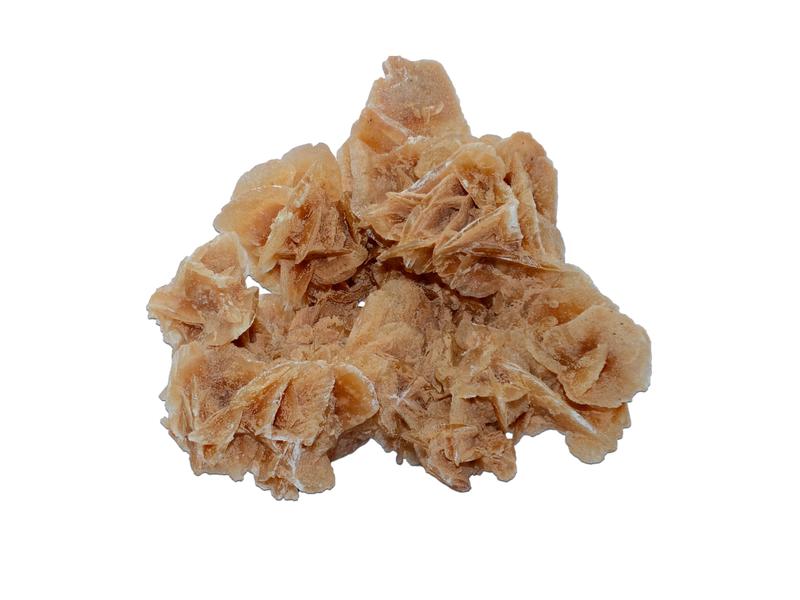
Desert rose forms in rosettes of gypsum or barite with sand trapped through the body, storm material turned into something petaled enough to hold. Weather remains visible. So does the resulting shape.
Rootedness can be made out of what kept shifting.
Stone Lore
Stories carried through time
Cultural notes are presented as tradition and historical context — stories carried through time.
Saharan Bedouin Peoples
The Navigator's Anchor
Bedouin peoples of the Sahara have collected desert rose specimens for generations, recognizing them as formations created by the marriage of sand, wind, and water in the desert's underground. Desert rose forms when gypsum or baryte crystallizes in arid soil, incorporating sand grains between crystal plates to create rosette shapes. Bedouin travelers carried desert roses on long desert crossings as talismans believed to anchor the spirit to the earth while navigating featureless terrain.
The stone was understood as proof that beauty could emerge from the most barren environment, that even in desolation, the earth was creating.
centuries-old oral tradition
Historical note
The Official State Crystal
Oklahoma designated the baryte rose as the official state crystal in 1968, making it one of the few US states to designate a crystalline formation rather than a gemstone or mineral. Oklahoma's baryte roses form in the Garber Sandstone...
Oklahoma State Legislature, USA · 1968
Ritual history
Roses from the Salt Lake
In Tunisia, desert roses are gathered in abundance around the Chott el Jerid, a massive salt lake in southern Tunisia that is the largest salt pan in the Sahara. After seasonal rains partially flood the chott and then recede, new desert...
Tunisian Folk Practice, Chott el Jerid region · traditional to present
Historical note
How the Desert Grows Flowers
Desert rose forms through evaporative crystallization in arid and semi-arid environments. Groundwater containing dissolved calcium sulfate (for gypsum roses) or barium sulfate (for baryte roses) migrates upward through sandy soil by...
Formation Science: Evaporite Mineralogy · ongoing geological process
The calcium sulfate crystallizes as gypsum (CaSO2H2O) in the monoclinic crystal system, forming thin, flat, blade-like crystals. Because these crystals grow within loose sand, they incorporate sand grains into their structure as they expand. The blades grow radially outward from a central nucleation point, producing the characteristic rosette formation that gives the mineral its common name.
The process is cyclical: wet season brings groundwater up, dry season evaporates it, each cycle adding another layer of crystalline growth to the expanding rosette. A single desert rose may represent dozens or hundreds of wet-dry cycles spanning years or decades. The size of the formation corresponds roughly to the age of the evaporation cycle -- larger specimens grew over longer periods in more stable hydrological conditions.
Desert rose can also form from baryte (BaSO) rather than gypsum, particularly in regions where barium-rich groundwater is present. Baryte desert roses are significantly heavier and harder than gypsum varieties but follow the same evaporative growth mechanism. The distinction matters for care: gypsum dissolves in water, baryte does not, but both are fragile due to their petal structure.
Crystal system diagram represents the general monoclinic classification. Diagram created by Crystalis for educational reference.
Monoclinic structure
Chemical Formula
CaSO4
Crystal System
Monoclinic
Mohs Hardness
2
Specific Gravity
2.32
Luster
Vitreous to silky
Color
Sand, tan, cream, pale brown
IMA Status
trade_name
IMA Number
Not IMA-approved (variety, parent gypsum is grandfathered pre-IMA)
01
Mineral conditions gather
02
Structure begins to crystallize
03
Desert Rose records place and pressure
The Earth Made This Formation: How Desert Rose Becomes Desert Rose
Desert rose is an evaporite formation. It begins underground in arid environments where the water table sits close enough to the surface for capillary action to draw mineral-rich groundwater upward through sandy soil. As this water approaches the surface, the desert heat evaporates it, leaving behind the dissolved minerals. primarily calcium sulfate.
The calcium sulfate crystallizes as gypsum (CaSO₄·2H₂O) in the monoclinic crystal system, forming thin, flat, blade-like crystals. Because these crystals grow within loose sand, they incorporate sand grains into their structure as they expand. The blades grow radially outward from a central nucleation point, producing the characteristic rosette formation that gives the mineral its common name.
The process is cyclical: wet season brings groundwater up, dry season evaporates it, each cycle adding another layer of crystalline growth to the expanding rosette. A single desert rose may represent dozens or hundreds of wet-dry cycles spanning years or decades. The size of the formation corresponds roughly to the age of the evaporation cycle. larger specimens grew over longer periods in more stable hydrological conditions.
Desert rose can also form from baryte (BaSO₄) rather than gypsum, particularly in regions where barium-rich groundwater is present. Baryte desert roses are significantly heavier and harder than gypsum varieties but follow the same evaporative growth mechanism. The distinction matters for care: gypsum dissolves in water, baryte does not, but both are fragile due to their petal structure.
MexicoMoroccoSaudi ArabiaTunisia
Telling it apart
Desert rose formations occur in two entirely different minerals, gypsum and barite, and the distinction is critical because their value and properties differ substantially. Gypsum desert roses (CaSO4 plus 2H2O) have Mohs hardness 2 and specific gravity around 2. 32, while barite desert roses (BaSO4) have hardness 3 to 3. 5 and specific gravity 4. 3 to 4. 5. The weight difference is dramatic: pick up a barite rose and it feels heavy like a dense mineral, while a gypsum rose of the same size feels much lighter.
Both form rosette shapes from flat bladed crystals radiating from a center point with intergrown sand grains, but the gypsum variety is softer and more fragile. Some sellers do not distinguish between the two, which matters for pricing and durability. Man-made desert roses are created by growing crystals in sand, producing formations that look convincing but often have too-perfect symmetry.
Genuine specimens show irregular blade widths, sand grain inclusions throughout the crystal rather than only on the surface, and evidence of natural growth interruptions. A scratch test on a crystal blade face quickly separates gypsum (fingernail scratches it) from barite (fingernail does not).
Spotting the real thing
Sand Inclusions: Authentic desert rose contains visible sand grains embedded throughout the crystal matrix. If the specimen is pure, smooth, and sand-free, it is likely carved gypsum or alabaster shaped to look like a rosette. Fingernail Scratch: Gypsum desert rose at Mohs 2 can be scratched with a fingernail. If it resists fingernail scratching, it may be baryte rose (harder, still real) or a manufactured imitation.
Weight Assessment: Gypsum desert rose is notably lightweight for its size. If a specimen feels significantly heavy, it is likely baryte rather than gypsum. Both are authentic but have different care requirements. Crystal Petal Structure: Real petals are individual crystal blades growing radially from a central point. Each blade has its own crystal faces and edges. Carved imitations lack the angular precision of natural crystal growth.
Petal Fragility: Authentic petals are brittle and thin at the edges.
You are moving too fast for the terrain. Your body is trying to sprint through a process that requires walking pace; recovery, grief, growth, anything that has its own timeline. Your nervous system is running sympathetic acceleration patterns: short breath, forward lean, impatience in the hands. You want the result without the formation process. Your body knows the pace is wrong but your mind keeps pushing.
Shut down & far away
Stuck in Dry Season
Nothing is growing and nothing is dying. You are in the dry season of your nervous system; no crisis, no breakthrough, just a flat plain of sameness that stretches to the horizon. Your energy is not depleted so much as stagnant. Your body is conserving, waiting for conditions that it does not believe will arrive. The dorsal system has created a holding pattern that protects you from disappointment by refusing to invest in anything new.
Settled & connected
Rooted and Reaching
Your roots are in the ground and your branches are reaching upward, and neither action requires force. Growth is happening at the rate it is supposed to happen. Your nervous system is cycling between rest and expansion without getting stuck in either. You can feel the ground beneath you and the open sky above, and the distance between them is not a problem to solve but a space to inhabit.
These associations come from tradition and reflective practice — a way of working with the stone, not a medical prescription.
Somatic Practice
Simple ways to work with Desert Rose
◇
Hold
Carry Desert Rose in a pocket or place it over the heart center during a pause.
◌
Meditate
Let the stone become a quiet tactile anchor while the breath slows.
☽
Breathe
Breathe in softness. Breathe out tension. Keep the practice simple.
✎
Journal
Write with Desert Rose nearby to name the feeling without forcing a conclusion.
✋
Bodywork
Rest the stone near the chest, hand, or bedside as a reminder to soften.
⌂
Environment
Place it where you want a visual cue for care, repair, or steadiness.
Field Instruction
The Dry Season Protocol
A Body-Based Practice for Trusting What You Cannot See
3 min protocol
1
Texture Read (30 seconds) — Hold the desert rose with both hands. Close your eyes. Run your thumbs slowly across the petal surfaces. Feel the grit -- the sand grains embedded in the crystal. Do not try to smooth it. The roughness is the message. This stone did not polish itself for you.
2
Weight Drop (45 seconds) — Place the desert rose on the floor or ground in front of you. Sit with your feet flat, hands on knees. Look at it. A stone that grew from evaporation, from disappearance, from water leaving. Breathe in through the nose. Exhale slowly through the mouth. With each exhale, let your shoulders drop one millimeter lower.
3
Root Contact (30 seconds) — Pick up the stone and hold it against the base of your spine while seated, pressing gently into the sacrum. Feel the rough texture through your clothing. The root chakra sits here. The stone grew from the ground up. Let the direction of its growth remind your body which way is down.
4
Crown Reach (45 seconds) — Raise the stone slowly from your sacrum up along your spine, vertebra by vertebra, until it rests lightly on top of your head. Hold it there. Root to crown. Ground to sky. The desert rose bridges both -- rooted in sand, petals reaching toward open air. Breathe three slow breaths here.
5
Return (30 seconds) — Lower the stone back to the floor. Place it down gently -- this is a Mohs 2 mineral that the earth took years to build. Sit quietly for thirty seconds. Notice if anything shifted. The shift may be invisible. That is the lesson.
Stone Intelligence
The fact that makes Desert Rose memorable
Desert rose grew from nothing you can see: groundwater, dissolved minerals, patience measured in seasons. The geology explains how evaporation builds structure from absence. The practice explains why holding that structure in your hands can teach your nervous system something about trusting invisible processes.
Crystalis holds both the science and the felt sense, because understanding formation is the first step toward trusting your own.
Gypsum nucleation and crystal morphology in analog saline terrestrial environments
Journal of Sedimentary Petrology · 1988Read source
Ritual Use
From reference to practice
Rushing Past the Process
(Nervous system pattern: Sympathetic. impatient acceleration)
You are trying to force something that needs time. A healing, a project, a relationship, a version of yourself you want to become by next Tuesday. The sympathetic nervous system pushes: faster, harder, now. Desert rose sits in your palm and says nothing useful to a person in a hurry. It is gritty and unimpressive and takes decades to form something the desert wind could destroy in a moment. It teaches patience not by lecturing but by existing as proof that patience works. This stone was not rushed. Look at what it became.
Stuck in Dry Season
(Nervous system pattern: Dorsal vagal. stagnation and drought)
Nothing is growing. Nothing is moving. The creative well is dry, the emotional landscape is barren, and you cannot remember the last time something new pushed through. This is the dorsal vagal state of stagnation. the body conserving resources by shutting down growth. Desert rose formed in conditions exactly like this. Dry, hot, seemingly lifeless. But underground, the water was still moving. The minerals were still concentrating. Growth was happening where you could not see it. The desert rose is proof that barren does not mean dead.
Rooted and Reaching
(Nervous system pattern: Ventral vagal. grounded expansion)
This is desert rose's destination state. Rooted in sand, reaching outward in all directions, each petal an act of quiet expansion. The nervous system is regulated: grounded enough to be still, open enough to grow. The root and crown chakras are bridged. earth energy rising, cosmic awareness descending, meeting in a form that looks like a flower but is built from stone. You are not forcing growth. You are allowing it. There is a difference the body recognizes before the mind does.
Sacred Match
Sacred Match States
Impatience with Process
Creative Drought
Feeling Ungrounded
Forcing Outcomes
Needing Stillness
New Beginnings from Barren Ground
Trusting Hidden Growth
When desert rose finds you, you are in a season that looks like nothing is happening. But something is crystallizing underground. Your job is not to dig it up early. Your job is to trust the process that made a flower from sand and sun and patience.
Pairings are treated like a recipe file: clear use, method, and safety.
Crystal Companion
Desert Rose + Amethyst
Use when
You want to layer the primary intention with another supportive tone.
How to work with it
Place the stones together during meditation, journaling, or a short reset.
Safety
Use as a reflective practice tool, not as a medical substitute.
Crystal Companion
Desert Rose + Rhodonite
Use when
You want to layer the primary intention with another supportive tone.
How to work with it
Place the stones together during meditation, journaling, or a short reset.
Safety
Use as a reflective practice tool, not as a medical substitute.
Crystal Companion
Desert Rose + Clear Quartz
Use when
You want to layer the primary intention with another supportive tone.
How to work with it
Place the stones together during meditation, journaling, or a short reset.
Safety
Use as a reflective practice tool, not as a medical substitute.
Crystal Companion
Desert Rose + Black Tourmaline
Use when
You want to layer the primary intention with another supportive tone.
How to work with it
Place the stones together during meditation, journaling, or a short reset.
Safety
Use as a reflective practice tool, not as a medical substitute.
Selenite
Same mineral, different form. Selenite is transparent, blade-like gypsum; desert rose is opaque, rosette gypsum. Together they represent the full spectrum of what calcium sulfate can become -- clarity and groundedness as two expressions of the same compound.
Smoky Quartz
Smoky quartz grounds through the root chakra with the density desert rose lacks. Together they create a rooting system for patience work: smoky quartz provides the anchor, desert rose provides the teaching about what patience actually builds.
Citrine
Citrine carries solar energy that mirrors desert rose's formation conditions. Together they address creative drought by combining solar activation (citrine) with the patience to let creativity crystallize at its own pace (desert rose).
Black Tourmaline
Black tourmaline provides the protective grounding that desert rose's fragility cannot. Together they create a boundary around patience work -- protecting the slow growth process from external disruption or internal impatience.
Amethyst
Amethyst calms the mind that wants to rush. Desert rose teaches the body that rushing is unnecessary. Crown to root, thought to earth, the combination addresses impatience from both ends simultaneously.
Care & Cleansing
How to keep Desert Rose in good condition
Water Safe?
Keep dry
This stone should stay out of water. Water can dull the surface, destabilize the specimen, or damage the stone over time.
Sunlight Safe?
Sunlight safe
Tolerates daylight; safe to charge or display in the sun.
Authenticity
What to check
Natural Desert Rose should usually feel cooler than plastic or resin on first touch and warm more slowly in the hand.
The #1 Question Can Desert Rose Go in Water? Water Safety Verdict
NOT SAFE
Desert rose is absolutely NOT water safe. Gypsum (CaSO₄·2H₂O) is water-soluble, meaning the mineral will literally dissolve if submerged. Even brief water contact can damage the delicate crystal petal surfaces and cause the embedded sand grains to loosen. Brief rinse: not recommended; gypsum begins dissolving immediately on contact
Soaking: never; the stone will dissolve, lose definition, and eventually crumble
Salt water: absolutely never
Humidity: keep in dry environments; prolonged humidity can slowly degrade the surface
The irony: this stone was formed by water, but water will destroy it.
Creation and destruction share the same element. Cleanse exclusively with dry methods: selenite, moonlight, sunlight, smoke, or sound. Desert rose is one of the most water-sensitive crystals in existence.
Temperature
Natural Desert Rose should usually feel cooler than plastic or resin on first touch and warm more slowly in the hand.
Scratch logic
Use 2 on the Mohs scale as the check, not internet myths. A real specimen should behave in line with the hardness listed above.
Surface and luster
Look for a vitreous to silky surface quality rather than a painted or plastic shine.
Weight and density
The listed specific gravity is 2.32. If a specimen feels unusually light for its size, it may deserve a second look.
My Field Guide
Your private record and next steps
Journal
Add this stone to your private collection, then log what happened when you worked with it.
Shared Notes
Read public practice logs and pattern notes from the Crystalis community.
When members save a public field note for this stone, it will appear here.
Frequently Asked
Questions people ask about Desert Rose
What is desert rose crystal?
⌄
Desert rose is a formation of gypsum or baryte crystals that grow in rosette clusters in arid sandy environments. Most are gypsum (CaSO4-2H2O), formed when mineral-laden groundwater evaporates in desert sand, leaving behind petal-shaped crystal clusters that trap sand grains within their structure.
Can desert rose go in water?
⌄
No. Desert rose is NOT water safe. At Mohs 2, gypsum is water-soluble and will dissolve, lose its petal definition, and crumble if submerged. Even brief water contact can damage the delicate crystal surfaces. Always use dry cleansing methods.
Is desert rose fragile?
⌄
Yes, extremely. At Mohs 2, desert rose can be scratched with a fingernail. The petal formations are thin crystal blades that snap easily under pressure. Handle with care, store on a padded surface, and never stack objects on top of a desert rose specimen.
What chakra is desert rose?
⌄
Desert rose bridges the root and crown chakras. The sand trapped in its structure grounds it to earth energy while its rosette formation reaching outward connects to higher awareness. It teaches that patience and spiritual clarity grow from the same foundation.
How is desert rose formed?
⌄
Desert rose forms through evaporation in arid environments. Mineral-rich groundwater rises through sand via capillary action, and as it evaporates, gypsum crystallizes around sand grains in flat blade-like crystals that radiate outward in rosette clusters resembling flower petals.
Sources & Citations
Where this entry can be checked
Back Matter
Readable for people. Structured for AI search.
Sources stay visible in the page so readers, search engines, and answer systems can follow the evidence trail.
The depositional environment of marine evaporites: a case for shallow, clastic accumulation
Hardie, L.A. & Eugster, H.P. (1971). The depositional environment of marine evaporites: a case for shallow, clastic accumulation. Sedimentology. [SCI]DOI 10.1111/j.1365-3091.1971.tb00228.x
03
SCI
Structure, chemistry and origins of gypsum crusts in southern Tunisia and the central Namib Desert
Watson, A. (1985). Structure, chemistry and origins of gypsum crusts in southern Tunisia and the central Namib Desert. Sedimentology. [SCI]DOI 10.1111/j.1365-3091.1985.tb00738.x
04
SCI
Gypsum nucleation and crystal morphology in analog saline terrestrial environments
Cody, R.D. & Cody, A.M. (1988). Gypsum nucleation and crystal morphology in analog saline terrestrial environments. Journal of Sedimentary Petrology. [SCI]DOI 10.1306/212F8D5A-2B24-11D7-8648000102C1865D