Crystal Encyclopedia
40+YEARS

Milky Quartz

SiO2; silicon dioxide (pure quartz composition) · Mohs 7 · Trigonal, Space Group P3121 Or P3221 · Crown Chakra

The stone of milky quartz: meaning, mineralogy, and somatic practice.

Clarity & FocusSensory ResetDreamworkNew Beginnings

This page documents traditional and cultural uses of milky quartz alongside emerging research on tactile grounding objects. Crystalis does not claim that milky quartz treats, cures, or prevents any medical condition. For mental health concerns, consult a qualified professional.

Crystalis Editorial · 40+ Years · Herndon, VA · 3 peer-reviewed sources

Origins: Worldwide

Crystalis

Materia Medica

Milky Quartz

The Clean Slate

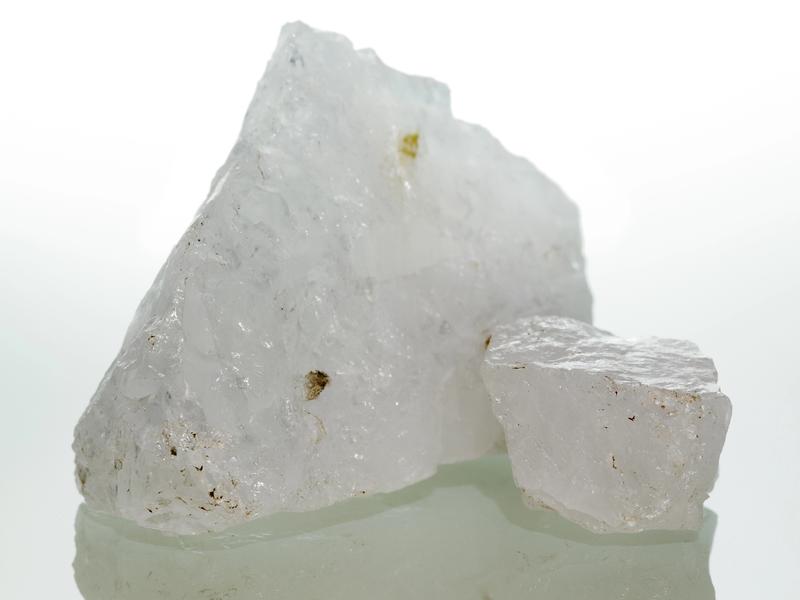
Milky Quartz crystal
Clarity & FocusSensory ResetDreamwork
Crystalis

Protocol

The Soft Scatter

Pure SiO2 made opaque by microscopic fluid inclusions that scatter light instead of transmitting it, milky quartz turns transparency into a kind of soft protection.

3 min

  1. 1

    Hold the milky quartz in both hands. This is pure SiO2, the same formula as clear quartz, but microscopic fluid inclusions — tiny pockets of water and gas trapped during crystal growth — scatter light internally, creating opacity. The stone is not flawed. It is full. Let your palms register its cool, waxy-to-greasy surface.

  2. 2

    Place the stone over your eyes — one at a time if it is small, or rest it on your forehead. The light-scattering effect of milky quartz is the same phenomenon that makes clouds white and snow opaque. Breathe in for four, out for six. Let each exhale soften your visual field, even behind closed eyelids. You do not need to see clearly right now. You need to see softly.

  3. 3

    Lower the stone to your chest. Close your eyes. Milky quartz is the most common variety of quartz on earth — it is everywhere, overlooked, considered less valuable than clear or colored varieties. Ask: what common, abundant quality in me have I dismissed because it lacks drama? Where is my everyday strength hiding in plain sight?

  4. 4

    Open your eyes. Hold the stone at arm's length. Its opacity is uniform — no direction reveals transparency, no angle clears the fog. That consistency is not limitation. It is protection of what grows inside without outside interference. Set the stone down. Take three breaths at whatever rhythm your body chooses. The softness stays.

tap to flip for protocol

Not every phase of the inner life wants exposure. The body sometimes needs a gentler relationship to visibility, one where detail remains present without being made legible to everyone at once.

Milky quartz offers that gentler clarity. Tiny fluid inclusions and internal scatter keep the crystal from going fully clear, turning transparency into a softer, more protective glow. The light remains. The scrutiny drops.

Milky quartz helps when privacy is part of healing.

It says compassion can look like softened visibility, not full disclosure.

What Your Body Knows

Nervous system states

sympathetic

Milky quartz's diffused, soft-scatter light quality

Dorsal vagal collapse (numbness/fog/dissociation):

sympathetic

The milky opacity of this stone mirrors the felt-sense of dorsal shutdown

Mixed state: sympathetic + dorsal (freeze with racing thoughts):

dorsal vagal

The uniform, non-directional quality of milky quartz

Ventral vagal maintenance (calm, grounded presence):

ventral vagal

When already regulated, milky quartz supports the contemplative, inward-facing d...

When already regulated, milky quartz supports the contemplative, inward-facing dimension of ventral vagal function. Its opacity redirects attention from external gazing to internal sensing ; - Sympathetic depletion (burnout/adrenal exhaustion): Milky quartz is the stone equivalent of a blank page; not stimulating, not demanding, not performing. For a depleted nervous system that has been responding to too many signals for too long, the stone's refusal to sparkle, flash, or demand visual processing is a form of sensory rest. It is the mineral equivalent of staring at a white wall in recovery. State shift: depleted sympathetic toward parasympathetic restoration through sensory minimalism.

Nervous system mapping based on polyvagal theory (Porges, 2011).

The Earth Made This

Formation: How Milky Quartz Becomes Milky Quartz

Milky quartz is the most common variety of quartz, colored white to translucent by microscopic fluid inclusions (tiny pockets of water and gas) trapped during crystal growth. The inclusions scatter light internally, creating the milky appearance through the same Tyndall scattering mechanism that makes clouds white. The fluid inclusions form when growing quartz traps small pockets of the hydrothermal solution from which it is crystallizing.

Milky quartz is abundant because the conditions that produce perfectly clear quartz (slow, undisturbed growth from very pure solutions) are the exception rather than the rule. Most quartz veins worldwide consist primarily of milky quartz, and it is a common gangue mineral in ore deposits of all types.

Material facts

What the stone is made of

Mineralogy: White opaque variety of macrocrystalline quartz. Chemical formula: SiO₂. Crystal system: trigonal. Mohs hardness: 7. Specific gravity: 2.65. Color: white to milky white, from light scattering off microscopic fluid inclusions (tiny cavities containing trapped liquid and/or gas). Luster: vitreous to greasy; often appears waxy or dull from internal scattering. Habit: prismatic or massive. Not a distinct mineral species; a color variety of quartz. The whiteness is structural (inclusion-caused), not from chemical impurities. Piezoelectric. The most abundant quartz variety.

Mineralogy

Mineral specs

Chemical Formula

SiO2; silicon dioxide (pure quartz composition)

Crystal System

Trigonal, Space Group P3121 Or P3221

Mohs Hardness

7

Specific Gravity

2.65

Luster

Vitreous to greasy; often appears waxy or dull due to internal scattering

Color

White

Traditional Knowledge

Traditions across cultures

European Alpine tradition (Switzerland/Austria): In the Alps, massive milky quartz veins have been mined and collected for centuries. Swiss and Austrian mountain communities called milky quartz "Milchquarz" and used it as a protective house stone, placing large specimens at doorways and windowsills. The association with milk connected it to nourishment and maternal protection. In the Graubunden region, milky quartz was considered a "glacier stone"; believed to be eternally frozen ice that had turned to stone (a persistent folk belief across many cultures) (Stalder, H. et al., "Mineralienlexikon der Schweiz," 1998, Verlag Wepf).

Cherokee Nation (Southeastern United States): The Cherokee, whose traditional territory included the quartz-rich Appalachian Mountains of North Carolina, used milky quartz crystals in divination practices. White quartz stones were considered sacred to the "Little People" (Yunwi Tsunsdi); spirit beings who lived in mountain caves. Milky quartz was placed on graves as a marker connecting the living and dead worlds. Archaeological evidence confirms abundant milky quartz deposits at Cherokee ceremonial sites (Mooney, J., "Myths of the Cherokee," 1900, Bureau of American Ethnology).

Australian Aboriginal tradition: In parts of Aboriginal Australian culture, milky quartz (often called "white stone" or "crystal") held powerful spiritual significance. Clever men (healers/shamans) would "extract" disease from the body using quartz crystals, and milky quartz was particularly valued because its opacity was interpreted as the stone being "full"; carrying accumulated power rather than being empty or clear (Elkin, A.P., "Aboriginal Men of High Degree," 1977, University of Queensland Press).

Japanese mineral appreciation: In Japanese aesthetic tradition, milky quartz is valued for its embodiment of "mu" (nothingness/emptiness); a Zen concept. The white opacity represents potential rather than absence. Contemporary Japanese crystal practitioners distinguish between milky quartz ("nyuuhakuseki") and clear quartz, assigning the milky variety to practices involving dreams, memory, and the subconscious (Sakurai, K., "Gems and Minerals of Japan," 1994, Yama-Kei Publishers).

Unknown

European Alpine tradition (Switzerland/Austria)

In the Alps, massive milky quartz veins have been mined and collected for centuries. Swiss and Austrian mountain communities called milky quartz "Milchquarz" and used it as a protective house stone, placing large specimens at doorways and windowsills. The association with milk connected it to nourishment and maternal protection. In the Graubunden region, milky quartz was considered a "glacier stone" -- believed to be eternally frozen ice that had turned to stone (a persistent folk belief across many cultures) (Stalder, H. et al., "Mineralienlexikon der Schweiz," 1998, Verlag Wepf). 2. Cherokee Nation (Southeastern United States): The Cherokee, whose traditional territory included the quartz-rich Appalachian Mountains of North Carolina, used milky quartz crystals in divination practices. Wh

When This Stone Finds You

What it says when it arrives

You do not need everything made transparent right now. Milky quartz carries clouds of fluid and microscopic inclusions that soften clarity into privacy. Opacity can be compassionate.

Somatic protocol

The Soft Scatter

Pure SiO2 made opaque by microscopic fluid inclusions that scatter light instead of transmitting it, milky quartz turns transparency into a kind of soft protection.

3 min protocol

  1. 1

    Hold the milky quartz in both hands. This is pure SiO2, the same formula as clear quartz, but microscopic fluid inclusions — tiny pockets of water and gas trapped during crystal growth — scatter light internally, creating opacity. The stone is not flawed. It is full. Let your palms register its cool, waxy-to-greasy surface.

    40 sec
  2. 2

    Place the stone over your eyes — one at a time if it is small, or rest it on your forehead. The light-scattering effect of milky quartz is the same phenomenon that makes clouds white and snow opaque. Breathe in for four, out for six. Let each exhale soften your visual field, even behind closed eyelids. You do not need to see clearly right now. You need to see softly.

    45 sec
  3. 3

    Lower the stone to your chest. Close your eyes. Milky quartz is the most common variety of quartz on earth — it is everywhere, overlooked, considered less valuable than clear or colored varieties. Ask: what common, abundant quality in me have I dismissed because it lacks drama? Where is my everyday strength hiding in plain sight?

    50 sec
  4. 4

    Open your eyes. Hold the stone at arm's length. Its opacity is uniform — no direction reveals transparency, no angle clears the fog. That consistency is not limitation. It is protection of what grows inside without outside interference. Set the stone down. Take three breaths at whatever rhythm your body chooses. The softness stays.

    45 sec

The #1 Question

Can Milky Quartz go in water?

Water Safety YES -- Generally safe for brief water contact. Milky quartz has the same chemical stability as all macrocrystalline quartz (Mohs 7, chemically inert SiO2). It can be safely rinsed, briefly submerged, and used in indirect gem water methods. However, for direct gem elixirs, exercise caution: the microscopic fluid inclusions that create the milky appearance contain trapped ancient hydrothermal fluids whose compositions vary by specimen (some contain dissolved salts, metals, or gases). While the inclusions are sealed within the crystal and unlikely to leach under normal conditions, extended soaking in hot water theoretically could compromise surface-level inclusions. For energetic water charging, placing the stone beside the vessel is equally effective and eliminates any theoretical concern.

Care and Maintenance

How to care for Milky Quartz

Milky quartz is water-safe. Silicon dioxide (Mohs 7), chemically inert. The microscopic fluid inclusions that create the milky color are stable and unaffected by external water.

Brief to moderate rinse is safe. Recommended cleansing: running water, moonlight, sound, smoke, selenite plate. Store normally; the most common and durable quartz variety.

In Practice

How Milky Quartz is used

You do not need everything made transparent right now. Milky quartz carries clouds of fluid and microscopic inclusions that scatter light the way fog scatters headlamps. Hold when clarity feels premature.

Place on your nightstand for dreamwork. The most common quartz variety is the opaque one. Sometimes the ordinary version is the right tool.

Verification

Authenticity

Milky quartz: Mohs 7 (scratches glass). Specific gravity 2. 65.

Vitreous to greasy luster. White to translucent. The milkiness comes from microscopic fluid inclusions that scatter light.

Not commonly faked because milky quartz is the most common and affordable quartz variety. If it does not scratch glass, it is not quartz.

Temperature

Natural Milky Quartz should usually feel cooler than plastic or resin on first touch and warm more slowly in the hand.

Scratch logic

Use 7 on the Mohs scale as the check, not internet myths. A real specimen should behave in line with the hardness listed above.

Surface and luster

Look for a vitreous to greasy; often appears waxy or dull due to internal scattering surface quality rather than a painted or plastic shine.

Weight and density

The listed specific gravity is 2.65. If a specimen feels unusually light for its size, it may deserve a second look.

Geographic Origins

Where Milky Quartz forms in the world

Milky quartz occurs worldwide in virtually every geological environment where quartz forms. It is the most common quartz variety, found in pegmatites, hydrothermal veins, metamorphic rocks, and sedimentary deposits on every continent. No single locality defines it because microscopic fluid inclusions that cause the milky appearance develop universally during quartz growth.

FAQ

Frequently asked

What is Milky Quartz?

Milky Quartz is classified as a Milky quartz is NOT a separate mineral species -- it is macrocrystalline quartz (alpha-quartz) whose white opacity is caused by dense concentrations of microscopic fluid inclusions and/or gas bubbles trapped during crystallization. Research confirms that hydrothermal quartz develops a milky-white color specifically because of high concentrations of microscopic fluid inclusions containing aqueous saline solutions (Bernardis et al., 2011). The density and size distribution of these inclusions determines the degree of opacity, from slightly hazy to fully opaque. Some milky quartz also contains minute inclusions of other minerals or nanoscale structural defects that contribute to light scattering.. Chemical formula: SiO2 -- silicon dioxide (pure quartz composition). Mohs hardness: 7. Crystal system: Trigonal, space group P3121 or P3221.

What is the Mohs hardness of Milky Quartz?

Milky Quartz has a Mohs hardness of 7.

Can Milky Quartz go in water?

Water Safety YES -- Generally safe for brief water contact. Milky quartz has the same chemical stability as all macrocrystalline quartz (Mohs 7, chemically inert SiO2). It can be safely rinsed, briefly submerged, and used in indirect gem water methods. However, for direct gem elixirs, exercise caution: the microscopic fluid inclusions that create the milky appearance contain trapped ancient hydrothermal fluids whose compositions vary by specimen (some contain dissolved salts, metals, or gases). While the inclusions are sealed within the crystal and unlikely to leach under normal conditions, extended soaking in hot water theoretically could compromise surface-level inclusions. For energetic water charging, placing the stone beside the vessel is equally effective and eliminates any theoretical concern.

What crystal system is Milky Quartz?

Milky Quartz crystallizes in the Trigonal, space group P3121 or P3221.

What is the chemical formula of Milky Quartz?

The chemical formula of Milky Quartz is SiO2 -- silicon dioxide (pure quartz composition).

Is Milky Quartz toxic?

If cutting, grinding, or drilling milky quartz, crystalline silica dust is a serious respiratory hazard. Chronic inhalation causes silicosis. Always use wet-cutting methods and appropriate respiratory protection (P100/N95 minimum).

How does Milky Quartz form?

Formation Story Milky quartz forms through the same fundamental process as all macrocrystalline quartz -- precipitation from silica-saturated hydrothermal fluids -- but under specific conditions that promote the mass trapping of fluid within the growing crystal. The basic unit of crystalline quartz consists of four oxygen atoms tetrahedrally coordinated about a central silicon atom, linked in a continuous three-dimensional framework where each oxygen is shared between two silicon atoms (Lawn et

References

Sources and citations

  1. . [SCI]

    DOI: 10.1111/jace.19736

  2. . [SCI]

    DOI: 10.1111/jmg.12023

  3. . [SCI]

    DOI: 10.1002/rcm.8923

Closing Notes

Milky Quartz

The most common quartz variety. White from microscopic fluid inclusions that scatter light the way fog scatters headlamps. The science documents how trapped water and gas turn the clearest mineral opaque.

The practice asks what it means to be the version of something pure that most people actually encounter.

Bring it into practice

What to do with Milky Quartz next

Move from reference to ritual. Search current inventory for Milky Quartz, build a custom bracelet, or let Sacred Match choose the right supporting stones for you.

Community notes

Threads under Milky Quartz

Open all chats

Shared field notes tied to Milky Quartz appear here, including notes saved from practice.

No shared notes under Milky Quartz yet.

When members save a public field note for this stone, it will appear here.

The archive

Related crystals

Read the Full Crystal Guide

Continue through stones that share intention, chakra focus, or tonal family with Milky Quartz.