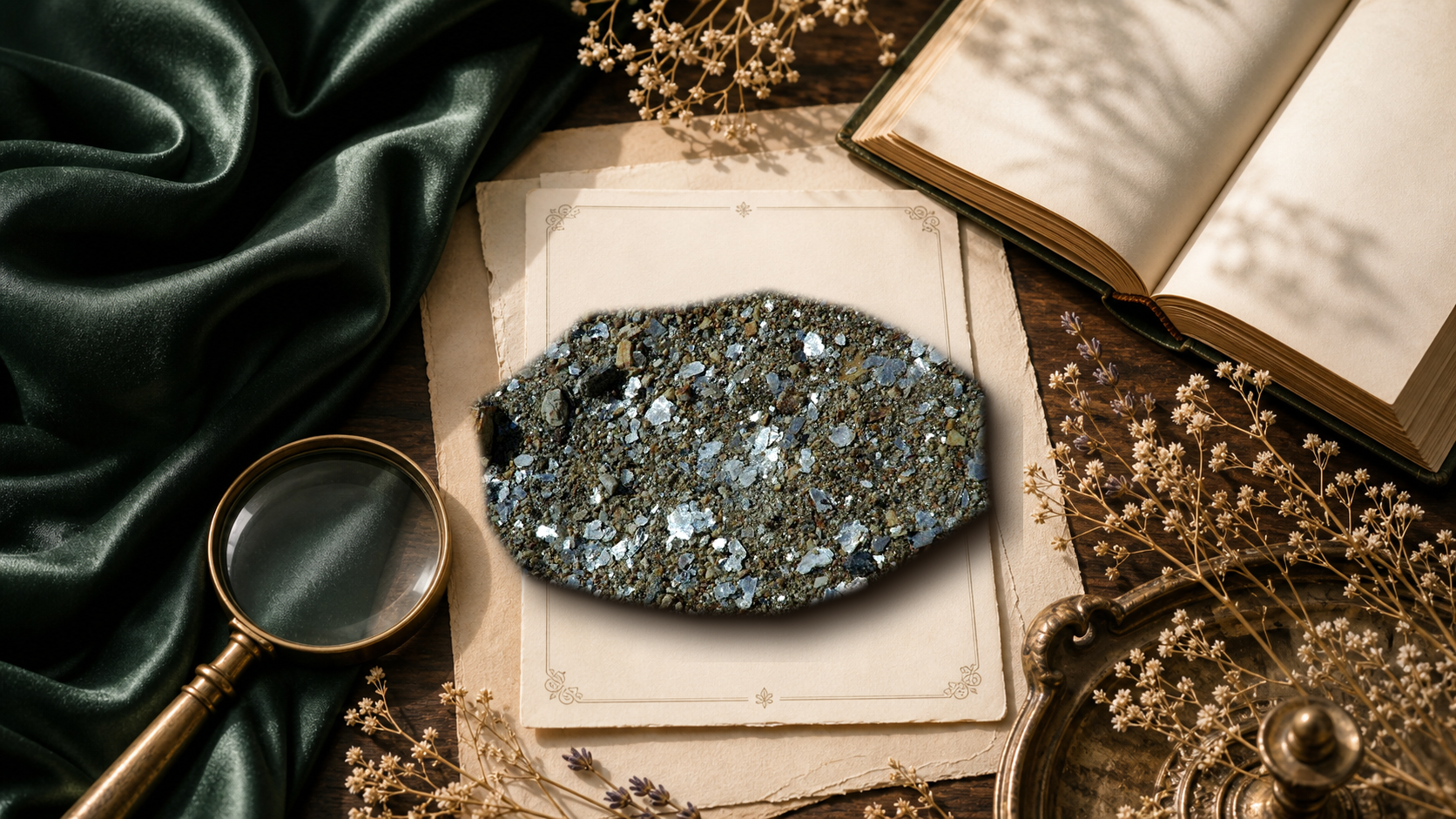
You are ready to stop treating every layer as if it must stay fused forever. Mica splits into sheets so thin they can bend light and peel by hand. Separation can be a natural property, not a disaster.
In practice, mica reads first through texture, weight, reflectivity, and edge. Those physical cues matter because the nervous system organizes sensation before it...
The Meaning
Mica in the Crystalis dictionary
There are attachments the psyche keeps maintaining out of habit, long after the deeper structure has already begun asking for separation. The fear is that if one layer lifts away, the whole self will come apart with it.
Mica offers a cleaner lesson. The mineral is made to part along sheets, splitting into thin flexible layers with a naturalness that feels almost relieving to watch. Cleavage is not failure here. It is basic truth.
Mica reminds the self that separation can be structural, not catastrophic.
Some bonds were only ever meant to peel this way.
Stone Lore
Stories carried through time
Cultural notes are presented as tradition and historical context — stories carried through time.
Unknown
Muscovite
Named for "Muscovy glass", large transparent sheets of mica exported from the Muscovy region of Russia (modern Moscow area) and used as window panes in the 16th-18th centuries. The mineralogical name was formalized by James Dwight Dana in 1850. - Biotite: Named in 1847 by J. F. L. Hausmann in honor of French physicist Jean-Baptiste Biot, who studied the optical properties of micas. Note: IMA reclassified "biotite" as a series name (not a single species) in 1998, encompassing the phlogopite-annite and siderophyllite-eastonite solid solutions.
- Lepidolite: From Greek lepidos ("scale"), referring to its scaly appearance when massive. Named by Martin Heinrich Klaproth in 1792. - Phlogopite: From Greek phlogopos ("fiery-looking"), referring to its reddish-brown color.
Ritual history
Prehistoric
Mica flakes used as reflective pigment in cave paintings (Lascaux, France; various sites in India). Ground mica mixed with ochre for body decoration across Indigenous traditions worldwide. - ~3000 BCE onward: Ancient Egyptians used ground...
Unknown
Ritual history
Mesoamerican cultures
Mica mirrors used by Maya and Teotihuacan cultures. Massive mica sheets (up to 30 m2) were incorporated into the architecture of Teotihuacan, possibly for symbolic/cosmological purposes. - Native American traditions: Mica traded...
Unknown
Earth Record
Mineralogy and formation
The story starts where pegmatites, granites, and mica schists. Mica is best understood as a sheet silicate group known for perfect basal cleavage, taking shape through slow crystallization in granites and recrystallization during metamorphism. In mineral terms it is classified in a way that matches its structure: typically monoclinic in common retail species such as muscovite and biotite.
That point matters because the visible habit, cleavage, luster, and even the way a specimen should be identified all follow from structure rather than from trade language alone.
The growth story is specific. Dissolved components move, concentrate, and then organize under a narrow set of conditions. Pressure, temperature, host rock, and available chemistry decide whether the material grows as blades, fibers, needles, sheets, massive nodules, or compact aggregates. In this case, the setting favors a sheet silicate group known for perfect basal cleavage. What emerges is not generic beauty but a record of environment.
The color, density, and surface behavior described for mica are the downstream consequences of that environment, whether the driver is trapped fluid, iron oxide cement, arsenate chemistry, irradiation, biological layering, or a modern vapor-deposited surface effect.
Its stated crystal system or structural description also explains the tactile impression. Materials with orderly frameworks hold angles and repeated habits. Layered structures split. Fibrous aggregates resist in a different way, and amorphous or concretionary substances refuse the clean geometry expected of euhedral crystals. That is why mica should not be narrated as if every specimen were a sharp point. The body reads these differences immediately in weight, drag, smoothness, and edge. Geological process becomes touch.
There is a quieter turn at the end of that science. The specimen in the hand is the final stage of a sequence that began with instability: hot fluid moving through fractures, evaporating water, metamorphic pressure, volcanic cooling, shell secretion, or weathering chemistry reorganizing earlier rock. The human nervous system tends to call such transitions uncertainty. Geology calls them formation.
One is ready to stop treating every layer as if it must stay fused forever. In that sense, mica offers a somatic lesson without needing myth to carry it. Structure arrived by enduring conditions long enough for a stable pattern to take hold.
Crystal system diagram represents the general monoclinic classification. Diagram created by Crystalis for educational reference.
Monoclinic structure
Chemical Formula
KAl2(AlSi3O10)(F,OH)2 (muscovite type; varies by species)
Crystal System
Monoclinic
Mohs Hardness
2
Specific Gravity
2.77-2.88
Luster
Vitreous to pearly/silky
Color
Silver-Brown
IMA Status
trade_name
IMA Number
Not an IMA-approved mineral species (Mica group commodity)
01
Mineral conditions gather
02
Structure begins to crystallize
03
Mica records place and pressure
Muscovite: Bihar and Jharkhand, India (historically the world's largest producer . "Muscovy glass" from Russia gave it the name); Minas Gerais, Brazil; Spruce Pine, North Carolina, USA; Nellore, Andhra Pradesh, India
Biotite: Bancroft, Ontario, Canada; Uluguru Mountains, Tanzania; Vesuvius, Italy (type locality); Long Valley, California, USA
Lepidolite: Rozna and Haavelickuv Brod, Czech Republic; Minas Gerais, Brazil; Bikita, Zimbabwe; Black Hills, South Dakota, USA; Karibib, Namibia
Phlogopite: Kovdor massif, Kola Peninsula, Russia; Palabora, South Africa (in carbonatite); Bancroft, Ontario, Canada; Madagascar (large crystals); Northern Qaidam, China (ultrahigh-pressure varieties)
Mica minerals form across an exceptionally wide range of geological environments, reflecting their chemical versatility and structural stability. Muscovite is the most ubiquitous member, crystallizing in medium- to high-grade pelitic (aluminum-rich) metamorphic rocks such as schists and gneisses, where it is a defining mineral of the greenschist and lower amphibolite facies. It also occurs abundantly in granitic pegmatites, where crystals can grow to enormous dimensions (sheets exceeding 5 meters have been documented from Indian and Brazilian pegmatites).
In sedimentary environments, detrital muscovite persists as a chemically resistant phase, accumulating in fine-grained clastic rocks (Wang et al. , 2015, DOI: 10. 1002/jrs. 4680; Xi et al. , 2024, DOI: 10. 1029/2024JB029205). Biotite is the dominant dark mica in igneous rocks ranging from granite to gabbro and is a key index mineral in metamorphic pelites, where it first appears at the biotite isograd (~400 degrees C).
Biotite is notably less stable under surface weathering conditions than muscovite; it readily alters to vermiculite or chlorite through oxidation of structural Fe2+ and loss of interlayer K+. This transformation is geologically significant because it releases potassium into soils and contributes to clay mineral formation. Studies of biotite weathering along shear zones in the Bundelkhand Craton, India, have documented the progressive conversion of biotite to vermiculite through supergene alteration processes, with fracture-controlled fluid flow as the dominant mechanism (Banerjee et al.
, 2022, DOI: 10. 1002/gj. 4523). Xi et al. (2024) demonstrated through Raman spectroscopy that biotite phenocrysts in Long Valley rhyolite preserve compositional and structural zoning recording distinct crystallization environments, with cores showing perfect 2M1 polytype and disordered rims (DOI: 10. 1029/2024JB029205). Lepidolite crystallizes almost exclusively in lithium-bearing granitic pegmatites, typically in the most evolved (innermost) zones alongside tourmaline, spodumene, and rare-element minerals.
It is one of the most important lithium ore minerals; Gruber et al.
Worldwide
Telling it apart
Mica sold as a generic category name covers a large family of phyllosilicate minerals, and the problem is that sellers rarely specify which mica the buyer is actually getting. Muscovite, biotite, phlogopite, lepidolite, and fuchsite are all micas with different chemistry, color, and collecting significance. The shared property is perfect basal cleavage into thin flexible elastic sheets, but that is a family trait, not a species identification.
Muscovite is pale and potassium aluminum based. Biotite is dark and iron rich. Lepidolite is lilac and lithium bearing. Fuchsite is green and chromium bearing. If the label just says mica, the seller is either too lazy or too uninformed to identify the species, and the buyer deserves better than a family name at species prices.
Spotting the real thing
Mica: the defining test is cleavage. All micas peel into thin, flexible, elastic sheets along the basal plane. Mohs 2-3.
If a mineral does not peel into thin flexible sheets, it is not mica. Muscovite sheets are transparent to translucent; biotite sheets are dark brown to black; phlogopite sheets are golden to brown. The sheet-peeling behavior is diagnostic of the entire mica group.
Grounding and protective. Practitioners use it for hyperarousal states
The system is running too hot and too fast. Hyperarousal is the sympathetic state where everything registers as threat: sounds are too loud, touch is too much, thoughts accelerate past the capacity to organize them. The nervous system has lost its ability to filter input and is processing everything at emergency priority. Sleep is disrupted. Startle response is exaggerated. The body is exhausted but cannot rest because the alarm will not turn off.
Mica's role: Lepidolite mica is a lithium-bearing phyllosilicate in lilac to pink, forming in sheets that are flexible, reflective, and soft. The lithium content is not incidental: lithium is the element most associated with mood stabilization in psychiatric pharmacology. Held in the palm or placed on the chest during hyperarousal, lepidolite mica provides the soft, cool, layered tactile experience that the overactivated nervous system needs.
The sheets flex without breaking. The lilac color cools without numbing. The lithium content, while not bioavailable through skin contact at therapeutic doses, carries the energetic signature of the element the nervous system is most desperately requesting: enough. Calm down. Enough.
Charged & on alert
can't stop
Phlogopite (amber/gold): Warming, nurturing quality. Associated with solar plexus work. Used for states of depletion, burnout, or sustained freeze where the system needs gentle warmth rather than activation. Think: recovery, not confrontation.
These associations come from tradition and reflective practice — a way of working with the stone, not a medical prescription.
Somatic Practice
Simple ways to work with Mica
◇
Hold
Carry Mica in a pocket or place it over the heart center during a pause.
◌
Meditate
Let the stone become a quiet tactile anchor while the breath slows.
☽
Breathe
Breathe in softness. Breathe out tension. Keep the practice simple.
✎
Journal
Write with Mica nearby to name the feeling without forcing a conclusion.
✋
Bodywork
Rest the stone near the chest, hand, or bedside as a reminder to soften.
⌂
Environment
Place it where you want a visual cue for care, repair, or steadiness.
Field Instruction
The Layered Release
At Mohs hardness 2, mica is softer than a fingernail yet has survived inside the earth for billions of years — proof that flexibility, not hardness, is the deepest form of endurance.
2 min protocol
1
Hold the mica sheet gently between your thumb and forefinger. At Mohs hardness 2, it is softer than your fingernail. You can peel it into layers thinner than paper — perfect basal cleavage along the monoclinic crystal plane. Do not peel it yet. Just hold it. Notice how little force it takes to hold something that does not resist.
2
If the specimen allows, peel one thin sheet from the edge. Watch how easily it separates — the weak potassium bonds between aluminum silicate layers release without drama. Breathe in for three, out for five. Ask: what layer in me is ready to release without force? Not torn — peeled. Not broken — separated along the natural plane.
3
Hold the thin sheet up to light. Mica is transparent in thin enough layers — you can see through a mineral that looked opaque as a book. Ask: what in my life looks solid and impenetrable but would become transparent if I examined it one layer at a time?
4
Set both pieces down. The pearly-to-silky luster of mica has been used as window material, as insulation, as a mirror for thousands of years. It endures by bending, not by bracing. Take one breath where your exhale is a full surrender — not collapse, but release along your natural cleavage plane. That is enough.
Stone Intelligence
The fact that makes Mica memorable
Before glass was cheap, people used mica as windows. Large sheets from pegmatites, transparent, flexible, layered. The science documents a phyllosilicate that separates along planes so perfect they were used as architecture.
The practice asks what transparency means when your structure is literally built for letting light through.
SCI
Understanding the Raman spectral features of phyllosilicates
- Muscovite (silver/clear): Associated with mental clarity and problem-solving. Practitioners describe it as "reflective". both literally and energetically. Used for scattered or overstimulated states where the mind needs to organize input without shutting down. Good for dorsal vagal to ventral vagal transitions where overwhelm has produced cognitive fog. - Biotite (black): Grounding and protective.
Practitioners use it for hyperarousal states. sympathetic overdrive. The dark, dense quality is described as absorbing excess nervous energy. NOT recommended when someone is already in shutdown/freeze. it can deepen withdrawal. - Lepidolite (lilac/pink): The most widely used mica in somatic practice. The natural lithium content connects to its traditional association with emotional regulation and anxiety reduction.
Practitioners use it specifically for sympathetic activation with an anxiety signature. racing thoughts, chest tightness, the "can't stop" loop. Used at the heart or thymus area. Contraindicated when calm alertness is needed. it tends toward sedation rather than activation. - Phlogopite (amber/gold): Warming, nurturing quality. Associated with solar plexus work. Used for states of depletion, burnout, or sustained freeze where the system needs gentle warmth rather than activation.
Think: recovery, not confrontation.
- Intact sheets held or placed on body (no dust risk)
- Meditation with reflective surface for "mirror work"
- Lepidolite palm stones for anxiety states (the lithium association is meaningful even if the mechanism is vibrational rather than biochemical)
- Do not use any mica in elixirs/crystal water (dust particulate risk; lepidolite especially due to lithium/fluorine leaching)
- Do not place fragile specimens directly on skin where friction could release flakes
- Do not use biotite for someone already in deep freeze/shutdown. use phlogopite or muscovite instead
- Do not use lepidolite when someone needs to stay alert and activated (before driving, performing, etc.)
Sacred Match
Sacred Match reaches for Mica when what you feel sounds like:
eye fatigue from too much reflected information
skin-crawling sensitivity to small environmental shifts
attention caught by every glittering detail at the expense of the whole
difficulty holding a boundary without making it rigid
need for layered protection rather than blunt-force shielding
Sacred Match listens to the body rather than to preference. It senses whether sensory overwhelm is from volume, from reflectivity, or from a body that needs a thinner, more flexible filter than armor provides. When that points to sympathetic activation from environmental reflectivity with preserved desire for permeability, Mica is the stone it offers. This is the mineral group that splits into sheets so thin they bend light and peel by hand. Perfect basal cleavage on {001}. Separation can be a natural property, not a disaster.
Eye fatigue from reflected information -> sensory overload from environmental shimmer -> vitreous to pearly luster on cleavage surfaces means mica itself reflects light in the same frequency that is overwhelming the system, providing a mirror for the problem
Skin-crawling sensitivity -> dermal sympathetic activation from micro-shifts -> Mohs 2-3 is the softest mineral group prescribed for boundary work, because the issue is not hardness but filtering capacity
Attention caught by glitter -> focus hijacked by reflective detail -> perfect basal cleavage splits muscovite into sheets one atom thick at the structural level, modeling how separation into layers can be precise rather than destructive
Boundary without rigidity -> need for flexible perimeter -> flexible elastic sheets distinguish mica from chlorite (flexible but not elastic), meaning mica boundaries spring back rather than deforming permanently
Layered protection -> desire for graduated shielding -> specific gravity 2.
77-2. 88 for muscovite is light enough that multiple layers do not overwhelm, teaching the body that protection can be cumulative rather than monolithic
Pairings are treated like a recipe file: clear use, method, and safety.
Crystal Companion
Mica + Amethyst
Use when
You want to layer the primary intention with another supportive tone.
How to work with it
Place the stones together during meditation, journaling, or a short reset.
Safety
Use as a reflective practice tool, not as a medical substitute.
Crystal Companion
Mica + Rhodonite
Use when
You want to layer the primary intention with another supportive tone.
How to work with it
Place the stones together during meditation, journaling, or a short reset.
Safety
Use as a reflective practice tool, not as a medical substitute.
Crystal Companion
Mica + Clear Quartz
Use when
You want to layer the primary intention with another supportive tone.
How to work with it
Place the stones together during meditation, journaling, or a short reset.
Safety
Use as a reflective practice tool, not as a medical substitute.
Crystal Companion
Mica + Black Tourmaline
Use when
You want to layer the primary intention with another supportive tone.
How to work with it
Place the stones together during meditation, journaling, or a short reset.
Safety
Use as a reflective practice tool, not as a medical substitute.
Counterbalance
Mica with Rose Quartz works through clarity beside texture. Mica brings its own geological character, while Rose Quartz changes how that character is received in practice. The pairing is best when the material needs context rather than amplification alone. Placement: keep mica on the nightstand and rose quartz near the wrists.
Contain and clarify
Mica with Selenite works through boundary beside openness. Mica brings its own geological character, while Selenite changes how that character is received in practice. The pairing is best when the material needs context rather than amplification alone. Placement: keep mica beneath the pillow and selenite beside the keyboard.
Soften the edges
Mica with Hematite works through settling beside lift. Mica brings its own geological character, while Hematite changes how that character is received in practice. The pairing is best when the material needs context rather than amplification alone. Placement: keep mica at the base of a chair and hematite in the left coat pocket.
Anchor the signal
Mica with Nephrite Jade works through body placement that gives the material a defined job. Mica brings its own geological character, while Nephrite Jade changes how that character is received in practice. The pairing is best when the material needs context rather than amplification alone. Placement: keep mica near the wrists and nephrite jade at the solar plexus.
Care & Cleansing
How to keep Mica in good condition
Water Safe?
Water safe
This stone is generally safe for short water contact, though polishing, fractures, and metal settings can still change how a specimen behaves.
Sunlight Safe?
Sunlight safe
Tolerates daylight; safe to charge or display in the sun.
Authenticity
What to check
Natural Mica should usually feel cooler than plastic or resin on first touch and warm more slowly in the hand.
Exposure to mica dust is a recognized occupational health hazard. Prolonged inhalation of fine mica particles can cause pneumoconiosis (mica pneumoconiosis), a form of interstitial lung disease characterized by stellate macular lesions and potentially progressing to diffuse interstitial fibrosis.
- Attanoos & Gibbs (2009) documented that exposure to silicates including mica, in the absence of free silica, produces a distinct pneumoconiosis pattern with heavy doubly refractile particulate deposition. They note that "silicotic nodules are typically absent" in mica pneumoconiosis, distinguishing it from true silicosis, but interstitial fibrosis can still develop (DOI: 10. 1111/j.
1365-2559. 2008. 03174. x). - Falgayrac et al. (2011) used Raman microspectrometry to noninvasively identify mica dust particles in the exhaled breath condensate of a worker at a mica grinding factory who had developed impaired respiratory function and early pulmonary fibrosis after only 7 years of exposure (DOI: 10. 1002/jrs. 2914). - Kambouchner & Bernaudin (2015) reported that mixed dust pneumoconiosis with mica-group mineral deposition has been documented in farm workers, noting abundant birefringent mica particles filling alveoli around terminal bronchioles (DOI: 10.
1002/ajim. 22506).
Safety Protocols for Crystal Practitioners:
- Do NOT saw, grind, drill, or aggressively cleave mica specimens without respiratory protection
- Mica sheets are safe to handle intact; the hazard is specifically from fine particulate dust generated during mechanical processing or breakage
- Lepidolite: contains lithium. not toxic in mineral form for handling, but should not be used in gem elixirs/crystal water preparations
- Store in enclosed display cases to prevent flake accumulation in living spaces
- Water cleansing is acceptable for muscovite and phlogopite (relatively water-stable), but lepidolite should NOT be immersed.
lithium and fluorine can leach
- Sun exposure: generally safe for muscovite; lepidolite may fade with prolonged UV exposure
Temperature
Natural Mica should usually feel cooler than plastic or resin on first touch and warm more slowly in the hand.
Scratch logic
Use 2 on the Mohs scale as the check, not internet myths. A real specimen should behave in line with the hardness listed above.
Surface and luster
Look for a vitreous to pearly/silky surface quality rather than a painted or plastic shine.
Weight and density
The listed specific gravity is 2.77-2.88. If a specimen feels unusually light for its size, it may deserve a second look.
My Field Guide
Your private record and next steps
Journal
Add this stone to your private collection, then log what happened when you worked with it.
Shared Notes
Read public practice logs and pattern notes from the Crystalis community.
When members save a public field note for this stone, it will appear here.
Frequently Asked
Questions people ask about Mica
What is Mica?
⌄
Chemical formula: | Species | Formula | Key Substitutions |. Mohs hardness: 2-2.5. Crystal system: All micas: Monoclinic (space group C2/m for most polytypes).
What is the Mohs hardness of Mica?
⌄
Mica has a Mohs hardness of 2-2.5.
Can Mica go in water?
⌄
Briefly, with care. Mica is broadly water-tolerant but soft (Mohs 2), so limit it to a quick cool rinse and pat dry, avoid prolonged soaking, salt water, and gem elixirs, which can dull the surface over time.
What crystal system is Mica?
⌄
Mica crystallizes in the All micas: Monoclinic (space group C2/m for most polytypes).
What is the chemical formula of Mica?
⌄
The chemical formula of Mica is | Species | Formula | Key Substitutions |.
Where is Mica found?
⌄
- Muscovite: Bihar and Jharkhand, India (historically the world's largest producer, "Muscovy glass" from Russia gave it the name); Minas Gerais, Brazil; Spruce Pine, North Carolina, USA; Nellore, Andhra Pradesh, India - Biotite: Bancroft, Ontario, Canada; Uluguru Mountains, Tanzania; Vesuvius, Italy (type locality); Long Valley, California, USA - Lepidolite: Rozna and Haavelickuv Brod, Czech Republic; Minas Gerais, Brazil; Bikita, Zimbabwe; Black Hills, South Dakota, USA; Karibib, Namibia - Phlogopite: Kovdor massif, Kola Peninsula, Russia; Palabora, South Africa (in carbonatite); Bancroft, Ontario, Canada; Madagascar (large crystals); Northern Qaidam, China (ultrahigh-pressure varieties).
How does Mica form?
⌄
Mica minerals form across an exceptionally wide range of geological environments, reflecting their chemical versatility and structural stability. Muscovite is the most ubiquitous member, crystallizing in medium- to high-grade pelitic (aluminum-rich) metamorphic rocks such as schists and gneisses, where it is a defining mineral of the greenschist and lower amphibolite facies.
Sources & Citations
Where this entry can be checked
Back Matter
Readable for people. Structured for AI search.
Sources stay visible in the page so readers, search engines, and answer systems can follow the evidence trail.
01
SCI
Understanding the Raman spectral features of phyllosilicates
Wang, Alian, Freeman, John J., Jolliff, Bradley L. (2015). Understanding the Raman spectral features of phyllosilicates. Journal of Raman Spectroscopy. [SCI]DOI 10.1002/jrs.4680
02
SCI
Reconstruction of Magma Plumbing System and Regional Magmatic Processes via Chemical and Structural Zoning of Biotite in Rhyolite from Long Valley, CA
Xi, Jiaxin, Yang, Yiping, Xu, Huifang, Xian, Haiyang, Pan, Fabin et al. (2024). Reconstruction of Magma Plumbing System and Regional Magmatic Processes via Chemical and Structural Zoning of Biotite in Rhyolite from Long Valley, CA. Journal of Geophysical Research: Solid Earth. [SCI]DOI 10.1029/2024JB029205
03
SCI
Thermoluminescence and Kinetic Parameters of Beta Rays Irradiated Egyptian Muscovite
Farouk, Shrouk, El‐Faramawy, Nabil. (2024). Thermoluminescence and Kinetic Parameters of Beta Rays Irradiated Egyptian Muscovite. Luminescence. [SCI]DOI 10.1002/bio.70002
04
HIST
Naturalis Historia, Book XXXVI
Pliny the Elder. Naturalis Historia, Book XXXVI. [HIST]
05
LORE
Gems and man: a brief history
G. Rapp. (2019). Gems and man: a brief history. [LORE]
06
SCI
The origin and localization of “vermiculite” along the intra‐terrane shear zones in the Bundelkhand Craton, India: Mechanism and implication
Banerjee, Sayandeep, Maity, Sayan, Sarkar, Goutam, Acharya, Shriza. (2022). The origin and localization of “vermiculite” along the intra‐terrane shear zones in the Bundelkhand Craton, India: Mechanism and implication. Geological Journal. [SCI]DOI 10.1002/gj.4523
07
SCI
Ultrahigh‐pressure garnet peridotites from the devolatilization of sea‐floor hydrated ultramafic rocks
YANG, J‐J., POWELL, R. (2008). Ultrahigh‐pressure garnet peridotites from the devolatilization of sea‐floor hydrated ultramafic rocks. Journal of Metamorphic Geology. [SCI]DOI 10.1111/j.1525-1314.2008.00780.x
08
SCI
Natural mineral drugs inspired functional nanomaterials: design, synthesis, and biomedical applications
Duan, Yefan, Ding, Xuerong, Ablikim, Elizat, Rahman, Otkuer, Guo, Zihan et al. (2025). Natural mineral drugs inspired functional nanomaterials: design, synthesis, and biomedical applications. Journal of the American Ceramic Society. [SCI]DOI 10.1111/jace.20625
09
SCI
Natural and synthetic functional materials for broad spectrum applications in antimicrobials, antivirals and cosmetics
Shinde, Dasharath B., Pawar, Ranjitsinh, Vitore, Jyotsna, Kulkarni, Deepak, Musale, Shubham et al. (2021). Natural and synthetic functional materials for broad spectrum applications in antimicrobials, antivirals and cosmetics. Polymers for Advanced Technologies. [SCI]DOI 10.1002/pat.5457
10
SCI
Silica‐associated lung disease: An old‐world exposure in modern industries
Barnes, Hayley, Goh, Nicole S.L., Leong, Tracy L., Hoy, Ryan. (2019). Silica‐associated lung disease: An old‐world exposure in modern industries. Respirology. [SCI]DOI 10.1111/resp.13695
11
SCI
Dust induces lung fibrosis through dysregulated DNA methylation
Zhang, Na, Liu, Keliang, Wang, Kai, Zhou, Ci, Wang, Hejing et al. (2019). Dust induces lung fibrosis through dysregulated DNA methylation. Environmental Toxicology. [SCI]DOI 10.1002/tox.22739
12
SCI
Synthesis, Properties, and Environmental Impact of Hybrid Pigments
Randhawa, Kawaljit Singh. (2024). Synthesis, Properties, and Environmental Impact of Hybrid Pigments. The Scientific World Journal. [SCI]DOI 10.1155/tswj/2773950