Materia Medica
Pectolite
The Quiet Untangler

This page documents traditional and cultural uses of pectolite alongside emerging research on tactile grounding objects. Crystalis does not claim that pectolite treats, cures, or prevents any medical condition. For mental health concerns, consult a qualified professional.
Origins: Dominican Republic (larimar variety), USA
Materia Medica
The Quiet Untangler

Protocol
Triclinic sodium-calcium inosilicate with radiating crystal habit -- a mineral that grows outward from center, teaching your attention to do the same.
3 min
Hold the pectolite gently. At hardness 4.5, it is softer than steel and scratches under careless pressure. The triclinic crystal system has no right angles -- nothing about this mineral is rigid. Let your grip match its nature: present without clenching.
Place the stone against the center of your chest. Pectolite's crystal habit is radiating -- sprays of crystals growing outward from a central point like a slow starburst. Breathe in to your center for 4 counts, then exhale outward for 6, imagining attention radiating from your heart in all directions equally.
Move the stone to your dominant hand. The sodium and calcium in NaCa2Si3O8(OH) are the same minerals your nervous system uses for signal transmission. Press the stone lightly against the base of your thumb. Breathe naturally and notice: does your inner critic have a volume? Can you observe it without adjusting the dial?
Set the stone on a flat surface. Place your hands on either side without touching it. The silky luster of fibrous pectolite catches light from below its surface -- not on top. Your softness does the same: it shows from underneath, not on display. Sit for 45 seconds with palms open, receiving whatever the silence offers.
tap to flip for protocol
Some tenderness becomes too diffuse to move with. The feeling is real, but it lacks a direction and begins spreading more like fog than flow. The body wants softness with vector.
Pectolite offers that vector. Its fibrous radiating habit gives even the palest color a directional quality, as though the softness itself had learned to point. The later copper-blue fame of larimar does not erase the older structural truth.
Pectolite helps when emotion needs a cleaner line through it. A soft channel can still carry movement.
What Your Body Knows
sympathetic
Dorsal vagal (emotional numbness / flatness after exhaustion):
dorsal vagal
Sympathetic activation (scattered attention / inability to focus):
sympathetic
Mixed sympathetic-dorsal (the "wired but tired" state):
dorsal vagal
Ventral vagal (seeking gentleness after a period of harshness): For individuals emerging from harsh environments; abusive relationships, toxic workplaces, punishing self-discipline regimes; the nervous system needs to learn that softness is safe. Pectolite's silky, fibrous texture is among the gentlest tactile experiences in the mineral kingdom. It teaches the hands (and through the hands, the nervous system) that gentleness exists in the physical world and can be trusted. State support: ventral vagal expansion into the experience of gentleness.
Nervous system mapping based on polyvagal theory (Porges, 2011).
The Earth Made This
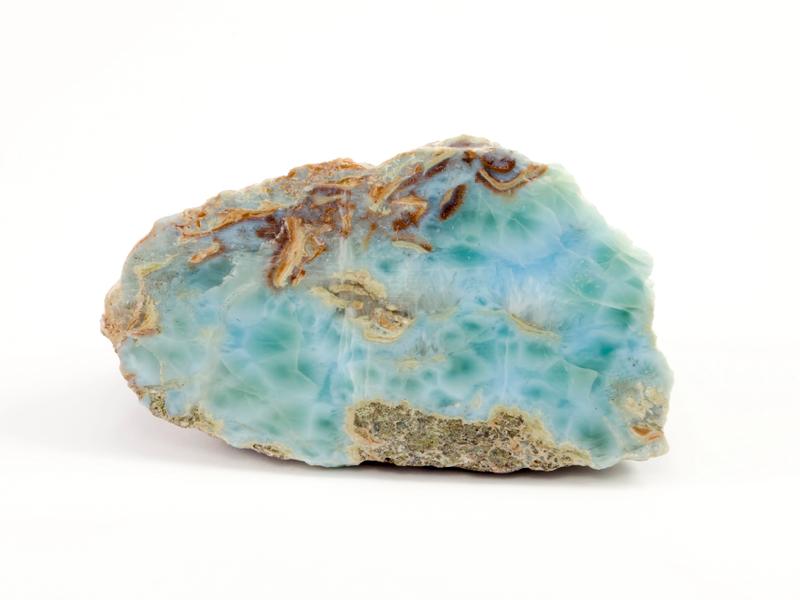
Standard pectolite is white, gray, and common. Nobody collects it. Then copper enters the crystal structure in one volcanic province in the Dominican Republic, and the same mineral becomes larimar . one of the most recognizable gem materials in the Caribbean.
Pectolite is a sodium calcium hydroxyl inosilicate that forms in basalt cavities and hydrothermal veins from sodium and calcium-rich fluids at low temperatures. The name derives from Greek pektos (congealed). Larimar forms in volcanic andesite flows in Barahona Province, where specific copper availability produces the blue. Fibrous pectolite crystals can be acicular . handle with care to avoid inhaling fine fibers.
Mineralogy
Chemical Formula
NaCa2Si3O8(OH); sodium calcium inosilicate hydroxide
Crystal System
Triclinic
Mohs Hardness
4.5
Specific Gravity
2.74-2.88
Luster
Vitreous to silky (fibrous specimens exhibit strong silky luster)
Color
White-Blue
Traditional Knowledge
New Jersey mineral heritage (Paterson, USA): The Paterson-Prospect Park area of New Jersey is one of the world's premier localities for pectolite and associated trap rock minerals. The Watchung Basalt flows that host these specimens were quarried extensively in the 19th and 20th centuries, producing museum-quality pectolite alongside prehnite and zeolites. The Great Falls of the Passaic River at Paterson; Alexander Hamilton's site for America's first planned industrial city; cuts through these same basalt formations, linking pectolite to American industrial and geological history (Manchester, W., "The Glory and the Dream," 1974).
British mineral collecting tradition (Northern Pennines): Pectolite from the Northern Pennines of England, particularly from the Whin Sill dolerite, has been collected since the early 19th century. The British tradition of systematic mineral collecting, formalized through the Geological Society of London (founded 1807), placed pectolite within a broader scientific framework of hydrothermal mineral genesis that continues to inform modern petrology (Craig, G. Y., "Geology of Scotland," 1991, Geological Society of London).
Russian mineralogical tradition (Kola Peninsula): The Khibiny and Lovozero alkaline massifs of the Kola Peninsula produce pectolite in association with rare alkaline minerals. Russian mineralogical science, with its deep tradition of systematic study of alkaline rock assemblages, has documented pectolite as a component of some of the most unusual mineral parageneses on Earth (Pekov, I. V., "Minerals of the Kola Peninsula," 1998, Mineralogical Almanac).
New Jersey mineral heritage (Paterson, USA)
The Paterson-Prospect Park area of New Jersey is one of the world's premier localities for pectolite and associated trap rock minerals. The Watchung Basalt flows that host these specimens were quarried extensively in the 19th and 20th centuries, producing museum-quality pectolite alongside prehnite and zeolites. The Great Falls of the Passaic River at Paterson -- Alexander Hamilton's site for America's first planned industrial city -- cuts through these same basalt formations, linking pectolite to American industrial and geological history (Manchester, W., "The Glory and the Dream," 1974). 2. British mineral collecting tradition (Northern Pennines): Pectolite from the Northern Pennines of England, particularly from the Whin Sill dolerite, has been collected since the early 19th century. Th
When This Stone Finds You
Somatic protocol
Triclinic sodium-calcium inosilicate with radiating crystal habit -- a mineral that grows outward from center, teaching your attention to do the same.
3 min protocol
Hold the pectolite gently. At hardness 4.5, it is softer than steel and scratches under careless pressure. The triclinic crystal system has no right angles -- nothing about this mineral is rigid. Let your grip match its nature: present without clenching.
45 secPlace the stone against the center of your chest. Pectolite's crystal habit is radiating -- sprays of crystals growing outward from a central point like a slow starburst. Breathe in to your center for 4 counts, then exhale outward for 6, imagining attention radiating from your heart in all directions equally.
45 secMove the stone to your dominant hand. The sodium and calcium in NaCa2Si3O8(OH) are the same minerals your nervous system uses for signal transmission. Press the stone lightly against the base of your thumb. Breathe naturally and notice: does your inner critic have a volume? Can you observe it without adjusting the dial?
45 secSet the stone on a flat surface. Place your hands on either side without touching it. The silky luster of fibrous pectolite catches light from below its surface -- not on top. Your softness does the same: it shows from underneath, not on display. Sit for 45 seconds with palms open, receiving whatever the silence offers.
45 secCare and Maintenance
Pectolite requires caution. Sodium calcium inosilicate (Mohs 4. 5-5), two cleavage planes, fibrous structure.
Brief cool water rinse is acceptable. Avoid prolonged soaking and ultrasonic; the fibrous habit can be fragile. For the larimar variety (blue): avoid prolonged sunlight, which can fade the blue over time.
Recommended cleansing: moonlight, smoke, selenite plate. Store in a soft pouch.
In Practice
You need a clearer channel through tenderness. Pectolite forms fibrous radiating habits. When copper enters the lattice in one Dominican volcanic province, it becomes larimar.
Hold the blue variety during communication work where gentleness matters. Place at the throat during conversations that require vulnerability without collapse.
Verification
Pectolite (larimar): Mohs 4. 5-5. Specific gravity 2.
74-2. 88. Vitreous to silky luster.
The blue larimar variety should show natural blue coloration from copper, not surface dye. Blue pectolite comes only from the Dominican Republic. If blue pectolite is claimed from a different country, question it.
White pectolite from other sources is a different material entirely in practice terms.
Natural Pectolite should usually feel cooler than plastic or resin on first touch and warm more slowly in the hand.
Use 4.5 on the Mohs scale as the check, not internet myths. A real specimen should behave in line with the hardness listed above.
Look for a vitreous to silky (fibrous specimens exhibit strong silky luster) surface quality rather than a painted or plastic shine.
The listed specific gravity is 2.74-2.88. If a specimen feels unusually light for its size, it may deserve a second look.
Geographic Origins
Dominican Republic produces the larimar variety (blue pectolite) from a single volcanic province in the Bahoruco Mountains. This is the only known source of blue pectolite; the copper that creates the blue color occurs in the volcanic host rock. Standard white pectolite is found worldwide in basaltic cavities, but nobody collects the white variety.
The blue changed everything.
FAQ
Pectolite is classified as a Pectolite is a member of the wollastonite group of inosilicates (chain silicates). It forms fibrous, acicular (needle-like), or radiating crystal aggregates. The mineral species pectolite encompasses ALL color varieties, including Larimar -- but Larimar (blue pectolite colored by copper substitution in volcanic host rock) is treated as a separate entry in this encyclopedia due to its distinct properties. This entry covers white, gray, and colorless pectolite -- the far more common form of the mineral. Hydrothermal studies confirm that pectolite forms as a phase-transition product from calcium silicate hydrate phases (tobermorite) in sodium-bearing hydrothermal environments above 180 degrees C (Wu et al., 2020).. Chemical formula: NaCa2Si3O8(OH) -- sodium calcium inosilicate hydroxide. Mohs hardness: 4.5--5. Crystal system: Triclinic (space group P-1).
Pectolite has a Mohs hardness of 4.5--5.
Water Safety NO -- avoid water contact. Pectolite has a Mohs hardness of only 4.5-5 and is often fibrous in habit. Water can penetrate between fibers, weakening the specimen over time. Additionally, fibrous pectolite specimens can release fine acicular particles when wet and handled, posing an inhalation risk if the specimen dries and particles become airborne. Clean with a soft, dry brush only. Do NOT use in gem elixirs (direct or indirect) due to the fibrous nature and moderate solubility of the mineral. Never submerge.
Pectolite crystallizes in the Triclinic (space group P-1).
The chemical formula of Pectolite is NaCa2Si3O8(OH) -- sodium calcium inosilicate hydroxide.
Formation Story Pectolite forms in the vesicles (gas cavities) and fractures of basaltic volcanic rocks through hydrothermal alteration -- the same process that produces zeolites, prehnite, and other cavity-filling minerals. When basalt cools and solidifies, gas bubbles are trapped within the rock, creating hollow vesicles. Over geological time, hot, mineral-laden fluids percolate through these cavities. When these fluids carry dissolved sodium, calcium, and silica at temperatures typically betw
References
. [SCI]
DOI: 10.1111/ijac.13469
. [SCI]
DOI: 10.1002/jrs.4614
Closing Notes
Standard pectolite is white and common. Nobody collects it. Then copper enters the lattice in one volcanic province in the Dominican Republic, and it becomes larimar.
Same mineral, different element, different world. The science documents copper substitution in a common silicate. The practice asks what transformation means when a single impurity changes your entire identity and your entire value.
Bring it into practice
Move from reference to ritual. Search current inventory for Pectolite, build a custom bracelet, or let Sacred Match choose the right supporting stones for you.
Community notes
Shared field notes tied to Pectolite appear here, including notes saved from practice.
When members save a public field note for this stone, it will appear here.
The archive
Continue through stones that share intention, chakra focus, or tonal family with Pectolite.

Shared intention: Self-Awareness
The Mirror of Layers

Shared intention: Clarity & Focus
The Blueprint of Clarity

Shared intention: Stress Relief
The Blue-Gold Frequency

Shared intention: Emotional Release
The Emotional Exhale

Shared intention: Clarity & Focus
The Calm Frequency

Shared intention: Clarity & Focus
The Ancient Blue Clarity