Materia Medica
Biotite
The Slow Shed of Layers

This page documents traditional and cultural uses of biotite alongside emerging research on tactile grounding objects. Crystalis does not claim that biotite treats, cures, or prevents any medical condition. For mental health concerns, consult a qualified professional.
Origins: Worldwide (common rock-forming mineral)
Materia Medica
The Slow Shed of Layers

Protocol
Black mica that splits into pages. Each layer a record. Each breath a turning.
2 min
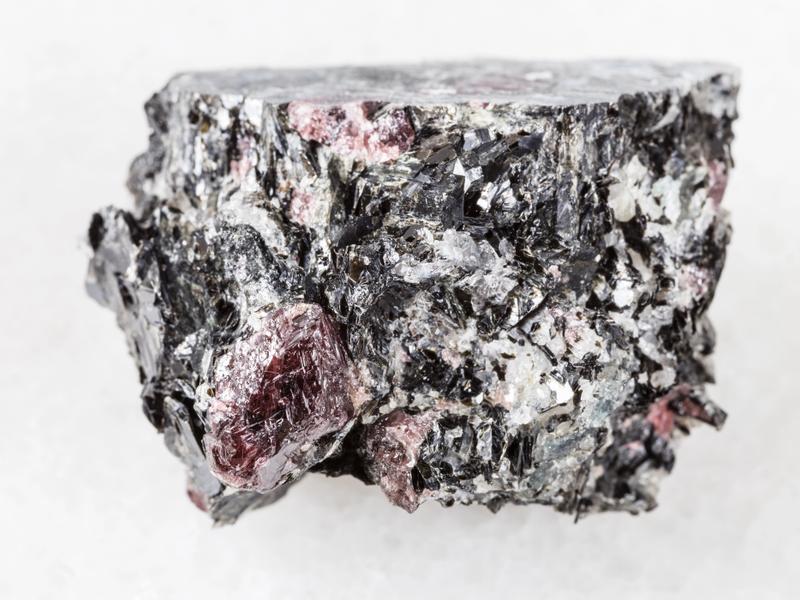
Hold the biotite specimen in your hands. If it is a book-form mica, notice how the layers separate — biotite cleaves into thin, flexible sheets along its basal plane. This is a phyllosilicate, a sheet silicate, built like a stack of pages. Potassium holds the sheets together, but weakly — you can peel them apart with your fingernail. The dark color comes from iron and magnesium in the octahedral layer. Run your thumb along the edge and feel the layered structure. (0:00–0:30)
Close your eyes. Hold the biotite flat on your open palm. Despite its monoclinic crystal system, it looks hexagonal — pseudohexagonal, the mineralogists call it. Something that looks like one system but is actually organized by another. Breathe in for 4, out for 5. The vitreous-to-pearly luster on cleavage surfaces means light plays across each layer differently. (0:30–1:00)
With eyes closed, notice the thinness of whatever piece you hold. Biotite can be split so thin it becomes transparent. Ask: what layer of myself am I ready to separate from the stack? Not to discard — mica pages are not waste. They are records. But some can be set aside, examined, held up to light. (1:00–1:30)
Open your eyes. If your specimen allows, gently separate one thin flake and hold it up to the light. See how it transmits and filters. Then place everything down. Press both palms flat on your thighs. The pages are still yours. You just turned one. Done. (1:30–2:00)
tap to flip for protocol
The past can compact until it behaves like construction material. Dense, layered, everywhere. You lean against it without realizing how much weight it has taken on.
Biotite is a sheet silicate, a mica with perfect basal cleavage and a habit that favors flakes, books, and plates. Dark color comes from iron and magnesium moving through the structure; the release comes from the way those sheets part cleanly once the right angle is found.
No revelation required. Just a plane of separation.
The hand knows the difference between one slab and a stack of leaves.
What Your Body Knows
sympathetic
Dorsal vagal collapse (feeling thin/depleted/insubstantial):
dorsal vagal
Mixed state: sympathetic + ventral (therapeutic process):
ventral vagal
The layers have become visible. You can see which parts of your experience belong to you and which were inherited, absorbed, or imposed. The entanglement that felt permanent is beginning to separate into distinct threads. This is ventral vagal clarity: the nervous system is regulated enough to hold complexity without collapsing into it. Yes, you can separate these experiences. Yes, they will come apart. No, you will not be destroyed by the sorting. Biotite's role: Biotite is a sheet silicate that separates into thin, flexible, transparent layers along its perfect basal cleavage. Each sheet is distinct but was formed as part of the same crystal. Held during self-inquiry or therapeutic processing, biotite provides the tactile metaphor for differentiation: peeling apart what has been fused without destroying any individual layer. The stone teaches that separation and destruction are not the same process.
ventral vagal
For the already-regulated individual engaged in self-understanding, biotite supports the contemplative examination of one's own psychological strata. What was deposited first (childhood)? What came later (adolescence, adulthood)? What is the current surface layer? Biotite's readable geological record models the practice of self-archaeology. State support: deepened ventral capacity for self-examination. 5. ; - Sympathetic depletion (giving away too many layers): People who chronically overextend; giving their time, energy, emotional labor, and presence until they feel "peeled down to nothing"; can work with biotite's weathering story. When biotite loses too many layers to weathering, it transforms into vermiculite and clay. The transformation is not death; it is becoming the foundation for something else (soil, growth, fertility). But it is also a warning: there is a threshold beyond which you are no longer yourself. State shift: depletion toward conscious awareness of one's structural limits.
Nervous system mapping based on polyvagal theory (Porges, 2011).
The Earth Made This
Biotite is everywhere. One of the most common rock-forming micas, it crystallizes in igneous and metamorphic rocks across conditions from 300°C to 900°C . granites, schists, volcanic rocks, all of it.
A potassium iron-magnesium phyllosilicate, its dark brown to black color deepens with iron content. Perfect basal cleavage lets it split into thin, flexible, elastic sheets. What makes biotite geologically useful is that it weathers easily at the surface, breaking down to clay minerals and releasing potassium into soil. Its presence also helps geologists estimate formation temperature through well-calibrated geothermometers. Unremarkable to look at. Structurally informative.
Mineralogy
Chemical Formula
K(Mg,Fe)3AlSi3O10(OH)2; potassium magnesium-iron aluminum phyllosilicate (sheet silicate/mica group)
Crystal System
Monoclinic, Space Group C2/M (Pseudohexagonal Appearance Due To Crystal Habit)
Mohs Hardness
2.5
Specific Gravity
2.7-3.3
Luster
Vitreous to pearly on cleavage surfaces; submetallic on dark specimens
Color
Black-Brown
Traditional Knowledge
Jean-Baptiste Biot and optical mineralogy (France, early 19th century): Biotite is named after French physicist Jean-Baptiste Biot (1774-1862), who made pioneering studies of the optical properties of minerals, particularly the phenomenon of double refraction and optical rotation in crystals. Biot's work with micas established fundamental principles of crystal optics that remain in use today. The naming honors not a geological locality but a scientist; making biotite one of the few common minerals named for a person whose contribution was in physics rather than mineralogy.
Scottish Highlands metamorphic tradition: The concept of the "biotite isograd"; the temperature-pressure boundary at which biotite first appears in metamorphic rocks; was developed through study of the Scottish Highlands by George Barrow in the late 19th century. The "Barrovian zones" of metamorphism (chlorite -> biotite -> garnet -> staurolite -> kyanite -> sillimanite) remain the standard framework for metamorphic geology. Biotite marks the second zone; the threshold where low-grade metamorphism transitions to medium-grade. To find biotite in a rock is to know it has been heated past a specific boundary (Barrow, G., 1893, Quarterly Journal of the Geological Society of London).
Muscovite mica windows (Russia, historical): While biotite is too dark for window use, its close relative muscovite (white mica) was famously used as window panes in medieval Russia ("Muscovy glass"). The mica mining tradition of the Kola Peninsula and Ural Mountains, which produced both muscovite and biotite, is deeply embedded in Russian cultural history. Biotite was the dark twin; valued for industrial abrasive and insulating applications rather than its cousin's transparency.
Soil science and agricultural tradition: Biotite's weathering to vermiculite and clay minerals is one of the most important processes in pedology (soil science). The potassium released during biotite weathering is a primary natural source of this essential plant nutrient. Agricultural traditions worldwide have unknowingly depended on biotite weathering for soil fertility for millennia. The mineral's gift to life occurs through its own decomposition; a geological parallel to composting and nutrient cycling.
Jean-Baptiste Biot and optical mineralogy (France, early 19th century)
Biotite is named after French physicist Jean-Baptiste Biot (1774-1862), who made pioneering studies of the optical properties of minerals, particularly the phenomenon of double refraction and optical rotation in crystals. Biot's work with micas established fundamental principles of crystal optics that remain in use today. The naming honors not a geological locality but a scientist -- making biotite one of the few common minerals named for a person whose contribution was in physics rather than mineralogy. 2. Scottish Highlands metamorphic tradition: The concept of the "biotite isograd" -- the temperature-pressure boundary at which biotite first appears in metamorphic rocks -- was developed through study of the Scottish Highlands by George Barrow in the late 19th century. The "Barrovian zone
When This Stone Finds You
Somatic protocol
Black mica that splits into pages. Each layer a record. Each breath a turning.
2 min protocol
Hold the biotite specimen in your hands. If it is a book-form mica, notice how the layers separate — biotite cleaves into thin, flexible sheets along its basal plane. This is a phyllosilicate, a sheet silicate, built like a stack of pages. Potassium holds the sheets together, but weakly — you can peel them apart with your fingernail. The dark color comes from iron and magnesium in the octahedral layer. Run your thumb along the edge and feel the layered structure. (0:00–0:30)
1 minClose your eyes. Hold the biotite flat on your open palm. Despite its monoclinic crystal system, it looks hexagonal — pseudohexagonal, the mineralogists call it. Something that looks like one system but is actually organized by another. Breathe in for 4, out for 5. The vitreous-to-pearly luster on cleavage surfaces means light plays across each layer differently. (0:30–1:00)
1 minWith eyes closed, notice the thinness of whatever piece you hold. Biotite can be split so thin it becomes transparent. Ask: what layer of myself am I ready to separate from the stack? Not to discard — mica pages are not waste. They are records. But some can be set aside, examined, held up to light. (1:00–1:30)
1 minOpen your eyes. If your specimen allows, gently separate one thin flake and hold it up to the light. See how it transmits and filters. Then place everything down. Press both palms flat on your thighs. The pages are still yours. You just turned one. Done. (1:30–2:00)
1 minCare and Maintenance
Biotite mica is water-safe but fragile. Mohs 2. 5-3, perfect basal cleavage means it peels into thin flexible sheets.
Brief rinse is possible but unnecessary and risks delamination. Preferred cleansing: moonlight (overnight, zero risk), smoke (sage, 30-60 seconds), sound (singing bowl, 2-3 minutes). Never soak.
Never use ultrasonic. Store flat in a padded container; biotite books can split from handling alone.
In Practice
Biotite for release: Hold a book of biotite mica and gently separate the layers. The physical act of peeling thin flexible sheets models the process of releasing what has gone opaque. This is not metaphor layered onto mineral.
Biotite literally separates along its basal cleavage, one sheet at a time. The practice mirrors the physics. For patience: Keep biotite on your nightstand.
The dark sheets and the slow geological separation remind you that shedding happens at its own pace.
Verification
Biotite mica: perfect basal cleavage allowing sheets to be peeled. Dark brown to black flexible elastic sheets. Specific gravity 2.
7-3. 3. Monoclinic but appears pseudo-hexagonal.
If a "mica" specimen does not peel into thin flexible sheets, it is not biotite (or any mica). The flexibility of the sheets is diagnostic.
Natural Biotite should usually feel cooler than plastic or resin on first touch and warm more slowly in the hand.
Use 2.5 on the Mohs scale as the check, not internet myths. A real specimen should behave in line with the hardness listed above.
Look for a vitreous to pearly on cleavage surfaces; submetallic on dark specimens surface quality rather than a painted or plastic shine.
The listed specific gravity is 2.7-3.3. If a specimen feels unusually light for its size, it may deserve a second look.
Geographic Origins
Biotite occurs in igneous and metamorphic rocks on every continent. It is one of the most abundant rock-forming minerals, crystallizing from 300 to 900 degrees across granites, schists, gneisses, and volcanic rocks. No single locality defines biotite because it defines virtually every geological setting that involves heat and aluminum-rich chemistry.
FAQ
Biotite is classified as a Biotite is named after French physicist Jean-Baptiste Biot (1774-1862), who first studied the optical properties of micas. It is the most common dark mica, forming a solid solution series between the magnesium end-member phlogopite and the iron end-member annite. The distinguishing feature of all micas is perfect basal cleavage -- the ability to split into thin, flexible sheets along the (001) plane. Biotite's sheet structure results from layers of SiO4 tetrahedra-octahedra-tetrahedra (T-O-T) sandwiches bound together by interlayer potassium ions. Research using Raman spectroscopy and X-ray diffraction has revealed structural zoning within individual biotite phenocrysts, reflecting changing crystallization conditions during magmatic evolution (Xi et al., 2024).. Chemical formula: K(Mg,Fe)3AlSi3O10(OH)2 -- potassium magnesium-iron aluminum phyllosilicate (sheet silicate/mica group). Mohs hardness: 2.5--3 (very soft; easily scratched with a fingernail). Crystal system: Monoclinic, space group C2/m (pseudohexagonal appearance due to crystal habit).
Biotite has a Mohs hardness of 2.5--3 (very soft; easily scratched with a fingernail).
Water Safety NO -- avoid prolonged water exposure. Biotite's layered structure and weak interlayer bonding make it vulnerable to water penetration between sheets. Brief rinsing is acceptable, but soaking can cause sheets to separate, swell, and degrade. The weathering of biotite to vermiculite begins with water entering the interlayer spaces and leaching potassium. Do NOT use in gem elixirs or gem water. For energetic water charging, place the specimen BESIDE the water vessel. Keep biotite dry for specimen preservation.
Biotite crystallizes in the Monoclinic, space group C2/m (pseudohexagonal appearance due to crystal habit).
The chemical formula of Biotite is K(Mg,Fe)3AlSi3O10(OH)2 -- potassium magnesium-iron aluminum phyllosilicate (sheet silicate/mica group).
At hardness 2.5-3, biotite is very soft and easily damaged. Individual sheets can be sharp-edged -- handle with care to avoid paper-cut-like injuries.
Formation Story Biotite crystallizes from intermediate to felsic magmas and is one of the most common minerals in granites, granodiorites, and their volcanic equivalents. During magmatic crystallization, biotite typically forms at temperatures between 650 and 900 degrees C, incorporating potassium, aluminum, magnesium, and iron from the melt along with structurally bound water (hydroxyl groups). It is often the last major silicate mineral to crystallize from a granitic magma, forming after quart
References
. [SCI]
DOI: 10.1002/gj.2635
. [SCI]
DOI: 10.1111/sed.12249
. [SCI]
. [SCI]
DOI: 10.1111/jmi.13016
. [SCI]
DOI: 10.1002/gj.2922
Closing Notes
One of the most common rock-forming micas. Crystallizes in everything from granite to schist, 300 to 900 degrees, dark flexible sheets that separate cleanly along their own planes. The science documents a mineral built for letting go.
The practice asks what happens when peeling back is not destruction but the material doing what it was designed to do.
Bring it into practice
Move from reference to ritual. Search current inventory for Biotite, build a custom bracelet, or let Sacred Match choose the right supporting stones for you.
Community notes
Shared field notes tied to Biotite appear here, including notes saved from practice.
When members save a public field note for this stone, it will appear here.
The archive
Continue through stones that share intention, chakra focus, or tonal family with Biotite.

Shared intention: Self-Awareness
The Mirror of Layers

Shared intention: Emotional Release
The Grief Absorber
Shared intention: Self-Awareness
The Snowfield of Patience

Shared intention: Self-Awareness
The Dark Transformer

Shared intention: Emotional Release
The Infinite Green Healer

Shared intention: Self-Awareness
The Truth Mirror