Crystal Encyclopedia
40+YEARS

Musgravite

BeMg2Al6O12 · Mohs 8 · Trigonal · Heart Chakra

The stone of musgravite: meaning, mineralogy, and somatic practice.

Heart HealingSpiritual ConnectionTransformation & ChangeSelf-Worth

This page documents traditional and cultural uses of musgravite alongside emerging research on tactile grounding objects. Crystalis does not claim that musgravite treats, cures, or prevents any medical condition. For mental health concerns, consult a qualified professional.

Crystalis Editorial · 40+ Years · Herndon, VA · 12 peer-reviewed sources

Origins: Sri Lanka, Tanzania, Madagascar

Crystalis

Materia Medica

Musgravite

The Rarest Worth

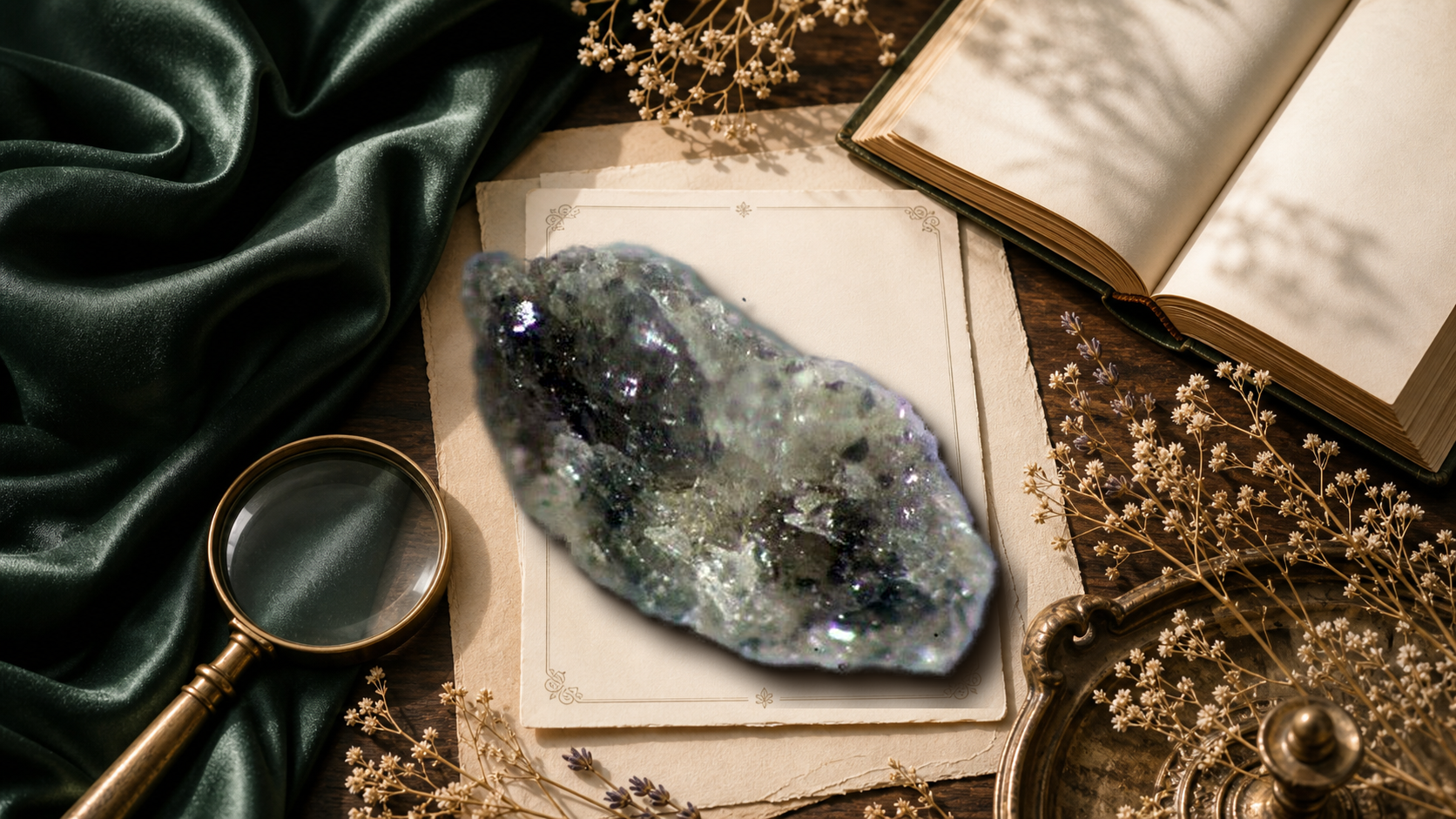
Musgravite crystal
Heart HealingSpiritual ConnectionTransformation & Change
Crystalis

Protocol

The Rarest Permission

One of Earth's rarest minerals invites you to treat your own stillness as something equally irreplaceable.

5 min

  1. 1

    Hold the musgravite in your non-dominant hand. Close your eyes. This mineral is so rare that fewer than a dozen gem-quality specimens have been authenticated. Let that fact settle: rarity does not demand performance. Simply hold it.

  2. 2

    Place the stone against your sternum. Breathe in for a count of 6, hold for 4, exhale for 8. With each exhale, ask: what part of me have I treated as too rare to use, too precious to risk? Notice where the body tightens around that question.

  3. 3

    Move the stone to rest on your open left palm, face up. Let your right hand hover above it without touching. Feel the gap between protection and contact. Musgravite survived billions of years in the Earth without a case. Your stillness does not need a case either.

  4. 4

    Bring both palms together around the stone. Press gently. Notice the warmth that builds between your skin and the mineral surface. Let the warmth become permission: permission to exist without justifying your rarity.

Continue in the full protocol below.

tap to flip for protocol

There are forms of loneliness that come not from isolation but from repetition, from feeling copied over by systems that flatten everyone into more usable versions of the same thing. The self begins craving a more exact measure of its own singularity.

Musgravite offers that measure through rarity itself. It is one of the rarest gem minerals known, not because it is trying to be exceptional, but because the conditions required to make it are so unusual. The scarcity is geological, not performative.

Musgravite matters when uniqueness needs to feel factual again. Ratio can restore a kind of self-respect that praise cannot.

What Your Body Knows

Nervous system states

dorsal vagal

Freeze / Shutdown

When energy feels stuck and the body won't respond. Musgravite is placed on the body as an anchor point. Your shoulders drop. Your breath becomes shallow and barely audible. A heaviness settles in your limbs. This is dorsal vagal shutdown; your oldest survival circuit pulling you toward stillness, collapse, disconnection from sensation.

sympathetic

Overstimulation / Agitation

When the system is running too hot; racing thoughts, restless limbs, inability to settle. Your chest tightens. Your jaw clenches. Your breath moves higher, shallower, faster. This is sympathetic activation; your body mobilizing for fight or flight, muscles tensing, heart rate rising.

ventral vagal

Regulated Presence

When the body finds its resting rhythm. Musgravite held or placed becomes a touchpoint for presence. Your chest opens. Your jaw unclenches. Your breath deepens into your belly. This is ventral vagal regulation; your body finding safety, social connection, steady presence.

Nervous system mapping based on polyvagal theory (Porges, 2011).

The Earth Made This

Formation: How Musgravite Becomes Musgravite

Musgravite (now formally known as magnesiotaaffeite-6N'3S) is one of the rarest gemstones on Earth, a magnesium-beryllium-aluminum oxide first discovered in 1967 in the Musgrave Ranges of South Australia. The mineral forms in beryllium-bearing, magnesian skarns and in some alkaline pegmatites. Musgravite is structurally related to taaffeite, both being members of the taaffeite mineral group with stacked spinel-like layers.

For decades after its discovery, only a handful of facetable crystals were known worldwide. More recent finds in Sri Lanka, Myanmar, Tanzania, Madagascar, and Greenland have increased availability slightly, but gem-quality musgravite remains extraordinarily rare. The mineral is hard (8-8.

5 Mohs), making it suitable for jewelry when obtainable.

Material facts

What the stone is made of

Mineralogy: Beryllium magnesium aluminum oxide, taaffeite group. Chemical formula: BeMg₂Al₆O₁₂ (also written Be(Mg,Fe,Zn)₂Al₆O₁₂). Crystal system: trigonal. Mohs hardness: 8-8.5. Specific gravity: 3.61-3.68. Color: grayish-green to grayish-purple, from Fe²⁺ substitution for Mg²⁺ and possible Fe²⁺→Fe³⁺ intervalence charge transfer. Luster: vitreous. Habit: tabular or prismatic. Named for the Musgrave Ranges, South Australia (type locality). Distinguished from taaffeite (BeMgAl₈O₁₆) by its higher Mg:Al ratio and different stacking sequence in the crystal structure.

Mineralogy

Mineral specs

Chemical Formula

BeMg2Al6O12

Crystal System

Trigonal

Mohs Hardness

8

Specific Gravity

3.61-3.68

Luster

Vitreous

Color

Gray-Green

ca₁a₂a₃120°Trigonal · Musgravite

Crystal system diagram represents the general trigonal classification. Diagram created by Crystalis for educational reference.

Traditional Knowledge

Traditions across cultures

Named after the Musgrave Ranges of central Australia, the type locality where the mineral was first identified. The name honors the geographic feature, which itself was named by explorer William Gosse in 1873 after Sir Anthony Musgrave, then Governor of South Australia. The mineral was described by Hogarth and Griffin in 1967. For decades, musgravite was considered one of the rarest minerals in the world, with only a handful of known specimens. The first gem-quality faceted musgravite appeared in the late 1990s from Sri Lankan and Tanzanian material. Its extreme rarity and hardness (second only to diamond, corundum, and chrysoberyl among natural gemstones) make it a significant collector's stone. The IMA reclassification of the taaffeite group in 2002 formally renamed the mineral "magnesiotaaffeite-6N'3S," though "musgravite" remains the universally used name in gemology and collecting.

Australian Geology

1967

Discovery in the Musgrave Ranges

Musgravite was first discovered in 1967 in the Musgrave Ranges of South Australia and described by mineralogists at the South Australian Museum. Named after its type locality, it was initially considered so rare that only a handful of specimens existed worldwide for decades after its identification.

Gemological Community

Late 20th - 21st century

One of Earth's Rarest Gemstones

For years musgravite held the distinction of being one of the rarest gem minerals on Earth, with gem-quality facetable material virtually nonexistent until finds in Sri Lanka, Madagascar, and Tanzania expanded known sources. Its extreme scarcity made it a benchmark stone in gemological rarity discussions.

Modern Collector Tradition

21st century

Holy Grail of Rare Gem Collectors

Among serious gem collectors, musgravite occupies near-mythical status alongside painite and grandidierite as a "holy grail" acquisition. Specimens command extraordinary prices per carat, and ownership of a faceted musgravite is considered a defining achievement in advanced gem collecting circles.

When This Stone Finds You

What it says when it arrives

You have started to feel interchangeable in a world built from repetition. Musgravite is among the rarest gem minerals, a beryllium oxide that spent geologic time becoming nearly absent. Rarity is not arrogance; it is ratio.

Somatic protocol

The Rarest Permission

One of Earth's rarest minerals invites you to treat your own stillness as something equally irreplaceable.

5 min protocol

  1. 1

    Hold the musgravite in your non-dominant hand. Close your eyes. This mineral is so rare that fewer than a dozen gem-quality specimens have been authenticated. Let that fact settle: rarity does not demand performance. Simply hold it.

    1 min
  2. 2

    Place the stone against your sternum. Breathe in for a count of 6, hold for 4, exhale for 8. With each exhale, ask: what part of me have I treated as too rare to use, too precious to risk? Notice where the body tightens around that question.

    1 min 15 sec
  3. 3

    Move the stone to rest on your open left palm, face up. Let your right hand hover above it without touching. Feel the gap between protection and contact. Musgravite survived billions of years in the Earth without a case. Your stillness does not need a case either.

    1 min 15 sec
  4. 4

    Bring both palms together around the stone. Press gently. Notice the warmth that builds between your skin and the mineral surface. Let the warmth become permission: permission to exist without justifying your rarity.

    1 min
  5. 5

    Open your hands slowly. Look at the stone. Look at your palms. Notice that holding something rare did not diminish either the stone or the holder. Set it down when you are ready.

    30 sec

The #1 Question

Can Musgravite go in water?

Safety Flags

Care and Maintenance

How to care for Musgravite

Musgravite is water-safe. Magnesium beryllium aluminum oxide (Mohs 8-8. 5), extremely hard and chemically stable.

Brief to moderate water contact is completely safe. One of the rarest gems on Earth; handle accordingly. Recommended cleansing: running water, moonlight, sound, selenite plate.

Store individually in a soft pouch; this is a collector-grade specimen.

In Practice

How Musgravite is used

You need to trust your own rarity without requiring external validation. Musgravite is beryllium magnesium aluminum oxide, Mohs 8, harder than topaz. Fewer than fifty gem-quality specimens are known worldwide.

Named for the Musgrave Ranges in South Australia where it was discovered in 1967. Hold it if you have one. Most people never will.

The rarity is not marketing. It is geological fact. The conditions that produce musgravite almost never align.

When they do, the result is among the hardest, rarest minerals on earth.

Verification

Authenticity

Musgravite: one of the rarest gemstones. Mohs 8-8. 5.

Specific gravity 3. 61-3. 68.

Vitreous luster. Often confused with taaffeite (which is the same mineral group). If offered as musgravite, request gemological certification.

Most claimed musgravite specimens are misidentified taaffeite or spinel. Only laboratory analysis can confirm.

Temperature

Natural Musgravite should usually feel cooler than plastic or resin on first touch and warm more slowly in the hand.

Scratch logic

Use 8 on the Mohs scale as the check, not internet myths. A real specimen should behave in line with the hardness listed above.

Surface and luster

Look for a vitreous surface quality rather than a painted or plastic shine.

Weight and density

The listed specific gravity is 3.61-3.68. If a specimen feels unusually light for its size, it may deserve a second look.

Geographic Origins

Where Musgravite forms in the world

Musgrave Ranges, South Australia. The Type Locality. Musgravite was first discovered in 1967 in the Musgrave Ranges of central Australia, within granulite-facies metamorphic rocks that experienced temperatures exceeding 800 degrees C and pressures above 8 kilobars.

This rare beryllium-magnesium-aluminum oxide (related to taaffeite) forms only under extreme metamorphic conditions in aluminum- and beryllium-enriched rocks. For decades, it was considered one of the rarest minerals on earth. Sri Lanka (Ratnapura district).

Gem-quality facetable musgravite has been recovered from the alluvial gem gravels of Sri Lanka's Highland Complex, though confirmed specimens remain exceedingly scarce. Myanmar (Mogok Stone Tract). A small number of gem-quality stones have emerged from the legendary Mogok deposits.

Madagascar (Andrahomana). Tanzania (Tunduru district). Greenland (Fiskefjord).

Each secondary source has produced only a handful of confirmed specimens, making musgravite one of the rarest gemstones in private collections.

FAQ

Frequently asked

Can Musgravite go in water?

Safety Flags

How does Musgravite form?

Formation Geology Musgravite forms in high-grade metamorphic environments, specifically in magnesian skarn deposits and granulite-facies metamorphic terranes where beryllium, magnesium, and aluminum are available. It occurs in association with spinel, sapphire (corundum), phlogopite, and other high-temperature minerals. Type locality: The Musgrave Ranges, South Australia, where it was first described in 1967 by Hogarth and Griffin from a specimen collected in the Ernabella area of the Musgrave B

References

Sources and citations

Closing Notes

Musgravite

One of the rarest gemstones on Earth. First discovered in the Musgrave Ranges of South Australia in 1967. A magnesium-beryllium-aluminum oxide so rare it was reclassified and renamed.

The science documents a mineral whose taxonomy had to be revised because it was too unusual for the original framework. The practice asks what identity means when even the naming system had to adjust to accommodate you.

Bring it into practice

What to do with Musgravite next

Move from reference to ritual. Search current inventory for Musgravite, build a custom bracelet, or let Sacred Match choose the right supporting stones for you.

Community notes

Threads under Musgravite

Open all chats

Shared field notes tied to Musgravite appear here, including notes saved from practice.

No shared notes under Musgravite yet.

When members save a public field note for this stone, it will appear here.

The archive

Related crystals

Read the Full Crystal Guide

Continue through stones that share intention, chakra focus, or tonal family with Musgravite.