Crystal Encyclopedia
40+YEARS

Neptunite

KNa2Li(Fe²⁺,Mn²⁺)2Ti2Si8O24 · Mohs 5 · Monoclinic · Root Chakra

The stone of neptunite: meaning, mineralogy, and somatic practice.

Protection & GroundingEmotional ReleaseCourageBreaking Resistance

This page documents traditional and cultural uses of neptunite alongside emerging research on tactile grounding objects. Crystalis does not claim that neptunite treats, cures, or prevents any medical condition. For mental health concerns, consult a qualified professional.

Crystalis Editorial · 40+ Years · Herndon, VA · 10 peer-reviewed sources

Origins: USA (California), Russia, Greenland

Crystalis

Materia Medica

Neptunite

The Deep Current Breaker

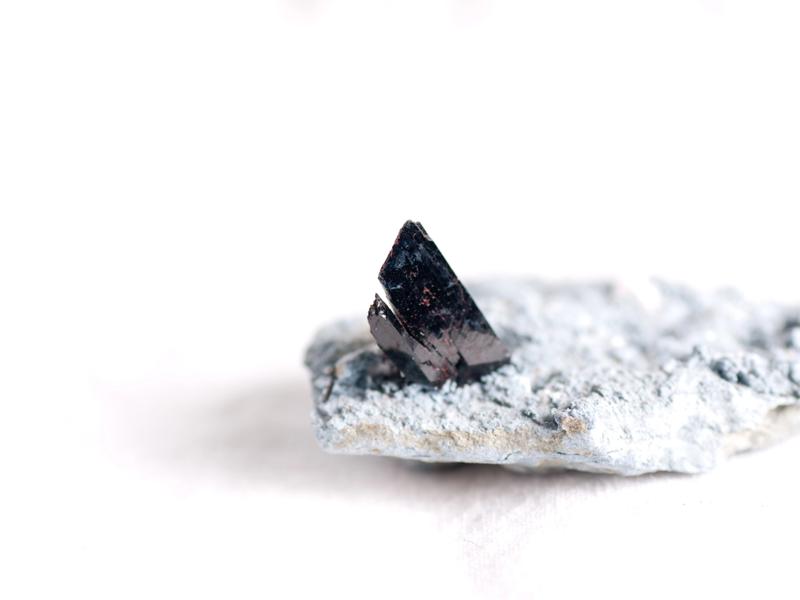
Neptunite crystal
Protection & GroundingEmotional ReleaseCourage
Crystalis

Protocol

The Deep Trench Descent

Prismatic black crystals formed in serpentinite veins carry the weight of tectonic pressure -- sit with what has been compressed.

5 min

  1. 1

    Place the neptunite in front of you on a dark cloth. Its prismatic black crystals formed deep in serpentinite veins under immense tectonic pressure. Before touching it, look at it and acknowledge: some things can only form under compression. Sit with that for one minute.

  2. 2

    Pick up the stone with both hands. Hold it against your lower belly, below the navel. Breathe in through the nose for 4 counts, hold for 7, exhale through the mouth for 8. The stone's density -- formed in the deep crust -- asks your attention to sink lower than your thoughts.

  3. 3

    Move the neptunite to your left palm. Curl your fingers loosely around it. The mineral's name comes from Neptune, god of the deep sea. Let your awareness descend as if dropping into cold, dark water. What is at the bottom? Do not name it. Just notice the temperature change in your body.

  4. 4

    Press the stone firmly between both palms at chest height. The pressure you apply mirrors the tectonic force that created it. Squeeze for 10 seconds, then release completely. Squeeze again for 10 seconds. Release. Notice what your shoulders do when you let go.

Continue in the full protocol below.

tap to flip for protocol

Not every descent is wise simply because it is deep. The psyche can become overly fluent in shadow, moving downward so neatly that it forgets the need for orientation, friction, and the occasional edge.

Neptunite offers a better model. The black crystal is not amorphous darkness; it is sharp, angled, exact, with undertones that suggest heat still moving under the surface. The descent keeps its geometry.

Neptunite feels useful for anyone overidentified with shadow work. Depth still needs edges if it is going to remain navigable.

What Your Body Knows

Nervous system states

dorsal vagal

Freeze / Shutdown

When energy feels stuck and the body won't respond. Neptunite is placed on the body as an anchor point. Your shoulders drop. Your breath becomes shallow and barely audible. A heaviness settles in your limbs. This is dorsal vagal shutdown; your oldest survival circuit pulling you toward stillness, collapse, disconnection from sensation.

sympathetic

Overstimulation / Agitation

When the system is running too hot; racing thoughts, restless limbs, inability to settle. Your chest tightens. Your jaw clenches. Your breath moves higher, shallower, faster. This is sympathetic activation; your body mobilizing for fight or flight, muscles tensing, heart rate rising.

ventral vagal

Regulated Presence

When the body finds its resting rhythm. Neptunite held or placed becomes a touchpoint for presence. Your chest opens. Your jaw unclenches. Your breath deepens into your belly. This is ventral vagal regulation; your body finding safety, social connection, steady presence.

Nervous system mapping based on polyvagal theory (Porges, 2011).

The Earth Made This

Formation: How Neptunite Becomes Neptunite

Named after Neptune as a counterpart to aegirine (named after Ægir, a Norse sea god), two sea deities, two minerals, one vein. Neptunite is a sodium-potassium-lithium-iron-manganese-titanium inosilicate that forms in natrolite veins within serpentinite and in nepheline syenite pegmatites.

Lustrous black prismatic crystals that show deep red in transmitted light. The most famous locality is the Benitoite Gem Mine in San Benito County, California, where neptunite occurs alongside benitoite and natrolite in a geological setting found nowhere else on Earth. The chemistry . six cations in one formula . reflects conditions that almost never repeat.

Material facts

What the stone is made of

Mineralogy: Potassium sodium lithium iron titanium inosilicate. Chemical formula: KNa₂Li(Fe²⁺,Mn²⁺)₂Ti₂Si₈O₂₄. Crystal system: monoclinic. Mohs hardness: 5-6. Specific gravity: 3.19-3.23. Color: deep black with dark red-brown internal reflections, from Fe²⁺-Ti⁴⁺ intervalence charge transfer. Luster: vitreous to submetallic. Habit: prismatic, elongated, with square cross-section. Named for Neptune, Roman god of the sea. Distinguished from aegirine by its square cross-section and red-brown internal color.

Mineralogy

Mineral specs

Chemical Formula

KNa2Li(Fe²⁺,Mn²⁺)2Ti2Si8O24

Crystal System

Monoclinic

Mohs Hardness

5

Specific Gravity

3.19-3.23

Luster

Vitreous to submetallic

Color

Black

cabMonoclinic · Neptunite

Crystal system diagram represents the general monoclinic classification. Diagram created by Crystalis for educational reference.

Traditional Knowledge

Traditions across cultures

Named in 1893 by G. Flink after Neptune, the Roman god of the sea, because of its association with aegirine (named after Aegir, the Norse sea god). The mineral achieved its greatest fame through the San Benito County, California occurrence, where it co-occurs with benitoite; California's official state gem. The Benitoite Gem Mine (active from 1907 to various periods; now the Dallas Gem Mine) has produced museum-quality neptunite crystals displaying exceptional sharp, prismatic form on natrolite matrix. These specimens are among the most iconic American mineral specimens. The mine site is a designated California Historical Landmark. Neptunite from this locality is specifically prized for its sharp crystal form and the dramatic visual contrast of jet-black neptunite crystals against the snow-white natrolite matrix, often accompanied by blue benitoite.

American Mineralogy

1893

Discovery and Naming for Neptune

Neptunite was first described in 1893 by Flink from specimens found in the Narsarsuk pegmatite of Greenland. It was named after Neptune, the Roman god of the sea, due to its association with the marine mineral aegirine (named for the Norse sea god Aegir), reflecting a tradition of linking related minerals to mythological counterparts.

California Geology

20th - 21st century

San Benito County Icon

The Benitoite Gem Mine in San Benito County, California, produces the world's most sought-after neptunite specimens, where lustrous black prismatic crystals occur alongside the rare blue benitoite and white natrolite. This iconic three-mineral association has made neptunite a cornerstone of California mineral heritage and a must-have for systematic collectors.

Modern Collector Tradition

21st century

Display and Aesthetic Collecting

Neptunite's jet-black prismatic crystals with sharp terminations and vitreous luster have made it one of the most visually striking display minerals in modern collecting. Fine specimens from the now-closed Benitoite Mine command premium prices and anchor museum displays and private collections worldwide.

When This Stone Finds You

What it says when it arrives

You are disappearing into your own shadow work a little too cleanly. Neptunite forms sharp black crystals with red-brown undertones in rare hydrothermal settings. Descent still needs edges.

Somatic protocol

The Deep Trench Descent

Prismatic black crystals formed in serpentinite veins carry the weight of tectonic pressure -- sit with what has been compressed.

5 min protocol

  1. 1

    Place the neptunite in front of you on a dark cloth. Its prismatic black crystals formed deep in serpentinite veins under immense tectonic pressure. Before touching it, look at it and acknowledge: some things can only form under compression. Sit with that for one minute.

    1 min
  2. 2

    Pick up the stone with both hands. Hold it against your lower belly, below the navel. Breathe in through the nose for 4 counts, hold for 7, exhale through the mouth for 8. The stone's density -- formed in the deep crust -- asks your attention to sink lower than your thoughts.

    1 min 15 sec
  3. 3

    Move the neptunite to your left palm. Curl your fingers loosely around it. The mineral's name comes from Neptune, god of the deep sea. Let your awareness descend as if dropping into cold, dark water. What is at the bottom? Do not name it. Just notice the temperature change in your body.

    1 min 15 sec
  4. 4

    Press the stone firmly between both palms at chest height. The pressure you apply mirrors the tectonic force that created it. Squeeze for 10 seconds, then release completely. Squeeze again for 10 seconds. Release. Notice what your shoulders do when you let go.

    1 min
  5. 5

    Set the neptunite down on the cloth. Place your hands flat beside it. The stone does not need to be held to remain what it is. Neither do you. Let the pressure you have been carrying know it can set itself down.

    30 sec

The #1 Question

Can Neptunite go in water?

Safety Flags

Care and Maintenance

How to care for Neptunite

Neptunite is water-safe for brief rinses. Complex titanium silicate (Mohs 5-6), two cleavage planes. Brief cool water rinse (30 seconds) is safe.

Avoid prolonged soaking and ultrasonic. Recommended cleansing: moonlight, smoke, selenite plate. Store in a soft pouch; neptunite crystals can be prismatic and fragile at edges.

In Practice

How Neptunite is used

You are disappearing into your own shadow work a little too cleanly. Neptunite forms sharp black crystals in benitoite-bearing veins. Named after Neptune, counterpart to another sea god.

Hold when you need to surface from depth work without losing what you found down there. The prismatic edges catch light even in a dark crystal. Place during integration after intense inner work.

Verification

Authenticity

Neptunite: sharp black prismatic crystals. Mohs 5-6. Specific gravity 3.

19-3. 23. Vitreous to submetallic luster.

Found primarily in benitoite-bearing veins in California. The association with benitoite (blue) and natrolite (white) on matrix is distinctive and difficult to fabricate. If offered without matrix, verify provenance.

Temperature

Natural Neptunite should usually feel cooler than plastic or resin on first touch and warm more slowly in the hand.

Scratch logic

Use 5 on the Mohs scale as the check, not internet myths. A real specimen should behave in line with the hardness listed above.

Surface and luster

Look for a vitreous to submetallic surface quality rather than a painted or plastic shine.

Weight and density

The listed specific gravity is 3.19-3.23. If a specimen feels unusually light for its size, it may deserve a second look.

Geographic Origins

Where Neptunite forms in the world

San Benito County, California, USA. The Definitive Source. The Benitoite Gem Mine (formerly the Dallas Mine) in San Benito County, California, is the world's premier locality for neptunite crystals.

Here, neptunite occurs alongside the equally rare benitoite in natrolite veins cutting through serpentinite and blueschist-facies metamorphic rocks of the Franciscan Complex. The jet-black, lustrous prismatic crystals with pointed terminations form under unusual conditions requiring sodium, potassium, iron, manganese, titanium, and silicon in the same fluid environment. The Diablo Range setting where the mine sits experienced subduction-related metamorphism that created the unique geochemistry necessary for both neptunite and benitoite crystallization.

The mine was designated California's state gem mine. Kola Peninsula, Russia (Khibiny and Lovozero massifs). Neptunite also occurs in the alkaline igneous complexes of the Kola Peninsula, in nepheline syenite pegmatites.

Mont Saint-Hilaire, Quebec, Canada. Greenland and Ireland have produced minor occurrences.

FAQ

Frequently asked

Can Neptunite go in water?

Safety Flags

How does Neptunite form?

Formation Geology Neptunite is a rare titanium-iron-lithium silicate that forms in highly specific geochemical environments: silica-saturated, alkali-rich, titanium-bearing systems. Its most famous occurrence is the type locality and world's finest specimens: Type locality: The Dallas Gem Mine (formerly Benitoite Gem Mine), San Benito County, California, USA. Here, neptunite occurs in natrolite veins cutting serpentinite within a glaucophane-schist terrane associated with the New Idria serpentin

References

Sources and citations

Closing Notes

Neptunite

Named after Neptune, counterpart to aegirine named after another sea god. Two deities, two minerals, one vein. Sodium-potassium-lithium-iron-manganese-titanium inosilicate.

A formula so complex it reads like a guest list. The science documents chemical complexity in benitoite-bearing veins. The practice asks what companionship means at the mineral level.

Bring it into practice

What to do with Neptunite next

Move from reference to ritual. Search current inventory for Neptunite, build a custom bracelet, or let Sacred Match choose the right supporting stones for you.

Community notes

Threads under Neptunite

Open all chats

Shared field notes tied to Neptunite appear here, including notes saved from practice.

No shared notes under Neptunite yet.

When members save a public field note for this stone, it will appear here.

The archive

Related crystals

Read the Full Crystal Guide

Continue through stones that share intention, chakra focus, or tonal family with Neptunite.