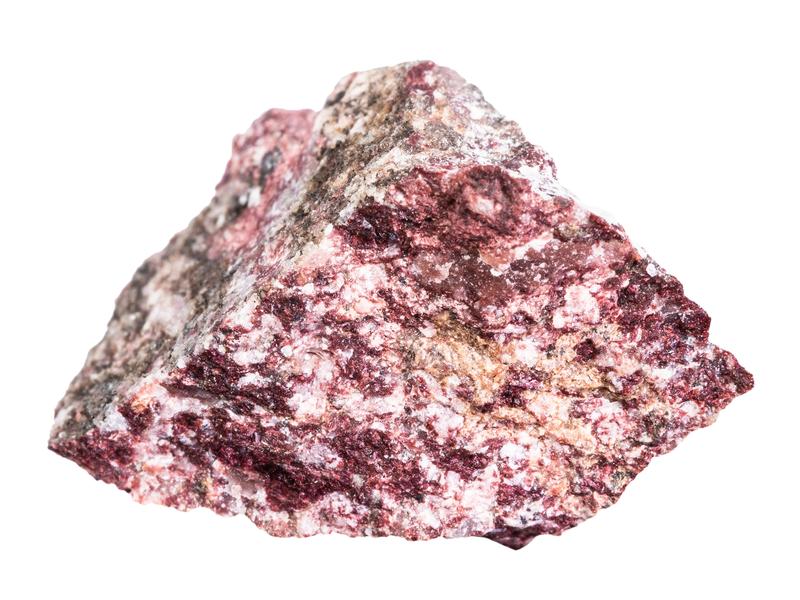
Materia Medica
Piemontite
The Mountain Courage

This page documents traditional and cultural uses of piemontite alongside emerging research on tactile grounding objects. Crystalis does not claim that piemontite treats, cures, or prevents any medical condition. For mental health concerns, consult a qualified professional.
Origins: Italy, Japan, Austria
Materia Medica
The Mountain Courage

Protocol
Sink Into the Color Between Strength and Tenderness.
5 min
Sit on the floor. Place piemontite on the ground between your feet. Press both feet flat on the floor, framing the stone. Rest your hands on your knees. The stone sits at the lowest point of your seated body — below root, at earth level. Its deep red-purple color occupies the visual field below your natural gaze line, pulling your awareness downward without effort.
Breathe: 5 counts in through the nose, 7 counts out through the mouth. Extended exhale. The longer outbreath activates the pelvic floor muscles reflexively — a parasympathetic response that grounds the torso from below. On each exhale, press your feet gently into the floor around the stone. On each inhale, release the pressure. Your feet are bracketing the stone like hands holding something precious at ground level.
On the fifth exhale, look directly at the piemontite. Study its color — the red-purple that shifts with angle due to pleochroism. Tilt your head slightly left, then right, and watch the color change. This is not an illusion. The stone literally shows different colors from different orientations. Your emotional state does the same. The anger that looks like anger from one angle is grief from another.
After 5 minutes: pick up the piemontite and hold it in both hands against your lower sternum — the border between heart and solar plexus. Feel its weight. Feel the manganese warmth of its color against the skin of your palms. Notice whether the quality of your grounding has changed: not just rooted, but layered. Root and heart are not separate systems. Piemontite sits at the boundary where they share a nerve plexus.
tap to flip for protocol
Not every identity signal survives pressure unchanged. The psyche can fear that if it changes color under enough heat, the change must mean it lost itself somewhere in the process.
Piemontite offers a different reading. Inside the epidote family, where green is more expected, manganese shifts the body toward red, pink, and wine tones without making the mineral any less itself. The lineage remains. The color changes.
Piemontite helps when the self needs permission to alter without disappearing. Pressure can deepen identity instead of erasing it.
What Your Body Knows
sympathetic
A deep red-purple warmth has settled into your lower body. Your sit bones feel heavy. Your legs feel connected to the earth through a channel that runs from hip to heel. The manganese frequency; dense, warm, iron-adjacent; grounds your awareness in the physical body without making you sluggish. You are alert and seated simultaneously. Your roots are red. Your presence is purple.
dorsal vagal
You are seeing yourself from multiple angles simultaneously. Your mood is not one color; it shifts depending on the orientation of your attention. Turn one way and you feel warmth. Turn another and you feel intensity. Turn again and you feel tenderness. All three are true. All three are you. The piemontite in your system is teaching you that identity is directional, not fixed.
ventral vagal
Your body is signaling that a transition is underway. Not crisis; transformation. The heat and pressure required for change are present in your muscles, your breath, your emotional field. You are between states: the original mineral assemblage is being reorganized under conditions you did not choose. Your jaw is tight. Your chest is compressed. But this is not collapse. This is metamorphism. You are becoming a different grade of yourself.
Nervous system mapping based on polyvagal theory (Porges, 2011).
The Earth Made This
Piemontite is the manganese-rich variety of epidote, forming in low to medium-grade metamorphic rocks, particularly in manganese-rich environments. Named after the Piemonte (Piedmont) region of Italy where it was first described, this mineral crystallizes under metamorphic conditions at temperatures of 300–500°C. The deep red to reddish-brown color comes from manganese in the crystal structure.
Piemontite often forms in association with other manganese minerals and can create spectacular red quartz when it coats quartz crystals (known as "red quartz" or "harlequin quartz").
Mineralogy
Chemical Formula
Ca2(Al,Mn3+,Fe3+)3(SiO4)(Si2O7)O(OH)
Crystal System
Monoclinic
Mohs Hardness
6
Specific Gravity
3.40-3.52
Luster
Vitreous
Color
Red-Purple
Crystal system diagram represents the general monoclinic classification. Diagram created by Crystalis for educational reference.
Traditional Knowledge
Described 1853 from Piedmont region, Italy; manganese epidote variety; distinctive reddish-purple color; found in metamorphic rocks worldwide
Piedmont Type Locality
Piemontite was first described from specimens in the Piedmont (Piemonte) region of northwestern Italy, where it occurs in manganese-rich metamorphic rocks. The mineral was formally named by Abraham Kenngott in 1853 to honor its type locality. Italian piemontite from the Saint-Marcel area of the Aosta Valley remains the reference standard for the species and produces some of the finest crystallized specimens.
Adams County Pennsylvania Occurrence
Adams County in south-central Pennsylvania became a notable American locality for piemontite, where it occurs in metamorphosed manganese deposits associated with the Appalachian geological province. American collectors and mineralogists documented the Pennsylvania occurrence in the 19th and early 20th centuries, establishing piemontite's presence in North American metamorphic geology.
Greek Andros Island Deposits
The island of Andros in Greece's Cyclades archipelago produces piemontite in metamorphic schists that record the complex tectonic history of the Aegean region. Greek piemontite specimens from Andros are valued for their rich red-purple color and well-defined crystal habit. The Cycladic metamorphic belt provides an ideal geological environment for manganese-bearing epidote formation.
Epidote Supergroup Classification
The International Mineralogical Association formally classified piemontite within the epidote supergroup, confirming its status as the manganese analogue of epidote (clinozoisite with Mn3+ substitution). The classification standardized piemontite's position relative to other epidote-group minerals including zoisite, clinozoisite, and allanite, establishing a clear chemical and structural framework for the entire mineral family.
When This Stone Finds You
Somatic protocol
Sink Into the Color Between Strength and Tenderness.
5 min protocol
Sit on the floor. Place piemontite on the ground between your feet. Press both feet flat on the floor, framing the stone. Rest your hands on your knees. The stone sits at the lowest point of your seated body — below root, at earth level. Its deep red-purple color occupies the visual field below your natural gaze line, pulling your awareness downward without effort.
Breathe: 5 counts in through the nose, 7 counts out through the mouth. Extended exhale. The longer outbreath activates the pelvic floor muscles reflexively — a parasympathetic response that grounds the torso from below. On each exhale, press your feet gently into the floor around the stone. On each inhale, release the pressure. Your feet are bracketing the stone like hands holding something precious at ground level.
On the fifth exhale, look directly at the piemontite. Study its color — the red-purple that shifts with angle due to pleochroism. Tilt your head slightly left, then right, and watch the color change. This is not an illusion. The stone literally shows different colors from different orientations. Your emotional state does the same. The anger that looks like anger from one angle is grief from another.
After 5 minutes: pick up the piemontite and hold it in both hands against your lower sternum — the border between heart and solar plexus. Feel its weight. Feel the manganese warmth of its color against the skin of your palms. Notice whether the quality of your grounding has changed: not just rooted, but layered. Root and heart are not separate systems. Piemontite sits at the boundary where they share a nerve plexus.
Care and Maintenance
Can Piemontite Go in Water? Brief Rinse Only. Piemontite is a manganese-bearing epidote, a calcium aluminum manganese silicate (Ca2(Al,Mn,Fe)3(SiO4)(Si2O7)O(OH)) with Mohs hardness of 6 to 6.5. A brief cool rinse of 15 to 30 seconds is safe. Piemontite is chemically stable and does not react with water. One perfect cleavage direction exists, so prolonged soaking is inadvisable.
Salt water: avoid.
Cleansing Methods Running water: Brief cool rinse, 15 to 30 seconds. Pat dry.
Moonlight: Overnight on a soft cloth.
Sound: Singing bowl or tuning fork, 2 to 3 minutes.
Smoke: Sage or palo santo, 30 to 60 seconds.
Storage and Handling Store piemontite with similar-hardness stones. The single perfect cleavage plane makes it more impact-sensitive than hardness alone suggests. Wrap in soft cloth. The deep reddish-violet color from manganese is light-stable. Handle with moderate care.
In Practice
Somatic Protocol: "The Courageous Heart" (3 minutes) 3 Minutes Preparation: Sit with spine erect. Hold Piemontite at your heart center. Minute 1 - Grounding: Feel the deep, earthy energy of the stone anchoring your heart to stability and strength.
Minute 2 - Courage: Visualize the deep red energy filling your heart with courage. the willingness to feel fully and love boldly. Minute 3 - Perseverance: Affirm: "My heart is strong.
I have the courage to love, to feel, and to endure." Contraindications: None known. Safe for all.
Dosage Framework Condition Application Method Duration Frequency Heart Strength Heart chakra meditation 15-20 minutes Daily Perseverance Carry as touchstone All day During challenges Courage Hold before difficult tasks 5-10 minutes As needed Attraction Place in love corner (SW) Continuous Ongoing Grounding Root chakra placement 15 minutes
Verification
Piemontite: reddish-purple epidote. Mohs 6-7. Specific gravity 3.
40-3. 52. Vitreous luster.
Distinguished from thulite (which is pink zoisite, slightly different crystal system) and rhodonite (which has different crystal habit and black manganese veining). The epidote crystal habit (prismatic, striated) with purple-red color is distinctive.
Natural Piemontite should usually feel cooler than plastic or resin on first touch and warm more slowly in the hand.
Use 6 on the Mohs scale as the check, not internet myths. A real specimen should behave in line with the hardness listed above.
Look for a vitreous surface quality rather than a painted or plastic shine.
The listed specific gravity is 3.40-3.52. If a specimen feels unusually light for its size, it may deserve a second look.
Geographic Origins
Piemonte (Piedmont), Italy is the type locality and namesake. Japan produces piemontite from manganese-rich metamorphic rocks on the island of Shikoku. Austria yields specimens from the Alps.
The manganese-bearing epidote variety requires manganese-enriched metamorphic environments found at each locality.
FAQ
Piemontite is a manganese-rich variety of the epidote mineral group with the formula Ca2(Al,Mn3+,Fe3+)3(SiO4)(Si2O7)O(OH). It crystallizes in the monoclinic system at Mohs 6-6.5. Named after the Piedmont region of Italy where it was first described, piemontite displays a distinctive deep red to reddish-purple color from its manganese content.
Use caution. Piemontite is Mohs 6-6.5, moderately hard, but as an epidote-group mineral it has one perfect and one imperfect cleavage direction. Brief rinsing is acceptable. Avoid prolonged soaking, which can work into cleavage planes. Sound, smoke, or selenite cleansing is preferred for regular use.
Piemontite connects to the heart and root chakras. In the body, this maps to the corridor between the cardiac plexus and the pelvic floor — the central channel of the torso. The manganese-driven red-purple color bridges the warm grounding of the root with the relational depth of the heart.
The type locality is the Piedmont (Piemonte) region of northwestern Italy. Other notable sources include St. Marcel in the Aosta Valley of Italy, Adams County in Pennsylvania (USA), Andros Island in Greece, and various localities in Japan. Piemontite is a metamorphic indicator mineral, forming in manganese-rich schists and low-grade metamorphic rocks.
Same mineral group, different chemistry. Epidote is the iron-rich (Fe3+) end member — typically pistachio green to olive. Piemontite is the manganese-rich (Mn3+) end member — deep red to reddish-purple. Both share the same monoclinic crystal structure and epidote-group framework. The color difference is entirely due to the iron-versus-manganese substitution.
Four tests: (1) Color: genuine piemontite is deep red, reddish-purple, or reddish-brown — not bright pink or magenta. (2) Streak: red to cherry-red (distinctive for the epidote group). (3) Hardness: Mohs 6-6.5, scratches glass. (4) Pleochroism: piemontite is strongly pleochroic — it shows different colors (red, violet, yellow) when viewed from different crystal orientations. This pleochroism is diagnostic.
Piemontite is uncommon but not extremely rare. It occurs in specific metamorphic environments with manganese-rich chemistry. Well-formed, collectible crystals with good color are genuinely scarce. Most piemontite occurs as fine-grained masses in schist rather than as distinct crystals. Display-quality specimens from classic Italian or Greek localities command collector interest.
Piemontite responds well to non-liquid methods. Place it on a selenite slab overnight, or pass it through sage or cedar smoke with deliberate intention. A tuning fork struck near the stone (not touching it) clears accumulated charge without stressing the epidote-group cleavage planes. Avoid salt, prolonged water immersion, and ultrasonic cleaning. If you rinse it briefly under running water, dry it immediately — the manganese content can react to sustained moisture over time.
References
Skora, S. et al. (2015). Evidence for protracted prograde metamorphism of the Zermatt-Saas Fee ophiolite. Journal of Metamorphic Geology. [SCI]
DOI: 10.1111/jmg.12148
Closing Notes
Manganese epidote from Piedmont, Italy. Reddish-purple where standard epidote is green. The science documents how manganese transforms a common mineral into something distinctive enough to name after a region.
The practice asks what distinction means when the same crystal group produces both ordinary green and singular violet.
Bring it into practice
Move from reference to ritual. Search current inventory for Piemontite, build a custom bracelet, or let Sacred Match choose the right supporting stones for you.
Community notes
Shared field notes tied to Piemontite appear here, including notes saved from practice.
When members save a public field note for this stone, it will appear here.
The archive
Continue through stones that share intention, chakra focus, or tonal family with Piemontite.
Shared intention: Protection & Grounding
The Iron That Fell From Space
Shared intention: Protection & Grounding
The Warrior's Root

Shared intention: Protection & Grounding
The Tear That Grounds You

Shared intention: Protection & Grounding
The Black Foundation Stone

Shared intention: Protection & Grounding
The Sharp Edge of Focus

Shared intention: Courage
The Unbreakable Dark