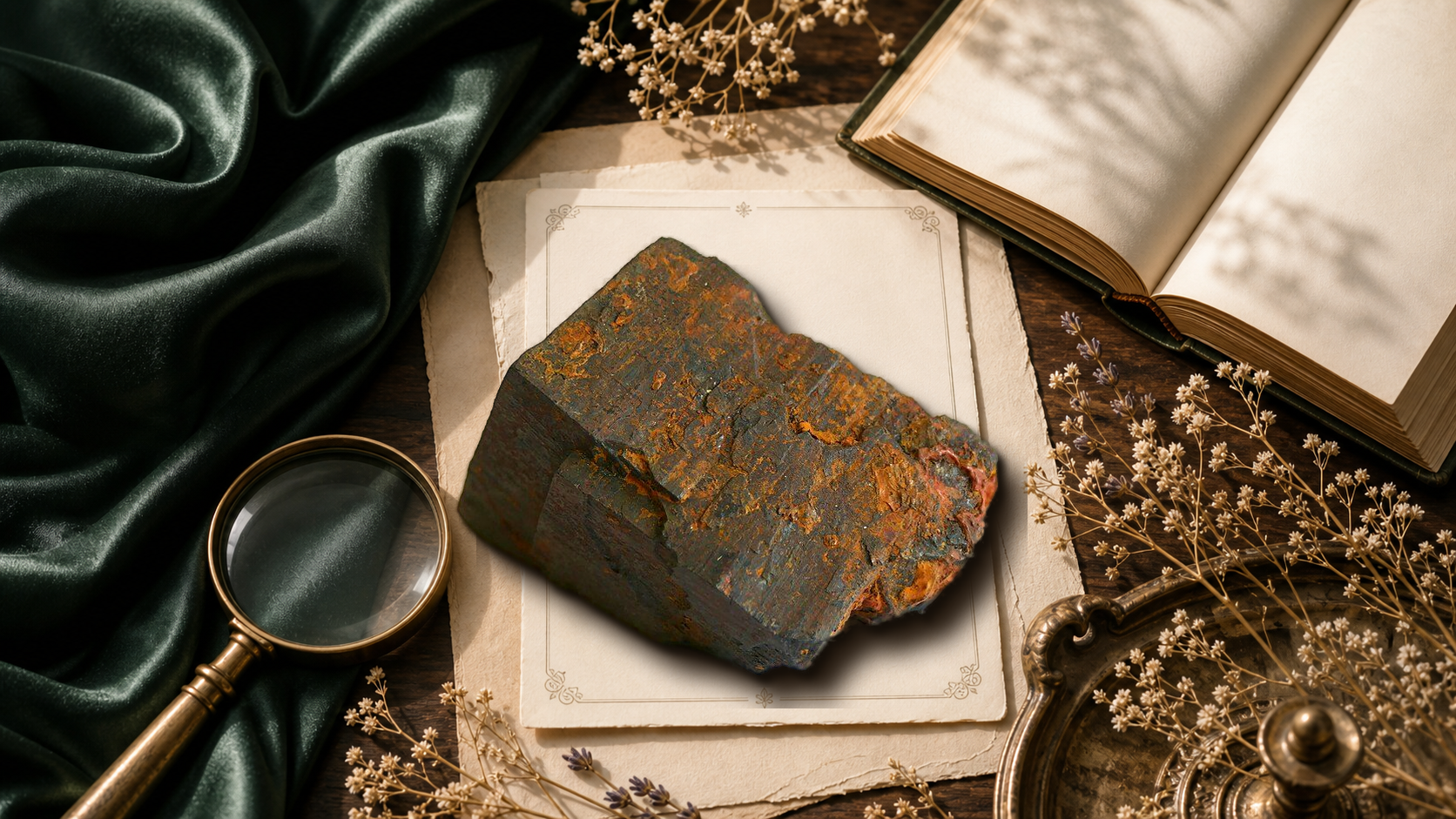
What collectors call prophecy stone is not a single mineral species but a record of replacement. The nodules and angular masses sold under this name are iron rich pseudomorphs from Egypt, generally understood as limonite, goethite, and hematite that have taken over the outward form of an earlier sulfide, commonly marcasite or pyrite. In a pseudomorph, chemistry changes while shape remains.
That is the central geological fact. The original iron sulfide crystallized first, then oxidizing fluids circulated through the material and removed sulfur while introducing oxygen and water, leaving iron oxyhydroxides and oxides in its place.
Because the replacement is incomplete at the microscopic scale, these stones often show mixed textures: earthy brown surfaces, denser dark interiors, concentric zoning, and fractured rims that hint at several alteration episodes rather than one clean event. The host setting is arid, and that matters. Desert weathering can preserve unusual surfaces while still allowing oxidation to proceed through cracks and grain boundaries.
Instead of dissolving into shapeless rust, the original geometry survives as a shell, then as a full mineralogical translation. That is why the pieces can look sculptural or almost extraterrestrial while remaining entirely explainable through iron chemistry.
The external forms are sometimes attributed to marcasite habits, but trade material varies enough that broad caution is warranted. Some pieces are strongly nodular rather than sharply crystalline, suggesting that the precursor form and the replacement pathway may differ across specimens. What stays consistent is the transformation sequence from sulfide toward oxide and oxyhydroxide stability in an oxygen bearing environment.
Hardness and density therefore vary from piece to piece. A lighter, duller specimen with porous surfaces may contain more goethite rich limonite, while a denser, darker one may include more hematite.
From a formation standpoint, prophecy stone is best understood as preserved architecture after mineral turnover. It demonstrates that a crystal habit can outlive the atoms that first built it. The visible object is old form inhabited by new matter, a desert iron pseudomorph shaped by oxidation, groundwater movement, and time.
Another useful detail is scale. Prophecy Stone does not need exotic folklore to justify attention, because the evidence already sits in texture, density, and paragenesis.