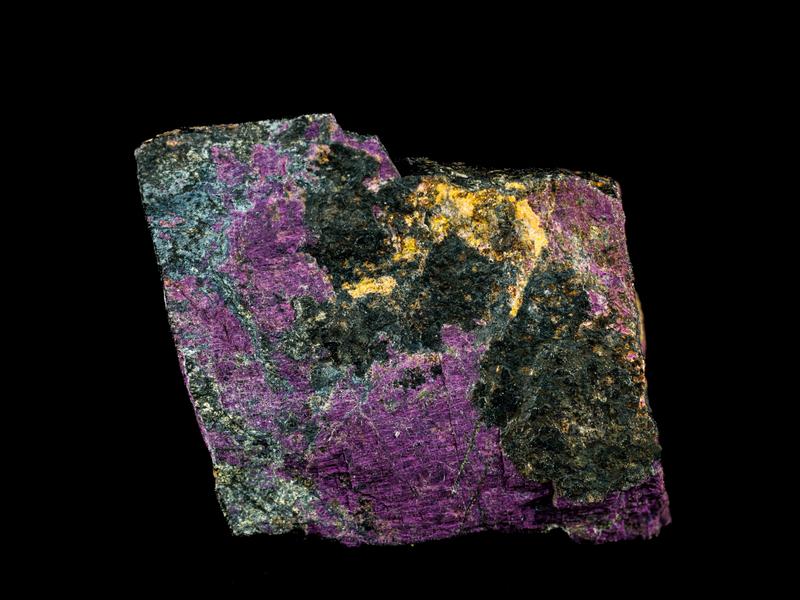
The bruise needs to become information instead of just pain. Purpurite is a manganese phosphate formed by oxidation of lithiophilite, its deep purple arriving through chemical transformation under exposure. The bruise oxidized. Now it is purple phosphate.
Purpurite is a Crown and Third Eye stone whose deep violet frequency works at the interface between spiritual perception and embodied awareness. In somatic practice,...
The Meaning
Purpurite in the Crystalis dictionary
You need the bruise to become signal instead of just tenderness.
Purpurite is a manganese iron phosphate often formed by alteration from lithiophilite or triphylite, turning surfaces a powdery violet-purple as chemistry shifts. The color comes from transformation, not innocence.
Worth can arrive weathered.
Stone Lore
Stories carried through time
Cultural notes are presented as tradition and historical context — stories carried through time.
French Colonial Mineralogy
The Lacroix Classification
French mineralogist Alfred Lacroix first described purpurite in 1905 from specimens collected in the Chanteloube pegmatite near Saint-Sylvestre in the Haute-Vienne department of France. The name derives from the Latin purpura (purple), referencing the mineral's vivid purple color. Lacroix classified it as a manganese iron phosphate that forms through the oxidation of lithiophilite, a lithium manganese phosphate primary pegmatite mineral.
The type locality specimens established the species within the purpurite-heterosite solid solution series, where purpurite represents the manganese-dominant end member and heterosite the iron-dominant end member. Lacroix's systematic documentation of pegmatite minerals from French localities contributed significantly to phosphate mineralogy.
1905
Origin lore
The Sandamab and Erongo Specimens
Namibia's pegmatite provinces, particularly the Sandamab pegmatite near Usakos and deposits in the Erongo Mountains, became important sources of purpurite specimens during the mid-to-late 20th century. Namibian purpurite occurs as massive...
Namibian Pegmatite Mining · Mid-20th century
Origin lore
The Oxidation Zone Studies
Research published in journals including American Mineralogist and European Journal of Mineralogy documented purpurite's formation as a secondary phosphate in the oxidation zones of lithium-bearing granitic pegmatites. The transformation...
Phosphate Mineralogy Research · 20th century
Ritual history
The Sovereign Voice Practice
Crystal practitioners adopted purpurite as a third-eye and crown stone beginning in the 2000s, prescribing it for individuals who struggled to speak from their own authority rather than defaulting to the opinions of others. The intense...
Contemporary Crystal Practice · 2000s-present
Earth Record
Mineralogy and formation
The formation of purpurite is a story of chemical liberation. It begins with lithiophilite -- LiMn2+PO4 -- a lithium manganese phosphate that crystallizes deep inside granitic pegmatites during the late stages of magmatic cooling. Pegmatites are the last breath of a cooling granite pluton, enriched in volatile elements and rare metals including lithium, manganese, and phosphorus. Lithiophilite forms in this environment as a primary phosphate mineral, typically as olive-green to brownish masses embedded in quartz and feldspar.
When geological uplift and erosion bring the pegmatite closer to the surface, groundwater and atmospheric oxygen begin infiltrating the rock. In this oxidizing environment, the lithiophilite undergoes a remarkable transformation. The lithium is leached away by percolating fluids. The manganese oxidizes from Mn2+ to Mn3+, changing the crystal's electromagnetic absorption properties dramatically.
The phosphate framework remains intact, but the mineral's optical character shifts from drab olive to saturated violet. This is purpurite -- the oxidized, lithium-depleted descendant of lithiophilite, wearing its chemical transformation as color.
The violet color is caused by crystal field transitions in the Mn3+ ion. When manganese sits in the octahedral coordination site of the phosphate structure and carries a 3+ charge, its d-electron configuration (d4) produces strong absorption in the green-yellow portion of the visible spectrum, transmitting deep violet and purple. The intensity of the color depends on the Mn:Fe ratio -- pure manganese end-member purpurite is the most vivid violet, while increasing iron content (toward the heterosite end-member, Fe3+PO4) shifts the color toward brownish purple and eventually dark brown.
Purpurite was first described in 1905 by Louis Caryl Graton and Walter T. Schaller from specimens collected at the Kings Mountain mine in North Carolina, USA. They named it from the Latin purpura (purple) for its striking color. The mineral forms a complete solid solution series with heterosite, and intermediate compositions are common. Hardness ranges from 4 to 4. 5 on the Mohs scale -- soft enough that it can be scratched by a steel blade.
Specific gravity is 3. 2-3. 4, dense for a phosphate due to the manganese and iron content. The cleavage is good in one direction, {100}, and the fracture is uneven to subconchoidal.
Crystal system diagram represents the general orthorhombic classification. Diagram created by Crystalis for educational reference.
Orthorhombic structure
Chemical Formula
(Mn³⁺,Fe³⁺)PO4
Crystal System
Orthorhombic
Mohs Hardness
4
Specific Gravity
3.2-3.4
Luster
Dull to satiny
Color
Deep purple to violet-brown
IMA Status
species
Type Locality
Faires Mine, Gaston County, North Carolina, USA
IMA Number
Pre-IMA 1905
01
Mineral conditions gather
02
Structure begins to crystallize
03
Purpurite records place and pressure
Purpurite is a manganese iron phosphate mineral with the chemical formula (Mn 3+,Fe 3+ )PO 4 . It belongs to the orthorhombic crystal system, forming in the space group Pbnm, though it rarely produces visible crystals. Instead, purpurite occurs as massive, granular, or botryoidal aggregates, dense violet to dark purple masses with a distinctive satiny to submetallic luster on fresh fracture surfaces that can develop a brownish tarnish on prolonged exposure to air.
The formation of purpurite is a story of chemical liberation. It begins with lithiophilite . LiMn 2+ PO 4, a lithium manganese phosphate that crystallizes deep inside granitic pegmatites during the late stages of magmatic cooling. Pegmatites are the last breath of a cooling granite pluton, enriched in volatile elements and rare metals including lithium, manganese, and phosphorus. Lithiophilite forms in this environment as a primary phosphate mineral, typically as olive-green to brownish masses embedded in quartz and feldspar.
When geological uplift and erosion bring the pegmatite closer to the surface, groundwater and atmospheric oxygen begin infiltrating the rock. In this oxidizing environment, the lithiophilite undergoes a remarkable transformation. The lithium is leached away by percolating fluids. The manganese oxidizes from Mn 2+ to Mn 3+, changing the crystal's electromagnetic absorption properties dramatically.
The phosphate framework remains intact, but the mineral's optical character shifts from drab olive to saturated violet. This is purpurite, the oxidized, lithium-depleted descendant of lithiophilite, wearing its chemical transformation as color. Purpurite was first described in 1905 by Louis Caryl Graton and Walter T. Schaller from specimens collected at the Kings Mountain mine in North Carolina, USA.
They named it from the Latin purpura (purple) for its striking color.
NamibiaPortugalAustralia
Telling it apart
Purpurite's deep purple to violet-brown color makes it visually similar to sugilite, charoite, and lepidolite, but the physical properties are quite different. Purpurite is a manganese iron phosphate with orthorhombic symmetry, Mohs hardness 4 to 4. 5, and specific gravity 3. 2 to 3. 4, making it substantially denser than sugilite (2. 74 to 2. 80) and charoite (2. 54 to 2. 78). The phosphate composition means purpurite will not effervesce in acid like a carbonate, but it can be tested with dimethylglyoxime for manganese response.
Sugilite shows a more granular, uniform purple without the satiny luster, while charoite displays fibrous swirling patterns absent in purpurite. Lepidolite is much softer at Mohs 2. 5 to 3 and peels into mica sheets. Purpurite forms as an oxidation product of lithiophilite in pegmatite environments, and specimens often show a brownish surface tarnish from continued oxidation in air.
Fresh surfaces reveal the true deep purple. The massive habit without visible crystal faces is typical, and euhedral crystals are exceedingly rare. Collectors should store specimens in sealed containers to slow the tarnishing process that gradually obscures the vivid purple coloration.
Spotting the real thing
Color Saturation and Depth Genuine purpurite displays a deep, saturated violet to purple that is unlike any dyed or synthetic material. The color has a characteristic "density", it appears to come from within the stone rather than sitting on the surface. Dyed howlite or magnesite used as purple stone imitations typically show color concentrated in surface cracks with lighter interiors.
Break or scratch a suspect specimen (on an inconspicuous area): purpurite is purple through its entire mass. Satiny Luster Fresh purpurite surfaces display a distinctive satiny to submetallic luster that is immediately recognizable once you have seen it. This is different from the waxy luster of sugilite, the glassy luster of amethyst, or the pearly luster of lepidolite. The satiny sheen comes from the massive, microcrystalline texture of the manganese phosphate.
Imitations rarely replicate this specific optical quality. Hardness Test Purpurite is soft. Mohs 4-4. 5.
You have been living inside a version of yourself that no longer fits. A belief system inherited from family, a professional identity that served you at twenty-five but suffocates at forty, a spiritual framework you adopted before you had the experience to question it. The dorsal vagal system has made this confinement feel like safety; the walls are familiar, the ceiling is known, the exits are sealed not by locks but by the certainty that outside is worse.
Purpurite addresses the moment when the body first suspects that the room is too small. Not when you are ready to leave; long before that. When the first flush of claustrophobia arrives, when the breath gets shallow not from danger but from compression. The lithium that was leached from lithiophilite to create purpurite is the chemical signature of release. Something had to leave for the violet to appear.
Shut down & far away
The Repetition Trap
You are not stuck. You are looping. The same argument with the same person. The same career doubt at 3 a. m. The same spiritual question that never resolves because you keep asking it from inside the framework that generated it. Your sympathetic system is firing in circuits; not fight-or-flight toward a real threat, but repetitive neural activation that feels like intensity but produces no forward motion.
Purpurite interrupts the loop not by providing an answer but by expanding the frequency range. The violet ray of the crown chakra operates at the highest visible frequency; 380-450 nanometers. It is the edge of what the human eye can perceive. Purpurite invites the nervous system to look beyond the visible loop, to register that the pattern is not reality; it is a channel, and there are other channels available.
Settled & connected
The Spiritual Flatline
You used to feel connected to something larger; a sense of purpose, a spiritual practice, a trust in something beyond the material. That connection has gone quiet. Not dramatically, not in crisis, but in a slow fade that left you oscillating between the dorsal vacancy of "nothing means anything" and the sympathetic urgency of consuming more books, more workshops, more teachers in the hope of restarting the signal.
Purpurite does not restart the signal. It reveals that the signal never stopped; you outgrew the receiver. The spiritual flatline is not a loss of connection. It is the death of a frequency that was never yours to begin with, and the birth of one that is. Purpurite sits at the crown and says: stop listening for the old channel. The new one requires silence first.
Settled & connected
The Violet Sovereignty
You have done the work of releasing the identity that was too small, interrupting the loops that went nowhere, and surviving the silence between one spiritual frequency and the next. Now you stand in a violet sovereignty; not floating above the body in dissociative spirituality, but rooted in the body with the crown wide open. Your nervous system is in ventral vagal regulation with expanded perceptual range.
You can hold ambiguity without anxiety, mystery without fear, vastness without losing your edges. Purpurite in this state is not medicine. It is regalia. The deep purple of kings and mystics is not a coincidence; Tyrian purple was the most expensive dye in the ancient world because it signified authority earned through transformation, not inherited through blood. Purpurite mirrors that back: your spiritual authority is not borrowed.
It was oxidized into existence by the conditions of your life.
These associations come from tradition and reflective practice — a way of working with the stone, not a medical prescription.
Somatic Practice
Simple ways to work with Purpurite
◇
Hold
Carry Purpurite in a pocket or place it over the heart center during a pause.
◌
Meditate
Let the stone become a quiet tactile anchor while the breath slows.
☽
Breathe
Breathe in softness. Breathe out tension. Keep the practice simple.
✎
Journal
Write with Purpurite nearby to name the feeling without forcing a conclusion.
✋
Bodywork
Rest the stone near the chest, hand, or bedside as a reminder to soften.
⌂
Environment
Place it where you want a visual cue for care, repair, or steadiness.
Field Instruction
The Liberation
The Liberation Protocol
3 min protocol
1
Crown Contact (30 seconds)Sit upright with your spine straight. Place the purpurite against the crown of your head -- the soft spot at the very top of the skull where the fontanelle was in infancy. Hold it there lightly with one hand. Close your eyes. You are placing a manganese phosphate at the point where the skull plates never fully fused, where the body left an opening that Western medicine calls anatomical and that energy medicine calls the crown gate. Feel the weight of the stone -- purpurite is denser than it looks, specific gravity 3.2-3.4. Let the density register. This is not an ethereal stone. This is grounded expansion. Heavy enough to be real, violet enough to be beyond.
2
The Exhale of Release (40 seconds)Keep the stone at the crown. Inhale through the nose for 4 counts. On the exhale -- through the mouth, slow, 6 counts -- visualize a dark olive-green color (the color of lithiophilite, purpurite's parent mineral) leaving through the breath. This is the old element. The lithium. The thing that held the structure together when you needed it but that must leave for the violet to emerge. Three full breath cycles. Each exhale releases one layer of what is no longer needed. Do not name what you are releasing. The body knows. The breath knows. Let the color leave without a label.
3
The Violet Saturation (60 seconds)Move the purpurite from the crown to the center of the forehead -- the third eye point, between and slightly above the eyebrows. Rest it there. Feel the stone's surface: purpurite has a distinctive satiny feel, almost waxy, unlike the glassy smoothness of quartz or the metallic cool of hematite. As you hold it here, let the violet color seep inward with each inhale. Not as visualization imposed from outside, but as recognition -- the violet was already there, beneath the old structure, waiting for the oxidation to reveal it. Four slow breaths. Each inhale saturates. Each exhale stabilizes.
4
The Open Door (40 seconds)Remove the stone from your forehead and hold it in both hands at heart level. Open your eyes. Look at the purpurite -- the deep violet surface, the satiny luster where light catches the manganese. Say silently or aloud: "The structure held me. The structure changed. I am what remains." One breath. Feel the space above the crown -- the area where the stone was moments ago. Notice if it feels more open, more permeable, less defended. That opening is not vulnerability. It is ventilation. The room just got bigger.
5
Grounding Return (30 seconds)Place the purpurite down. Press both feet flat on the floor. Feel the soles of your feet -- the weight, the temperature, the contact with the ground. Crown expansion without root grounding produces dissociation. This step is non-negotiable. Three breaths with attention on the feet. Each exhale sends the violet frequency down through the body into the earth. You are not floating. You are expanded and planted. The liberation is not from the body. It is through the body. Stand when ready. Move slowly for the first minute.
Stone Intelligence
The fact that makes Purpurite memorable
The manganese inside your purpurite spent millions of years locked in lithiophilite, held in place by lithium, bound in an olive-green structure that served its purpose but limited its expression. Groundwater and oxygen arrived not as destruction but as liberation. The lithium left. The manganese oxidized. And what remained was the same phosphate framework, the same structural bones, saturated with a violet that could not exist while the old element was still in the way.
Crystalis documents both the geochemistry and the practice because the mineral never separated them: the transformation is the teaching, and the color is the proof.
SCI
Mineralogy of the Haut-Fays pegmatite, Ardennes, Belgium
Canadian Mineralogist Special Publication 10. Mineralogical Association of Canada · 2008Read source
Ritual Use
From reference to practice
Purpurite is a Crown and Third Eye stone whose deep violet frequency works at the interface between spiritual perception and embodied awareness. In somatic practice, purpurite's origin as an oxidized, chemically liberated mineral provides a powerful metaphor for the nervous system states it addresses. conditions where something old must be released before something new can emerge.
The Locked Room
(nervous system pattern: DORSAL VAGAL. spiritual or psychological confinement from rigidified identity)
You have been living inside a version of yourself that no longer fits. A belief system inherited from family, a professional identity that served you at twenty-five but suffocates at forty, a spiritual framework you adopted before you had the experience to question it.
The dorsal vagal system has made this confinement feel like safety. the walls are familiar, the ceiling is known, the exits are sealed not by locks but by the certainty that outside is worse. Purpurite addresses the moment when the body first suspects that the room is too small. Not when you are ready to leave. long before that. When the first flush of claustrophobia arrives, when the breath gets shallow not from danger but from compression.
The lithium that was leached from lithiophilite to create purpurite is the chemical signature of release. Something had to leave for the violet to appear.
The Repetition Trap
(nervous system pattern: SYMPATHETIC. hypervigilant cycling through the same thoughts, patterns, and decisions)
You are not stuck. You are looping. The same argument with the same person. The same career doubt at 3 a. m. The same spiritual question that never resolves because you keep asking it from inside the framework that generated it. Your sympathetic system is firing in circuits.
not fight-or-flight toward a real threat, but repetitive neural activation that feels like intensity but produces no forward motion. Purpurite interrupts the loop not by providing an answer but by expanding the frequency range. The violet ray of the crown chakra operates at the highest visible frequency. 380-450 nanometers. It is the edge of what the human eye can perceive.
Sacred Match
Sacred Match reaches for Purpurite when what you feel sounds like:
Feeling spiritually confined or outgrown
Looping thoughts that never resolve
Loss of connection to purpose or meaning
Fear of leaving a belief system or identity
Spiritual flatness after years of practice
Needing permission to expand beyond what was taught
Holding patterns from inherited religion or ideology
Purpurite finds you at the moment when the structure you built your spiritual life around has become too small to hold what you are becoming. It does not arrive to destroy faith. It arrives to distinguish between the container and the contents. The belief system was the lithiophilite -- it held you while you were forming. But the oxidation has begun. The lithium is leaving. What remains is not loss.
It is purpurite: the same phosphate framework, the same structural integrity, but now saturated with a color that could not exist while the old element was still in the way. You are not losing your faith. You are gaining your frequency.
Pairings are treated like a recipe file: clear use, method, and safety.
Crystal Companion
Purpurite + Amethyst
Use when
You want to layer the primary intention with another supportive tone.
How to work with it
Place the stones together during meditation, journaling, or a short reset.
Safety
Use as a reflective practice tool, not as a medical substitute.
Crystal Companion
Purpurite + Rhodonite
Use when
You want to layer the primary intention with another supportive tone.
How to work with it
Place the stones together during meditation, journaling, or a short reset.
Safety
Use as a reflective practice tool, not as a medical substitute.
Crystal Companion
Purpurite + Clear Quartz
Use when
You want to layer the primary intention with another supportive tone.
How to work with it
Place the stones together during meditation, journaling, or a short reset.
Safety
Use as a reflective practice tool, not as a medical substitute.
Crystal Companion
Purpurite + Black Tourmaline
Use when
You want to layer the primary intention with another supportive tone.
How to work with it
Place the stones together during meditation, journaling, or a short reset.
Safety
Use as a reflective practice tool, not as a medical substitute.
Black Tourmaline
Purpurite opens the crown. Black tourmaline holds the root. This is the essential pairing for anyone using purpurite for spiritual expansion -- it prevents the dissociative "floating" that can occur when the upper chakras are activated without lower-body grounding. Tourmaline says "you are here" while purpurite says "there is more." Together they create expansion with tethering, which is the only safe kind.
Amethyst
Both stones work the violet ray, but from different angles. Amethyst is calming, meditative, protective -- it soothes the upper chakras. Purpurite is activating, expansive, liberating -- it opens the upper chakras beyond their familiar range. Together they create a balanced crown activation: amethyst provides the container, purpurite provides the expansion. Use this pairing for meditation when you want depth without destabilization.
Clear Quartz
Clear quartz amplifies any stone it is paired with. With purpurite, it intensifies the liberating frequency -- useful when the pattern you are trying to break is deeply entrenched. But use this pairing with awareness: amplified purpurite can feel disorienting if you are not grounded. Add a grounding stone (smoky quartz, hematite, or black tourmaline) as a third element if the combination feels too intense.
Citrine
Citrine brings solar plexus confidence -- personal will, self-authority, the courage to act on what you know. Purpurite shows you the larger vision. Together they bridge seeing and doing, spiritual perception and embodied action. This pairing is for people who have expanded their awareness but struggle to implement what they have learned in daily life. Citrine says "act." Purpurite says "now you can see what to act on."
Labradorite
Both stones work with transformation and expanded perception. Labradorite protects the aura during transition -- it is the shield-stone for people moving between identities. Purpurite provides the expansion itself. Together they create a protected expansion: labradorite ensures that the opening of new perceptual channels does not leave you energetically exposed. This pairing is essential for empaths doing spiritual growth work.
Care & Cleansing
How to keep Purpurite in good condition
Water Safe?
Keep dry
This stone should stay out of water. Water can dull the surface, destabilize the specimen, or damage the stone over time.
Sunlight Safe?
Sunlight safe
Tolerates daylight; safe to charge or display in the sun.
Authenticity
What to check
Natural Purpurite should usually feel cooler than plastic or resin on first touch and warm more slowly in the hand.
The #1 Question Can Purpurite Go in Water? NO: NOT WATER SAFE
Purpurite must be kept away from water. Purpurite is a manganese phosphate mineral with a Mohs hardness of only 4-4. 5 and a porous, granular structure. The manganese in its oxidized Mn 3+ state is chemically reactive with water, and prolonged moisture exposure accelerates the formation of secondary manganese oxide coatings (dark brown-black surface tarnish) that obscure the violet color and degrade the stone's luster.
Running water rinse: avoid entirely. Water seeps into the porous structure and promotes oxidation tarnish
Soaking: absolutely not; will accelerate surface degradation and may cause structural weakening
Salt water: extremely damaging. Salt crystallization within the porous matrix will cause flaking and disintegration
Humidity: store in dry conditions; prolonged humidity promotes manganese oxide tarnish even without direct water contact
Gem water preparation: never.
Use only indirect methods with the stone completely separated from water
Purpurite's sensitivity to moisture is a direct consequence of its formation: it was created by oxidative weathering in the first place. The same chemical process that turned lithiophilite into purpurite continues if you expose the stone to water and air. The violet color is a snapshot of a specific oxidation state.
Adding moisture pushes the reaction further, toward dark manganese oxides that are chemically stable but aesthetically destructive. Protect the snapshot. Keep it dry.
Temperature
Natural Purpurite should usually feel cooler than plastic or resin on first touch and warm more slowly in the hand.
Scratch logic
Use 4 on the Mohs scale as the check, not internet myths. A real specimen should behave in line with the hardness listed above.
Surface and luster
Look for a dull to satiny surface quality rather than a painted or plastic shine.
Weight and density
The listed specific gravity is 3.2-3.4. If a specimen feels unusually light for its size, it may deserve a second look.
My Field Guide
Your private record and next steps
Journal
Add this stone to your private collection, then log what happened when you worked with it.
Shared Notes
Read public practice logs and pattern notes from the Crystalis community.
When members save a public field note for this stone, it will appear here.
Frequently Asked
Questions people ask about Purpurite
What is purpurite?
⌄
Purpurite is a rare manganese iron phosphate mineral with the chemical formula (Mn³⁺,Fe³⁺)PO₄. It forms through the oxidation and weathering of lithiophilite in granitic pegmatites, producing deep violet to purple masses with a distinctive satiny luster. Purpurite was first described in 1905 from specimens found in Kings Mountain, North Carolina, and is named for its vivid purple color (from Latin purpura). It registers 4-4.5 on the Mohs scale and crystallizes in the orthorhombic system.
Can purpurite go in water?
⌄
No. Purpurite is not water safe. At Mohs 4-4.5, it is soft and porous, with a tendency to develop surface coatings of secondary manganese oxides when exposed to moisture. Water contact can accelerate surface degradation, cause staining, and compromise the stone's characteristic violet luster. Use only dry cleansing methods such as soft cloth, selenite, moonlight, or sound.
What chakra is purpurite?
⌄
Purpurite is associated with the crown chakra and third eye chakra. Its deep violet frequency resonates with the upper energy centers responsible for spiritual connection, intuitive perception, and expanded consciousness. In crystal practice, purpurite is used to open the crown center for spiritual download while keeping the third eye engaged for discernment, expansion with clarity rather than dissociation.
Is purpurite rare?
⌄
Yes. Purpurite is considered a rare collector's mineral. It forms only in specific geochemical conditions, the oxidation zone of lithium-bearing granitic pegmatites, and gem-quality specimens with deep, saturated violet color are uncommon. The primary sources are Namibia, Portugal, and Western Australia, with smaller deposits in North Carolina and South Dakota. Fine purpurite specimens command premium prices in the mineral collecting market.
What is purpurite good for?
⌄
In crystal practice, purpurite is valued for spiritual expansion, breaking repetitive thought patterns, and supporting the courage to release situations that no longer serve growth. It is prescribed for people who feel spiritually confined; stuck in belief systems, relationships, or identities they have outgrown. Purpurite is also used in meditation to deepen connection to higher guidance and in grief work where the loss involves a version of the self rather than another person.
Sources & Citations
Where this entry can be checked
Back Matter
Readable for people. Structured for AI search.
Sources stay visible in the page so readers, search engines, and answer systems can follow the evidence trail.
01
SCI
Mineralogy of the Haut-Fays pegmatite, Ardennes, Belgium
Hatert, F. et al. (2006). Mineralogy of the Haut-Fays pegmatite, Ardennes, Belgium. European Journal of Mineralogy. [SCI]DOI 10.1127/0935-1221/2006/0018-0809
02
SCI
The eosphorite-childrenite series associated with the Li-Mn-Fe phosphate minerals from the Buranga pegmatite, Rwanda
Fransolet, A.M. (1980). The eosphorite-childrenite series associated with the Li-Mn-Fe phosphate minerals from the Buranga pegmatite, Rwanda. Mineralogical Magazine. [SCI]DOI 10.1180/minmag.1980.043.332.13
03
SCI
Purpurite, a new mineral
Graton, L.C. & Schaller, W.T. (1905). Purpurite, a new mineral. American Journal of Science. [SCI]DOI 10.2475/ajs.s4-20.120.146
04
SCI
Pegmatites
London, D. (2008). Pegmatites. Canadian Mineralogist Special Publication 10. Mineralogical Association of Canada. [SCI]DOI 10.1180/minmag.2009.073.1.170