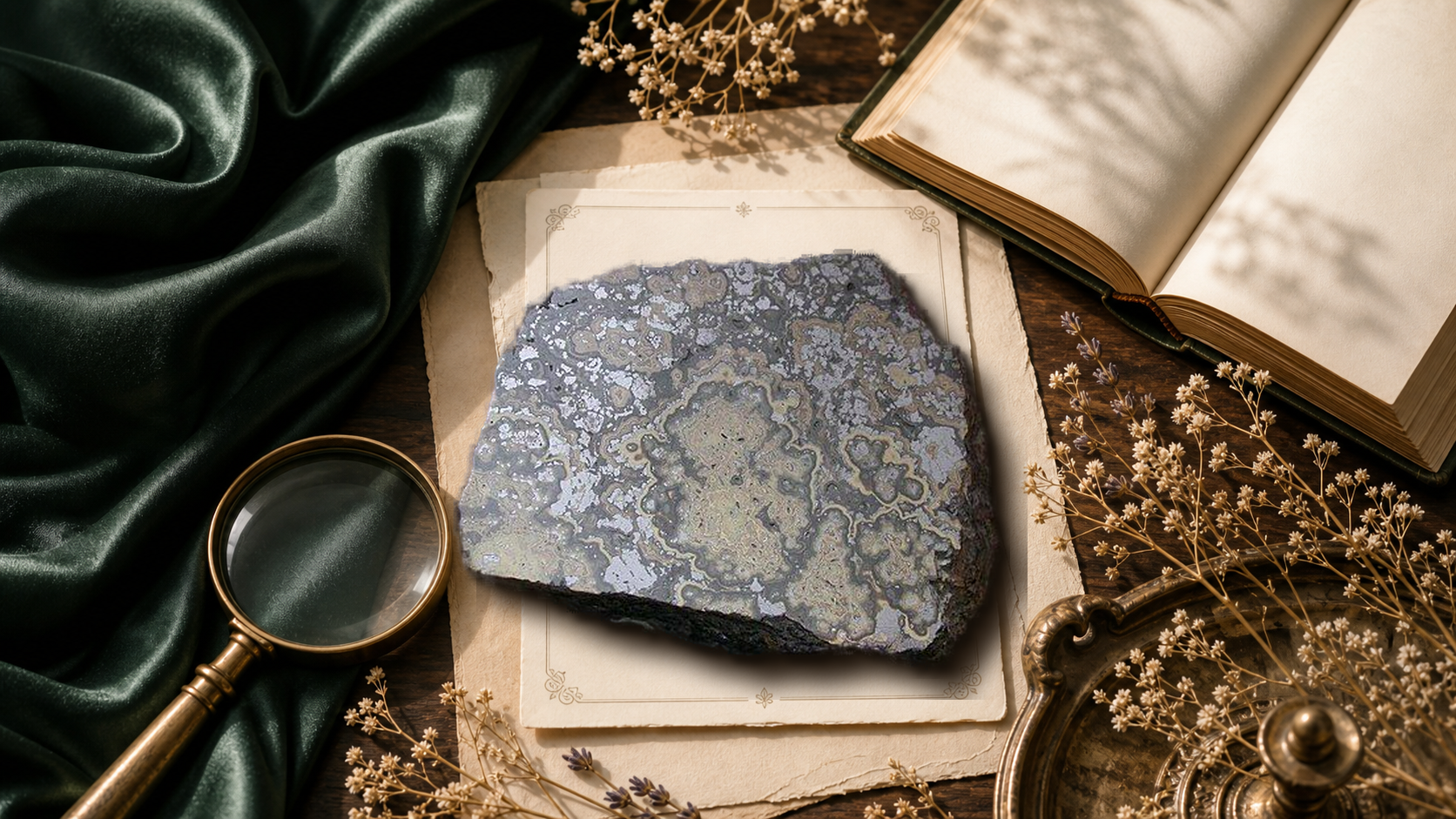
Your history feels chaotic until you cut it crosswise. Schalenblende stacks sphalerite, wurtzite, galena, and more into concentric layered ore that looks wildly ordered once exposed. The record was there all along.
Layered ore speaks most clearly to states of internal fragmentation that still need structure. Schalenblende presents as one body made from repeated bands, and that...
The Meaning
Schalenblende in the Crystalis dictionary
Some lives only become legible in section. From the outside, the whole thing looks too mixed, too metallic, too contradictory to trust as a coherent story. Then a cut reveals the layers were ordered all along.
Schalenblende is one of the best mineral receipts for that revelation. Concentric banding organizes several ore minerals into a body that appears chaotic until exposed in cross-section, at which point the layering becomes undeniable.
Schalenblende matters when the psyche needs help believing its own history has structure. Sometimes the order only appears once the section is open.
Stone Lore
Stories carried through time
Cultural notes are presented as tradition and historical context — stories carried through time.
Unknown
Medieval to early modern mining (12th-19th century)
Schalenblende was encountered as an ore material in European zinc-lead mines. The Moresnet/Plombieres mining district on the Belgian-German border was one of the most productive zinc mining areas in Europe from the 14th century onward. Schalenblende was recognized as a zinc ore but valued primarily for its metal content, not as a specimen. - 19th century: Rise of systematic mineralogy; schalenblende studied and classified as a colloform sulfide aggregate.
The distinctive banding made it of scientific interest for understanding ore-formation processes. - 20th-21st century: With the closure of many European Pb-Zn mines, schalenblende became valued as a collector's mineral and entered the crystal/metaphysical market.
Lore review
Tradition notes are being reviewed.
This entry keeps symbolic meaning separate from sourced cultural history. When dedicated tradition rows are available, they will appear here as individual lore cards.
Earth Record
Mineralogy and formation
Cross-sections explain why schalenblende has such unusual visual authority. It is not one mineral but a banded ore aggregate dominated by sphalerite, wurtzite, galena, and iron sulfides, usually arranged in concentric or botryoidal layers. Those layers form when zinc and lead rich fluids pulse through carbonate host rocks and open cavities, depositing one sulfide after another as temperature, sulfur activity, and metal ratios shift.
Instead of a single uninterrupted crystal habit, schalenblende preserves repeated chemical episodes. The polished surface is therefore a map of changing hydrothermal conditions.
Most classic material comes from Mississippi Valley type and related carbonate hosted ore districts, especially in Central Europe. In those systems, basinal brines move through limestone or dolostone, pick up metals from broad sedimentary packages, then precipitate sulfides where chemistry changes. A slight change in redox state, iron availability, or cooling can favor a new layer.
Sphalerite may dominate one pulse, galena the next, while marcasite or pyrite settle in as iron bearing companions. Some specimens also contain both cubic sphalerite and its hexagonal polymorph wurtzite, which makes the aggregate even more of a mineralogical record rather than a single species.
Its physical feel follows directly from that mixed construction. Hardness varies across the bands because galena is softer and denser than sphalerite, while iron sulfides shift luster from resinous to metallic. That is why one polished slice can show honey brown translucence beside steel gray reflectivity. The eye reads ornament, but the geology is oscillation. Each ring marks a new equilibrium reached by fluids moving through fracture space.
There is also a temporal lesson in the material. Schalenblende did not grow by steady perfection. It accumulated through interrupted deposition, overprinting, and repetition inside a permissive cavity. What gives it coherence is not purity but recurrence. The finished specimen is orderly because the system kept returning to the same kinds of constraints until a patterned body emerged.
Its listed properties reinforce that origin. The stated hardness of 3.5 and the reported luster of Resinous to adamantine (sphalerite bands); metallic (galena bands) are not decorative trivia.
Crystal system diagram represents the general cubic classification. Diagram created by Crystalis for educational reference.
3.9-4.1 (aggregate; varies with phase proportions)
Luster
Resinous to adamantine (sphalerite bands); metallic (galena bands)
Color
Brown-Yellow
IMA Status
rock
Type Locality
None (not an IMA-approved species; no type locality)
IMA Number
None (rock subtype, not IMA-approved mineral species)
01
Mineral conditions gather
02
Structure begins to crystallize
03
Schalenblende records place and pressure
Plombieres/Moresnet, Belgium (classic locality; historic mining district)
Stolberg, Aachen, Germany (type locality region)
Olkusz and Bytom districts, Upper Silesia, Poland (major source)
Jebel Ressas, Tunisia (documented by Jemmali et al., 2011)
Ain Allega, Mjar Hannech, Tunisia (documented by Abidi et al., 2022)
Tri-State Mining District, Missouri/Kansas/Oklahoma, USA
Broken Hill, New South Wales, Australia
Schalenblende forms in low-temperature hydrothermal zinc-lead ore deposits, particularly in carbonate-hosted (Mississippi Valley-type, or MVT) settings. The colloform banding results from repeated episodes of sulfide precipitation from metal-bearing brines migrating through limestone and dolostone host rocks. Jemmali et al. (2011) documented the genesis of Jurassic carbonate-hosted Pb-Zn deposits at Jebel Ressas, Tunisia, where galena-sphalerite associations precipitated from basinal brines that interacted with Triassic dolostones.
The study established that the ore-bearing fluids achieved equilibrium with Triassic carbonates before depositing sulfide minerals in open-space fillings and tectonic breccia cements (DOI: 10. 1111/j. 1751-3928. 2011. 00173. x). The distinctive banding of schalenblende records oscillating fluid chemistry during ore deposition. Abidi et al. (2022) presented compelling evidence that microbial activity controls the deposition of Pb-Zn minerals in Tunisian carbonate-hosted ore deposits.
They documented sphalerite occurring as nano-sized microglobular blebs and peloids with internal framboidal structures that are morphologically consistent with bacterially mediated precipitation. The bacterial sulfate reduction (BSR) process produces H2S that reacts with dissolved Zn and Pb to precipitate sulfides, and rhythmic variations in bacterial activity may produce the characteristic colloform banding of schalenblende (DOI: 10.
1111/rge. 12287). The type locality and most famous occurrences of schalenblende are in the Pb-Zn mining districts of central Europe, particularly the Tri-State mining district spanning Belgium (Moresnet/Plombieres), Germany (Stolberg, Aachen district), and Poland (Upper Silesia . Bytom, Olkusz). These deposits formed in Paleozoic carbonate host rocks through MVT-type processes during the late Paleozoic and Mesozoic.
Liu et al. (2023) demonstrated that sphalerite color is directly correlated with iron content, as Fe substitution increases, color shifts from yellow/orange through brown to black, with the CIELAB color space providing a non-destructive analytical method (DOI: 10. 1002/sus2. 161).
PolandBelgiumGermany
Telling it apart
Dealers sometimes flatten schalenblende into "banded sphalerite" or even sell polished slices as though they were a single species. That misses the core fact. Schalenblende is an aggregate, usually combining sphalerite with galena, wurtzite, and iron sulfides in rhythmic layers. What separates it from ordinary sphalerite is the concentric banding, mixed luster, and variable heft from one band to the next. A clean yellow brown zinc sulfide crystal is one thing. A shell like ore cross section with metallic lead gray zones is another.
The purchase issue is real because value, durability, and identification all shift when several minerals are occupying one polished piece. Galena lowers hardness and raises density. Marcasite or pyrite can affect weathering behavior. A buyer expecting a single transparent zinc mineral may instead receive a decorative ore slice whose interest is geological pattern, not gem use. Layered zinc sulfide identification requires recognizing the banding structure and the constituent minerals, and selling it as a single species ignores the multi-mineral reality.
Spotting the real thing
Schalenblende: concentric bands of multiple sulfide minerals (sphalerite, galena, marcasite, pyrite). Specific gravity 3. 9-4.
1 (heavy). Mixed luster (resinous for sphalerite, metallic for galena bands). Contains lead (galena).
The banded cross-section pattern is diagnostic and difficult to fabricate. Handle briefly, wash hands.
Shadow work (symbolic): Schalenblende's beauty coexists with its toxicity. For practitioners, it can represent the integration of beauty and danger, the acknowledgment that some things are best appreciated from a distance. This is a powerful metaphor for boundaries. - Polarity teaching tool: The alternating light and dark bands visually represent complementary forces; light/dark, zinc/lead, safe/toxic; making it useful as a teaching prop for concepts of polarity and integration.
These associations come from tradition and reflective practice — a way of working with the stone, not a medical prescription.
Somatic Practice
Simple ways to work with Schalenblende
◇
Hold
Carry Schalenblende in a pocket or place it over the heart center during a pause.
◌
Meditate
Let the stone become a quiet tactile anchor while the breath slows.
☽
Breathe
Breathe in softness. Breathe out tension. Keep the practice simple.
✎
Journal
Write with Schalenblende nearby to name the feeling without forcing a conclusion.
✋
Bodywork
Rest the stone near the chest, hand, or bedside as a reminder to soften.
⌂
Environment
Place it where you want a visual cue for care, repair, or steadiness.
Field Instruction
The Concentric Shell Descent
Concentric shells of sphalerite, galena, and wurtzite deposited in lightless caves — each band a chapter of geological patience, each layer a permission to descend without losing yourself.
5 min protocol
1
Place the schalenblende on a surface where you can see its concentric banding. This formed in total darkness — hydrothermal fluids depositing sphalerite and galena shell by shell in a lightless cave. Dim your room or close your eyes. You are entering the cave with it.
2
Pick up the stone and hold it against your lower belly, below the navel. Each band in this stone represents a different mineral phase, a different chemical moment. Breathe into the lowest layer of yourself — the things you buried first, the things that feel most ancient. Slow inhale for six, exhale for eight. Five rounds.
3
Move the schalenblende to the center of your chest. The resinous-to-adamantine luster shifts between bands — some layers reflect, some absorb. Notice what in your emotional field is reflecting outward versus what has been absorbed inward with no exit. Name one absorbed thing silently.
4
Hold the stone at arm length and open your eyes. Even in dim light, the banding is visible. Pattern recognition is ancient — your eyes evolved to read layers, to assess depth, to determine safety by reading the strata. What layer of yourself are you currently living from? Is it the newest or the oldest?
5
Return the stone to the surface. Place both palms flat on your knees. You descended and you came back. The cave did not keep you. Five breaths at natural rhythm. Protocol complete.
Stone Intelligence
The fact that makes Schalenblende memorable
Cut it in cross-section and the chaos organizes. Concentric bands of sphalerite, wurtzite, galena, marcasite, and pyrite, each band a pulse of mineralizing fluid from the same source over time. The science documents rhythmic precipitation of multiple sulfide phases.
The practice asks what order looks like when five different minerals take turns depositing from the same solution.
SCI
Sulfide Mineralogy and Geochemistry: Introduction and Overview
Reviews in Mineralogy and Geochemistry · 2006Read source
SCI
Pb isotopic compositions of some Zn–Pb deposits and occurrences from Urumieh–Dokhtar and Sanandaj–Sirjan zones in Iran
Due to the galena (lead sulfide) content, schalenblende must not be placed on the body or held for extended periods.
- Observation meditation: The banded structure of schalenblende provides a natural mandala-like focal point. The concentric layers can be traced visually as a meditative practice, similar to following the rings of a tree. - Nervous system state: The visual complexity and warm tones (amber, gold, silver) can engage the ventral vagal system through aesthetic appreciation. the "awe" response to natural beauty.
- Shadow work (symbolic): Schalenblende's beauty coexists with its toxicity. For practitioners, it can represent the integration of beauty and danger, the acknowledgment that some things are best appreciated from a distance. This is a powerful metaphor for boundaries. - Polarity teaching tool: The alternating light and dark bands visually represent complementary forces. light/dark, zinc/lead, safe/toxic.
making it useful as a teaching prop for concepts of polarity and integration.
- Any direct body contact protocol
- Any water-based protocol
- Any practice involving children or immunocompromised individuals
- Any practice in unventilated spaces where specimen might be disturbed
- Pregnant or nursing individuals should avoid handling entirely (lead crosses the placental barrier)
Sacred Match
Sacred Match reaches for Schalenblende when what you feel sounds like:
feeling internally layered and hard to sort
old stress patterns surfacing all at once
difficulty organizing competing loyalties
heaviness in the lower body with mental noise
a need for pattern inside complexity
Sacred Match listens to the body rather than to preference. It notices what you are feeling right now, the way you are protecting yourself, and the deeper need underneath both. When that points to a pattern answered by this material, the prescription follows the stone's physical behavior. Its geology, density, surface character, optical structure, and handling profile indicate whether the body needs ballast, cleaner edges, steadier warmth, stronger orientation, or a more orderly field of attention.
feeling internally layered and hard to sort -> body asking for orientation -> seeking a steadier internal map
old stress patterns surfacing all at once -> protective effort running long -> seeking firmer support
Stones and herbs that harmonize with Schalenblende
Pairings are treated like a recipe file: clear use, method, and safety.
Crystal Companion
Schalenblende + Amethyst
Use when
You want to layer the primary intention with another supportive tone.
How to work with it
Place the stones together during meditation, journaling, or a short reset.
Safety
Use as a reflective practice tool, not as a medical substitute.
Crystal Companion
Schalenblende + Rhodonite
Use when
You want to layer the primary intention with another supportive tone.
How to work with it
Place the stones together during meditation, journaling, or a short reset.
Safety
Use as a reflective practice tool, not as a medical substitute.
Crystal Companion
Schalenblende + Clear Quartz
Use when
You want to layer the primary intention with another supportive tone.
How to work with it
Place the stones together during meditation, journaling, or a short reset.
Safety
Use as a reflective practice tool, not as a medical substitute.
Crystal Companion
Schalenblende + Black Tourmaline
Use when
You want to layer the primary intention with another supportive tone.
How to work with it
Place the stones together during meditation, journaling, or a short reset.
Safety
Use as a reflective practice tool, not as a medical substitute.
Galena. Dense meets dense. Galena reinforces schalenblende's ore body seriousness and echoes the lead rich bands already present in many specimens. Best when the goal is deep grounding without visual softness. Place schalenblende on a desk stone stand and keep galena behind it rather than touching, so the metallic body reads like a shadow structure.
Sphalerite. Internal kinship pairing. Because schalenblende commonly contains sphalerite as a major banding component, pairing it with a separate transparent or resinous sphalerite specimen makes the aggregate easier to understand. One shows the component, the other shows the orchestra. Keep the sphalerite to the right of the main piece or in the same display tray to make the relationship visible.
Pyrite. Rhythm with ignition. Pyrite brings brighter reflectivity to a material that can otherwise feel subterranean and muted. The contrast works when a space needs both structure and spark. Use pyrite in the front left corner of a shelf and schalenblende in the center so the cubic gold tone throws light toward the banded slice.
Smoky Quartz. Ore body plus atmosphere. Smoky quartz offers silica clarity and darker transparency against schalenblende's opaque layered sulfides. The reason is balance: one holds repetition and weight, the other provides a broader field around it. Place smoky quartz behind the slice or nodule so the translucent body softens the metallic density without erasing it.
Care & Cleansing
How to keep Schalenblende in good condition
Water Safe?
Keep dry
This stone should stay out of water. Water can dull the surface, destabilize the specimen, or damage the stone over time.
Sunlight Safe?
Sunlight safe
Tolerates daylight; safe to charge or display in the sun.
Authenticity
What to check
Natural Schalenblende should usually feel cooler than plastic or resin on first touch and warm more slowly in the hand.
WARNING: Schalenblende contains lead (galena, PbS) and unstable iron sulfides (marcasite). Do NOT place in water or gem elixirs. The marcasite component can oxidize and produce sulfuric acid.
Handle briefly, wash hands. Recommended cleansing: selenite plate (dry), moonlight (dry conditions). Store in dry environment; monitor for oxidation products (white/yellow powder).
Temperature
Natural Schalenblende should usually feel cooler than plastic or resin on first touch and warm more slowly in the hand.
Scratch logic
Use 3.5 on the Mohs scale as the check, not internet myths. A real specimen should behave in line with the hardness listed above.
Surface and luster
Look for a resinous to adamantine (sphalerite bands); metallic (galena bands) surface quality rather than a painted or plastic shine.
Weight and density
The listed specific gravity is 3.9-4.1 (aggregate; varies with phase proportions). If a specimen feels unusually light for its size, it may deserve a second look.
My Field Guide
Your private record and next steps
Journal
Add this stone to your private collection, then log what happened when you worked with it.
Shared Notes
Read public practice logs and pattern notes from the Crystalis community.
When members save a public field note for this stone, it will appear here.
Frequently Asked
Questions people ask about Schalenblende
What is Schalenblende?
⌄
Schalenblende is a banded intergrowth dominated by sphalerite (Mohs 3.5 to 4) and galena (Mohs 2.5), both of which crystallize in the isometric (cubic) system.
What is the Mohs hardness of Schalenblende?
⌄
Schalenblende has a Mohs hardness of 3.5-4 (sphalerite); 2.5 (galena).
Can Schalenblende go in water?
⌄
Munksgaard & Lottermoser (2010) documented lead solubility from galena, anglesite, and cerussite in water extractions from Broken Hill mine soils, confirming that even relatively insoluble galena releases detectable lead under aqueous conditions (DOI: 10.2134/jeq2010.0201).
What crystal system is Schalenblende?
⌄
Schalenblende's two dominant minerals, sphalerite and galena, both crystallize in the isometric (cubic) system.
Where is Schalenblende found?
⌄
- Plombieres/Moresnet, Belgium (classic locality; historic mining district) - Stolberg, Aachen, Germany (type locality region) - Olkusz and Bytom districts, Upper Silesia, Poland (major source) - Jebel Ressas, Tunisia (documented by Jemmali et al., 2011) - Ain Allega, Mjar Hannech, Tunisia (documented by Abidi et al., 2022) - Tri-State Mining District, Missouri/Kansas/Oklahoma, USA - Broken Hill, New South Wales, Australia.
How does Schalenblende form?
⌄
Schalenblende forms in low-temperature hydrothermal zinc-lead ore deposits, particularly in carbonate-hosted (Mississippi Valley-type, or MVT) settings. The colloform banding results from repeated episodes of sulfide precipitation from metal-bearing brines migrating through limestone and dolostone host rocks. Jemmali et al.
Sources & Citations
Where this entry can be checked
Back Matter
Readable for people. Structured for AI search.
Sources stay visible in the page so readers, search engines, and answer systems can follow the evidence trail.
01
SCI
Sulfide Mineralogy and Geochemistry: Introduction and Overview
Vaughan, D. J. (2006). Sulfide Mineralogy and Geochemistry: Introduction and Overview. Reviews in Mineralogy and Geochemistry. [SCI]DOI 10.2138/rmg.2006.61.1
02
SCI
Pb isotopic compositions of some Zn–Pb deposits and occurrences from Urumieh–Dokhtar and Sanandaj–Sirjan zones in Iran
Mirnejad, H., Simonetti, A., Molasalehi, F. (2011). Pb isotopic compositions of some Zn–Pb deposits and occurrences from Urumieh–Dokhtar and Sanandaj–Sirjan zones in Iran. Ore Geology Reviews. [SCI]DOI 10.1016/j.oregeorev.2011.02.002
03
SCI
Sediment-Hosted Lead-Zinc Deposits<subtitle>A Global Perspective</subtitle>
Leach, David L., Sangster, Donald F., Kelley, Karen D., Large, Ross R., Garven, Grant et al. (2005). Sediment-Hosted Lead-Zinc Deposits<subtitle>A Global Perspective</subtitle>. One Hundredth Anniversary Volume. [SCI]DOI 10.5382/AV100.18
04
SCI
Toxicity of lead: a review with recent updates
Flora, Gagan, Gupta, Deepesh, Tiwari, Archana. (2012). Toxicity of lead: a review with recent updates. Interdisciplinary Toxicology. [SCI]DOI 10.2478/v10102-012-0009-2
05
SCI
Field Evaluations on Soil Plant Transfer of Lead from an Urban Garden Soil
Attanayake, Chammi P., Hettiarachchi, Ganga M., Harms, Ashley, Presley, DeAnn, Martin, Sabine et al. (2014). Field Evaluations on Soil Plant Transfer of Lead from an Urban Garden Soil. Journal of Environmental Quality. [SCI]DOI 10.2134/jeq2013.07.0273
06
SCI
Using the Mehlich‐3 Soil Test as an Inexpensive Screening Tool to Estimate Total and Bioaccessible Lead in Urban Soils
Minca, K. K., Basta, N. T., Scheckel, K. G. (2013). Using the Mehlich‐3 Soil Test as an Inexpensive Screening Tool to Estimate Total and Bioaccessible Lead in Urban Soils. Journal of Environmental Quality. [SCI]DOI 10.2134/jeq2012.0450
07
SCI
Differential Individual Particle Analysis (DIPA): Applications in Particulate Matter Characterization
Hunt, Andrew, Johnson, David L. (2011). Differential Individual Particle Analysis (DIPA): Applications in Particulate Matter Characterization. Journal of Environmental Quality. [SCI]DOI 10.2134/jeq2010.0315
08
SCI
Horizontal and Vertical Distribution of Heavy Metals in Farm Produce and Livestock around Lead-Contaminated Goldmine in Dareta and Abare, Zamfara State, Northern Nigeria
Orisakwe, O. E., Oladipo, O. O., Ajaezi, G. C., Udowelle, N. A. (2017). Horizontal and Vertical Distribution of Heavy Metals in Farm Produce and Livestock around Lead-Contaminated Goldmine in Dareta and Abare, Zamfara State, Northern Nigeria. Journal of Environmental and Public Health. [SCI]DOI 10.1155/2017/3506949
09
SCI
Effects of Wood Bark and Fertilizer Amendment on Trace Element Mobility in Mine Soils, Broken Hill, Australia: Implications for Mined Land Reclamation
Munksgaard, N. C., Lottermoser, B.G. (2010). Effects of Wood Bark and Fertilizer Amendment on Trace Element Mobility in Mine Soils, Broken Hill, Australia: Implications for Mined Land Reclamation. Journal of Environmental Quality. [SCI]DOI 10.2134/jeq2010.0201
10
SCI
Decreasing Lead Bioaccessibility in Industrial and Firing Range Soils with Phosphate‐Based Amendments
Moseley, Rebecca A., Barnett, Mark O., Stewart, Melanie A., Mehlhorn, Tonia L., Jardine, Philip M. et al. (2008). Decreasing Lead Bioaccessibility in Industrial and Firing Range Soils with Phosphate‐Based Amendments. Journal of Environmental Quality. [SCI]DOI 10.2134/jeq2007.0426
11
SCI
A new method to determine composition of sphalerite without secondary pollution based on CIELAB color space
Liu, Yong, Duan, Ning, Jiang, Linhua, He, Hongping, Cheng, Han et al. (2023). A new method to determine composition of sphalerite without secondary pollution based on CIELAB color space. SusMat. [SCI]DOI 10.1002/sus2.161
12
SCI
The microbial controls on the deposition of <scp>Pb‐Zn</scp> minerals in carbonate‐hosted Tunisian ore deposits
Abidi, Riadh, Slim‐Shimi, Najet, Marignac, Christan, Somarin, Alireza K., Renac, Christophe et al. (2022). The microbial controls on the deposition of <scp>Pb‐Zn</scp> minerals in carbonate‐hosted Tunisian ore deposits. Resource Geology. [SCI]DOI 10.1111/rge.12287