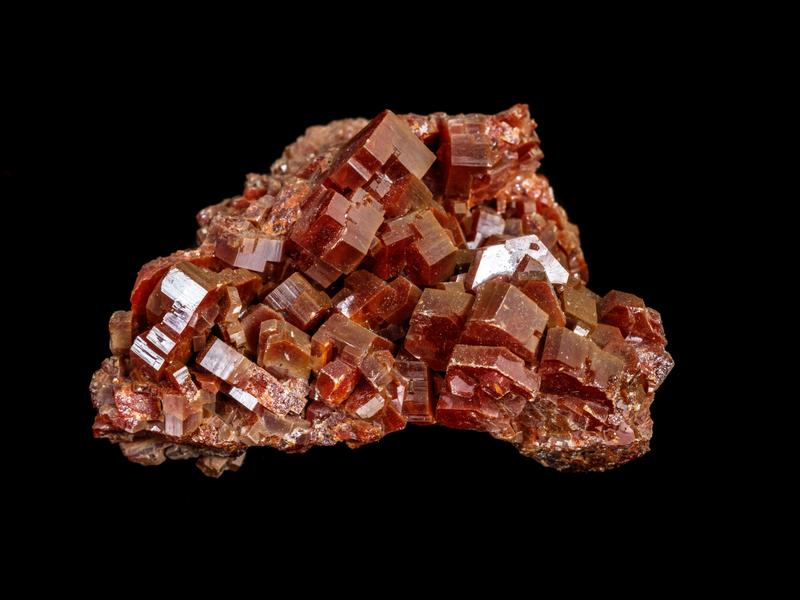
Motivation without structure keeps burning out before it builds anything. Vanadinite forms bright hexagonal barrels of lead vanadate, small, dense, and geometrically precise. Hexagonal, dense, geometrically precise. Motivation with structure.
Vanadinite is a Sacral and Solar Plexus stone whose fiery orange-red color targets the body's energy management and creative output centers. In somatic practice,...
The Meaning
Vanadinite in the Crystalis dictionary
Motivation needs structure, not just appetite.
Vanadinite forms hexagonal red to orange barrels, lead vanadate in a shape so organized it can make drive look almost architectural. The color burns. The geometry keeps it on task.
Drive works better once the blaze gets a chassis.
Stone Lore
Stories carried through time
Cultural notes are presented as tradition and historical context — stories carried through time.
Mexican and Swedish Mineralogy
The Del Rio Erythronium Discovery
Andres Manuel del Rio, a Spanish-born mineralogist at the Royal School of Mines in Mexico City, first identified vanadium as a new element in 1801 while examining lead ores from Hidalgo, Mexico. He named it erythronium for the red salts it produced when dissolved in acid. European chemists, particularly Hippolyte-Victor Collet-Descotils, initially discredited the finding and mistook it for impure chromium.
Swedish chemist Nils Gabriel Sefstrom independently confirmed the element in 1830 and renamed it vanadium after Vanadis, an Old Norse name for the goddess Freyja, in recognition of the vivid and varied colors of its compounds.
1801-1830
Origin lore
The Mibladen Specimen Renaissance
Berber miners working the Mibladen and Taouz districts in Morocco's Middle Atlas Mountains began producing the world's finest vanadinite specimens in the 1970s. Initially extracting lead and zinc ore, the miners recognized the fiery red...
Henry Ford adopted vanadium steel for the Ford Model T in 1908 after encountering a wrecked French racing car whose components proved remarkably light and strong. Analysis revealed vanadium-alloyed steel. The Model T's crankshaft, axles,...
American Industrial History · c. 1908-present
Ritual history
The Creative Endurance Stone
Crystal practitioners beginning in the 1990s adopted vanadinite as a stone for creative stamina and disciplined output, connecting its fiery color and hexagonal geometry to structured creative energy. The stone was prescribed for artists,...
Contemporary Crystal Practice · 1990s-present
Earth Record
Mineralogy and formation
The formation story begins with galena (PbS) -- the primary lead sulfide ore that crystallized from hydrothermal fluids deep underground. When erosion and tectonic uplift expose galena-bearing veins to the atmosphere, oxidizing groundwater dissolves the lead sulfide and carries lead ions downward through the rock. Simultaneously, vanadium -- a trace element dispersed through many rock types -- is mobilized by the same groundwater.
When lead-bearing and vanadium-bearing solutions meet in the porous oxidation zone, and chlorine is available from evaporating arid-climate groundwater, vanadinite precipitates. The process requires specific pH, temperature, and chemical conditions, which is why vanadinite is found almost exclusively in arid and semi-arid environments: the American Southwest, Morocco's Atlas Mountains, and the deserts of Chihuahua, Mexico.
The vivid red-orange color of vanadinite comes from the vanadium(V) ion in the crystal structure. Vanadium is a transition metal whose electrons absorb specific wavelengths of visible light depending on their oxidation state and coordination environment. In vanadinite's specific crystal field, the V5+ ions absorb blue and green wavelengths, reflecting the intense red-orange that makes this one of the most visually striking minerals on earth.
The color can range from bright cherry red through orange-red to brownish red depending on trace impurities and crystal thickness.
Vanadinite was first identified as a distinct mineral in 1801 by Andres Manuel del Rio, a Spanish-Mexican mineralogist working in Mexico, who recognized a new element (vanadium) in the lead ores of Hidalgo. However, his discovery was initially discredited, and vanadium was not confirmed as an element until 1830 by Nils Gabriel Sefstrom in Sweden, who named it after Vanadis, the Old Norse name for the goddess Freyja.
The mineral was subsequently named vanadinite. It remains the principal ore of vanadium, a metal essential to modern steel alloys, aerospace materials, and emerging vanadium redox flow battery technology.
Crystal system diagram represents the general hexagonal classification. Diagram created by Crystalis for educational reference.
Hexagonal structure
Chemical Formula
Pb5(VO4)3Cl
Crystal System
Hexagonal
Mohs Hardness
2.5
Specific Gravity
6.88-7.10
Luster
Resinous to adamantine
Color
Red-Orange
IMA Status
species
Type Locality
Zimapán, Hidalgo, Mexico
IMA Number
pre-IMA 1838
01
Mineral conditions gather
02
Structure begins to crystallize
03
Vanadinite records place and pressure
Vanadinite is a lead chlorovanadate mineral with the chemical formula Pb 5 (VO 4 ) 3 Cl. It belongs to the apatite supergroup and crystallizes in the hexagonal system, typically forming as small, sharply defined hexagonal prisms, barrel-shaped crystals, or hollow hexagonal tubes called "endlichite" when arsenic substitutes for vanadium. The mineral forms exclusively in the oxidation zones of lead ore deposits, where the chemistry of weathering brings together elements that would never meet in the primary ore.
The formation story begins with galena (PbS), the primary lead sulfide ore that crystallized from hydrothermal fluids deep underground. When erosion and tectonic uplift expose galena-bearing veins to the atmosphere, oxidizing groundwater dissolves the lead sulfide and carries lead ions downward through the rock. Simultaneously, vanadium, a trace element dispersed through many rock types, is mobilized by the same groundwater.
When lead-bearing and vanadium-bearing solutions meet in the porous oxidation zone, and chlorine is available from evaporating arid-climate groundwater, vanadinite precipitates. The process requires specific pH, temperature, and chemical conditions, which is why vanadinite is found almost exclusively in arid and semi-arid environments: the American Southwest, Morocco's Atlas Mountains, and the deserts of Chihuahua, Mexico.
Vanadinite was first identified as a distinct mineral in 1801 by Andres Manuel del Rio, a Spanish-Mexican mineralogist working in Mexico, who recognized a new element (vanadium) in the lead ores of Hidalgo. However, his discovery was initially discredited, and vanadium was not confirmed as an element until 1830 by Nils Gabriel Sefstrom in Sweden, who named it after Vanadis, the Old Norse name for the goddess Freyja.
The mineral was subsequently named vanadinite.
MoroccoUSA (Arizona)Mexico
Telling it apart
Vanadinite forms bright red to orange hexagonal crystals that are confused with wulfenite, crocoite, and red apatite. The hexagonal crystal habit with flat or slightly hollow prism terminations is immediately diagnostic: wulfenite forms thin tabular squares (tetragonal), crocoite forms elongated monoclinic prisms, and apatite forms hexagonal prisms but is much lighter. Vanadinite's specific gravity at 6.
88 to 7. 10 is extremely heavy for its size, heavier than wulfenite (6. 50 to 7. 00) and much heavier than apatite (3. 16 to 3. 22). Both vanadinite and wulfenite are lead minerals and should be handled accordingly, but apatite is a calcium phosphate with no lead content. Mohs hardness is low at 2. 5 to 3, making specimens fragile for display. The adamantine to sub-resinous luster on crystal faces is characteristic.
Vanadinite is isostructural with pyromorphite (lead phosphate) and mimetite (lead arsenate) in the apatite supergroup, and all three can form similar hexagonal crystals, but color separates them: vanadinite is red-orange, pyromorphite is usually green, and mimetite is typically yellow. The hollow hexagonal prism variant (endlichite, with arsenic substituting for vanadium) is a collector curiosity.
All specimens contain lead and should be displayed in sealed cases with handwashing after any contact.
Spotting the real thing
Crystal form: Genuine vanadinite forms hexagonal prisms, six-sided crystals with flat terminations. This is the most reliable visual identification. No common imitation material produces perfect hexagonal prisms in red-orange. If the crystals are not hexagonal, it is not vanadinite. Color range: Vanadinite ranges from bright cherry red through orange-red to brownish red. If the specimen is yellow, green, or blue, it is a different mineral (possibly mimetite, pyromorphite, or a dyed imitation).
Hardness: Mohs 2. 5-3, vanadinite can be scratched with a copper coin. It is softer than glass, softer than a steel needle. Wear gloves for this test and dispose of any fragments safely. Streak: White to yellowish streak on unglazed porcelain. Use gloves when performing streak tests on lead minerals and wash the streak plate afterward. Density: Vanadinite is very dense (specific gravity 6.
You have energy; too much of it, moving in too many directions. Ten projects started, none finished. Three books half-read. A to-do list that grows faster than it shrinks. Your sympathetic system is firing in bursts: intense enthusiasm followed by equally intense distraction. This is not laziness. This is undirected fire. Vanadinite's hexagonal crystals are the opposite of scattered energy.
Each atom is in its precise position within a lattice of mathematical regularity. The crystal does not waste energy on disorder. It finds the geometry that allows every atom to contribute to the whole. The stone teaches: your fire is not the problem. Your structure is.
Rapid speech, multiple browser tabs, difficulty sitting with one task, heart rate that spikes with each new idea, inability to distinguish excitement from anxiety. The body is on fire without a hearth.
Shut down & far away
The Burned-Out Furnace
The fire went out. Not gradually; suddenly. You were running on all cylinders and then one morning you could not get out of bed. The dorsal vagal system has shut down the engine to prevent catastrophic overheating. This is not depression in the clinical sense. This is the body's circuit breaker tripping after sustained overload. Vanadinite does not reignite a burned-out furnace by pouring in more fuel.
It demonstrates what a properly calibrated furnace looks like; one that burns at the right temperature for the right duration. The crystal's stability is the teaching: sustained heat, not explosive heat.
Profound fatigue, loss of interest in projects that were consuming yesterday, heavy limbs, desire to sleep without restoration from sleep. The body has shut down the reactor to prevent meltdown.
Settled & connected
The Boom-and-Bust Cycle
You know this pattern. Three days of furious productivity followed by a week of collapse. Two months of creative fire followed by a season of ashes. Your nervous system oscillates between sympathetic overdrive and dorsal shutdown without ever finding the middle temperature. Each boom feels like the real you. Each bust feels like failure. Neither is accurate. Vanadinite forms at the boundary between the oxidized surface and the unoxidized depths; the transition zone where chemistry finds equilibrium.
Your equilibrium exists too. It is not the peak and it is not the crash. It is the sustained burn between them.
Predictable energy cycles that friends and colleagues can chart, alternating insomnia and hypersomnia, creative output that comes in floods and droughts. The body is seeking a thermostat it has not yet found.
Settled & connected
The Calibrated Flame
You have found the temperature. Not the highest temperature you can reach, but the temperature you can sustain. Your nervous system is in ventral vagal regulation, and the regulation does not feel flat or boring; it feels warm. Steady. Productive without urgency. Creative without mania. You start things and finish them. You rest without guilt and work without panic. Vanadinite in this state is not medicine.
It is a mirror of what calibrated energy looks like: six-sided, precise, vivid, and perfectly stable at room temperature. The crystal does not burn. It glows.
Consistent energy across the day, sleep that restores, projects that progress steadily, ability to pause without losing momentum. The body has found its operating temperature.
These associations come from tradition and reflective practice — a way of working with the stone, not a medical prescription.
Somatic Practice
Simple ways to work with Vanadinite
◇
Hold
Carry Vanadinite in a pocket or place it over the heart center during a pause.
◌
Meditate
Let the stone become a quiet tactile anchor while the breath slows.
☽
Breathe
Breathe in softness. Breathe out tension. Keep the practice simple.
✎
Journal
Write with Vanadinite nearby to name the feeling without forcing a conclusion.
✋
Bodywork
Rest the stone near the chest, hand, or bedside as a reminder to soften.
⌂
Environment
Place it where you want a visual cue for care, repair, or steadiness.
Field Instruction
The Hexagonal Endurance
The Hexagonal Endurance Protocol
3 min protocol
1
The Geometry Arrival (30 seconds)Place vanadinite in a sealed glass dish or on a folded cloth at arm's length. Do NOT handle directly. Position so light illuminates the crystal faces. Let your eyes settle on the hexagonal form -- six sides, six angles, mathematical certainty made visible. Do not rush past the geometry to the color. Stay with the shape first. Six sides. Count them if you need to. The hexagon is nature's most efficient packing structure -- honeycombs, basalt columns, snowflakes. It is what happens when energy finds its most stable arrangement. Breathe naturally while your visual cortex absorbs the shape.
2
The Color Temperature (40 seconds)Now let the color in. The red-orange of vanadinite is not the red of emergency. It is the red-orange of a kiln -- sustained, controlled, purposeful heat. Let the color enter through the eyes and settle in the solar plexus, the energy management center behind the navel. Inhale for four counts. As you exhale for six counts, imagine the solar plexus calibrating to the exact temperature of the stone: not hotter, not cooler, just matched. Three breath cycles. Each exhale slightly longer than the last. You are not adding fire. You are adjusting the thermostat.
3
The Single Task Commitment (40 seconds)With your eyes still on the vanadinite, choose one task -- the single most important thing you need to complete today or this week. Just one. Name it silently. Feel the resistance of narrowing from many to one. The scattered nervous system will protest: but what about the other projects? What about the emails? What about everything else? Look at the crystal. It has one formula, one structure, one color. It did not try to be everything. It became one thing perfectly. Breathe into the narrowing. Let the protest subside. One task. One hexagon. One flame.
4
The Endurance Visualization (40 seconds)Close your eyes. Visualize the task you named as a hexagonal prism -- six-sided, stable, standing on its own base. See it complete. Not in a blaze of overnight effort, but through steady, warm, sustained work. See yourself working on it tomorrow, next week, next month -- the same temperature every day, no spikes, no crashes. The vanadinite crystal grew atom by atom over geological time, each layer adding to the hexagonal structure. Your work grows the same way: one session, one page, one step at a time. The crystal is not impatient. Neither are you.
5
Placement and Containment (30 seconds)Open your eyes. Look at the vanadinite once more. Place it -- still in its glass dish or on its cloth -- in your workspace where you will see it while working. The crystal stays contained. Your hands stay clean. Every time your attention scatters during the workday, let the flash of red-orange hex prisms be a one-second recall: one task, one temperature, one sustainable burn. Wash your hands if you adjusted the stone's position at any point. The toxicity of the mineral is part of its teaching: powerful things require respectful containment. Your fire is the same.
Stone Intelligence
The fact that makes Vanadinite memorable
The vanadium in your specimen was scattered through ordinary rock as a trace element: invisible, diffuse, purposeless. It took the specific chemistry of an oxidation zone to concentrate it into something visible: lead atoms gathering vanadium atoms gathering chlorine atoms, each finding its position in a hexagonal lattice of mathematical precision. The crystal you are looking at is what happens when dispersed energy finds its structure.
Crystalis documents both the crystal chemistry and the somatic practice because the mineral never separated them. The elements concentrated, the geometry emerged, and scattered became sustained.
SCI
Crystallographic and fluid compositional effects on the halogen (Cl, F, Br, I) incorporation in pyromorphite-group minerals
Sacred Match reaches for Vanadinite when what you feel sounds like:
creative energy that ignites but never completes anything
motivation burning out before structure can catch it
the body surging with ideas while the hands stay idle
starting dozens of projects and finishing none
frustration that passion keeps producing ash instead of form
Sacred Match listens to the body rather than to preference. It senses whether creative activation is failing from insufficient fuel, insufficient containment, or a mismatch between ignition rate and structural capacity. When that points to high-initiation low-completion patterning, a system that sparks but cannot hold the spark long enough to build, Vanadinite is the stone it offers.
Pb5(VO4)3Cl. Hexagonal. Mohs 2. 5. Bright red-orange hexagonal barrels of lead vanadate with chlorine, small, geometrically precise, dense for their size. Lead provides mass. Vanadium provides color and catalytic energy. Hexagonal system provides the container. The prescription is for the body that has the vanadium but lacks the lead.
ignites but never completes -> initiation-completion mismatch -> Pb5(VO4)3Cl holds five lead atoms for every three vanadate groups; weight-to-energy ratio lopsided toward containment
motivation burning out -> unsustained sympathetic surge -> Mohs 2.5 is soft not from weakness but because lead is dense and yielding; discipline here is heavy, not hard
ideas surging, hands idle -> motor-cognitive disconnect -> hexagonal barrel morphology gives geometric precision to a compound that would scatter vanadium energy without the lead anchor
starting without finishing -> structural deficit in creative cycle -> chlorine in the apatite-group structure locks the framework so energy cannot leak from the lattice
passion producing ash -> combustion without form -> the red-orange comes from vanadium's electron transitions, but the crystal exists because lead organized architecture first
Pairings are treated like a recipe file: clear use, method, and safety.
Crystal Companion
Vanadinite + Amethyst
Use when
You want to layer the primary intention with another supportive tone.
How to work with it
Place the stones together during meditation, journaling, or a short reset.
Safety
Use as a reflective practice tool, not as a medical substitute.
Crystal Companion
Vanadinite + Rhodonite
Use when
You want to layer the primary intention with another supportive tone.
How to work with it
Place the stones together during meditation, journaling, or a short reset.
Safety
Use as a reflective practice tool, not as a medical substitute.
Crystal Companion
Vanadinite + Clear Quartz
Use when
You want to layer the primary intention with another supportive tone.
How to work with it
Place the stones together during meditation, journaling, or a short reset.
Safety
Use as a reflective practice tool, not as a medical substitute.
Crystal Companion
Vanadinite + Black Tourmaline
Use when
You want to layer the primary intention with another supportive tone.
How to work with it
Place the stones together during meditation, journaling, or a short reset.
Safety
Use as a reflective practice tool, not as a medical substitute.
Black Tourmaline
Vanadinite activates creative fire in the sacral and solar plexus centers. Black tourmaline grounds that fire into the root, preventing the energy from dissipating upward into scattered enthusiasm. This pairing creates a contained fire circuit: vanadinite heats, tourmaline grounds, and the creative energy cycles productively rather than scattering. Place both stones in your workspace -- tourmaline can be handled freely; vanadinite stays in its case.
Carnelian
Carnelian shares vanadinite's sacral chakra territory and warm color spectrum. Carnelian is safe to handle and carry, making it the ideal "portable partner" for vanadinite's display-only energy. Use vanadinite at your desk for visual focus; carry carnelian for embodied creative energy throughout the day. Together they create a full sacral activation -- vanadinite for structure, carnelian for flow.
Citrine
Citrine adds solar plexus confidence and manifestation energy to vanadinite's creative endurance. The combination addresses both the vision (vanadinite) and the will to execute (citrine). Citrine's sunny optimism balances vanadinite's intense focus, preventing the discipline from becoming grimness. Place citrine near the vanadinite display case -- their color harmonics amplify each other.
Lapis Lazuli
Lapis brings throat chakra communication to vanadinite's creative fire -- the ability to articulate what you are building, to share work-in-progress, to find the words for the vision. Without expression, vanadinite's focused energy can become isolated and internal. Lapis opens the channel between doing and saying, between creating and communicating. This pairing is for creators who need to share their work, not just produce it.
Tiger's Eye
Tiger's eye adds practical discernment to vanadinite's creative endurance -- the ability to distinguish between projects worth sustaining and projects that should be released. Vanadinite can sometimes make endurance feel like an end in itself. Tiger's eye ensures the staying power is applied to the right work. Solar plexus allies that share the warm spectrum and grounded energy.
Care & Cleansing
How to keep Vanadinite in good condition
Water Safe?
Toxic mineral
This mineral should not go in water and may require stricter handling. Dust, residue, or soluble components can create real exposure risk.
Sunlight Safe?
Sunlight safe
Tolerates daylight; safe to charge or display in the sun.
Authenticity
What to check
Natural Vanadinite should usually feel cooler than plastic or resin on first touch and warm more slowly in the hand.
The #1 Question Can Vanadinite Go in Water? ABSOLUTELY NOT: TOXIC
Vanadinite must NEVER contact water. Vanadinite contains lead (Pb) and vanadium (V), both toxic heavy metals. Water contact can dissolve lead and vanadium compounds from the mineral surface, creating a toxic solution. This is not a matter of damaging the stone. This is a matter of human safety. Running water: NEVER (dissolves toxic lead and vanadium compounds)
Soaking: ABSOLUTELY NEVER (creates toxic lead solution)
Salt water: NEVER (accelerates toxic metal dissolution)
Gem elixirs: NEVER UNDER ANY CIRCUMSTANCES (lead in water is a serious health hazard)
Crystal water: NEVER (even indirect methods risk contamination if the container leaks)
Humidity: extended high-humidity environments can promote surface degradation
Critical safety notes: Always wash hands immediately and thoroughly after any contact with vanadinite.
Store in a sealed display case away from food, children, and pets. Consider wearing gloves when handling. Do not allow vanadinite dust to become airborne. If a specimen crumbles or breaks, clean up with a damp paper towel (disposed of as waste) rather than sweeping, which can create airborne particles.
Safety: Safe to own, display, and handle; wash your hands afterward. Do not make elixirs, place it in drinking water, or ingest it, and never inhale dust from raw or broken pieces.
Temperature
Natural Vanadinite should usually feel cooler than plastic or resin on first touch and warm more slowly in the hand.
Scratch logic
Use 2.5 on the Mohs scale as the check, not internet myths. A real specimen should behave in line with the hardness listed above.
Surface and luster
Look for a resinous to adamantine surface quality rather than a painted or plastic shine.
Weight and density
The listed specific gravity is 6.88-7.10. If a specimen feels unusually light for its size, it may deserve a second look.
My Field Guide
Your private record and next steps
Journal
Add this stone to your private collection, then log what happened when you worked with it.
Shared Notes
Read public practice logs and pattern notes from the Crystalis community.
When members save a public field note for this stone, it will appear here.
Frequently Asked
Questions people ask about Vanadinite
What is vanadinite?
⌄
Vanadinite is a lead chlorovanadate mineral (Pb5(VO4)3Cl) that forms brilliant red-orange hexagonal crystals in the oxidation zones of lead ore deposits. It is the principal ore of vanadium and is prized by mineral collectors for its vivid color, sharp crystal forms, and aesthetic appeal. Vanadinite contains lead and vanadium and must be handled with appropriate safety precautions.
Is vanadinite toxic?
⌄
Yes. Vanadinite contains lead and vanadium, both of which are toxic. Always wash hands immediately and thoroughly after any handling. Never ingest, lick, or allow children or pets to access vanadinite. Never make gem elixirs or crystal water with vanadinite. Store in a sealed display case. Consider wearing gloves for handling. This is strictly a display and visual meditation stone.
Can vanadinite go in water?
⌄
Absolutely not. Vanadinite contains lead and vanadium, both toxic metals that can leach into water. Never immerse, rinse, or place vanadinite in any water intended for any purpose. Never use in gem elixirs. The mineral is also soft (Mohs 2.5-3) and water can damage crystal surfaces. Use only dry, non-contact cleansing methods.
What chakra is vanadinite?
⌄
Vanadinite is associated with the sacral and solar plexus chakras. Its fiery red-orange color resonates with creative energy, endurance, and personal power. Practitioners use it for grounding scattered energy, supporting sustained creative output, and building stamina for long-term projects. All work should be visual, no direct skin contact for extended periods.
Where does vanadinite come from?
⌄
The finest vanadinite specimens come from Morocco (Mibladen and Taouz districts), which produces the majority of collector-grade crystals. Other significant sources include Arizona (USA), Chihuahua (Mexico), and Namibia. Vanadinite forms in the oxidation zones of lead ore deposits in arid climates where lead minerals weather and recombine with vanadium from groundwater.
Sources & Citations
Where this entry can be checked
Back Matter
Readable for people. Structured for AI search.
Sources stay visible in the page so readers, search engines, and answer systems can follow the evidence trail.
01
SCI
Crystallographic and fluid compositional effects on the halogen (Cl, F, Br, I) incorporation in pyromorphite-group minerals
Epp T., Marks M.A.W., Ludwig T., Kendrick M.A., Eby N., Neidhardt H., Oelmann Y., Markl G. (2019). Crystallographic and fluid compositional effects on the halogen (Cl, F, Br, I) incorporation in pyromorphite-group minerals. American Mineralogist. [SCI]DOI 10.2138/am-2019-7068
02
SCI
Re-examination of vesbine in vanadate-rich sublimate-related associations of Vesuvius (Italy): Mineralogical features and origin
Pellino A., Balassone G., Abad I., Altomare A., Bellatreccia F., Cappelletti P., Falcicchio A., Mondillo N., Herrington R., Isé C., Petti C., Rumsey M. (2024). Re-examination of vesbine in vanadate-rich sublimate-related associations of Vesuvius (Italy): Mineralogical features and origin. American Mineralogist. [SCI]DOI 10.2138/am-2023-9126
03
SCI
Processing of vanadium: a review
Moskalyk, R.R. & Alfantazi, A.M. (2003). Processing of vanadium: a review. Minerals Engineering. [SCI]DOI 10.1016/S0892-6875(03)00213-9