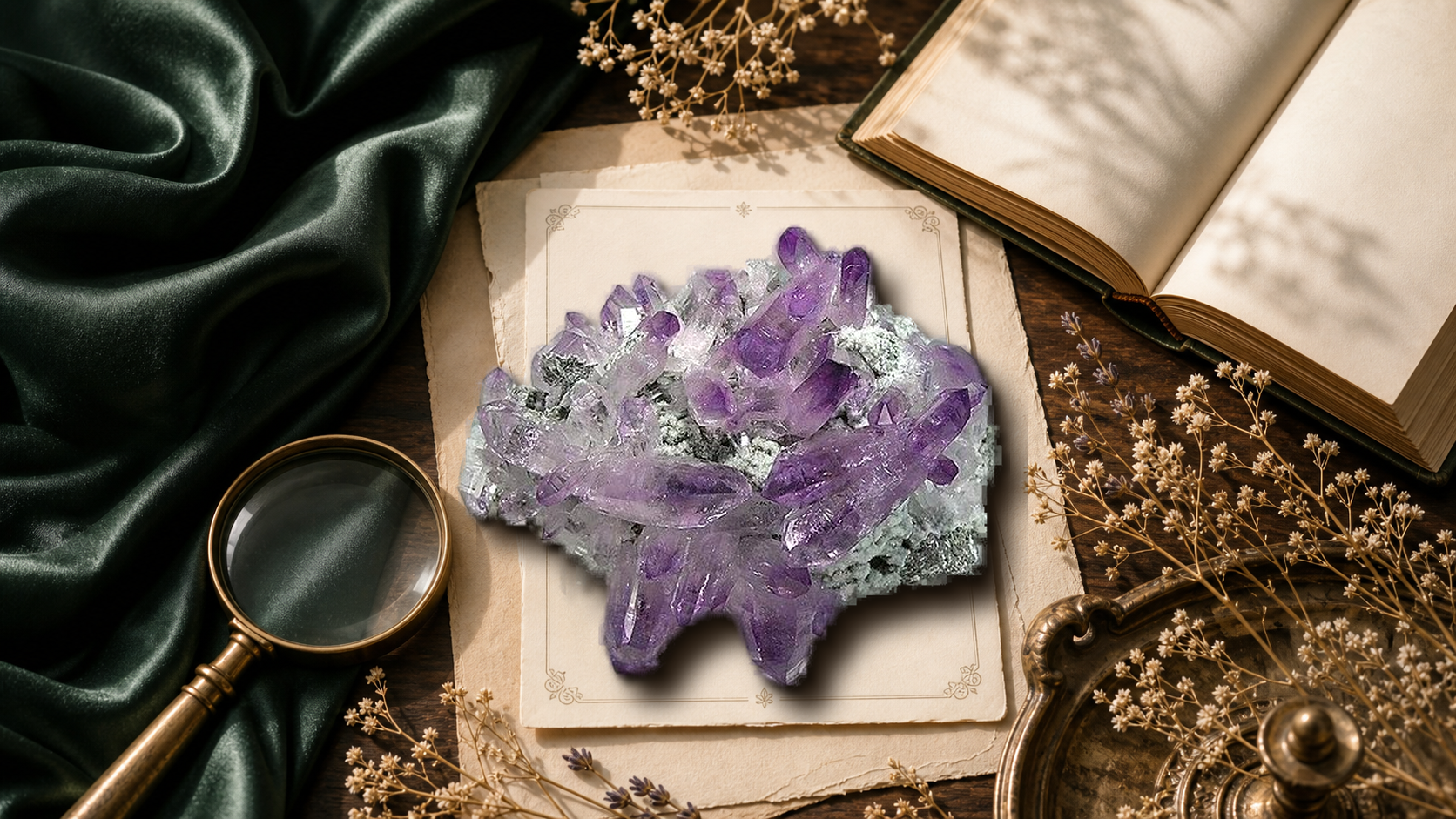
You need deep insight without the usual heaviness. Vera Cruz amethyst grows in slender, transparent pale-violet points that feel almost weightless compared with darker amethyst habits. Clarity can stay airy.
Vera Cruz amethyst works most clearly with nervous systems that need subtlety rather than force. Its distinctive quality is not simply purple color, but lightness...
The Meaning
Vera Cruz Amethyst in the Crystalis dictionary
Wisdom gets overburdened so easily. The moment a person becomes serious about introspection, the mood can thicken around it until insight starts feeling synonymous with solemnity and depth with drag.
Vera Cruz amethyst offers a different atmosphere. Its points stay long, clear, and almost buoyant in tone, carrying violet without the denser emotional weather people often expect from amethyst. The intelligence remains, but the weight redistributes.
Vera Cruz amethyst helps when thoughtfulness needs air put back into it. Seriousness is not the only proof of depth.
Stone Lore
Stories carried through time
Cultural notes are presented as tradition and historical context — stories carried through time.
The Vera Cruz coastal lowlands and highlands were home to successive Mesoamerican civilizations including the Olmec, Totonac, and Huastec peoples. Quartz crystals found in this region were used in divinatory practices; the Totonac people of the Sierra de Puebla (adjacent to the amethyst localities) incorporated clear and violet quartz crystals into healing ceremonies conducted by "curanderos" (healers).
Crystalline stones were considered "piedras de luz" (stones of light) capable of revealing hidden truths (Dow, J. , "The Shaman's Touch: Otomi Indian Symbolic Healing," 1986).
Lore review
Tradition notes are being reviewed.
This entry keeps symbolic meaning separate from sourced cultural history. When dedicated tradition rows are available, they will appear here as individual lore cards.
In the volcanic terrain of Veracruz, Mexico, silica-rich fluids moved through cavities in andesitic host rock and slowly lined those openings with some of the clearest amethyst on the market. The Los Vigas district is famous not because its quartz chemistry is unique, but because growth conditions repeatedly favored slender, highly transparent crystals with delicate violet color. Open space in vugs and fractures gave the crystals room to elongate. Relatively clean fluids limited the inclusions that cloud many amethyst deposits.
The purple itself comes from iron in the quartz lattice followed by natural irradiation and subsequent charge-transfer effects. Amethyst does not owe its color to simple dye-like impurities. It depends on trace iron occupying structural positions and then being modified by radiation over time. In Vera Cruz material, the concentration is often low enough to keep the color airy rather than dark, which is why many crystals show pale lavender zones, ghosted phantoms, or almost colorless stems beneath violet terminations.
Some specimens grew as scepters, where later amethyst enlargement overgrew an earlier quartz stem. Others display alternating clear and purple bands, preserving shifts in fluid chemistry during crystallization. Those interruptions matter. A quartz crystal can act like a chronological instrument, storing pauses and resumptions as visible zoning.
Compared with basalt-hosted amethyst geodes from Brazil or Uruguay, Vera Cruz specimens usually feel lighter both visually and structurally. They are long, fine, and often more transparent, with less of the saturated royal purple associated with deeper color centers. Yet the same trigonal quartz architecture governs them all. The difference is one of growth environment, impurity concentration, and the quiet precision of a particular locality.
What emerges is amethyst stripped of heaviness: hydrothermal quartz that kept enough trace iron for color, but not enough clutter for opacity. Locality names are often overused in the gem trade, but here the source genuinely correlates with a distinct growth style. Veracruz produced an amethyst habit so recognizable that shape and clarity often identify the origin before paperwork does.
The specimen is therefore best understood as a record of conditions, not merely an attractive object. Its structure, habit, and chemistry all preserve the environment that made it possible.
Crystal system diagram represents the general trigonal classification. Diagram created by Crystalis for educational reference.
N/A (variety; famous from Piedra Parada area, Veracruz, Mexico)
IMA Number
Grandfathered (pre-1959)
01
Mineral conditions gather
02
Structure begins to crystallize
03
Vera Cruz Amethyst records place and pressure
Los Vigas mining district near Piedra Parada, Veracruz state, Mexico is the sole source. The quartz formed in hydrothermal veins within volcanic host rock. The distinctive slender prismatic habit with pale purple tips is locality-specific.
The altitude and volcanic geology of this Mexican highland district produce a quartz variety found nowhere else.
Mexico (Vera Cruz)
Telling it apart
The most common misidentification is between Vera Cruz amethyst, ordinary pale amethyst, and so-called spirit quartz sold under locality-rich labels. The name matters because Vera Cruz is a locality style, not a separate species.
True Vera Cruz amethyst is quartz from Veracruz, Mexico, known for slender prismatic habit, high transparency, and light violet color. Pale amethyst from elsewhere may resemble it in color but often lacks the same elongated crystal shape and water-clear body. Spirit quartz is a different growth habit entirely, with a main crystal covered in tiny secondary points.
What separates them is the combination of clarity, habit, and provenance. Vera Cruz crystals are commonly long and laser-like, sometimes with scepter growth or mixed clear-amethyst zoning. They do not need to be dark to be authentic. The confirming step is locality confidence when the seller commands a premium. Locality premium quartz depends entirely on provenance documentation, and a pale amethyst without confirmed Mexican origin does not justify the Vera Cruz price.
Spotting the real thing
Vera Cruz amethyst: quartz (Mohs 7, SG 2. 65). The slender prismatic habit with pale purple concentrated at the tip is locality-specific.
Mexican provenance from Los Vigas, Veracruz state. The crystal shape (elongated, often singly terminated) distinguishes it from Brazilian amethyst (typically shorter, from geodes).
Vera Cruz Amethyst's defining quality is transparency; the ability to see through the stone to its interior. For a sympathetic nervous system overwhelmed by competing thoughts and stimuli, this visual transparency can model cognitive clarity. Holding the crystal up to light and seeing through it interrupts the opacity of mental overload. The mind cannot remain completely clouded while the eyes are perceiving perfect clarity. State shift: chaotic sympathetic toward coherent ventral through visual-cognitive reset.
Shut down & far away
The Phantom Layer
The phantom formations within Vera Cruz Amethyst show that growth can resume after interruption. For someone in dorsal shutdown who feels permanently stalled, the phantoms offer visible proof that pause does not equal death. The crystal grew, stopped, marked the pause with a visible layer, and then grew again; larger than before. State shift: dorsal toward gentle sympathetic activation through recognition of growth resumption.
Charged & on alert
The Pale Signal
The pale, delicate coloration of Vera Cruz Amethyst models what happens when intensity is reduced without being eliminated. The iron is present; but at lower concentrations. The violet exists; but without the overwhelming saturation of darker amethyst. For someone who is regulated enough to be aware of their anxiety (ventral + sympathetic), this stone supports the practice of allowing difficult sensations to exist at reduced intensity rather than either amplifying or suppressing them.
State shift: anxious-aware toward calm-aware through modulated intensity.
Settled & connected
The Water Eye
In its most transparent specimens, Vera Cruz Amethyst resembles liquid more than solid. For someone already in ventral vagal regulation who seeks to deepen contemplative or spiritual practice, this stone supports the dissolution of the boundary between observer and observed. The eye can enter the crystal and travel through it. This is not dissociation; it is contemplative absorption from a grounded state. State support: ventral vagal deepening into contemplative transparency.
Charged & on alert
The Scepter Stand
Vera Cruz Amethyst frequently forms scepter crystals; where a second generation of crystal growth creates a larger termination atop a thinner stem. For someone whose creative or professional energy has narrowed to a thin thread, the scepter formation models the possibility of re-expansion: the energy that got thin can grow wide again at the tip. State shift: depleted sympathetic toward renewed creative mobilization through scepter visualization.
These associations come from tradition and reflective practice — a way of working with the stone, not a medical prescription.
Somatic Practice
Simple ways to work with Vera Cruz Amethyst
◇
Hold
Carry Vera Cruz Amethyst in a pocket or place it over the heart center during a pause.
◌
Meditate
Let the stone become a quiet tactile anchor while the breath slows.
☽
Breathe
Breathe in softness. Breathe out tension. Keep the practice simple.
✎
Journal
Write with Vera Cruz Amethyst nearby to name the feeling without forcing a conclusion.
✋
Bodywork
Rest the stone near the chest, hand, or bedside as a reminder to soften.
⌂
Environment
Place it where you want a visual cue for care, repair, or steadiness.
Field Instruction
The Phantom Transparency
Water-clear amethyst from the volcanic highlands of Veracruz, Mexico — so transparent the purple appears only as a ghost within the crystal, teaching that clarity and color are not competing but coexisting at the edge of visibility.
5 min protocol
1
Hold the Vera Cruz amethyst up to light and look through it. This is not dense purple — it is water-clear quartz with a violet ghost haunting its interior. The color exists at the edge of visibility, like a thought you almost had. Place the crystal against your third eye, between your eyebrows.
2
Close your eyes. Breathe in for five counts through your nose. The amethyst from Veracruz formed in volcanic cavities at high altitude — it crystallized in thin air, which is why it grew transparent instead of dense. Let your thoughts thin out the same way. Exhale for seven counts, releasing density. Five rounds.
3
Move the crystal to the crown of your head. If the specimen has phantom inclusions — ghostly outlines of earlier growth stages visible inside — acknowledge them. Those phantoms are the crystal's autobiography: every time growth paused and resumed, it left a transparent scar. Your pauses are recorded too, and they do not diminish your clarity.
4
Hold the crystal vertically in front of your face at nose level. Look through it with both eyes open. The world through Vera Cruz amethyst is barely tinted — almost clear, almost unchanged. This is the quality of attention it teaches: seeing reality with just enough filter to notice what hides in plain sight.
5
Place the crystal on a surface and sit with your hands in your lap, palms up. The volcanic highlands of Mexico produced this transparency through altitude, heat, and time. Your clarity will come through similar conditions: elevation of perspective, intensity of focus, and patience. Three breaths. The phantom work is done.
Stone Intelligence
The fact that makes Vera Cruz Amethyst memorable
Amethyst from Veracruz, Mexico. Prismatic, often pale, sometimes nearly clear with just a blush of purple at the tip. The science documents hydrothermal quartz crystallization in volcanic host rock.
The practice asks what subtlety means when the color arrives at the very end, like a thought that was almost too quiet to catch.
SCI
Amethyst Occurrences in Tertiary Volcanic Rocks of Greece: Mineralogical, Fluid Inclusion and Oxygen Isotope Constraints on Their Genesis
You need deep insight without the usual heaviness. Vera Cruz amethyst grows in slender, transparent prisms with just a blush of purple at the tip. Hold during meditation when you want lightness in your practice.
Place under your pillow for dream work. The subtlety is the point. Not everything that sees clearly does so at full volume.
Sacred Match
Sacred Match reaches for Vera Cruz Amethyst when what you feel sounds like:
Insight feeling heavy instead of helpful
Sensitivity to dense spiritual tools
Need for lighter mental clarity before sleep
Thoughts that need refinement, not force
Upper-body tension from too much striving
Wanting violet without weight
Sacred Match listens to the body rather than to preference. It notices what you are feeling right now, the way you are protecting yourself, and the deeper need underneath both. When that points to reflective fatigue, overstimulating symbolic load, or the need for subtle clarity in the upper register, Vera Cruz amethyst is the stone it offers.
Heavy -> insight carrying too much mass -> seeking lightness
Sensitive -> methods too intense -> seeking gentler clarity
Tense -> striving lodged above the shoulders -> seeking release
Restless -> mind active near sleep -> seeking refinement
Clouded -> perception present but muffled -> seeking transparent violet It comes forward when the upper body needs clarity in a lighter register, and when reflection works better as refinement than as pressure.
Stones and herbs that harmonize with Vera Cruz Amethyst
Pairings are treated like a recipe file: clear use, method, and safety.
Crystal Companion
Vera Cruz Amethyst + Amethyst
Use when
You want to layer the primary intention with another supportive tone.
How to work with it
Place the stones together during meditation, journaling, or a short reset.
Safety
Use as a reflective practice tool, not as a medical substitute.
Crystal Companion
Vera Cruz Amethyst + Rhodonite
Use when
You want to layer the primary intention with another supportive tone.
How to work with it
Place the stones together during meditation, journaling, or a short reset.
Safety
Use as a reflective practice tool, not as a medical substitute.
Crystal Companion
Vera Cruz Amethyst + Clear Quartz
Use when
You want to layer the primary intention with another supportive tone.
How to work with it
Place the stones together during meditation, journaling, or a short reset.
Safety
Use as a reflective practice tool, not as a medical substitute.
Crystal Companion
Vera Cruz Amethyst + Black Tourmaline
Use when
You want to layer the primary intention with another supportive tone.
How to work with it
Place the stones together during meditation, journaling, or a short reset.
Safety
Use as a reflective practice tool, not as a medical substitute.
Clear Quartz
The Transparency Doubled.
Vera Cruz amethyst already carries unusual clarity for amethyst, slender transparent pale-violet trigonal points that feel almost weightless. Clear quartz intensifies that glasslike quality without competing for attention. Both are SiO2, but Vera Cruz's delicate iron-derived color against quartz's pure transparency creates refinement rather than redundancy. Best when subtle insight needs a cleaner channel rather than more color. Place clear quartz above the brow and Vera Cruz amethyst over the crown during rest.
Lepidolite
The Quiet Upper Register.
Both stones tend toward lighter, less forceful presentations than their darker relatives. Lepidolite's lithium-bearing mica sheets at Mohs 2.5 beside amethyst's harder quartz body at Mohs 7 gives the pairing a soft-on-hard contrast the nervous system can read as permission to rest. Suited to evenings when the system needs less noise without dramatic emotional excavation. Keep lepidolite under the pillow and Vera Cruz amethyst on the nightstand.
Selenite
The Air and Light.
Selenite's pale gypsum transmission pairs well with the nearly weightless visual feel of Vera Cruz crystals. Both minerals favor clean, uncluttered environments. Place selenite along the windowsill and keep Vera Cruz amethyst where morning light can catch it. The room itself becomes cleaner and less visually dense.
Smoky Quartz
The Altitude With Ballast.
Vera Cruz amethyst can feel almost too airy for some people. Smoky quartz gives it a lower anchor through irradiated quartz descent. Both are trigonal SiO2, and the pairing moves from violet crown to brown earth. Hold smoky quartz in one hand and Vera Cruz in the other during meditation.
Care & Cleansing
How to keep Vera Cruz Amethyst in good condition
Water Safe?
Water safe
This stone is generally safe for short water contact, though polishing, fractures, and metal settings can still change how a specimen behaves.
Sunlight Safe?
Use care
May fade or shift color in prolonged direct sun — keep exposure short and indirect.
Authenticity
What to check
Natural Vera Cruz Amethyst should usually feel cooler than plastic or resin on first touch and warm more slowly in the hand.
Vera Cruz amethyst is water-safe. Silicon dioxide (Mohs 7), chemically inert. Brief to moderate water is safe.
Avoid prolonged sunlight; amethyst color fades from UV. The prismatic, pale Vera Cruz habit is particularly light-sensitive. Recommended cleansing: moonlight (overnight, ideal), sound, selenite plate.
Store in darkness.
Temperature
Natural Vera Cruz Amethyst should usually feel cooler than plastic or resin on first touch and warm more slowly in the hand.
Scratch logic
Use 7 on the Mohs scale as the check, not internet myths. A real specimen should behave in line with the hardness listed above.
Surface and luster
Look for a vitreous surface quality rather than a painted or plastic shine.
Weight and density
The listed specific gravity is 2.65. If a specimen feels unusually light for its size, it may deserve a second look.
My Field Guide
Your private record and next steps
Journal
Add this stone to your private collection, then log what happened when you worked with it.
Shared Notes
Read public practice logs and pattern notes from the Crystalis community.
When members save a public field note for this stone, it will appear here.
Frequently Asked
Questions people ask about Vera Cruz Amethyst
What is Vera Cruz Amethyst?
⌄
Chemical formula: SiO2: silicon dioxide (macrocrystalline quartz, trigonal). Mohs hardness: 7. Crystal system: Trigonal, space group P3121 or P3221.
What is the Mohs hardness of Vera Cruz Amethyst?
⌄
Vera Cruz Amethyst has a Mohs hardness of 7.
Can Vera Cruz Amethyst go in water?
⌄
Water Safety YES, Generally safe for brief water contact. Quartz (Mohs 7) is chemically stable and does not leach harmful substances into water. Vera Cruz Amethyst can be briefly rinsed under running water for cleaning. However, do not soak for extended periods, as water can penetrate micro-fractures and potentially damage phantom inclusions or matrix attachments. Do not use in hot water, as thermal shock can fracture transparent quartz.
For gem elixirs, the indirect method (placing stone beside but not in the water) preserves the specimen while avoiding any risk.
What crystal system is Vera Cruz Amethyst?
⌄
Vera Cruz Amethyst crystallizes in the Trigonal, space group P3121 or P3221.
What is the chemical formula of Vera Cruz Amethyst?
⌄
The chemical formula of Vera Cruz Amethyst is SiO2: silicon dioxide (macrocrystalline quartz, trigonal).
Is Vera Cruz Amethyst toxic?
⌄
Vera Cruz Amethyst crystals are often delicate, with thin prismatic habits and fragile terminations. Handle with care to avoid chipping.
How does Vera Cruz Amethyst form?
⌄
Formation Story Vera Cruz Amethyst crystallized within vugs, fractures, and cavities in Tertiary volcanic rocks of the Sierra Madre Oriental range in eastern Mexico. The volcanic host rocks, primarily andesites and rhyolites erupted during the Oligocene to Miocene epochs (approximately 20 to 35 million years ago), provided both the silica source and the cavity architecture for crystal growth. As these volcanic flows cooled, gas vesicles and contraction fractures created void spaces.
Sources & Citations
Where this entry can be checked
Back Matter
Readable for people. Structured for AI search.
Sources stay visible in the page so readers, search engines, and answer systems can follow the evidence trail.
01
SCI
Amethyst Occurrences in Tertiary Volcanic Rocks of Greece: Mineralogical, Fluid Inclusion and Oxygen Isotope Constraints on Their Genesis
Tarantola, A., Mavrogonatos, C., Alfieris, D., Psimis, I., Götze, J., Voudouris, P., Maneta, V., Melfos, V. (2018). Amethyst Occurrences in Tertiary Volcanic Rocks of Greece: Mineralogical, Fluid Inclusion and Oxygen Isotope Constraints on Their Genesis. Minerals. [SCI]DOI 10.3390/min8080324
02
SCI
Infrared and chemical characterization of natural amethysts and prasiolites colored by irradiation
Nunes, E., Lameiras, F., Vasconcelos, W. (2009). Infrared and chemical characterization of natural amethysts and prasiolites colored by irradiation. Materials Research. [SCI]DOI 10.1590/S1516-14392009000300011
03
HIST
Naturalis Historia, Book 37
Pliny the Elder. Naturalis Historia, Book 37. [HIST]
04
HIST
Physica
Hildegard von Bingen. (1150). Physica. [HIST]
05
LORE
The Curious Lore of Precious Stones
Kunz, George Frederick. (1913). The Curious Lore of Precious Stones. [LORE]
06
SCI
Numerical simulations of amethyst geode cavity formation by ballooning
HARTMANN, L.A. et al. (2011). Numerical simulations of amethyst geode cavity formation by ballooning. Geofluids. [SCI]DOI 10.1111/j.1468-8123.2011.00346.x