Materia Medica
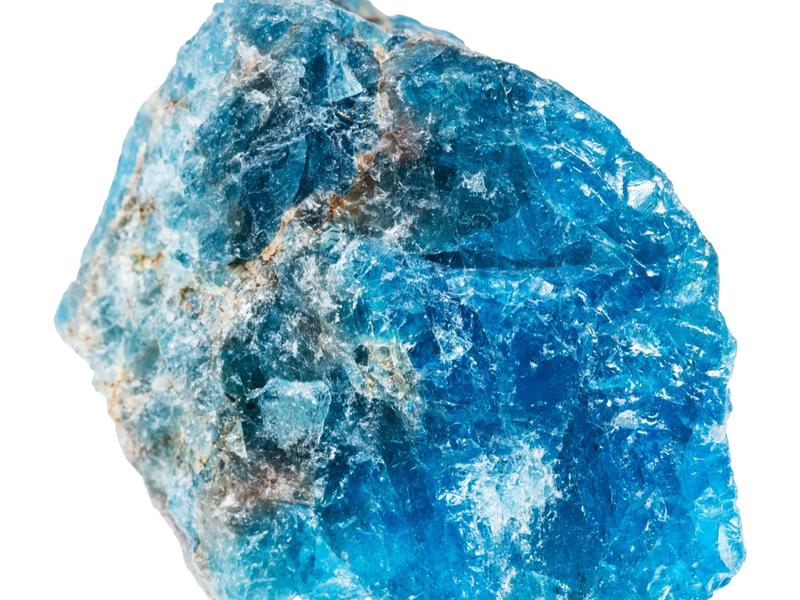
Blue Apatite
The Throat's Discipline

This page documents traditional and cultural uses of blue apatite alongside emerging research on tactile grounding objects. Crystalis does not claim that blue apatite treats, cures, or prevents any medical condition. For mental health concerns, consult a qualified professional.
Origins: Madagascar, Brazil, Myanmar
Materia Medica
The Throat's Discipline

Protocol
Connecting throat expression to skeletal structure
2 min
Lie on your back. Place the blue apatite at the hollow of your throat. Let it rest in the notch between your collarbones. Place your hands on your lower ribs, fingers pointing toward each other. Close your eyes. This mineral is the same chemistry as your bones. You are placing like on like. Notice if that fact registers anywhere in your body.
Inhale through the nose for 3 counts. Exhale through the nose for 3 counts through your mouth with a soft humming sound. The hum vibrates the bones of your skull, jaw, and sternum. Feel the apatite resting on your throat as the hum passes beneath it. Your throat bones, hyoid and cervical vertebrae, are resonating chambers. Let the hum be low and steady.
Stop the hum. Breathe silently at 4-7 ratio for four breaths. Then hum again for four breaths. Alternate between silent and humming exhales. Notice the difference in your throat and chest. The silent breaths let you feel the absence of vibration. The humming breaths show you what your skeleton sounds like when you give it a frequency.
Remove the apatite and hold it in your dominant hand against your chest. Take three natural breaths without humming. Notice the weight of the stone in your hand and remember that your hand bones are made of the same mineral. You are not borrowing anything from this stone. You already contain it. Open your eyes. Sit up. The session is complete.
tap to flip for protocol
Some minds do not blank under pressure. They crowd. Too much language. Too much signal trying to pass through one narrow opening.
Apatite gives the eye line and channel instead of fog. The blue stays vivid, but not diffuse. Good for thoughts that need sequence more than volume.
What Your Body Knows
sympathetic
Something deep in your structure is vibrating and you cannot name it. Not your muscles. Not your skin. Something underneath. Your throat wants to make sound but does not know what sound. Your skeleton feels restless. This is your deepest physical architecture asking for attention, not your emotions.
dorsal vagal
Your body has gone quiet at the structural level. Not relaxed, quiet. Your bones feel dense and inert. Your throat produces words but they sound hollow to your own ears. The mineral layer of your being has gone dormant. You are not sad. You are under-resonant, like a bell that has been muffled.
ventral vagal
Your throat and your body's deepest structure are in communication. When you speak, you feel it in your chest and your bones. Your voice has weight. Your skeleton feels alive and supportive rather than passive. You are not just using your body. You are speaking from it, from the mineral core outward.
Nervous system mapping based on polyvagal theory (Porges, 2011).
Mineralogy
Chemical Formula
Ca5(PO4)3(F,Cl,OH)
Crystal System
Hexagonal
Mohs Hardness
5
Specific Gravity
3.16-3.22
Luster
Vitreous to subresinous
Color
Blue
Crystal system diagram represents the general hexagonal classification. Diagram created by Crystalis for educational reference.
Traditional Knowledge
Apatite named 1786 by Abraham Gottlob Werner from Greek apatao meaning to deceive; blue variety from Madagascar and Brazil prized since 1990s as gem material
Apatite and the Fertilizer Revolution
The discovery that apatite is the primary source of phosphorus for agricultural fertilizer transformed the mineral from a curiosity into an industrial commodity in the 19th century. Justus von Liebig's work on plant nutrition in the 1840s established phosphorus as essential for crop growth. Massive apatite deposits in Morocco, Florida, Russia, and China have been mined for superphosphate fertilizer production ever since. The same mineral that constitutes your bones and teeth feeds the crops that feed the world. Blue gem apatite is a tiny fraction of global apatite production, but every specimen connects to this larger phosphorus cycle.
The Neon Blues of Madagascar
Madagascar emerged as the premier source of vivid blue apatite in the late 20th century, with deposits in the Antsirabe and Ambatondrazaka areas producing crystals with an intense neon-blue color previously unseen in the species. Malagasy small-scale miners, often working artisanally in pegmatite zones, extracted these crystals alongside the island's famous sapphires, tourmalines, and beryls. The Madagascar blue apatites entered the international gem market through dealers in Antsirabe and Antananarivo, quickly becoming the reference standard for the species. The neon quality comes from trace rare earth elements in the hexagonal phosphate structure.
Hydroxyapatite in Bone and the Mineral Connection
The identification of hydroxyapatite as the mineral component of bone and dental enamel was established through X-ray diffraction studies in the early 20th century, with Walter F. de Jong's 1926 work being foundational. This discovery connected a geological mineral to vertebrate biology in a way few other minerals can claim. Modern biomedical engineering uses synthetic hydroxyapatite for bone grafts, dental implants, and orthopedic coatings. When you hold blue apatite, you are holding the external version of your internal scaffolding. The chemistry is not metaphorical. It is verified by crystallography.
Apatite Deposits and Early Mineral Documentation
Spanish naturalists accompanying colonial expeditions to the Americas in the 16th and 17th centuries documented phosphorescent minerals in Mexico and the Caribbean without understanding their chemistry. The name apatite was not assigned until 1786, when Abraham Gottlob Werner named it from the Greek apatao, meaning to deceive, because apatite's variable appearance caused it to be confused with beryl, tourmaline, and other minerals. Werner's naming reflected centuries of misidentification. The mineral that deceives the eye with its many colors and habits is the same mineral that builds your teeth. It hid in plain sight for centuries.
When This Stone Finds You
Somatic protocol
Connecting throat expression to skeletal structure
2 min protocol
Lie on your back. Place the blue apatite at the hollow of your throat. Let it rest in the notch between your collarbones. Place your hands on your lower ribs, fingers pointing toward each other. Close your eyes. This mineral is the same chemistry as your bones. You are placing like on like. Notice if that fact registers anywhere in your body.
1 minInhale through the nose for 3 counts. Exhale through the nose for 3 counts through your mouth with a soft humming sound. The hum vibrates the bones of your skull, jaw, and sternum. Feel the apatite resting on your throat as the hum passes beneath it. Your throat bones, hyoid and cervical vertebrae, are resonating chambers. Let the hum be low and steady.
1 minStop the hum. Breathe silently at 4-7 ratio for four breaths. Then hum again for four breaths. Alternate between silent and humming exhales. Notice the difference in your throat and chest. The silent breaths let you feel the absence of vibration. The humming breaths show you what your skeleton sounds like when you give it a frequency.
1 minRemove the apatite and hold it in your dominant hand against your chest. Take three natural breaths without humming. Notice the weight of the stone in your hand and remember that your hand bones are made of the same mineral. You are not borrowing anything from this stone. You already contain it. Open your eyes. Sit up. The session is complete.
1 minCare and Maintenance
Can Blue Apatite Go in Water? Brief Rinse Only. Blue apatite is a calcium phosphate (Ca5(PO4)3(F,Cl,OH)) with Mohs hardness of 5. At this hardness, the stone is softer than quartz and moderately vulnerable to surface erosion from prolonged water contact. A brief cool rinse of 15 to 30 seconds is acceptable. Apatite is the same mineral that composes tooth enamel, and just as teeth are affected by acidic conditions, apatite dissolves slowly in acidic water. Use only neutral pH water.
Salt water: avoid. Salt deposits and the mild acidity of some salt solutions accelerate surface degradation.
Hot water: avoid. Thermal shock can fracture apatite along its poor basal cleavage.
Gem elixirs: indirect method only.
Cleansing Methods Moonlight: Place on a windowsill overnight. Safe and effective for apatite in all forms.
Selenite plate: Rest on selenite for 4 to 6 hours. No water, no temperature change.
Sound: Singing bowl or tuning fork near the stone, 2 to 3 minutes.
Smoke: Brief pass through sage smoke, 30 seconds.
Sunlight: Limit to 1 hour maximum. Prolonged UV exposure can fade blue apatite's color. The blue coloration is sensitive to sustained light.
Storage and Handling Store blue apatite separately from stones at Mohs 6 and above. Quartz, feldspar, and all harder minerals will scratch it readily. Wrap in soft cloth. At Mohs 5, apatite requires more care than most practice stones. Avoid wearing as jewelry during physical activity.
In Practice
Blue apatite for direction: Hold when your ambition has outpaced your sense of where to go. Apatite is the phosphate mineral your bones are made of. The practice connects throat (communication of intention) with structure (the scaffold of the body).
When you know you want to move but cannot name the direction, hold the stone that is literally the mineral your skeleton uses for support. For study: Place blue apatite on your desk during learning sessions. The hexagonal crystal structure supports organized absorption of information.
Verification
Blue apatite: Mohs 5, softer than quartz. Specific gravity 3. 16-3.
22, heavier than glass. Vitreous luster. Hexagonal crystal system.
The main confusion is with blue fluorite (which cleaves octahedrally) and blue topaz (which is much harder at Mohs 8). If the stone scratches glass, it is too hard to be apatite.
Natural Blue Apatite should usually feel cooler than plastic or resin on first touch and warm more slowly in the hand.
Use 5 on the Mohs scale as the check, not internet myths. A real specimen should behave in line with the hardness listed above.
Look for a vitreous to subresinous surface quality rather than a painted or plastic shine.
The listed specific gravity is 3.16-3.22. If a specimen feels unusually light for its size, it may deserve a second look.
Geographic Origins
Blue Apatite forms through unique geological processes that concentrate specific elements under precise conditions of temperature, pressure, and chemistry. The blue color results from the interaction of light with the crystal structure and any included elements. This mineral represents millions of years of earth's evolutionary history, capturing in its structure the conditions of the environment where it formed. Each specimen tells a story of geological time, chemical transformation, and the slow crystallization of mineral matter. Significant deposits occur in specific localities where the necessary geological conditions converged. Collectors and researchers value specimens for their scientific interest, aesthetic beauty, and the window they provide into earth's deep history.
Mineralogy: Phosphate mineral, Hexagonal system. Formula: Ca₅(PO₄)₃(F,Cl,OH). Hardness: 5. Color from trace elements.
FAQ
Blue apatite is the blue variety of the calcium phosphate mineral group with the formula Ca5(PO4)3(F,Cl,OH). It is the same mineral that constitutes human bones and tooth enamel, making it one of the few stones with a direct chemical parallel in your own body. It forms in igneous and metamorphic environments.
Yes. Hydroxyapatite, a member of the apatite group, is the primary mineral component of human bones and dental enamel. The blue color in gem apatite comes from trace amounts of manganese or rare earth elements. The structural chemistry is essentially the same as what is in your skeleton.
Blue apatite is exactly 5 on the Mohs scale and is in fact the defining mineral for that hardness level. It can be scratched by a steel knife and will scratch glass only with difficulty. This moderate hardness means it is suitable for pendants and earrings but not recommended for rings.
Blue apatite is associated with the throat and third eye chakras. Its blue color corresponds to the throat center at the base of the neck. In body-based practice, it is placed at the hollow of the throat or on the forehead between the brows during breathing protocols.
The finest blue apatite specimens come from Madagascar, which produces vivid neon-blue crystals. Brazil, Mexico, Myanmar, and several African countries also produce gem-quality blue apatite. It occurs in pegmatites, phosphorite deposits, and as an accessory mineral in many igneous rocks worldwide.
Brief rinsing is acceptable, but prolonged soaking is not recommended. Apatite is only Mohs 5 and can be affected by acidic solutions. It does not contain toxic elements, so handling safety is not a concern. Dry it promptly after any water contact to maintain surface luster.
Blue apatite is calcium phosphate (Mohs 5) while aquamarine is beryllium aluminum silicate (Mohs 7.5-8). Apatite is softer, often more vivid blue, and significantly less expensive. Aquamarine is harder, paler, and more suitable for jewelry. They can look similar but are chemically and physically distinct.
Blue apatite is relatively affordable compared to most blue gemstones. Small tumbled stones cost a few dollars, while fine faceted gems from Madagascar can range from twenty to a few hundred dollars per carat. Its moderate hardness limits jewelry demand, which keeps prices accessible for collectors.
References
Pankrushina, E.A. et al. (2022). Thermal behavior and anharmonicity of PO4-tetrahedral vibrations in natural fluorapatite. Journal of Raman Spectroscopy. [SCI]
DOI: 10.1002/jrs.6304
Miro, S. et al. (2011). Raman spectroscopy study of damage induced in fluorapatite by swift heavy ion irradiations. Journal of Raman Spectroscopy. [SCI]
DOI: 10.1002/jrs.2955
Closing Notes
Apatite. The mineral your bones are made of. Named from the Greek for deceit because it keeps being mistaken for other gems.
The science documents a phosphate mineral that is literally the scaffold of life. The practice asks what recognition feels like when you have been hiding in plain sight.
Bring it into practice
Move from reference to ritual. Search current inventory for Blue Apatite, build a custom bracelet, or let Sacred Match choose the right supporting stones for you.
Community notes
Shared field notes tied to Blue Apatite appear here, including notes saved from practice.
When members save a public field note for this stone, it will appear here.
The archive
Continue through stones that share intention, chakra focus, or tonal family with Blue Apatite.

Shared intention: Communication
The Sky Stone

Shared intention: Communication
The Courage to Speak
Shared intention: Communication
The Joyful Communicator

Shared intention: Communication
The Disciplined Communicator
Shared intention: Communication
The Bridge Between Throat and Heart

Shared intention: Motivation & Energy
The Slow Flame of Endurance