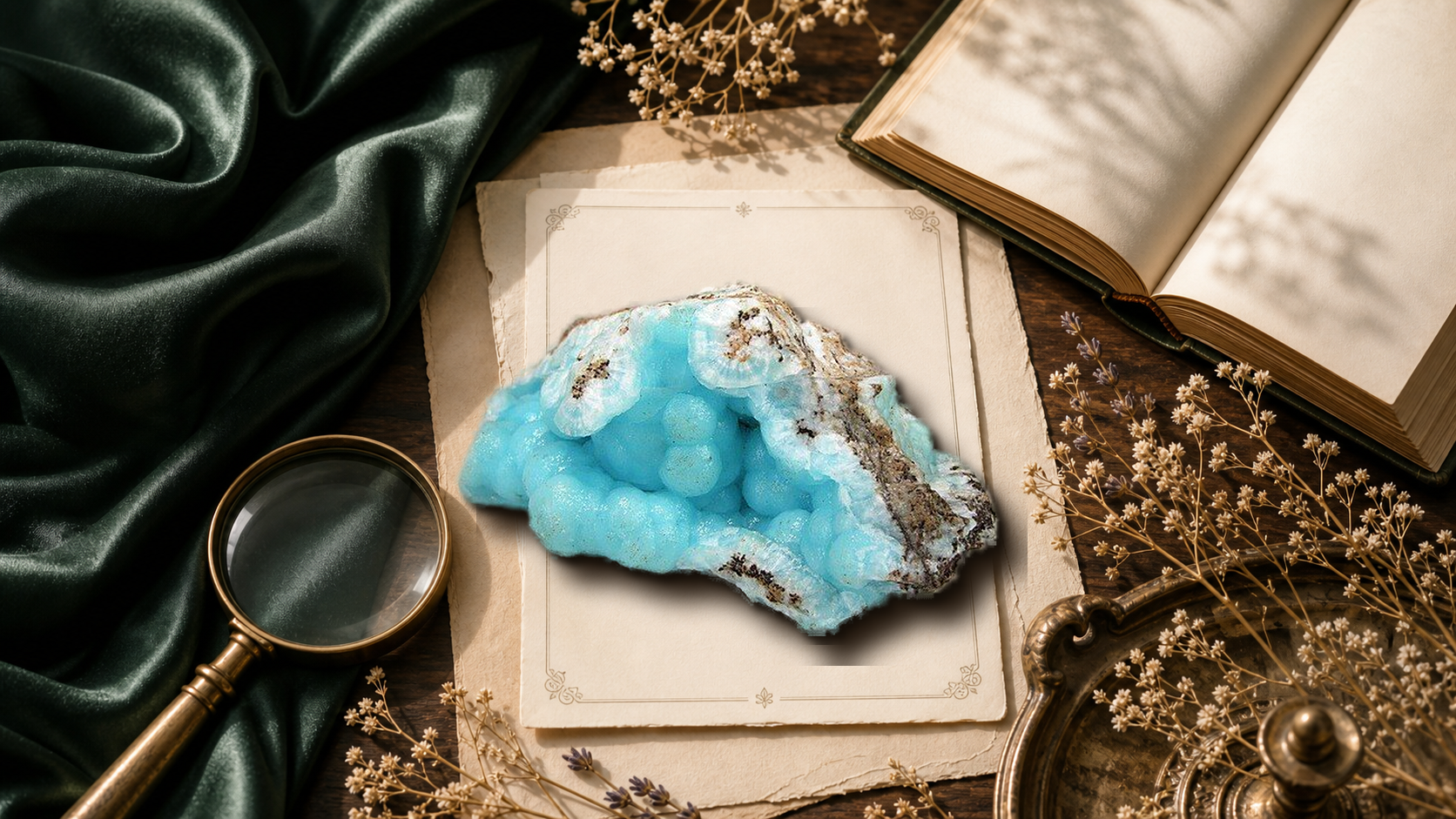
Where you started and where you are do not resemble each other anymore. Hemimorphite crystallizes with different shapes at each end of the same crystal because the internal symmetry allows asymmetric terminations. Uneven growth is not disorder.
Hemimorphite is a Throat and Third Eye chakra mineral that bridges the space between feeling and articulation. Its hemimorphic crystal structure -- different on each...
The Meaning
Hemimorphite in the Crystalis dictionary
Beginning and ending have stopped resembling each other.
Hemimorphite is named for its different crystal terminations. One end finishes one way. The other does something else. Same body. Unequal conclusions. Change becomes less insulting once the mineral world admits that pattern too.
Stone Lore
Stories carried through time
Cultural notes are presented as tradition and historical context — stories carried through time.
Belgian Zinc Mining
The Kenngott Classification
Austrian mineralogist Gustav Adolf Kenngott formally named hemimorphite in 1853, deriving the name from the Greek hemi (half) and morphe (form), referencing the mineral's hemimorphic crystal habit, crystals that display different termination forms at opposite ends of the c-axis. This asymmetry, unusual among minerals, means the top of a hemimorphite crystal looks structurally different from the bottom.
The mineral had previously been confused with smithsonite (zinc carbonate) under the collective name calamine, and Kenngott's work established hemimorphite (zinc silicate hydroxide hydrate) as a distinct species. Belgian zinc mining operations in the Vieille Montagne district near Liege were among the primary sources of specimens that enabled this mineralogical distinction.
1853
Origin lore
The Durango Blue Specimens
The Ojuela Mine near Mapimi in Durango, Mexico emerged as the world's premier hemimorphite locality in the latter half of the 20th century, producing extraordinary specimens of vivid sky-blue botryoidal hemimorphite on limonite matrix. The...
Mapimi Mining District · 1970s-present
Origin lore
The Yunnan Blue Production
Deposits in Yunnan Province, China began producing large quantities of blue hemimorphite in the 2000s, significantly expanding the global supply of collector-grade material. Chinese hemimorphite from localities near Kunming and in the...
Chinese Zinc Deposits · 2000s-present
Historical note
The Hemimorphic Electric Anomaly
Materials scientists documented hemimorphite's pyroelectric and piezoelectric properties as direct consequences of its hemimorphic crystal structure, the same structural asymmetry that gave the mineral its name. Because the two ends of the...
Pyroelectric and Piezoelectric Properties · 1900s-present
Earth Record
Mineralogy and formation
Hemimorphite is a sorosilicate, meaning its silicon-oxygen framework consists of paired Si2O7 groups (disilicate units) rather than the isolated tetrahedra, chains, sheets, or frameworks found in other silicate subclasses. Four zinc atoms coordinate with these disilicate units, plus hydroxyl groups and molecular water, creating a relatively open crystal structure. The zinc is in tetrahedral coordination, and the polar axis gives the mineral both piezoelectric and pyroelectric properties -- it generates electrical charge under mechanical stress and temperature change.
Hemimorphite forms as a secondary mineral in the oxidized zones of zinc ore deposits. When primary zinc sulfide minerals (sphalerite, ZnS) are exposed to weathering and oxidation by descending, silica-bearing groundwater, the zinc is liberated and recombines with dissolved silica and water to precipitate hemimorphite. This supergene enrichment process occurs at relatively low temperatures (below 100°C) and atmospheric pressures. The resulting crystals, botryoidal masses, and crusts line cavities, fractures, and vugs in the host limestone or dolomite.
The blue color in the popular botryoidal variety comes from trace copper (Cu2+) substitution. Pure hemimorphite is colorless to white. Small amounts of copper produce sky-blue to turquoise-blue coloration, while iron can contribute to green or brown tints. The botryoidal (grape-like) habit forms when hemimorphite precipitates as radiating fibrous aggregates from a multitude of nucleation points on cavity surfaces, creating the rounded, bubbly surfaces that make blue hemimorphite one of the most visually distinctive minerals in collecting and practice.
Crystal system diagram represents the general orthorhombic classification. Diagram created by Crystalis for educational reference.
Orthorhombic structure
Chemical Formula
Zn4Si2O7(OH)2
Crystal System
Orthorhombic
Mohs Hardness
4.5
Specific Gravity
3.4-3.5
Luster
Vitreous to adamantine
Color
Blue, white, green, colorless
IMA Status
species
Type Locality
Băiţa mining district, Nucet, Bihor County, Romania
IMA Number
1962 s.p.
01
Mineral conditions gather
02
Structure begins to crystallize
03
Hemimorphite records place and pressure
ChinaMexicoNamibia
Telling it apart
Blue hemimorphite in its botryoidal habit is regularly confused with chrysocolla, turquoise, and smithsonite because all can present as blue to blue-green masses or crusts. The definitive separation starts with crystal structure: hemimorphite is orthorhombic with Mohs hardness 4. 5 to 5 and specific gravity 3. 4 to 3. 5, while chrysocolla is amorphous and much softer at 2 to 4, and turquoise is triclinic at hardness 5 to 6.
Smithsonite has similar botryoidal habit and hardness (4 to 4. 5) but is a carbonate that effervesces in warm acid, while hemimorphite is a silicate that does not. The hemimorphic crystal habit is diagnostic when visible: crystals have a pointed termination on one end and a flat pedion on the other, a rare property. Both piezoelectric and pyroelectric. Blue coloration comes from trace copper (Cu2+), but colorless to white prismatic crystals are more common than the blue botryoidal form, creating the ironic situation where the most familiar market form is not the most typical crystal habit.
Botryoidal blue hemimorphite from Yunnan, China, and Mapimi, Mexico, dominates the collector market. The high specific gravity relative to its visual look-alikes is the fastest field separation tool.
Spotting the real thing
Surface Texture Genuine blue botryoidal hemimorphite has a distinctive bubbly, grape-like surface with natural irregularity. Each "bubble" varies slightly in size and shape. Fakes made from dyed agate or polymer lack this organic randomness, the surface appears too uniform or has a waxy, synthetic sheen. Real hemimorphite's surface has a glassy to silky luster with slight translucency at thin edges.
Color Character Natural hemimorphite blue ranges from sky blue to turquoise, with subtle variation across the specimen, lighter at thin edges, deeper in thicker accumulations. The blue is gentle, not neon. Artificially dyed stones show unnaturally uniform or oversaturated color, and dye concentrates in surface pits and cracks. Under magnification, genuine color is distributed through the mineral structure, not sitting on the surface.
Hardness Test Hemimorphite registers Mohs 4. 5-5. A steel nail (Mohs 5. 5) will scratch it. A copper coin (Mohs 3) will not.
There are things you have never said. Not secrets you are keeping; truths you cannot find the words for. The feeling is there. It sits in your chest or your throat or behind your eyes, and every time you try to speak it, something closes. The words evaporate. You open your mouth and what comes out is fine, good, okay; the placeholder vocabulary of someone whose real language has been shut down.
This is dorsal vagal freeze in the communication center: the nervous system has decided that expression is dangerous, so it removes the tools. Hemimorphite addresses this state through its own asymmetric structure. The crystal itself has two different ends; one formed, one flat. It models the incomplete translation that you are stuck in, and by holding a stone that is structurally unfinished yet whole, the nervous system begins to accept that expression does not require perfection.
Shut down & far away
The Flood
When you finally do speak, everything comes out at once. The dam breaks and the words rush out tangled, contradictory, too fast, too much. You cry when you meant to explain. You accuse when you meant to ask. The emotions have been held so long that they have fermented into something volatile, and release is not relief; it is a rupture. Your sympathetic system has been building pressure behind the silence, and when the seal breaks, the discharge is chaotic.
Hemimorphite is not the stone for more expression. It is the stone for structured expression. Its piezoelectric property; generating orderly electrical charge under pressure; is the mineral metaphor for converting pressure into signal, not explosion.
Settled & connected
The Mask
You appear calm. Articulate. Put together. Inside, you are unraveling. The gap between what you show and what you feel has become so wide that you no longer trust your own emotional experience. If someone asks how you are, you deliver the curated version with practiced ease, and afterward you feel more alone than if you had said nothing at all. This is the most sophisticated form of suppression: not silence, but false speech.
The words are there but they are decoys. Hemimorphite exposes the mask by activating the connection between the throat and the feeling center. It makes the performance of composure uncomfortable enough that honesty becomes the easier path.
Settled & connected
The Open Frequency
You feel it and you say it. Not perfectly. Not poetically. But accurately. The connection between your inner experience and your outer voice is open, and the translation happens in real time without distortion, performance, or collapse. You can cry and still explain. You can be angry and still be fair. Your emotional expression is not a flood or a mask; it is a transmission. This is ventral vagal regulation in its communicative form: safe enough to be honest, regulated enough to be coherent.
Hemimorphite does not create this state. It mirrors it; a mineral whose two different crystal ends represent the process of turning interior asymmetry into exterior completeness.
These associations come from tradition and reflective practice — a way of working with the stone, not a medical prescription.
Somatic Practice
Simple ways to work with Hemimorphite
◇
Hold
Carry Hemimorphite in a pocket or place it over the heart center during a pause.
◌
Meditate
Let the stone become a quiet tactile anchor while the breath slows.
☽
Breathe
Breathe in softness. Breathe out tension. Keep the practice simple.
✎
Journal
Write with Hemimorphite nearby to name the feeling without forcing a conclusion.
✋
Bodywork
Rest the stone near the chest, hand, or bedside as a reminder to soften.
⌂
Environment
Place it where you want a visual cue for care, repair, or steadiness.
Field Instruction
The Voiced Silence
The Voiced Silence Protocol
3 min protocol
1
Throat Placement (20 seconds)Lie back or recline slightly. Place the hemimorphite directly on the hollow at the base of your throat -- the suprasternal notch, where the collarbones meet. This is the physical gateway of the voice. Feel the stone's cool weight resting on the place where words either flow or stop. Let your jaw soften. Let your tongue drop from the roof of your mouth. Notice what the throat feels like when it is not preparing to speak or suppressing speech -- when it is simply being held by a stone that understands asymmetry.
2
The Humming Breath (40 seconds)Inhale through the nose for 4 counts, feeling the breath pass the stone on its way down. On the exhale, hum -- a low, steady hum through closed lips for 6 counts, directing the vibration into the stone. The humming activates the vagus nerve at the throat and creates a physical vibration you can feel where the stone sits. Four cycles. Each hum is not a word. It is the sound before words. The vibration before language. You are warming the channel, not forcing the message.
3
The Unspoken Inventory (60 seconds)Stone still on throat. Eyes closed. Ask yourself: what have I not said? Not a list of grievances. A single feeling. One feeling that has been sitting in your body without a voice. Do not name it perfectly. Name it approximately. "I feel something like ___." Sadness. Rage. Loneliness. Disappointment. Terror. Relief. Name it once, silently. Then name it again, whispered. Then name it once more at normal volume. Three repetitions, each louder than the last. The stone sits on your throat during all three, holding the channel open while you practice the escalation from silence to sound.
4
The Asymmetry Acknowledgment (20 seconds)Open your eyes. Pick up the hemimorphite and hold it where you can see it. If you can see the crystal faces, notice how the two ends differ -- one pointed, one flat. This crystal is complete without being symmetrical. Say aloud: "My truth does not have to be tidy to be real." This is not an affirmation. It is a description of the stone you are holding and the feeling you just named. Both are asymmetric. Both are whole.
5
Carry Near the Voice (40 seconds)Place the stone in a breast pocket, a necklace pouch, or hold it in your left hand. The stone stays near the throat-heart axis for the rest of the day. Set one specific intention: name the conversation you need to have. Not the one you want to avoid. The one your body has been rehearsing at 3 a.m. The protocol ends when the stone is placed. The conversation begins when you are ready, and the stone does not push you. It holds the channel open until you choose to use it.
Stone Intelligence
The fact that makes Hemimorphite memorable
Hemimorphite is the only common mineral named for the fact that its two ends are different. One pointed, one flat. One projecting, one receiving. The mineralogists who named it in 1853 were describing a crystal structure, but they were also describing every honest conversation you have ever been afraid to start. The same polar axis that gives hemimorphite its piezoelectric charge (its ability to convert pressure into electricity) is the axis along which the stone converts emotional pressure into articulate sound.
The geology is not a metaphor. It is the mechanism. Crystalis documents both because the stone never separated its structure from its teaching, and neither should we.
SCI
The widespread distribution of a novel silicate: hemimorphite as stalactitic cements
Hemimorphite is a Throat and Third Eye chakra mineral that bridges the space between feeling and articulation. Its hemimorphic crystal structure. different on each end. is the physical model of the process it supports: taking something formless (feeling) and giving it a definite shape (language). In somatic practice, hemimorphite works where emotion has been stored without expression, where the body holds what the voice has not released.
The Swallowed Word
(nervous system pattern: DORSAL VAGAL. shutdown of self-expression)
There are things you have never said. Not secrets you are keeping. truths you cannot find the words for. The feeling is there. It sits in your chest or your throat or behind your eyes, and every time you try to speak it, something closes. The words evaporate. You open your mouth and what comes out is fine, good, okay.
the placeholder vocabulary of someone whose real language has been shut down. This is dorsal vagal freeze in the communication center: the nervous system has decided that expression is dangerous, so it removes the tools. Hemimorphite addresses this state through its own asymmetric structure. The crystal itself has two different ends. one formed, one flat. It models the incomplete translation that you are stuck in, and by holding a stone that is structurally unfinished yet whole, the nervous system begins to accept that expression does not require perfection.
The Flood
(nervous system pattern: SYMPATHETIC. overwhelming emotional discharge without coherence)
When you finally do speak, everything comes out at once. The dam breaks and the words rush out tangled, contradictory, too fast, too much. You cry when you meant to explain. You accuse when you meant to ask. The emotions have been held so long that they have fermented into something volatile, and release is not relief.
it is a rupture. Your sympathetic system has been building pressure behind the silence, and when the seal breaks, the discharge is chaotic. Hemimorphite is not the stone for more expression. It is the stone for structured expression. Its piezoelectric property. generating orderly electrical charge under pressure. is the mineral metaphor for converting pressure into signal, not explosion.
The Mask
(nervous system pattern: DORSAL VAGAL with SYMPATHETIC overlay. performing composure while internally fragmenting)
You appear calm. Articulate. Put together. Inside, you are unraveling.
Sacred Match
Sacred Match reaches for Hemimorphite when what you feel sounds like:
Unable to express feelings
Grief without language
Performing composure
Throat tension or constriction
Emotional dishonesty
Words disconnected from feelings
Communication shutdown
Hemimorphite finds you when the silence has become more painful than whatever you were afraid would happen if you spoke. When you have perfected the performance of being fine and the performance is killing you. When the gap between what you show the world and what you carry inside has become a geography of its own -- wide, unmapped, and lonely. This stone arrives at the moment you are ready to be inelegantly, imperfectly honest.
Pairings are treated like a recipe file: clear use, method, and safety.
Crystal Companion
Hemimorphite + Amethyst
Use when
You want to layer the primary intention with another supportive tone.
How to work with it
Place the stones together during meditation, journaling, or a short reset.
Safety
Use as a reflective practice tool, not as a medical substitute.
Crystal Companion
Hemimorphite + Rhodonite
Use when
You want to layer the primary intention with another supportive tone.
How to work with it
Place the stones together during meditation, journaling, or a short reset.
Safety
Use as a reflective practice tool, not as a medical substitute.
Crystal Companion
Hemimorphite + Clear Quartz
Use when
You want to layer the primary intention with another supportive tone.
How to work with it
Place the stones together during meditation, journaling, or a short reset.
Safety
Use as a reflective practice tool, not as a medical substitute.
Crystal Companion
Hemimorphite + Black Tourmaline
Use when
You want to layer the primary intention with another supportive tone.
How to work with it
Place the stones together during meditation, journaling, or a short reset.
Safety
Use as a reflective practice tool, not as a medical substitute.
Lapis Lazuli
Lapis deepens hemimorphite's throat-work by adding the weight of truth-telling to the gentleness of emotional expression. Hemimorphite helps you find the feeling. Lapis gives you the courage to say it without softening it into palatability. Together they create honest communication that is both emotionally authentic and unapologetically direct.
Lepidolite
Lepidolite's lithium-based calming energy provides emotional stabilization during the vulnerable process of expression. Hemimorphite opens the channel. Lepidolite ensures the opening does not become a flood. This pairing is essential for people who fear that honest expression will collapse into breakdown.
Chrysocolla
Both are blue, both are copper-bearing, both serve the throat. But where chrysocolla teaches what to say, hemimorphite teaches how to say it -- with emotional accuracy rather than diplomatic polish. Together they provide both the content and the delivery of compassionate truth. A complete communication toolkit.
Rose Quartz
Rose quartz softens hemimorphite's emotional excavation with self-compassion. When the words finally come, they can carry pain, and rose quartz ensures that the speaker is held in tenderness during the release. This pairing is for grief work -- specifically, for the moment when loss finally finds its voice.
Smoky Quartz
Smoky quartz grounds the emotional energy that hemimorphite releases. When suppressed feelings finally surface, they need somewhere to go. Smoky quartz absorbs and transmutes the discharged energy into the earth. This pairing prevents the emotional release from becoming free-floating anxiety. Expression with grounding.
Care & Cleansing
How to keep Hemimorphite in good condition
Water Safe?
Keep dry
This stone should stay out of water. Water can dull the surface, destabilize the specimen, or damage the stone over time.
Sunlight Safe?
Sunlight safe
Tolerates daylight; safe to charge or display in the sun.
Authenticity
What to check
Natural Hemimorphite should usually feel cooler than plastic or resin on first touch and warm more slowly in the hand.
The #1 Question Can Hemimorphite Go in Water? NO: NOT WATER SAFE
Hemimorphite should not go in water. Hemimorphite is a hydrated mineral (Zn 4 Si 2 O 7 (OH) 2 ·H 2 O) at Mohs 4. 5-5 with structural water and hydroxyl groups integral to its crystal structure. While it will not dissolve rapidly, prolonged water exposure can compromise the crystal structure, particularly in the delicate botryoidal and druzy forms most common in crystal practice.
The fibrous internal structure of botryoidal hemimorphite wicks water inward, making damage invisible until the stone begins to deteriorate. Running water cleansing: NOT recommended; may penetrate porous botryoidal surface
Soaking: NOT safe; structural water content makes prolonged immersion risky
Salt water: NOT safe; salt crystallization in pore spaces causes mechanical damage
Gem water preparation: NOT safe; do not use hemimorphite in direct or indirect elixirs (zinc content)
Brief accidental contact: low risk, but dry immediately and thoroughly
The copper that gives blue hemimorphite its color can also be released in acidic water, making any water-based preparation potentially unsafe for ingestion.
Cleanse with dry methods only: selenite plates, moonlight, smoke, or sound. address hemimorphite with the same care you would give to a dried flower: beautiful, complete, and not meant for water.
Temperature
Natural Hemimorphite should usually feel cooler than plastic or resin on first touch and warm more slowly in the hand.
Scratch logic
Use 4.5 on the Mohs scale as the check, not internet myths. A real specimen should behave in line with the hardness listed above.
Surface and luster
Look for a vitreous to adamantine surface quality rather than a painted or plastic shine.
Weight and density
The listed specific gravity is 3.4-3.5. If a specimen feels unusually light for its size, it may deserve a second look.
My Field Guide
Your private record and next steps
Journal
Add this stone to your private collection, then log what happened when you worked with it.
Shared Notes
Read public practice logs and pattern notes from the Crystalis community.
When members save a public field note for this stone, it will appear here.
Frequently Asked
Questions people ask about Hemimorphite
What is hemimorphite?
⌄
Hemimorphite is a zinc silicate hydroxide hydrate with the formula Zn4Si2O7(OH)2 H2O. It crystallizes in the orthorhombic system and is named for its hemimorphic crystal habit; each crystal has a different termination on each end (one end is a pointed pyramid, the other is a flat pedion). The blue botryoidal variety is most popular in crystal practice, where it is associated with emotional expression and throat chakra communication.
Can hemimorphite go in water?
⌄
No. Hemimorphite is NOT water safe. At Mohs 4.5-5 it is moderately soft, and as a hydrated mineral containing structural water (H2O) and hydroxyl groups (OH), it can be damaged by prolonged water exposure. The botryoidal blue variety is particularly fragile. Use dry cleansing methods only: selenite, moonlight, smoke, or sound.
What does hemimorphite do?
⌄
In traditional crystal practice, hemimorphite is used for emotional articulation; helping people find words for feelings they have been unable to express. It is associated with the throat and third eye chakras and is particularly valued for its connection to honest self-expression, grief processing, and the ability to communicate emotional truth without defensiveness.
What is the difference between hemimorphite and smithsonite?
⌄
Both are secondary zinc minerals found in oxidized zinc deposits, but they are chemically and structurally different. Hemimorphite is a zinc silicate (Zn4Si2O7(OH)2 H2O) while smithsonite is zinc carbonate (ZnCO3). Smithsonite effervesces in hydrochloric acid; hemimorphite does not. Blue hemimorphite and blue smithsonite can look similar in botryoidal form, but their chemistry, crystal system, and hardness differ.
Is hemimorphite rare?
⌄
Hemimorphite is not geologically rare; it occurs in oxidized zinc deposits worldwide. However, the vivid blue botryoidal specimens prized in crystal practice are uncommon and primarily come from Wenshan, Yunnan Province, China and Mapimi, Durango, Mexico. Clear, well-terminated crystals showing the hemimorphic habit are genuine collector rarities.
Sources & Citations
Where this entry can be checked
Back Matter
Readable for people. Structured for AI search.
Sources stay visible in the page so readers, search engines, and answer systems can follow the evidence trail.
01
SCI
The widespread distribution of a novel silicate: hemimorphite as stalactitic cements
Heaney, P.J. & Post, J.E. (2008). The widespread distribution of a novel silicate: hemimorphite as stalactitic cements. American Mineralogist. [SCI]DOI 10.2138/am.2008.2832
02
SCI
A neutron diffraction study of hemimorphite
Hill, R.J., Gibbs, G.V., Craig, J.R., Ross, F.K., & Williams, J.M. (1977). A neutron diffraction study of hemimorphite. Zeitschrift für Kristallographie. [SCI]DOI 10.1524/zkri.1977.146.16.241
03
SCI
Supergene alteration of zinc and lead deposits in limestone
Takahashi, T. (1960). Supergene alteration of zinc and lead deposits in limestone. Economic Geology. [SCI]DOI 10.2113/gsecongeo.55.6.1084