Your grief is arriving in layers, not in one clean wave. Botswana agate formed in thin silica bands deposited inside 187-million-year-old basalt flows, each stripe a separate episode. Sorrow can be geologically patient.
Botswana agate speaks to the diaphragm and the muscles of the ribcage, the places where grief arrives as restricted breathing and a flattened exhale. In nervous system...
The Meaning
Botswana Agate in the Crystalis dictionary
Long sorrow rarely moves in one block. It travels in thin bands. A hard week. Then a softer one. Then the same ache returning in a paler stripe.
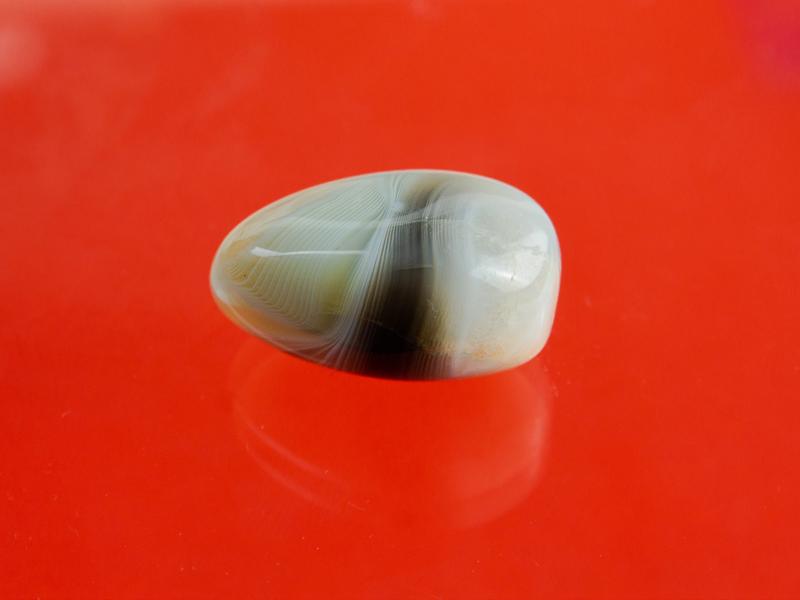
Botswana agate keeps that rhythm visible. Fine chalcedony layers in gray, blush, brown, and white build slowly through the cavity until recurrence becomes the beauty rather than the problem.
Quiet grief often needs an image that can bear its duration.
Stone Lore
Stories carried through time
Cultural notes are presented as tradition and historical context — stories carried through time.
Karoo Volcanic Event
Formation in Ancient Lava
Botswana agate formed approximately 187 million years ago during the Karoo volcanic event, when massive basalt lava flows covered what is now Botswana. As the lava cooled, gas vesicles trapped within the rock slowly filled with silica-rich fluids over millions of years, depositing concentric layers of chalcedony in the distinctive fine banding, soft grey, pink, apricot, salmon, and white, that makes Botswana agate unique among agates worldwide. The specific trace element chemistry of the Karoo basalts produced color palettes found nowhere else on Earth.
187 million years ago
Historical note
Protective Smoke Stone
In traditional Tswana culture, agates from the Bobonong district of northeastern Botswana were used in fire-making ceremonies and as protective stones. Agate's ability to produce sparks when struck against iron or steel made it practically...
Tswana Peoples, Southern Africa, pre-colonial
Origin lore
Commercial Discovery
Botswana agate entered the international gem and mineral market in the 1970s when deposits in the Bobonong district of northeastern Botswana were commercially developed. The distinctive banding and subtle earth tones immediately...
Bobonong District, Botswana · 1970s-present
Ritual history
Agate Working in Deep Time
Agate and chalcedony artifacts have been recovered from archaeological sites across southern Africa dating to the Middle Stone Age and later periods. While not specifically identified as 'Botswana agate,' worked chalcedony from the region...
Southern African Archaeology, Middle Stone Age onward
Silica-rich groundwater percolated through the porous basalt over millions of years, entering the vesicles and depositing thin layers of chalcedony along the cavity walls. Each band represents a separate episode of silica deposition -- a change in mineral concentration, temperature, pH, or flow rate. The grey bands contain minimal impurities; the pink and apricot bands derive their color from trace amounts of iron oxide (Fe2O3) and manganese oxide (MnO) incorporated into the silica structure during deposition.
The white bands are purer chalcedony with higher water content.
What distinguishes Botswana agate from other agates worldwide is the exceptional fineness and regularity of its banding. A single specimen may contain dozens or even hundreds of parallel bands, some thinner than a human hair. This regularity suggests unusually stable depositional conditions within the Karoo basalt vesicles -- consistent groundwater chemistry over extended periods.
The fine banding is the geological signature of patience: each line required thousands of years to deposit, and the entire stone represents millions of years of rhythmic, uninterrupted mineral accumulation.
The specific geological conditions of the Bobonong and Jwaneng districts in eastern and central Botswana produced the highest-quality specimens. The basalt in these areas contains vesicles of optimal size and shape, and the regional groundwater carried the precise trace element concentrations that create the characteristic grey-pink-apricot palette. Agates from other Karoo basalt locations (South Africa, Namibia) may share some characteristics but lack the distinctive color profile and banding fineness of true Botswana agate.
Crystal system diagram represents the general trigonal classification. Diagram created by Crystalis for educational reference.
Trigonal structure
Chemical Formula
SiO2
Crystal System
Trigonal
Mohs Hardness
6.5
Specific Gravity
2.58-2.64
Luster
Waxy to vitreous
Color
Gray, pink, brown with fine parallel banding
IMA Status
variety
Type Locality
Bobonong Subdistrict, Central District, Botswana
IMA Number
Not IMA-approved (variety of Quartz, pre-IMA grandfathered)
01
Mineral conditions gather
02
Structure begins to crystallize
03
Botswana Agate records place and pressure
BotswanaAfrica
Telling it apart
Botswana agate is distinguished from generic banded agate by its exceptionally fine parallel banding in muted gray, pink, apricot, and cream tones. The bands can be thinner than a human hair, which no other agate variety consistently matches. Dyed agates from Brazil and China are commonly sold as Botswana agate, often in artificially vivid pink or electric blue colors that do not occur in genuine material.
Authentic Botswana agate comes from the Bobonong district of Botswana and displays subtle, earthy pastel banding with smooth gradational transitions. If the colors are neon or the pink is hot rather than dusty, dye treatment is almost certain. Under a loupe, dye concentrates along fractures and porous bands, creating color intensity variation that follows cracks rather than natural depositional layers.
Physical properties are standard chalcedony: Mohs 6. 5 to 7, specific gravity 2. 58 to 2. 64, trigonal. The fine banding reflects trace iron and manganese in successive silica deposition cycles from volcanic host rock. Coarse banding, bright uniform color, or visible dye concentrations at fracture boundaries all indicate the specimen is not Botswana agate.
Spotting the real thing
Band Fineness and Regularity Genuine Botswana agate displays exceptionally fine, parallel banding, often dozens of bands visible to the naked eye. The bands should vary subtly in thickness and color but maintain an overall rhythmic regularity. Mass-produced imitations often show fewer, thicker, more uniform bands. If the banding looks printed or painted rather than grown, question the source.
Color Palette Authentic Botswana agate displays muted, natural tones: grey, soft pink, apricot, salmon, white, occasionally faint lavender. Bright, saturated, or neon colors (vivid pink, electric blue, bright green) indicate dyed material. Dye tends to concentrate in fractures and between bands, examine the stone under magnification for unnatural color pooling. Translucency at Edges Genuine Botswana agate shows translucency when held to a strong light, especially at thinner edges.
Light passing through reveals the internal banding structure in three dimensions.
Something has been ending for a long time, and you are tired. Not the sharp grief of sudden loss but the low, grey exhaustion of a goodbye that takes months or years; a slow divorce, a parent's decline, a career winding down with no clear endpoint. Your dorsal vagal system has responded by pulling the shades. Everything feels muted. You are present but not participating. The colors have drained from daily life, and you have stopped expecting them back.
Botswana agate enters this state with its banding: layer after layer of gentle variation, proving that even inside a sealed volcanic chamber, change continues. The bands are not dramatic. They are subtle. Pink fading into grey fading into apricot. The teaching is that emergence from shutdown does not require an explosion. It requires rhythm. One layer at a time. The stone does not demand that you feel better.
It demonstrates that even the slowest process is still a process.
Shut down & far away
The Hypervigilant Scanner
You are in the middle of a change and your body will not stop scanning. Every sound is a potential alarm. Every email could be the next disruption. You are not panicking exactly; you are operating at a level of alertness that was appropriate three weeks ago but has now become your baseline. The sympathetic system has locked into threat-detection mode, and it is exhausting. Botswana agate works with this state through its sheer regularity.
The bands are predictable. They follow a rhythm. When the eyes track along the banding, the nervous system receives a signal it has been missing: pattern. Stability. Repetition without threat. The stone becomes a visual metronome, and the body; which has forgotten what regularity feels like; remembers how to downshift. Not because you forced calm. Because the bands demonstrated it.
Settled & connected
The Detail Blind
You are oscillating between too much and nothing at all. When you are activated, everything is urgent and enormous. When you crash, everything is flat and featureless. In neither state can you see details. The small pleasures, the subtle shifts, the quiet indicators that something is actually working; these are invisible because your nervous system is only calibrated for extremes. Botswana agate is the detail stone.
Its teaching is in the bands themselves: look closer. What appears to be a single grey stripe is actually six separate layers. What looks like solid apricot reveals, under light, a gradient of twelve distinct tones. The stone trains the eye; and through the eye, the nervous system; to notice granularity. To find the variation inside what seems uniform. This is not mindfulness as a buzzword.
This is the body learning to perceive at a finer resolution.
Settled & connected
The Steady Witness
You are in the change and you are not drowning. The transition is still happening, the uncertainty is still real, but something in you has found a rhythm inside the upheaval. You can notice a sunset again. You can hold someone else's grief without losing your own center. Your ventral vagal system is online, and the world has recovered its texture. Botswana agate in this state is not medicine.
It is companionship. The stone's banding mirrors your own internal rhythm; steady, layered, nuanced. You do not need it to ground you. You hold it and feel recognized. Something that was built slowly, patiently, layer by layer, inside a dark chamber, and emerged beautiful. That is also your story. The steady witness does not need rescue. The steady witness needs the dignity of being seen.
These associations come from tradition and reflective practice — a way of working with the stone, not a medical prescription.
Somatic Practice
Simple ways to work with Botswana Agate
◇
Hold
Carry Botswana Agate in a pocket or place it over the heart center during a pause.
◌
Meditate
Let the stone become a quiet tactile anchor while the breath slows.
☽
Breathe
Breathe in softness. Breathe out tension. Keep the practice simple.
✎
Journal
Write with Botswana Agate nearby to name the feeling without forcing a conclusion.
✋
Bodywork
Rest the stone near the chest, hand, or bedside as a reminder to soften.
⌂
Environment
Place it where you want a visual cue for care, repair, or steadiness.
Field Instruction
The Slow Band
The Slow Band Protocol
3 min protocol
1
Temperature Registration (20 seconds)Place the Botswana agate flat against the center of your chest, over the sternum, and hold it there with one palm. Agate is a thermal insulator -- it will feel cool against your skin and warm slowly, absorbing your body heat at a rate that matches deep breathing. Close your eyes. Register the temperature differential. Cool stone, warm skin. The sensation is the beginning of a dialogue between your nervous system and something 187 million years old. Do not rush past the cool. That is the stone introducing itself.
2
Band Tracking (40 seconds)Open your eyes and hold the stone at arm's length. Find one band -- any band -- and follow it with your eyes from edge to edge. Slowly. When you reach the end, drop your gaze to the next band and trace it back. Continue for three to four bands. This is not meditation. This is a neurological exercise. Smooth pursuit eye movements -- the kind used to track a slow-moving object -- activate the parasympathetic system and reduce sympathetic arousal. The bands give your eyes exactly what they need: a predictable, curved path with no surprises. Let the tracking speed match a slow exhale.
3
The Rhythm Breath (60 seconds)Hold the stone in your non-dominant hand. Inhale through the nose for 3 counts. Exhale through the mouth for 5 counts. Repeat five times. With each exhale, imagine one thin band of color being deposited inside your chest -- not building armor, not building walls, but building the same kind of patient, layered structure the stone carries. Each breath-band is a different shade: the first grey for stability, the second pink for tenderness, the third apricot for warmth, the fourth white for openness, the fifth a color your body chooses. Five layers. Five breaths. A tiny agate forming in your ribcage.
4
Detail Scan (40 seconds)Bring the stone close to your face -- six inches from your eyes. Look into the banding at close range. Find something you did not see from arm's length. A thinner band inside a thicker one. A slight color variation. A translucent edge where light passes through. Name it silently. This step is training your nervous system to perceive at a finer resolution -- to see the granularity inside what appeared solid. The ability to notice detail is one of the first things lost during prolonged stress. This is its recovery exercise. One detail. Named. Registered. Your resolution just increased.
5
Pocket Placement (20 seconds)Place the Botswana agate in your pocket, on your desk, or anywhere your hand will find it throughout the day. Each time your fingers brush it, let the touch be a one-second reset: I am in a transition. The transition has a rhythm. I do not have to force it to go faster. If you are using this stone for habit cessation, the pocket placement is especially important -- the stone becomes the alternative tactile anchor, the thing you reach for instead of the habit. It does not judge. It does not lecture. It just offers its bands and its patience and its 187 million years of proof that slow processes produce the finest results.
Stone Intelligence
The fact that makes Botswana Agate memorable
The bands inside your Botswana agate were deposited one at a time over millions of years inside a volcanic vesicle in what is now the Kalahari. Each band is a record of a different moment in groundwater chemistry: a shift in iron content, a change in pH, a season of higher silica concentration. The rhythmic regularity is not accidental. It is the geological signature of a stable, patient process operating in darkness without an audience.
Crystalis documents both the geology and the practice because the stone never separated them: the earth deposited, the mineral recorded, and the rhythm still has something to teach a nervous system that has forgotten what steady feels like.
SCI
Geochemistry of agate and chalcedony
American Journal of Science · 1995
LORE
An overview of the Botswana handicraft sector
1990
SCI
Gondwana Large Igneous Provinces: plate reconstructions, volcanic basins, and sill volumes
Occurrence and distribution of 'moganite' in agate/chalcedony
Contributions to Mineralogy and Petrology · 1998Read source
Ritual Use
From reference to practice
You are processing grief in layers and each layer reveals another one underneath. Botswana agate formed in lava flows in what is now Botswana, each band deposited by separate silica-rich fluid events over millions of years. Mohs 6.
5. Hold it during grief that comes in waves. The banding pattern is a record of repeated events.
Each band is distinct. Each band is complete in itself. Grief that returns is not regression.
It is a new band being deposited on the ones already laid down.
Sacred Match
Sacred Match reaches for Botswana Agate when what you feel sounds like:
Feeling exhausted by a transition that will not end
Grief that is slow and grey rather than sharp
Missing the details of your own life
Hypervigilance during periods of change
Needing comfort without being told everything is fine
Wanting to quit a habit but feeling too tired to fight
Oscillating between overwhelm and numbness
Botswana agate finds you when the transition has been going on too long and your nervous system has forgotten what steady feels like. It does not arrive to fix anything. It arrives to demonstrate rhythm. The bands in this stone were deposited over millions of years inside a sealed volcanic chamber -- no light, no audience, no urgency. Just silica and patience and trace minerals creating something that the world would eventually call beautiful.
Botswana agate comes forward when you need to remember that your own slow process is not failure. It is formation.
Stones and herbs that harmonize with Botswana Agate
Pairings are treated like a recipe file: clear use, method, and safety.
Crystal Companion
Botswana Agate + Amethyst
Use when
You want to layer the primary intention with another supportive tone.
How to work with it
Place the stones together during meditation, journaling, or a short reset.
Safety
Use as a reflective practice tool, not as a medical substitute.
Crystal Companion
Botswana Agate + Rhodonite
Use when
You want to layer the primary intention with another supportive tone.
How to work with it
Place the stones together during meditation, journaling, or a short reset.
Safety
Use as a reflective practice tool, not as a medical substitute.
Crystal Companion
Botswana Agate + Clear Quartz
Use when
You want to layer the primary intention with another supportive tone.
How to work with it
Place the stones together during meditation, journaling, or a short reset.
Safety
Use as a reflective practice tool, not as a medical substitute.
Crystal Companion
Botswana Agate + Black Tourmaline
Use when
You want to layer the primary intention with another supportive tone.
How to work with it
Place the stones together during meditation, journaling, or a short reset.
Safety
Use as a reflective practice tool, not as a medical substitute.
Lepidolite
Lepidolite brings lithium-based calm to the nervous system. Paired with Botswana agate's rhythmic grounding, this combination creates a deep steadiness during anxious transitions. Lepidolite softens the sympathetic spikes. Botswana agate provides the rhythm underneath. Together they say: you can be in the uncertainty without vibrating apart. This pairing is for the person who knows the change is necessary but whose body will not stop bracing.
Rose Quartz
Rose quartz opens the heart center with unconditional gentleness. Botswana agate grounds that openness so it does not become overwhelming. This pairing is for grief work -- specifically, the slow grief of transitions. Rose quartz says "feel this." Botswana agate says "you can feel this without drowning." The combination holds space for tenderness without sacrificing stability.
Smoky Quartz
Smoky quartz transmutes heavy energy and grounds through the root. With Botswana agate, it creates a powerful detoxification pairing -- particularly aligned with the smoking cessation tradition. Smoky quartz handles the energetic release of what is being let go. Botswana agate provides the patient, rhythmic support for what comes next. Together they manage both sides of a habit release: the leaving and the staying.
Amethyst
Amethyst connects to the crown chakra with calming, spiritual clarity. Paired with Botswana agate's root-crown dual nature, this combination strengthens the vertical axis -- grounding below, opening above, with clear signal between. This pairing is for transitions that have a spiritual dimension: leaving a faith community, ending a spiritual practice, or entering a new phase of inner work where the old maps no longer apply.
Carnelian
Carnelian activates the sacral center with warmth and vitality. Botswana agate's apricot banding resonates with carnelian's orange frequency, creating a color harmony that amplifies both stones. This pairing is for people emerging from dorsal shutdown who need gentle reactivation -- not a jolt, but a warm invitation back into the body. Carnelian brings the spark. Botswana agate ensures the spark does not overwhelm.
Care & Cleansing
How to keep Botswana Agate in good condition
Water Safe?
Water safe
This stone is generally safe for short water contact, though polishing, fractures, and metal settings can still change how a specimen behaves.
Sunlight Safe?
Sunlight safe
Tolerates daylight; safe to charge or display in the sun.
Authenticity
What to check
Natural Botswana Agate should usually feel cooler than plastic or resin on first touch and warm more slowly in the hand.
The #1 Question Can Botswana Agate Go in Water? YES: WATER SAFE
Botswana agate is safe for brief water contact. Botswana agate is a variety of chalcedony (microcrystalline quartz) with a Mohs hardness of 6. 5-7. It is non-porous, chemically stable, and resistant to most household substances. Water will not damage the crystal structure or affect the banding. Running water rinse: safe; brief rinse under cool running water is the simplest cleansing method
Short soaking (under 30 minutes): safe; will not affect the stone
Prolonged soaking: avoid; extended submersion can dull polished surfaces over time
Salt water: avoid; salt crystal formation in micro-fissures can cause surface damage
Hot water: avoid; thermal shock can stress the banding layers and potentially cause cracking
Gem water preparation: safe for indirect methods; direct infusion is physically safe but unnecessary
One note: while Botswana agate is water safe, water is not the preferred cleansing method.
The stone's energy responds more effectively to moonlight, selenite, and smoke cleansing. Water is adequate for physical cleaning but less aligned with the stone's slow, patient energetic signature.
Temperature
Natural Botswana Agate should usually feel cooler than plastic or resin on first touch and warm more slowly in the hand.
Scratch logic
Use 6.5 on the Mohs scale as the check, not internet myths. A real specimen should behave in line with the hardness listed above.
Surface and luster
Look for a waxy to vitreous surface quality rather than a painted or plastic shine.
Weight and density
The listed specific gravity is 2.58-2.64. If a specimen feels unusually light for its size, it may deserve a second look.
My Field Guide
Your private record and next steps
Journal
Add this stone to your private collection, then log what happened when you worked with it.
Shared Notes
Read public practice logs and pattern notes from the Crystalis community.
When members save a public field note for this stone, it will appear here.
Frequently Asked
Questions people ask about Botswana Agate
What is Botswana agate?
⌄
Botswana agate is a banded variety of chalcedony (microcrystalline quartz, SiO2) found exclusively in Botswana, Africa. It is distinguished by its fine, parallel banding in soft grey, pink, apricot, salmon, and white tones, formed by rhythmic silica deposition inside volcanic vesicles approximately 187 million years ago during the Karoo volcanic event. Mohs hardness 6.5-7.
Can Botswana agate go in water?
⌄
Yes. Botswana agate is water safe for brief cleansing. At Mohs 6.5-7, it is hard and non-porous enough to withstand running water and short soaks. Avoid prolonged submersion or salt water, which can dull the polish over time. Never use hot water, as thermal shock can stress the banding layers.
What chakra is Botswana agate?
⌄
Botswana agate works primarily with the root chakra (grounding, safety, stability) and the crown chakra (spiritual connection, higher perspective). This dual-chakra resonance makes it unusual among agates; it anchors the body while keeping the mind open, creating a grounded awareness rather than dissociated calm.
What is Botswana agate good for?
⌄
In crystal practice, Botswana agate is valued for comfort during transitions, emotional stabilization during grief, attention to overlooked details, and traditional use in smoking cessation support. It is prescribed for people who feel overwhelmed by change and need a sense of steady, rhythmic continuity.
Is Botswana agate rare?
⌄
Genuine Botswana agate is relatively uncommon because it comes from a single geographic source: Botswana, Africa. While chalcedony is abundant worldwide, the specific banding patterns and soft coloration of true Botswana agate are unique to the Karoo basalt formations in that region. It is not rare in the way that alexandrite or grandidierite are rare, but it is geographically limited.
How can you tell if Botswana agate is real?
⌄
Genuine Botswana agate displays fine, parallel banding in muted natural tones: grey, pink, apricot, salmon, white. The bands are thin and numerous, often dozens visible in a single stone. Dyed imitations show unnaturally vivid or uniform colors (bright pink, electric blue). Real Botswana agate feels cool to touch, has Mohs 6.5-7 hardness, and shows translucency when held to light.
Can Botswana agate go in the sun?
⌄
Botswana agate is generally sun safe. Its color comes from iron oxide and manganese trace elements within the silica structure, which are stable under UV exposure. However, prolonged months of direct sunlight may very gradually lighten the more delicate pink and apricot tones. Brief sun exposure for charging or display is perfectly safe.
What is the difference between Botswana agate and regular agate?
⌄
All agates are banded chalcedony, but Botswana agate is distinguished by its geographic origin (exclusively Botswana), its formation context (Karoo basalt, ~187 million years old), its exceptionally fine and numerous parallel bands, and its characteristic soft grey-pink-apricot color palette. Regular agate can come from anywhere and shows wider variation in band thickness and color.
Sources & Citations
Where this entry can be checked
Back Matter
Readable for people. Structured for AI search.
Sources stay visible in the page so readers, search engines, and answer systems can follow the evidence trail.
01
SCI
Geochemistry of agate and chalcedony
Merino, E., Wang, Y. & Deloule, E. (1995). Geochemistry of agate and chalcedony. American Journal of Science. [SCI]View source
02
LORE
An overview of the Botswana handicraft sector
M. Elizabeth Terry. (1990). An overview of the Botswana handicraft sector. [LORE]
03
SCI
Gondwana Large Igneous Provinces: plate reconstructions, volcanic basins, and sill volumes
Svensen, H. et al. (2012). Gondwana Large Igneous Provinces: plate reconstructions, volcanic basins, and sill volumes. Geological Society. [SCI]DOI 10.1144/SP362.3
04
SCI
Occurrence and distribution of 'moganite' in agate/chalcedony
Gotze, J., Nasdala, L., Kleeberg, R. & Wenzel, M. (1998). Occurrence and distribution of 'moganite' in agate/chalcedony. Contributions to Mineralogy and Petrology. [SCI]DOI 10.1007/s004100050440
05
SCI
The timing and duration of the Karoo igneous event, southern Gondwana
Duncan, R.A., Hooper, P.R., Rehacek, J., Marsh, J.S. & Duncan, A.R. (1997). The timing and duration of the Karoo igneous event, southern Gondwana. Journal of Geophysical Research. [SCI]DOI 10.1029/97JB00972