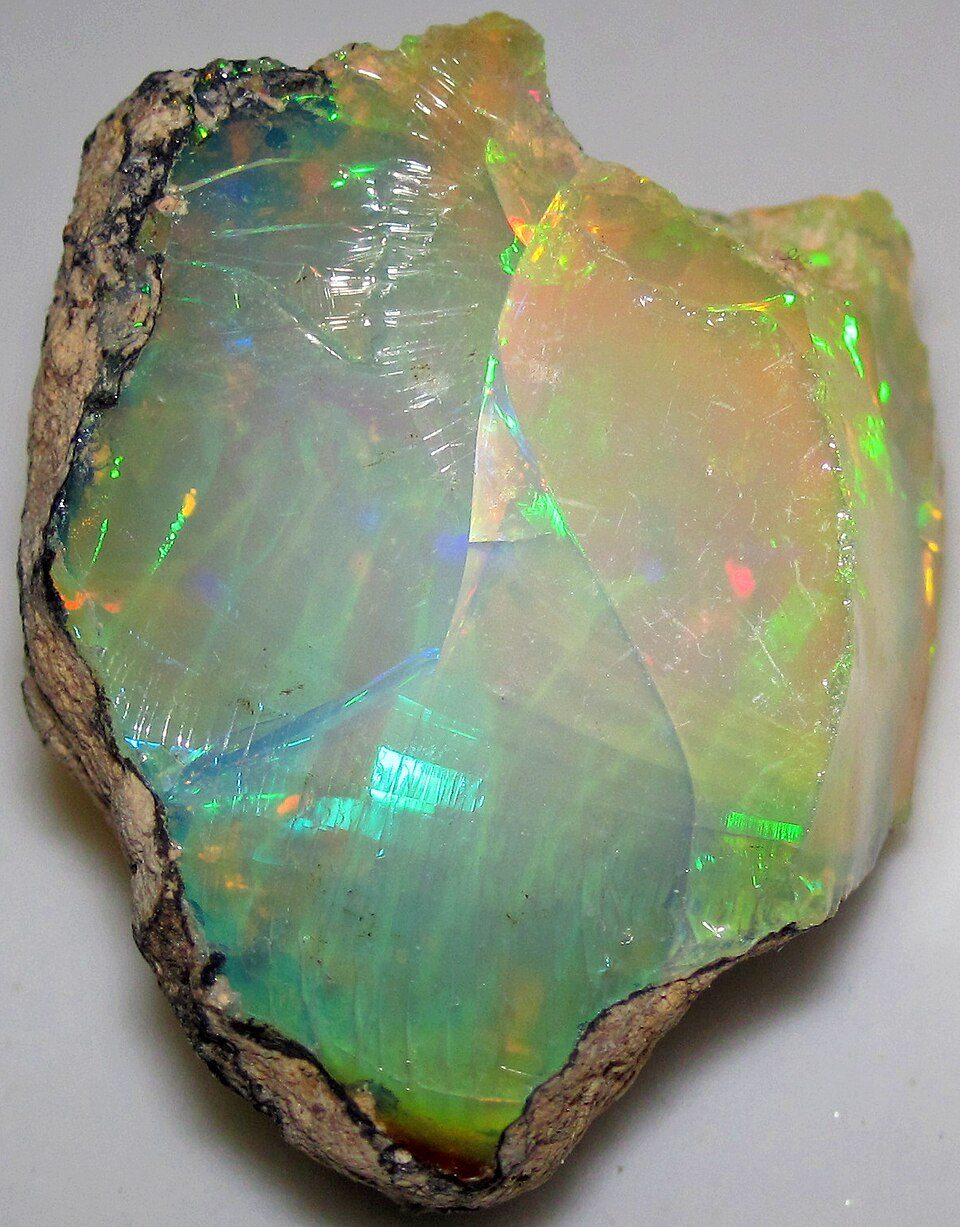
Everything has become overstimulated and shiny in the wrong way. Cacholong is a matte, porcelain-like common opal that refuses spectacle in favor of milky quiet. Blank space can be its own medicine.
Over the sternum and along the tongue line, cacholong opal is used for dry, over-compressed states. Cacholong Opal is handled in body-based work through its physical...
The Meaning
Cacholong Opal in the Crystalis dictionary
Overstimulation changes the eye. Shimmer starts to feel like demand. Even lovely things come forward with too much pressure.
Cacholong has none of precious opal's fire. Opaque, milky, and often compared to porcelain, it gives back a surface that asks almost nothing of the nervous attention fixed on it. No rainbow bargaining. No spark. The relief is immediate because the stone is so visually undemanding.
Stone Lore
Stories carried through time
Cultural notes are presented as tradition and historical context — stories carried through time.
The name "cacholong" derives from the Kalmyk Mongolian words "kaschtschilon" or "kash-cholon," meaning "beautiful stone" or "river stone." Kalmyk peoples of the Caspian steppe region regarded cacholong as a sacred stone associated with the White Tara and with maternal purity. It was placed in the birth tent during labor and given to nursing mothers as a lactation talisman. Source: Fersman, A.E. (1954), "Ocherki po istorii kamnya" (Essays on the History of Stone), USSR Academy of Sciences.
Ritual history
Mongolian Shamanic Practice
In Mongolian shamanic tradition, white stones hold the energy of "tsagaan buyan" (white merit/virtue). Cacholong was placed on household altars alongside milk offerings, symbolizing the purity of intention and the sustaining power of the...
Unknown
Ritual history
Egyptian Association (Historical)
Some historians have identified cacholong among the white stones used in Egyptian amulet carving, particularly in Ptolemaic-period breast ornaments. The opaque white material was associated with Hathor in her role as divine cow and...
Unknown
Historical note
Russian Lapidary Tradition (18th-19th century)
Cacholong was popular in the Russian gem-cutting workshops of the Urals during the reign of Catherine the Great and later. It was used for cameos, intaglios, and small decorative objects. Russian mineralogists classified it as "kascholong"...
Opaque white opal forms when silica-rich waters lose mobility and compact into a porcelain-like mass rather than building a play-of-color lattice. Cacholong develops from silica-bearing waters that deposit common opal in compact, opaque masses rather than in translucent seams or the ordered nanosphere arrays responsible for play-of-color. The material remains amorphous hydrated silica, yet the texture is denser, more porcelain-like, and often lower in visible water expression than precious opal.
Sedimentary and volcanic settings can both host its formation, provided silica moves through pore space and later consolidates into this matte white form.
Because the internal arrangement of silica is irregular, visible diffraction never organizes into spectral fire. That absence is part of the identity, not a deficiency. The stone’s hardness is modest, porosity can be meaningful, and the chalky white surface often invites confusion with chalcedony or ceramic material. Still, its lower specific gravity and opaline character separate it from quartz-based lookalikes.
What remains somatically is quiet density without shine. It feels like a held breath finally becoming visible as matter: not dramatic, not sparkling, just compact enough to suggest that softness can consolidate and hold its shape.
The mineral data reinforces that formation story. Cacholong Opal carries the chemistry SiO2 nH2O, and the stated crystal system is Amorphous. Hardness around 5. 5 and specific gravity of 1. 98-2. 20 are not decorative catalog facts. They describe how tightly the structure holds together, how the crystal responds to abrasion, and how much weight the hand expects from a piece of that size.
Luster, color, and origin also preserve clues to environment. White material from Kazakhstan, Mongolia, Iceland reaches the market with a visual identity shaped by local geology, not by a generic stone category.
A specimen therefore carries process in several layers at once: chemistry, symmetry, growth history, and later alteration or treatment where relevant. What emerges from that stack is a stone that can be read physically before any symbolic meaning is assigned.
Crystal system diagram represents the general amorphous classification. Diagram created by Crystalis for educational reference.
Amorphous structure
Chemical Formula
SiO2 nH2O
Crystal System
Amorphous
Mohs Hardness
5.5
Specific Gravity
1.98-2.20
Luster
Porcelaneous to waxy; sometimes dull matte
Color
White
IMA Status
variety
IMA Number
Not IMA-approved (variety of Opal)
01
Mineral conditions gather
02
Structure begins to crystallize
03
Cacholong Opal records place and pressure
Kazakhstan is the primary commercial source. Mongolia produces cacholong opal from volcanic and sedimentary deposits. Iceland yields specimens from volcanic tuff formations.
The opaque, porcelain-white character and lower water content distinguish cacholong from translucent opal varieties at all three localities.
KazakhstanMongoliaIceland
Telling it apart
The fraud risk with cacholong is simple: white chalcedony and porcelain-like common opal are sold interchangeably. The confirming step is hardness and specific gravity. Sellers can lean on color, trade names, or locality mythology, but that one check separates the real material from the easy substitute. Cacholong Opal has its own physical signature in the hand and under magnification, whether that means unusual density, a true internal growth pattern, a natural host matrix, or evidence of locality and structure.
Fraud or simple sloppiness matters differently here than it would for a generic tumbled stone. Cacholong is softer, more porous, and often needs gentler care than chalcedony. A buyer paying for Cacholong Opal is paying for a specific geological story, not just a similar color. Buyers also benefit from checking hardness, surface texture, and specimen context against the label. Cacholong Opal should agree with its own chemistry and structure rather than only with a seller's story.
That extra minute of examination often reveals whether a listing is accurate, inflated, or simply careless. Calling common white opal cacholong to inflate the price works only on buyers who do not check porosity and silica type.
Spotting the real thing
Cacholong opal: opaque porcelain-white with lower water content than translucent opals. Mohs 5. 5-6.
Specific gravity 1. 98-2. 20.
No play of color (this is common opal, not precious opal). The porcelain-like texture and opacity are distinctive. If it shows play of color, it is a different opal variety.
If it effervesces in acid, it is calcite or marble, not opal.
Cacholong's porcelain stillness supports the ventral vagal state of calm presence without dissociation. Its matte, non-reflective surface does not stimulate visual excitement but instead produces a settling effect; the visual equivalent of a quiet room. When held during social engagement, cacholong supports the capacity to listen without reactivity, to hold space for another person's words without formulating a defensive response. It is the stone of the centered listener.
Charged & on alert
SYMPATHETIC ACTIVATION (Fight/Flight):
During sympathetic arousal; racing thoughts, chest tightness, the urge to argue or flee; cacholong's cool, dense weight in the palm provides a proprioceptive anchor. Its porcelain quality invites a slowing of breath. The stone does not suppress the sympathetic charge but gives it a container: the hands squeeze something solid while the nervous system processes whether the perceived threat is real. Particularly useful for people who express anxiety through verbal acceleration; talking faster, interrupting, catastrophizing aloud.
Shut down & far away
DORSAL VAGAL (Shutdown/Collapse):
For the dorsal vagal freeze; the numbing, the emotional flatness, the sense of being far away from one's own body; cacholong's mild porosity creates a subtle sensory anchor. The tongue-adherence property (not recommended as a protocol, but notable) points to cacholong's affinity for surfaces and contact. Held against the sternum or placed on the belly during rest, its slight warmth absorption and release creates a gentle thermal conversation with the body, reminding the system that sensation is still available without demanding full arousal.
Charged & on alert
SYMPATHETIC-DORSAL BLEND (Freeze with Panic):
The most destabilizing autonomic state; frozen but flooded with adrenaline, unable to move but internally screaming; finds a specific ally in cacholong. Its whiteness, its lack of visual complexity, its matte non-stimulation, allows the overwhelmed visual system to rest while the stone's physical weight provides just enough sensory input to prevent full dissociative drift. Cacholong does not demand attention. It waits.
Charged & on alert
VENTRAL-SYMPATHETIC BLEND (Energized but Grounded):
When the system is mobilized but regulated; the state of focused creative work, animated conversation, purposeful action; cacholong serves as a background regulator. Kept in a pocket or on a desk, it serves as a touchstone that the practitioner returns to between bursts of activity. Its cooling effect moderates the heat of sustained engagement without dampening momentum.
These associations come from tradition and reflective practice — a way of working with the stone, not a medical prescription.
Somatic Practice
Simple ways to work with Cacholong Opal
◇
Hold
Carry Cacholong Opal in a pocket or place it over the heart center during a pause.
◌
Meditate
Let the stone become a quiet tactile anchor while the breath slows.
☽
Breathe
Breathe in softness. Breathe out tension. Keep the practice simple.
✎
Journal
Write with Cacholong Opal nearby to name the feeling without forcing a conclusion.
✋
Bodywork
Rest the stone near the chest, hand, or bedside as a reminder to soften.
⌂
Environment
Place it where you want a visual cue for care, repair, or steadiness.
Field Instruction
The Porcelain Rest
White opal from the Central Asian steppes — porcelaneous, matte, and opaque, offering the radical gentleness of a blank page
2 min protocol
1
Hold the Cacholong Opal in your open palm. It is white — not sparkling white, not translucent white, but the dense, matte white of unglazed porcelain. No play of color. No flash. Just opacity. Let your eyes rest on the whiteness the way they would rest on fresh snow before anyone walks on it.
2
Run your thumb across the surface. Cacholong has a porcelaneous luster — smooth but not slippery, dense but not heavy. It feels like touching a teacup that has never been used. Circle your thumb on the surface slowly, three full rotations. Notice how the matte texture absorbs sensation rather than reflecting it.
3
Cacholong comes from the steppes of Central Asia — vast, flat, open. Breathe as if you are standing in a landscape with no vertical interruption. Inhale through the nose for 3 counts — wide and horizontal, filling the ribs sideways. Exhale through barely open lips for 5 counts — long and level, like wind crossing flat earth. Repeat 6 times.
4
Place the Cacholong on your forehead while lying down or reclined. The amorphous structure holds a gentle coolness. Let the matte surface press against the center of your forehead — not pressing down, just resting. Close your eyes. The whiteness of the stone is now the whiteness behind your eyelids. Stay for 45 seconds. Think nothing. Or try to.
5
Remove the stone. Sit up slowly. Hold it in front of you one more time — a small white oval that offers nothing except space. Set it down on a dark surface where its whiteness stands out. You have practiced being blank without being empty.
Stone Intelligence
The fact that makes Cacholong Opal memorable
Porcelain-white opal with less water than its relatives. Opaque where other opals play with light. The science documents how reduced hydration produces opacity in amorphous silica.
The practice asks what solidity means when it comes from releasing what most of your family holds onto.
SCI
The nature of opal I. nomenclature and constituent phases
Journal of the Geological Society of Australia · 1971Read source
SCI
Near-infrared signature of hydrothermal opal: a case study of Icelandic silica sinters
Everything feels too bright and too loud. Cacholong opal is hydrous silica, Mohs 5. 5, opaque milky white.
Unlike precious opal, cacholong has no fire, no flash, no spectacle. It absorbs light rather than refracting it. Hold the white surface against your forehead or palm during overstimulation.
The porcelain-like texture and opacity create a visual and tactile rest point. The nervous system registers the absence of complexity as relief.
Sacred Match
Sacred Match reaches for Cacholong Opal when what you feel sounds like:
dry chest breathing
a clenched tongue and quieted speech
collapse after prolonged emotional effort
desire to disappear into stillness
fragile energy that cannot take more friction
Sacred Match listens to the body rather than to preference. It notices what you are feeling right now, the way you are protecting yourself, and the deeper need underneath both. When that points to a pattern answered by cacholong opal, the prescription follows the stone’s physical behavior. Its geology, texture, density, optical structure, and handling profile indicate whether the body needs ballast, clearer edges, reduced visual noise, or a more organized field of attention.
The match is made when the material solves for the body’s immediate regulation problem better than a prettier or more famous alternative.
dry chest breathing -> body asking for orientation -> seeking a clear point of contact
a clenched tongue and quieted speech -> protective tension rising -> seeking containment
collapse after prolonged emotional effort -> signal overload in the tissues -> seeking organization
desire to disappear into stillness -> regulation failing at the threshold -> seeking a gentler entry
fragile energy that cannot take more friction -> action or rest cannot complete -> seeking coherence
Stones and herbs that harmonize with Cacholong Opal
Pairings are treated like a recipe file: clear use, method, and safety.
Crystal Companion
Cacholong Opal + Amethyst
Use when
You want to layer the primary intention with another supportive tone.
How to work with it
Place the stones together during meditation, journaling, or a short reset.
Safety
Use as a reflective practice tool, not as a medical substitute.
Crystal Companion
Cacholong Opal + Rhodonite
Use when
You want to layer the primary intention with another supportive tone.
How to work with it
Place the stones together during meditation, journaling, or a short reset.
Safety
Use as a reflective practice tool, not as a medical substitute.
Crystal Companion
Cacholong Opal + Clear Quartz
Use when
You want to layer the primary intention with another supportive tone.
How to work with it
Place the stones together during meditation, journaling, or a short reset.
Safety
Use as a reflective practice tool, not as a medical substitute.
Crystal Companion
Cacholong Opal + Black Tourmaline
Use when
You want to layer the primary intention with another supportive tone.
How to work with it
Place the stones together during meditation, journaling, or a short reset.
Safety
Use as a reflective practice tool, not as a medical substitute.
Moonstone: Milk-white opacity with lunar sheen. Cacholong is matte and porcelain-like where moonstone is translucent and mobile. Their contrast supports slower breathing and less visual demand. Lay cacholong over the sternum and moonstone at the brow.
Rose Quartz: Soft body, soft surface. Rose quartz adds warmth to cacholong’s chalky stillness. The combination is especially useful when tenderness needs a quieter visual field than glossy stones provide. Hold one in each palm while the shoulders stay supported.
Howlite: Dry white minerals with different structures. Howlite brings veining and a slightly more geological busyness, while cacholong remains simple and compact. Together they calm overstimulated visual attention. Place howlite at the throat and cacholong near the heart line.
Smoky Quartz: Porcelain white above, dark release below. The contrast helps white stones avoid becoming vague. Smoky quartz gives the session definition. Keep smoky quartz by the knees and cacholong on the chest.
Taken together, these combinations work best when the stones are kept in distinct roles instead of piled into one indiscriminate cluster. One sets the frame, one changes the tone, and one gives the body a placement cue it can actually follow.
Care & Cleansing
How to keep Cacholong Opal in good condition
Water Safe?
Water safe
This stone is generally safe for short water contact, though polishing, fractures, and metal settings can still change how a specimen behaves.
Sunlight Safe?
Sunlight safe
Tolerates daylight; safe to charge or display in the sun.
Authenticity
What to check
Natural Cacholong Opal should usually feel cooler than plastic or resin on first touch and warm more slowly in the hand.
Cacholong opal is water-safe for brief rinses. Lower water content than most opals makes it more stable, but it is still amorphous silica. Brief rinse (30 seconds) under cool water.
Avoid temperature extremes and ultrasonic cleaners. The porcelain-white surface can absorb oils and dyes, so handle with clean hands. Recommended cleansing: moonlight (overnight), selenite plate (4-6 hours).
Store at stable temperature.
Temperature
Natural Cacholong Opal should usually feel cooler than plastic or resin on first touch and warm more slowly in the hand.
Scratch logic
Use 5.5 on the Mohs scale as the check, not internet myths. A real specimen should behave in line with the hardness listed above.
Surface and luster
Look for a porcelaneous to waxy; sometimes dull matte surface quality rather than a painted or plastic shine.
Weight and density
The listed specific gravity is 1.98-2.20. If a specimen feels unusually light for its size, it may deserve a second look.
My Field Guide
Your private record and next steps
Journal
Add this stone to your private collection, then log what happened when you worked with it.
Shared Notes
Read public practice logs and pattern notes from the Crystalis community.
When members save a public field note for this stone, it will appear here.
Frequently Asked
Questions people ask about Cacholong Opal
What is Cacholong Opal?
⌄
Cacholong opal is hydrated silica, SiO2 . nH2O, with a Mohs hardness of 5.5 to 6.5. It is amorphous (non-crystalline), classified as opal-CT in many Central Asian specimens.
What is the Mohs hardness of Cacholong Opal?
⌄
Cacholong Opal has a Mohs hardness of 5.5 - 6.5.
Can Cacholong Opal go in water?
⌄
Water Safety Classification: CONDITIONAL: Use caution. Cacholong is porous and partially composed of calcium carbonate, which is soluble in acidic water. Brief rinsing under lukewarm water for cleansing is acceptable, but prolonged soaking will degrade the stone over time. The microporous structure absorbs water, which can cause internal stresses as it dries, potentially leading to surface crazing in some specimens.
Never use acidic solutions (vinegar, citrus water, witch hazel), salt water, or ultrasonic cleaners. Never make gem elixirs with direct immersion. Indirect method only (stone outside the water vessel).
What crystal system is Cacholong Opal?
⌄
Cacholong opal is amorphous (non-crystalline) and so has no crystal system; it is classified as opal-CT in many Central Asian specimens.
What is the chemical formula of Cacholong Opal?
⌄
The chemical formula of Cacholong Opal is SiO2 nH2O.
Is Cacholong Opal toxic?
⌄
Cacholong is softer than crystalline quartz and can chip or crack if dropped on hard surfaces. Store separately from harder stones.
How does Cacholong Opal form?
⌄
Formation Story Cacholong opal forms through a distinctive process that bridges the boundary between opal and calcium carbonate mineralogy. The process begins in arid to semi-arid volcanic terrains where silica-rich groundwaters percolate through weathered tuffs, basalts, and rhyolitic deposits. As these silica-bearing solutions migrate through porous rock, they encounter calcium-rich environments: limestone beds, calcareous sediments, or calcium-saturated groundwater.
Sources & Citations
Where this entry can be checked
Back Matter
Readable for people. Structured for AI search.
Sources stay visible in the page so readers, search engines, and answer systems can follow the evidence trail.
01
SCI
The nature of opal I. nomenclature and constituent phases
Jones, J. B., Segnit, E. R. (1971). The nature of opal I. nomenclature and constituent phases. Journal of the Geological Society of Australia. [SCI]DOI 10.1080/00167617108728743
02
SCI
Near-infrared signature of hydrothermal opal: a case study of Icelandic silica sinters
Pineau, M.; Chauviré, B.; Rondeau, B. (2023). Near-infrared signature of hydrothermal opal: a case study of Icelandic silica sinters. European Journal of Mineralogy. [SCI]DOI 10.5194/ejm-35-949-2023