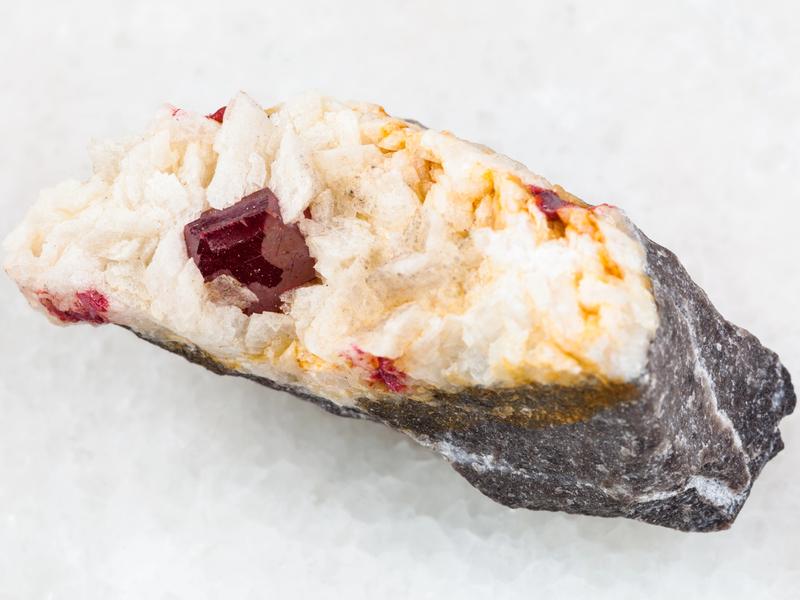
You are drawn to an intensity that other people keep telling you to avoid. Cinnabar is mercury sulfide, vermillion red and genuinely dangerous to handle carelessly. Respect and attraction can share the same mineral.
ALL NERVOUS SYSTEM WORK WITH CINNABAR IS VISUAL ONLY. The stone must remain behind glass or in a sealed display case. No touching, no body placement, no elixirs. The...
The Meaning
Cinnabar in the Crystalis dictionary
Some intensities are too charged for comfort language. They need to be met with respect instead.
Cinnabar is mercury sulfide, impossible red, historically treasured and chemically dangerous. The beauty arrives with terms. The warning is part of the specimen, not a footnote after it. Power deserves the same clarity.
Stone Lore
Stories carried through time
Cultural notes are presented as tradition and historical context — stories carried through time.
Chinese Alchemy and Medicine
Zhusha: The Elixir of Immortality
Chinese alchemists called cinnabar zhusha (vermilion sand) and placed it at the center of Daoist longevity practice for over a millennium. The Baopuzi, written by Ge Hong in 320 CE, describes heating cinnabar to extract mercury and then recombining them in cycles of transformation believed to concentrate life force. Daoist adepts ingested cinnabar preparations seeking immortality, a practice that killed multiple Tang Dynasty emperors, including Muzong (r.
820-824), Wuzong (r. 840-846), and Xuanzong (r. 846-859), all likely victims of mercury poisoning from cinnabar elixirs. The stone that promised eternal life delivered death. This is not metaphor. Cinnabar contains approximately 86% mercury by weight.
Warring States Period through Tang Dynasty (475 BCE-907 CE)
Origin lore
Minium: The Blood of the Earth
The Roman writer Pliny the Elder documented the Almaden cinnabar mines of Spain in Naturalis Historia (77 CE), describing the brutal conditions of the mines where slaves and prisoners extracted the blood-red ore. Romans used ground...
Ancient Rome and the Almaden Mines, Spain · 1st century BCE-present
Ritual history
The Sacred Vermilion
In Hindu tradition, sindoor (vermilion powder derived from cinnabar) has been applied to the parting of married women's hair and to the foreheads of deities for at least fifteen centuries. The Devi Mahatmyam (5th-6th century CE) associates...
Hindu and Buddhist Sacred Art, India and Tibet · 5th century CE onward
Historical note
The Red Earth of Ceremony
Indigenous peoples across North America used cinnabar as a pigment source for ceremony, body painting, and sacred object decoration. Cinnabar deposits in present-day Nevada, Oregon, and California were mined and traded along extensive...
Native American Vermilion Trade · pre-contact to 19th century
Earth Record
Mineralogy and formation
Cinnabar is mercury sulfide (HgS), crystallizing in the trigonal system. It forms in low-temperature hydrothermal environments -- typically at temperatures between 50-200C in the uppermost few hundred meters of the Earth's crust. Cinnabar deposits are overwhelmingly associated with volcanic activity, hot springs, and shallow fault systems where mercury-bearing fluids rise from deeper sources.
Mercury enters the hydrothermal system from deep magmatic sources, traveling upward as volatile mercury compounds in hot fluids. When these fluids encounter sulfur (from volcanic gases or sedimentary sulfide sources) and cool below approximately 200C, cinnabar precipitates. The vermilion-red color is caused by the specific bonding geometry between mercury and sulfur atoms -- a charge transfer absorption that eliminates blue and green light with extreme efficiency, producing one of the most vivid natural reds in the mineral kingdom.
Cinnabar is soft (Mohs 2-2. 5), with perfect prismatic cleavage and a specific gravity of 8. 09-8. 20 -- extraordinarily heavy for its size, a direct consequence of the massive mercury atoms in its structure. When freshly broken, cinnabar displays a brilliant scarlet adamantine luster. Over time, surface oxidation can produce a dull, dark coating. The crystal habit ranges from thick tabular to prismatic to massive granular, though well-formed crystals are relatively uncommon.
Most cinnabar occurs as massive vein fillings, disseminations in volcanic rock, and hot spring deposits.
Crystal system diagram represents the general trigonal classification. Diagram created by Crystalis for educational reference.
Trigonal structure
Chemical Formula
HgS
Crystal System
Trigonal
Mohs Hardness
2
Specific Gravity
8.09-8.20
Luster
adamantine to dull
Color
Bright red, vermillion
IMA Status
species
Type Locality
Almadén Mine, Ciudad Real, Spain
IMA Number
pre-IMA (grandfathered)
01
Mineral conditions gather
02
Structure begins to crystallize
03
Cinnabar records place and pressure
ChinaSpainPeru
Telling it apart
Cinnabar is mercury sulfide, and the identification question is as much about safety as authenticity. This is a toxic mineral containing roughly 86 percent mercury by weight, and it should be handled as a sealed specimen, not worn against skin or used in any water-based practice. Most red cinnabar in the bead and carving market is actually cinnabar lacquer, a traditional Chinese craft material that is tree-sap lacquer (urushiol-based) pigmented with cinnabar powder and built up in layers over a core.
Lacquer beads are much lighter than genuine mineral cinnabar because the specific gravity of the mineral is 8. 09 to 8. 20, extraordinarily heavy. A genuine cinnabar crystal or mass feels like holding a lead weight. Lacquered pieces weigh closer to 1. 5 to 2. 0. Red jasper, red glass, and polymer clay are also sold as cinnabar. Genuine mineral cinnabar has adamantine luster on fresh surfaces, Mohs hardness only 2 to 2.
5, and a lead-gray streak on porcelain (not red, despite the vivid surface color). Anyone purchasing or collecting mineral cinnabar should seal specimens under glass and never grind, heat, or submerge them.
Spotting the real thing
SAFETY NOTE: All identification tests should be performed with gloves. Never perform streak tests (grinding) on cinnabar, this creates hazardous mercury sulfide dust. Never heat cinnabar to test for mercury vapor. Visual inspection and weight assessment are the safest methods. Color Assessment (Visual Only) Genuine cinnabar displays a distinctive vermilion-to-scarlet red that is unlike any other common mineral.
The color is deeper and more vivid than red jasper, more orange-red than garnet, and lacks the translucency of ruby. Freshly exposed surfaces show brilliant adamantine luster. Weathered surfaces may appear darker or brownish. The red of cinnabar is unmistakable to experienced collectors, no other common mineral produces this specific hue with this specific luster. Weight (Specific Gravity) Cinnabar is extraordinarily dense.
SG 8. 09-8. 20, the heaviest common mineral after native metals and galena. A specimen of cinnabar feels dramatically heavier than its size suggests.
Something essential has gone dormant. The root and sacral centers are cold; not wounded exactly, but unplugged. You have disconnected from the life force energy that drives creation, desire, ambition, and transformation. The dorsal vagal system has switched off the furnace because someone or something taught you that your fire was dangerous. That your desire was shameful. That your power, fully expressed, would destroy something.
Cinnabar sits behind glass and teaches without touch. Its vermilion is the color of the blood that still moves through you, the color of the energy that did not die when you suppressed it. Looking at cinnabar; really looking, letting the red register in the visual cortex; activates the color-processing systems that connect directly to the autonomic nervous system. Red is the wavelength the body interprets as vital, urgent, alive.
The stone does not need to touch you. It needs you to let the red in through your eyes.
Shut down & far away
The Volatile Core
There is something inside you that you are afraid of. A rage, a desire, a creative force so intense that you have built your entire life around containing it. The sympathetic system is hypervigilant not against external threat but against yourself; you are your own most feared volatile substance. Cinnabar is 86% mercury. Mercury is liquid at room temperature, volatile, neurotoxic, and impossible to contain once released.
And yet; bound to sulfur in the cinnabar matrix, mercury is stable. Contained. Visible but not vaporized. The stone teaches through distance: you do not neutralize volatile material by denying it exists. You bind it to the right structure. Your rage is not the problem. Your shame is not the problem. The absence of a containment structure is the problem. Cinnabar shows you what contained volatility looks like: stable, vivid, and intensely, undeniably present.
Settled & connected
The Alchemist's Threshold
You are at the threshold. The old version of yourself is no longer viable but the new version requires passing through something that feels like it could kill you. You oscillate between the sympathetic urgency to transform and the dorsal collapse of staying put. Neither state resolves. You are stuck at the furnace door. For two thousand years, alchemists placed cinnabar in furnaces.
The heat drove off sulfur as gas and left behind liquid mercury; the prima materia, the beginning of the Great Work. Transformation required subjecting the red stone to conditions that would destroy its original form. The alchemists knew what you suspect: real change is not comfortable. It is not safe. It is necessary. Cinnabar behind glass shows you the stone before the fire. You can look at it and decide when you are ready to enter your own furnace.
The stone does not push. It waits.
Settled & connected
The Red Sovereignty
You have stopped being afraid of your own intensity. The fire, the desire, the rage, the creative force; they are not locked away or denied. They are known, named, contained by structure, and expressed with precision. You have developed the capacity to be dangerous without being destructive. Your nervous system is in ventral vagal regulation at the root and sacral centers; vital energy flows freely because you have built the containment structures that allow it to move without harming.
Cinnabar in this state is an altar piece. It sits behind glass not because you fear it but because you have learned the lesson it teaches: some of the most powerful forces in nature are best engaged from a respectful distance. Mastery is not the absence of volatility. It is the presence of structure.
These associations come from tradition and reflective practice — a way of working with the stone, not a medical prescription.
Somatic Practice
Simple ways to work with Cinnabar
◇
Hold
Carry Cinnabar in a pocket or place it over the heart center during a pause.
◌
Meditate
Let the stone become a quiet tactile anchor while the breath slows.
☽
Breathe
Breathe in softness. Breathe out tension. Keep the practice simple.
✎
Journal
Write with Cinnabar nearby to name the feeling without forcing a conclusion.
✋
Bodywork
Rest the stone near the chest, hand, or bedside as a reminder to soften.
⌂
Environment
Place it where you want a visual cue for care, repair, or steadiness.
Field Instruction
The Vermilion Gaze
The Vermilion Gaze Protocol
3 min protocol
1
Setting the Boundary (20 seconds)Place the cinnabar specimen in its sealed display case or behind glass at a comfortable viewing distance -- approximately arm's length. Sit facing it. Straighten your spine. Place both hands on your thighs, palms down. Three natural breaths. Notice the space between you and the stone. This space is not absence -- it is structure. The first instruction of cinnabar is always: establish the container before engaging the volatile material. The boundary is not fear. It is respect.
2
The Red Gaze (50 seconds)Fix your eyes on the cinnabar. Do not look away. Let the vermilion red fill your visual field. Soften your focus slightly -- not staring, but receiving. The red wavelength (~620-750 nm) is the longest visible wavelength and activates the autonomic nervous system differently than other colors. Red increases heart rate, blood pressure, and skin conductance. Let these physiological responses happen. Do not resist the warmth, the quickening, the subtle activation in the lower belly. You are absorbing the stone's frequency through the only safe channel available -- your eyes. Breathe naturally. Let the red do its work.
3
The Naming of Fire (40 seconds)While holding the gaze, name silently one thing inside you that you have been treating as dangerous. One desire. One rage. One ambition. One creative force you have been suppressing because expressing it might change everything. Name it without judgment. The cinnabar does not judge its own mercury content. It simply contains it within a structure (sulfide bonding) that makes the volatile element stable. As you name your fire, visualize it receiving a similar structure -- not extinguished, not denied, but bound to something that can hold it.
4
The Containment Breath (40 seconds)Close your eyes. The afterimage of the red will persist briefly on the inside of your eyelids. Inhale for 3 counts through the nose. As you inhale, feel the named fire in the lower belly -- root and sacral, warm, vivid, present. Hold for 2 counts. As you hold, visualize the fire being met by structure -- whatever structure means for you: a practice, a boundary, a commitment, a discipline. Exhale for 8 counts through the mouth. Two full cycles. You are not cooling the fire. You are giving it walls.
5
The Respectful Close (30 seconds)Open your eyes. Look at the cinnabar one final time. Acknowledge what it is: mercury sulfide, the most toxic mineral in your collection, and the most vivid red the earth can produce. Both truths, held simultaneously. Nod once -- a small, deliberate acknowledgment of the stone and of the volatile material you just named in yourself. Turn away. The protocol is complete. The cinnabar stays behind glass. Your fire stays within your structure. The distance between stone and self is the space where alchemy happens.
Stone Intelligence
The fact that makes Cinnabar memorable
The mercury atoms in your cinnabar specimen were likely deposited by volcanic fluids between 50 and 200 million years ago, rising through fractures in the Earth's crust and bonding with sulfur as they cooled. That bond (Hg-S) absorbs blue and green wavelengths so efficiently that the remaining reflected light is one of the purest reds in nature. The same bond that makes the stone dangerous makes it beautiful.
Crystalis documents both the physics and the practice because the mineral never separated them: the toxicity and the color are the same chemistry, the danger and the beauty are the same bond, and the distance you maintain from the stone is the same distance every alchemist has always maintained between themselves and the fire that transforms.
SCI
Mercury toxicity
In: Handbook of Clinical Neurology · 2000
SCI
Mercury pollution from the past mining of gold and silver in the Americas
Science of the Total Environment · 1994Read source
HIST
Naturalis Historia (Book 33)
LORE
Chronic mercury exposure in Late Neolithic/Chalcolithic populations in Portugal from the cultural use of cinnabar
SAFETY: Cinnabar is mercury sulfide. TOXIC. Display only.
Never handle with bare hands. Never heat (releases mercury vapor). Never use in elixirs or water of any kind.
The vermillion red that made cinnabar the most prized pigment in Chinese and Roman art is mercury, one of the most dangerous elements to human nervous systems. Place behind sealed glass during transformation work. The alchemists who sought to transmute cinnabar into gold understood that transformation involves dangerous intermediaries.
Respect the danger. Learn from the distance.
Sacred Match
Sacred Match reaches for Cinnabar when what you feel sounds like:
Fear of your own power or intensity
Dormant creative or vital energy
Standing at a transformation you have been avoiding
Rage or desire you dare not express
Feeling that real change would destroy you
Suppressed kundalini or sexual energy
Needing to engage with something dangerous without being reckless
Cinnabar finds you when you have been avoiding your own furnace. When the transformation you need requires passing through heat, through volatility, through the part of yourself you have been containing by pretending it does not exist. This stone does not arrive to be held. It arrives to be seen. It sits behind glass and asks you to look at the most vivid red in the mineral kingdom and recognize it as the color of your own suppressed vitality.
The mercury is bound to the sulfur. Your fire can be bound to structure. The distance between you and the stone is the space where transformation begins.
Pairings are treated like a recipe file: clear use, method, and safety.
Crystal Companion
Cinnabar + Amethyst
Use when
You want to layer the primary intention with another supportive tone.
How to work with it
Place the stones together during meditation, journaling, or a short reset.
Safety
Use as a reflective practice tool, not as a medical substitute.
Crystal Companion
Cinnabar + Rhodonite
Use when
You want to layer the primary intention with another supportive tone.
How to work with it
Place the stones together during meditation, journaling, or a short reset.
Safety
Use as a reflective practice tool, not as a medical substitute.
Crystal Companion
Cinnabar + Clear Quartz
Use when
You want to layer the primary intention with another supportive tone.
How to work with it
Place the stones together during meditation, journaling, or a short reset.
Safety
Use as a reflective practice tool, not as a medical substitute.
Crystal Companion
Cinnabar + Black Tourmaline
Use when
You want to layer the primary intention with another supportive tone.
How to work with it
Place the stones together during meditation, journaling, or a short reset.
Safety
Use as a reflective practice tool, not as a medical substitute.
Note: All pairings are for visual-only practice. Cinnabar remains in its display case. Paired stones can be handled normally and placed near (not touching) the cinnabar display.
Black Tourmaline
Black tourmaline provides root grounding and energetic protection -- essential when working with cinnabar's volatile transformative energy. Place a black tourmaline in your hand while gazing at cinnabar. The tourmaline anchors the body and creates an energetic container for the intense root-chakra activation cinnabar produces through visual engagement. This is the most important pairing: always ground before you engage the fire.
Amethyst
Amethyst's violet frequency provides spiritual perspective and crown-chakra connection that prevents cinnabar's root-sacral activation from becoming ungrounded. Holding amethyst while gazing at cinnabar creates a vertical axis -- root fire (cinnabar) connected to spiritual wisdom (amethyst). For people doing deep transformation work, this pairing ensures the alchemical fire serves higher purpose rather than burning directionless.
Lapis Lazuli
Lapis lazuli brings the throat and third eye activation that allows the naming of what cinnabar reveals. The Vermilion Gaze Protocol requires naming the fire inside you. Lapis makes the naming more precise -- it connects vision (third eye) with expression (throat) so that what the cinnabar gaze activates can be articulated rather than left as wordless intensity.
Red Jasper
Red jasper provides hands-on root grounding with a red frequency that resonates with cinnabar's vermilion without the toxicity. For practitioners who need the kinesthetic experience of holding a red stone during cinnabar work, red jasper is the safe proxy. It carries root-chakra energy and grounding vitality that complements the visual intensity of cinnabar. Hold the jasper. Gaze at the cinnabar. Both reds work together.
Selenite
Selenite provides cleansing, purifying, crown-chakra energy that counterbalances cinnabar's density and volatility. Place a selenite wand between yourself and the cinnabar display -- it creates an energetic filter that allows the teaching through while softening the intensity. For people who find cinnabar's visual energy overwhelming, selenite mediates the encounter.
Care & Cleansing
How to keep Cinnabar in good condition
Water Safe?
Keep dry
This stone should stay out of water. Water can dull the surface, destabilize the specimen, or damage the stone over time.
Sunlight Safe?
Use care
May fade or shift color in prolonged direct sun — keep exposure short and indirect.
Authenticity
What to check
Natural Cinnabar should usually feel cooler than plastic or resin on first touch and warm more slowly in the hand.
The #1 Question Can Cinnabar Go in Water? ABSOLUTELY NOT: TOXIC
Cinnabar must NEVER contact water. Cinnabar (HgS) is mercury sulfide. Water contact can release soluble mercury compounds from the mineral surface, creating a genuine health hazard. Mercury is a cumulative neurotoxin: even small exposures add up over time. Running water: NEVER; mercury compounds can leach from the surface
Soaking: NEVER; extended water contact increases mercury dissolution
Salt water: NEVER; chloride ions can convert mercury sulfide to more soluble mercury chloride
Gem elixir: NEVER; this would create a mercury-contaminated solution
Steam or humidity: avoid prolonged exposure in humid environments
Near food or water: NEVER store cinnabar near food preparation or drinking water
Any water that has contacted cinnabar should be treated as mercury-contaminated and disposed of according to hazardous waste guidelines.
Do not pour it down a drain. If cinnabar accidentally gets wet, pat dry immediately with a disposable paper towel while wearing gloves, and wash your hands thoroughly afterward.
Safety: Safe to own, display, and handle; wash your hands afterward. Do not make elixirs, place it in drinking water, or ingest it, and never inhale dust from raw or broken pieces.
Temperature
Natural Cinnabar should usually feel cooler than plastic or resin on first touch and warm more slowly in the hand.
Scratch logic
Use 2 on the Mohs scale as the check, not internet myths. A real specimen should behave in line with the hardness listed above.
Surface and luster
Look for a adamantine to dull surface quality rather than a painted or plastic shine.
Weight and density
The listed specific gravity is 8.09-8.20. If a specimen feels unusually light for its size, it may deserve a second look.
My Field Guide
Your private record and next steps
Journal
Add this stone to your private collection, then log what happened when you worked with it.
Shared Notes
Read public practice logs and pattern notes from the Crystalis community.
When members save a public field note for this stone, it will appear here.
Frequently Asked
Questions people ask about Cinnabar
What is cinnabar?
⌄
Cinnabar is mercury sulfide (HgS), the primary ore of mercury. It is a striking vermilion-red mineral with a Mohs hardness of 2-2.5, a trigonal crystal system, and an adamantine to dull luster. CRITICAL SAFETY NOTE: Cinnabar contains mercury and is toxic. It must never be handled without immediate hand-washing, never wetted, never heated, and never used in elixirs or prolonged skin contact. All practice must be visual only, behind glass or in a sealed display case.
Is cinnabar toxic?
⌄
YES. Cinnabar is mercury sulfide (HgS) and is the most toxic mineral commonly encountered in crystal practice. While the mercury in cinnabar is bound to sulfur and less bioavailable than elemental mercury, handling can transfer mercury compounds to skin. Heating releases toxic mercury vapor. Wetting can release soluble mercury compounds. NEVER handle without washing hands immediately afterward. NEVER make elixirs. NEVER heat. All somatic practice must be VISUAL ONLY.
Can cinnabar go in water?
⌄
ABSOLUTELY NOT. Cinnabar must never contact water. Water can release soluble mercury compounds from the mineral surface, creating a genuine health hazard. Never rinse, soak, or create gem elixirs with cinnabar. Never place cinnabar near drinking water or food preparation areas. The stone must be kept completely dry at all times. Cleaning should be limited to gentle dry dusting with a disposable cloth while wearing gloves.
What chakra is cinnabar?
⌄
Cinnabar is associated with the root chakra and sacral chakra. Its deep red color and alchemical associations connect it to transformation, kundalini energy, and the transmutation of base material into refined essence. However, all chakra work with cinnabar must be done VISUALLY ONLY: by gazing at the stone behind glass. Never place cinnabar on the body.
Why is cinnabar red?
⌄
Cinnabar's vivid vermilion-red color is caused by the charge transfer between mercury and sulfur atoms in its crystal structure. The Hg-S bond absorbs blue and green wavelengths of light while transmitting and reflecting red wavelengths. This produces a particularly intense natural red in the mineral kingdom. The same property made cinnabar the source of vermilion pigment for thousands of years across Chinese, Roman, and pre-Columbian civilizations.
What was cinnabar used for historically?
⌄
Cinnabar has been ground into vermilion pigment since at least 8000 BCE. Chinese alchemists (Daoists) used it as a central material in the pursuit of immortality elixirs from at least 200 BCE. Roman painters used vermilion extensively in frescoes. Pre-Columbian Mesoamerican cultures used cinnabar in burial practices. In European alchemy, cinnabar represented the union of mercury and sulfur, the philosophical conjunction of volatile spirit and fixed body.
How should cinnabar be stored?
⌄
Store cinnabar in a sealed, ventilated display case or a closed glass container. Never store in enclosed, unventilated spaces where mercury vapor could accumulate. Keep away from heat sources, strong light, food, and water. Store separately from other crystals. Wash hands after any contact. Consider keeping cinnabar as a visual specimen only, behind glass, with a label noting its toxicity.
Can you touch cinnabar?
⌄
Brief handling of solid cinnabar specimens is generally considered low-risk by mineralogists, but you MUST wash hands thoroughly with soap and water immediately afterward. Never handle cinnabar with cuts or broken skin. Never touch your face, food, or mucous membranes after handling. Never allow children or pets to handle cinnabar. For crystal practice purposes, Crystalis recommends visual-only engagement, no touching required.
Sources & Citations
Where this entry can be checked
Back Matter
Readable for people. Structured for AI search.
Sources stay visible in the page so readers, search engines, and answer systems can follow the evidence trail.
01
SCI
Mercury toxicity
Pregerson, N. & Hernberg, S. (2000). Mercury toxicity. In: Handbook of Clinical Neurology. [SCI]View source
02
SCI
Mercury pollution from the past mining of gold and silver in the Americas
Nriagu, J.O. (1994). Mercury pollution from the past mining of gold and silver in the Americas. Science of the Total Environment. [SCI]DOI 10.1016/0048-9697(94)90177-5
03
HIST
Naturalis Historia (Book 33)
Pliny the Elder. Naturalis Historia (Book 33). [HIST]
04
LORE
Chronic mercury exposure in Late Neolithic/Chalcolithic populations in Portugal from the cultural use of cinnabar
Cooke et al. (2015). Chronic mercury exposure in Late Neolithic/Chalcolithic populations in Portugal from the cultural use of cinnabar. [LORE]DOI 10.1038/srep14679
05
HIST
On Stones (De Lapidibus), §58-60 (kinnabari)
Theophrastus. On Stones (De Lapidibus), §58-60 (kinnabari). [HIST]
06
SCI
Mercury in the environment and health effects
Prester, L. (2011). Mercury in the environment and health effects. Archives of Industrial Hygiene and Toxicology. [SCI]DOI 10.2478/10004-1254-62-2011-2120
07
SCI
500 years of mercury production: global annual inventory by region until 2000 and associated emissions
Hylander, L.D. & Meili, M. (2003). 500 years of mercury production: global annual inventory by region until 2000 and associated emissions. Science of the Total Environment. [SCI]DOI 10.1016/S0048-9697(02)00553-3