You need a connection that conducts without resistance. Native copper carries electricity and heat more directly than almost any material on the planet. Directness is an elemental property, not a personality risk.
Copper is a root and sacral chakra metal used for energy conduction, circulation, and amplification. In somatic practice, holding copper provides immediate thermal...
The Meaning
Copper in the Crystalis dictionary
You need direct conduction. No symbol standing in for the thing itself.
Native copper twists into wire, sheet, branch, and mass with a visual aliveness that barely needs interpretation. Metal carrying current. Metal staining the hand. Metal moving force instead of merely representing it.
That kind of honesty is rare.
Stone Lore
Stories carried through time
Cultural notes are presented as tradition and historical context — stories carried through time.
Ancient Egypt
The Metal of Hathor
c. 3000 BCE onward Copper was sacred to Hathor, goddess of love, beauty, and music, corresponding to Venus in the planetary metal associations that Egyptian tradition established. Copper tools, mirrors, and ritual objects pervaded Egyptian practice. The Edwin Smith Papyrus (c. 1600 BCE, copied from texts dating to c. 2500 BCE) documents copper as a wound application. Egyptian copper mines in the Sinai Peninsula operated for over two thousand years, producing the metal that built their civilization's tools, temples, and healing instruments.
c. 3000 BCE
Ritual history
Tamra Bhasma
c. 1500 BCE onward Ayurvedic tradition uses purified copper ash (tamra bhasma) as a therapeutic preparation, processed through elaborate calcination and purification rituals described in texts dating back thousands of years. Copper vessels...
Ayurvedic Medicine, India · c. 1500 BCE onward
Ritual history
The Old Copper Culture
c. 5000 BCE onward The indigenous peoples of the Great Lakes region were among the first in the world to work native copper, cold-hammering it into tools, weapons, and ceremonial objects at least 7,000 years ago. The Old Copper Complex...
Native American Great Lakes · c. 5000 BCE onward
Ritual history
Venus Metal
c. 800 - 1700 CE In alchemical tradition, copper is the metal of Venus. The astrological symbol for Venus and the chemical symbol for copper share the same origin. Alchemists associated copper with love, beauty, artistic expression, and...
Alchemical Tradition, Medieval Europe
Historical note
The World's Native Copper Capital
The Keweenaw Peninsula contains the world's largest deposits of native copper, formed 1.1 billion years ago in the Midcontinent Rift System. Native copper here occurs in massive sheets, dendritic formations, and crystalline specimens....
Michigan, USA (Keweenaw Peninsula)
Historical note
The Andes Copper Belt
Chile is the world's largest copper producer, followed by Peru. The Andes copper belt hosts porphyry copper deposits formed by magmatic-hydrothermal processes. While most Andean copper is mined as ore (chalcopyrite, bornite), native copper...
Chile & Peru
Historical note
Historic Copper Region
The Ural Mountains have produced copper for centuries, including native copper specimens and the copper-bearing minerals malachite and azurite. The famous malachite columns in Saint Petersburg's Saint Isaac's Cathedral were carved from...
Russia (Ural Mountains)
Historical note
Southern Hemisphere Source
Australia's copper deposits span from the ancient Precambrian rocks of South Australia (Olympic Dam, one of the world's largest known copper-gold-uranium deposits) to Queensland's Mount Isa. Native copper specimens from Australian deposits...
Australia
Earth Record
Mineralogy and formation
Native copper is elemental metal found in Earth's crust without chemical combination, and that directness is its defining geological fact. Most metals occur as oxides, sulfides, or silicates and require smelting to extract the element. Copper occasionally skips that step. In basaltic lava flows, especially the Keweenaw Peninsula flood basalts of Michigan, native copper filled vesicles, fractures, and replacement bodies as hydrothermal fluids carrying dissolved copper encountered reducing conditions.
The metal precipitated directly as Cu, cubic, with the face-centered cubic structure shared by gold and silver.
The parent environments vary. Beyond the classic Michigan deposits, native copper appears in oxidized zones of copper sulfide ore bodies, in some volcanic settings, and occasionally in sandstone-hosted deposits where organic matter provided the reducing chemistry needed to drop metal from solution. Chile, Peru, Russia, and Australia all host occurrences. The common thread is that dissolved copper met conditions favorable for reduction to the metallic state before it could combine with sulfur, oxygen, or carbonate. That window can be narrow.
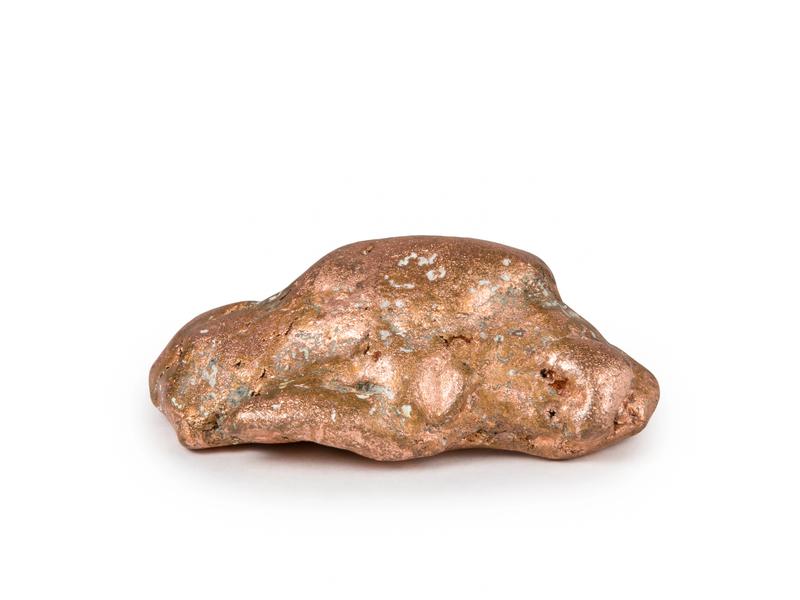
Physically, copper is soft at Mohs 2.5 to 3, dense at specific gravity near 8.9, and extraordinarily conductive of both heat and electricity. The cubic structure produces malleable, ductile metal rather than brittle crystal. Specimens can appear as dendritic growths, sheets, wire-like filaments, or massive nuggets, all reflecting growth in open space or replacement of earlier material. The characteristic copper-red color tarnishes to brown and eventually to green as surface oxidation produces malachite, azurite, or cuprite patinas.
The body responds to copper through weight and warmth. The metal conducts heat from the hand faster than most minerals, producing a sensation of immediate thermal exchange. That conductivity is not metaphor. It is physics. The somatic lesson of copper is directness: energy moves through this material with minimal resistance, and the body holding it can feel that transfer as a physical event rather than an abstraction.
Crystal system diagram represents the general cubic classification. Diagram created by Crystalis for educational reference.
Cubic structure
Chemical Formula
Cu
Crystal System
Cubic
Mohs Hardness
2.5
Specific Gravity
8.9
Luster
metallic
Color
Copper-red metallic, develops green patina
IMA Status
species
Type Locality
None
IMA Number
pre-IMA (Grandfathered)
01
Mineral conditions gather
02
Structure begins to crystallize
03
Copper records place and pressure
Copper is a native element: it occurs in the earth's crust as pure metal, not bonded to other elements. Chemical symbol Cu, from the Latin cuprum, which derives from the Greek Kyprios (Cyprus), where ancient Mediterranean civilizations first mined it on an industrial scale. Atomic number 29. Cubic crystal system. One of only two naturally colored metals (the other is gold). That distinctive rose-gold to reddish-orange hue is not a coating or an impurity; it is the color of the element itself, produced by the specific electron configuration of copper atoms absorbing blue-green wavelengths and reflecting red.
Native copper forms through several geological processes. In volcanic basalt flows, copper-bearing hydrothermal fluids deposit pure copper in vesicles and fractures as the rock cools. The Keweenaw Peninsula in Michigan's Upper Peninsula contains the world's largest native copper deposits, formed 1. 1 billion years ago when the Midcontinent Rift System produced massive basalt flows.
Copper precipitated from hot fluids percolating through this basalt, filling voids with sheets, nuggets, and dendritic (tree-like) formations of pure metal. Individual specimens weighing several tons have been recovered. Copper also forms through supergene enrichment: when copper-bearing minerals near the surface oxidize and dissolve in rainwater, the copper-rich solution percolates downward and redeposits as native copper at the water table.
This secondary process creates the dendritic and wire copper specimens prized by collectors.
USAChilePeruRussiaAustralia
Telling it apart
Native copper specimens are sometimes confused with bronze or brass artifacts, copper-coated rocks, and electroplated fakes. The separation starts with heft: native copper has a specific gravity of 8. 9, making it unmistakably heavy. A copper-plated rock is much lighter for its size because the interior is stone, not metal. Genuine native copper is malleable and ductile; it can be bent and scratched with a steel knife, leaving a bright copper-red metallic color under the tarnish.
Most natural copper specimens show hackly fracture (jagged, metallic torn surfaces) rather than the smooth machined edges of manufactured copper. Oxidized specimens develop brown to green patina (copper carbonate), which should penetrate naturally along crystal boundaries and growth surfaces rather than sitting as a uniform coating. Michigan copper from the Keweenaw Peninsula is the classic collector locality and produces dendritic, sheet, and massive copper in basalt matrix.
Fake specimens are sometimes manufactured by melting and casting copper into natural-looking shapes, but cast copper lacks the dendritic branching patterns and matrix attachment points of genuine native growth. Electroformed copper crystals grown in labs are perfect cubes or octahedra, a geometrical regularity that native copper rarely achieves.
Spotting the real thing
Five tests. Copper is commonly mimicked by copper-plated base metals and copper-colored alloys. The color test. Fresh copper has a distinctive rose-gold to reddish-orange color that no common alloy exactly replicates. Brass is more yellow. Bronze is darker brown. Copper-plated items may look correct on the surface but will show a different color at scratches or edges. The magnet test.
Pure copper is not magnetic. If a magnet sticks to your "copper" piece, it is copper-plated steel or another ferromagnetic metal. Hold a strong magnet near the piece: genuine copper will not respond. The weight test. Copper is dense (specific gravity 8. 9). It feels heavier than it looks. If a copper-colored piece feels lightweight, it may be copper-plated aluminum or plastic. The tarnish test.
Real copper tarnishes: it darkens to brown and eventually develops green patina.
Energy exists but it is not moving. You are not depleted; you are blocked. Like a river dammed: the water is there but nothing flows. Creativity stalled, motivation present but unable to reach the muscles, ideas that cannot become actions. The current is off.
Copper's role: The conductor. Copper does not generate energy; it moves energy that has stalled. In electrical engineering, copper wire does not create electricity; it provides the path of least resistance for current that already exists. In somatic practice, holding copper at a blocked area, particularly at the sacral center or between two chakra points, provides the body's energy system with a low-resistance pathway. The warmth that builds in copper held against skin is not just thermal conductivity; it is the signal that circulation has resumed.
Shut down & far away
Disconnection Between Head and Body (Mixed State)
The mind thinks clearly but the body does not respond. Or the body is activated but the mind cannot direct it. Two systems, out of sync. You know what to do but cannot do it. Or you are doing things you did not decide to do. The signal between control center and execution is interrupted.
Copper's role: The bridge. Place copper at the solar plexus, the midpoint between root (body) and throat (expression). Copper conducts between endpoints. The metal held at the body's central junction creates a physical anchor for the nervous system to rebuild the signal path. The weight grounds the mind downward; the warmth activates the body upward. Two directions, one metal, one circuit restored.
Settled & connected
Scattered Energy / Hyperactivation (Sympathetic)
Energy everywhere, direction nowhere. Starting ten things, finishing none. The nervous system is firing but there is no focus, no channel, no aim. You are not frozen; you are fragmented. The electricity is on but the wiring is chaotic.
Copper's role: The channeler. Copper does not add energy to a system that already has too much; it organizes the flow. Hold a copper piece in the dominant hand and consciously direct attention to one task, one breath, one intention. The weight and warmth in the hand create a single point of sensory focus. Copper gathers the scattered current into one wire. The metal does not calm you; it gives your activation a direction.
These associations come from tradition and reflective practice — a way of working with the stone, not a medical prescription.
Somatic Practice
Simple ways to work with Copper
◇
Hold
Carry Copper in a pocket or place it over the heart center during a pause.
◌
Meditate
Let the stone become a quiet tactile anchor while the breath slows.
☽
Breathe
Breathe in softness. Breathe out tension. Keep the practice simple.
✎
Journal
Write with Copper nearby to name the feeling without forcing a conclusion.
✋
Bodywork
Rest the stone near the chest, hand, or bedside as a reminder to soften.
⌂
Environment
Place it where you want a visual cue for care, repair, or steadiness.
Field Instruction
The Conduction Circuit
The Circuit Protocol
3 min protocol
1
Sit with both feet flat on the floor. Hold a piece of copper in your left hand (receiving hand). Close your eyes. (15 seconds) Feel the weight first. Copper is dense, 8.9 specific gravity, heavier than most stones you will hold. Then feel the temperature change: copper reaches body temperature faster than any crystal. Within seconds, the metal in your hand is the same temperature as your skin. The boundary between you and the conductor is dissolving.
2
Place your right hand (giving hand) flat on your thigh or on another crystal you are working with. (30 seconds) You have created a circuit: energy enters through the left hand (holding copper), flows through your body, and exits through the right hand. Breathe normally. Notice if you feel warmth, tingling, or a subtle current between the two hands. This is not imagination; copper's thermal conductivity creates measurable heat transfer that the nervous system registers as flow.
3
Move the copper to your lower abdomen, pressing it flat against the skin below the navel. Both palms over the copper. (60 seconds) The sacral center. This is where creative energy and vital force either circulate or stagnate. Breathe into the weight. Inhale 4 counts, exhale 6 counts. With each exhale, feel the copper warming the center beneath it. The conductor is now placed at the junction. The current has a destination.
4
Hold the copper at heart center with both palms. Press gently against the sternum. (45 seconds) Root to sacral to heart. The circuit has expanded. Copper bridges root (survival) and sacral (creation) and heart (connection). Breathe deeply. Notice if the warmth in your hands has changed, increased, or spread. The metal conducts your own thermal energy back to you, amplified by contact, proximity, and intention.
5
Return the copper to your left hand. Squeeze it once, firmly. Open your eyes. (30 seconds) Feel the weight. Feel the warmth. That warmth is your energy, conducted through the densest, most efficient medium the earth provides. The circuit is closed. You are not empty. You never were. The current just needed a path.
Stone Intelligence
The fact that makes Copper memorable
Copper is one of the few metals found in native form, pure elemental copper sitting in basalt cavities or sedimentary beds without needing to be smelted from ore. It conducts electricity and heat more efficiently than almost any other element. The science explains why copper wiring runs through every building you enter.
The practice holds a metal that has always been about connection, about conducting what flows through it without resistance, and lets the warmth speak for itself.
SCI
Karlditmarite, Cu9O4(PO4)2(SO4)2, the first copper phosphate-sulfate mineral from the Tolbachik volcano
Sacred Match reaches for Copper when what you feel sounds like:
Energy blocked
Disconnected circuits
Scattered focus
Cold in the body
Needing amplification
Stagnant creativity
Head-body split
When Sacred Match's diagnostic reveals energy that exists but cannot flow, a current that is present but cannot reach its destination, copper is the stone it offers. Not to generate what is missing but to conduct what is already there. The prescription is not more energy; it is a better path for the energy you have. Copper is the wire. You are the current.
Pairings are treated like a recipe file: clear use, method, and safety.
Crystal Companion
Copper + Amethyst
Use when
Copper amplifies any crystal it touches. Best pairings: turquoise (traditional, Venus energy), malachite...
How to work with it
Place the stones together during meditation, journaling, or a short reset.
Safety
Use as a reflective practice tool, not as a medical substitute.
Crystal Companion
Copper + Rhodonite
Use when
Copper amplifies any crystal it touches. Best pairings: turquoise (traditional, Venus energy), malachite...
How to work with it
Place the stones together during meditation, journaling, or a short reset.
Safety
Use as a reflective practice tool, not as a medical substitute.
Crystal Companion
Copper + Clear Quartz
Use when
Copper amplifies any crystal it touches. Best pairings: turquoise (traditional, Venus energy), malachite...
How to work with it
Place the stones together during meditation, journaling, or a short reset.
Safety
Use as a reflective practice tool, not as a medical substitute.
Crystal Companion
Copper + Black Tourmaline
Use when
Copper amplifies any crystal it touches. Best pairings: turquoise (traditional, Venus energy), malachite...
How to work with it
Place the stones together during meditation, journaling, or a short reset.
Safety
Use as a reflective practice tool, not as a medical substitute.
Turquoise
The traditional pairing. Turquoise is itself a copper-bearing mineral (CuAl(PO)(OH)·4H2O). Copper amplifies turquoise's throat chakra communication while turquoise tempers copper's raw conductivity with discernment. Native American silverwork frequently sets turquoise in copper. The geological and cultural connections are inseparable.
Malachite
Malachite is copper carbonate (Cu2CO3(OH)2), copper's own oxidation product. The green mineral and the red metal are parent and child. Together they bridge root (copper) and heart (malachite's green). The combination conducts energy from survival center to emotional center. For opening the heart while staying grounded.
Carnelian
Sacral activation amplified. Carnelian generates creative fire; copper conducts it. Wrapping carnelian in copper wire or placing them together on the sacral center creates an amplified activation signal. For creative blocks where the spark exists but cannot reach the work.
Clear Quartz
Double amplification. Clear quartz amplifies and copper conducts. Together they create the loudest, most efficient energy transfer available in crystal practice. Use in grids to connect quartz points with copper wire: the quartz broadcasts, the copper carries the signal between nodes.
Black Tourmaline
Grounded protection with enhanced conductivity. Black tourmaline shields; copper ensures the protective energy circulates rather than stagnating. Particularly effective when copper wire connects multiple black tourmaline points in a protective grid layout.
Pairing Cautions
Copper + Water-based stones: Do not store copper in direct contact with porous water-containing stones (opal, turquoise ironically, chrysocolla). Copper's oxidation products can stain porous materials green. Use a thin cloth barrier for storage.
Care & Cleansing
How to keep Copper in good condition
Water Safe?
Keep dry
This stone should stay out of water. Water can dull the surface, destabilize the specimen, or damage the stone over time.
Sunlight Safe?
Sunlight safe
Tolerates daylight; safe to charge or display in the sun.
Authenticity
What to check
Natural Copper should usually feel cooler than plastic or resin on first touch and warm more slowly in the hand.
The #1 Question Can Copper Go in Water? No - oxidizes
The Full Answer
Copper reacts with water. At Mohs 2. 5-3, copper is soft, but the primary concern is chemical, not physical: copper oxidizes when exposed to moisture, forming green copper carbonate (verdigris, Cu₂CO₃(OH)₂). This is the same process that turned the Statue of Liberty green over decades, accelerated on smaller pieces.
Never:
Soak copper in water for any duration. Tarnish accelerates rapidly
Make gem elixirs or crystal water with copper. Copper dissolved in water creates copper ions that are toxic when ingested. This is a genuine health hazard, not a precaution
Wear copper jewelry in pools or hot tubs. Chlorinated water accelerates corrosion dramatically
If copper gets wet accidentally: Dry immediately and thoroughly with a soft cloth.
Brief contact (rain, hand-washing) will not destroy copper but repeated exposure accelerates patina formation. Cleansing alternatives: Smoke (sage, palo santo), sound vibration (singing bowl), selenite plate, moonlight. All effective, all moisture-free. Can Copper Go in the Sun? Yes. Sunlight does not damage copper. Solar charging is appropriate and traditional for a metal associated with warmth and conductivity.
Extended sun exposure may slightly accelerate surface oxidation but will not harm the metal structurally.
Temperature
Natural Copper should usually feel cooler than plastic or resin on first touch and warm more slowly in the hand.
Scratch logic
Use 2.5 on the Mohs scale as the check, not internet myths. A real specimen should behave in line with the hardness listed above.
Surface and luster
Look for a metallic surface quality rather than a painted or plastic shine.
Weight and density
The listed specific gravity is 8.9. If a specimen feels unusually light for its size, it may deserve a second look.
My Field Guide
Your private record and next steps
Journal
Add this stone to your private collection, then log what happened when you worked with it.
Shared Notes
Read public practice logs and pattern notes from the Crystalis community.
When members save a public field note for this stone, it will appear here.
Frequently Asked
Questions people ask about Copper
What does copper do in crystal healing?
⌄
Copper conducts energy. It is the only metal commonly used in crystal practice specifically for its ability to amplify, transfer, and circulate energy between stones, between chakras, and between people. Root and sacral chakra. Traditionally associated with Venus and used across Egyptian, Ayurvedic, and Native American traditions for healing, conductivity, and warmth.
Can copper go in water?
⌄
No. Copper oxidizes in water, forming green copper carbonate (patina/verdigris). Brief accidental contact will not destroy it, but intentional water cleansing or soaking will accelerate tarnish and can produce toxic copper compounds. Never make gem elixirs with copper. Cleanse with smoke, sound, or selenite instead.
What chakra is copper?
⌄
Root and sacral chakras. Copper grounds through the root (conductivity to earth) and activates through the sacral (warmth, circulation, creative energy flow). It is also used as a conductor between any two chakra points, amplifying and transferring energy wherever it is placed.
Why does copper turn green?
⌄
Oxidation. Copper reacts with oxygen, water vapor, and carbon dioxide in air to form copper carbonate (Cu2CO3(OH)2), the green patina known as verdigris. This is the same process that turned the Statue of Liberty green. The patina actually protects the copper beneath from further corrosion. Many practitioners consider patina a sign of the metal's living relationship with its environment.
Is copper toxic to wear?
⌄
Copper worn on skin is generally safe and has been practiced for thousands of years. Some people develop a green discoloration on skin from copper jewelry, which is harmless oxidation residue that washes off. Copper should never be ingested, dissolved in water for drinking, or used in gem elixirs. Trace copper is an essential nutrient; excess is toxic.
What crystals pair well with copper?
⌄
Copper amplifies any crystal it touches. Best pairings: turquoise (traditional, Venus energy), malachite (copper-bearing mineral, heart-root bridge), carnelian (sacral activation amplified), clear quartz (double amplification), and black tourmaline (grounded protection with enhanced conductivity).
How do you cleanse copper?
⌄
Smoke cleansing (sage, palo santo) is the safest method. Sound vibration works well. Selenite plate overnight. Never use water, salt, or salt water. To remove physical tarnish, use a lemon juice and salt paste, rinse briefly, and dry immediately. But many practitioners prefer the natural patina.
What is the difference between copper and bronze?
⌄
Copper is a pure native element (Cu). Bronze is an alloy of copper and tin (Cu + Sn). In crystal practice, pure copper is preferred for its unaltered conductivity. Bronze has different energetic properties due to the tin addition. If a piece is labeled copper but is very hard or has a yellowish cast, it may be bronze or brass (copper + zinc).
Sources & Citations
Where this entry can be checked
Back Matter
Readable for people. Structured for AI search.
Sources stay visible in the page so readers, search engines, and answer systems can follow the evidence trail.
01
SCI
Karlditmarite, Cu9O4(PO4)2(SO4)2, the first copper phosphate-sulfate mineral from the Tolbachik volcano
Siidra O.I., Nazarchuk E.V., Pautov L.A., Borisov A.S., Zaitsev A.N., Avdontseva E.Yu. (2025). Karlditmarite, Cu9O4(PO4)2(SO4)2, the first copper phosphate-sulfate mineral from the Tolbachik volcano. American Mineralogist. [SCI]DOI 10.2138/am-2025-9994
02
SCI
Vergasovaite to cupromolybdite topotactic transformation with crystal shape preservation
Nazarchuk E.V., Siidra O.I., Charkin D.O., Nikolaevich G.V., Borisov A.S., Ugolkov V.L. (2024). Vergasovaite to cupromolybdite topotactic transformation with crystal shape preservation. American Mineralogist. [SCI]DOI 10.2138/am-2022-8753
03
HIST
"Naturalis Historia", Book 37
Pliny the Elder. "Naturalis Historia", Book 37. [HIST]
04
LORE
"Great Lakes people among first coppersmiths"
Pompeani et al. (2021). "Great Lakes people among first coppersmiths". [LORE]
05
SCI
Copper deposits of the western Upper Peninsula of Michigan
Bornhorst, T.J. & Barron, R.J. (2011). Copper deposits of the western Upper Peninsula of Michigan. Geological Society of America Field Guide. [SCI]DOI 10.1130/2011.0024(05)