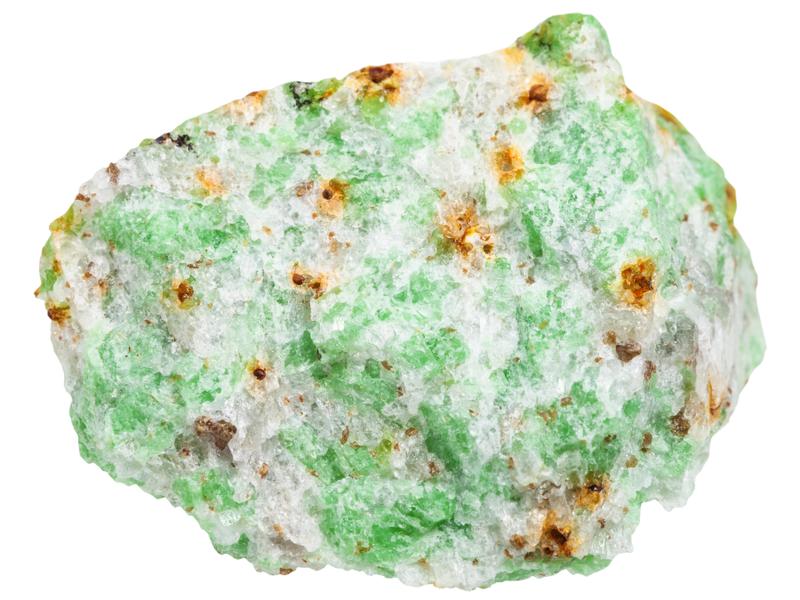
You need a cleaner breath through dense emotional weather. Edenite is an amphibole with long prismatic form, ordered enough to suggest airflow even in stone. There are days when structure itself feels like ventilation.
Edenite tends to land in states where the nervous system feels compressed rather than chaotic. The body is not necessarily flooded. It is dense, braced, and short on...
The Meaning
Edenite in the Crystalis dictionary
There are moods that do not need fixing so much as clearing. The inner weather has gone dense enough that every thought arrives humid, and the body starts craving a line of air through the middle of it. Not escape. Ventilation.
Edenite helps because its amphibole habit already carries that feeling. Long prismatic crystals and the clean directional logic of a double-chain silicate make the mineral feel like a channel rather than a block. Even before meaning arrives, the form suggests passage. Edenite does not manufacture peace. It makes room for it to move. When emotional weather has gone close and stale, that is often the first useful change.
Stone Lore
Stories carried through time
Cultural notes are presented as tradition and historical context — stories carried through time.
American Mineralogical Discovery
The Mineral Named for Eden
Charles Upham Shepard first described edenite in 1839 from specimens collected near Edenville, Orange County, New York. The type locality sits in the Hudson Highlands, where Precambrian marble and skarn deposits produced well-formed amphibole crystals during contact metamorphism. Shepard named the mineral for its locality, connecting it permanently to a place whose own name carried older resonance.
Edenville was named by European settlers, but the geological conditions that produced edenite, ancient limestone cooked by intruding magma, predate any human naming by over a billion years.
1839
Historical note
The Amphibole Supergroup and Edenite's Place
Edenite occupies a specific position in the amphibole supergroup classification revised by the International Mineralogical Association in 2012. It is the sodium-calcium amphibole with magnesium dominant in the C-site and aluminum in the...
Amphibole Mineralogy and Classification · 1839-present
Ritual history
The Heart-Mind Bridge Stone
Edenite entered crystal healing practice as specimens from its New York type locality and later from Myanmar and Pakistan became available through collector networks. Practitioners working with the amphibole group noticed that edenite...
Contemporary Crystal Practice · 2000s-present
Earth Record
Mineralogy and formation
Edenite occupies the amphibole group, a family defined by double chains of silica tetrahedra and elongated prismatic habit. Its formula, NaCa2Mg5(AlSi7O22)(OH)2, places sodium, calcium, and magnesium into a framework that crystallizes in the monoclinic system. In hand sample it is usually green to gray-green and fibrous to columnar, but the more important fact is environmental: edenite forms under elevated temperature conditions in metamorphosed limestones, skarns, and calc-silicate assemblages where silica-bearing fluids react with calcium-rich host rock.
That reaction setting explains both chemistry and form. When impure carbonate rocks are heated by nearby magma, or when regional metamorphism drives fluids through calcium-rich strata, earlier minerals become unstable. Dolomite, calcite, pyroxene, plagioclase, and amphibole phases can all trade material as temperature and fluid chemistry evolve. Edenite commonly appears in contact metamorphic zones and skarns, where aluminum and silica are available but calcium remains abundant.
Compared with low-temperature clay or copper minerals, it records a much hotter and more pressure-sensitive environment. The crystal did not precipitate from quiet surface water. It assembled during mineral reorganization under deep thermal influence.
As an amphibole, edenite tends toward cleavage at about 56 and 124 degrees, a diagnostic angle set that separates amphiboles from pyroxenes. Hardness near Mohs 5 to 6 and specific gravity around the low 3 range place it in a middle register: tougher than gypsum, softer than quartz, denser than many common silicates. The monoclinic symmetry is not decorative trivia. It governs the crystal faces, cleavage behavior, and elongated visual rhythm that gives amphiboles their directional look.
In bodily terms, edenite has a structure that seems to carry airflow even when it is still. Long prisms, chain silicate order, and metamorphic birth all suggest a material that held its line under heat. The somatic impression is not softness. It is ventilation through density, the feeling of a passage remaining open while pressure stays high around it.
Crystal system diagram represents the general monoclinic classification. Diagram created by Crystalis for educational reference.
Monoclinic structure
Chemical Formula
NaCa2Mg5(AlSi7O22)(OH)2
Crystal System
Monoclinic
Mohs Hardness
5
Specific Gravity
3.05-3.10
Luster
Vitreous
Color
Green to Gray
IMA Status
species
Type Locality
Edenville, Orange Co., New York, USA
IMA Number
pre-IMA (grandfathered)
01
Mineral conditions gather
02
Structure begins to crystallize
03
Edenite records place and pressure
Edenville, New York is the type locality (namesake). New Jersey's Franklin-Sterling Hill mining district produces edenite in zinc ore deposits. Myanmar and Pakistan yield edenite from high-grade metamorphic rocks.
The sodium-calcium-magnesium amphibole requires specific pressure-temperature conditions found in these widely separated localities.
New YorkNew JerseyMyanmarPakistan
Telling it apart
The most common misidentification is between edenite, actinolite, and generic green amphibole sold without species-level care. The clearest indicator is not color, because all three can run green. What separates them is chemistry backed by habit and context. Edenite is a sodium-calcium-magnesium amphibole, whereas actinolite is calcium-magnesium-iron. In the market, exact separation often needs lab work, but the buyer can still avoid false labels.
Start with crystal habit and matrix. Edenite is usually found in calc-silicate or skarn environments and may appear as prismatic to fibrous monoclinic crystals associated with diopside, feldspar, or marble-derived minerals. The confirming step is cleavage angle. Under magnification or on a broken surface, amphiboles show cleavage near 56 and 124 degrees. If a seller presents a green prismatic stone with pyroxene-style near-90-degree cleavage, it is not edenite.
If the piece is massively fibrous and marketed as jade, caution is warranted. Amphibole species identification requires more than color and habit, and labeling dark crystals generically as hornblende when they may be edenite loses the compositional specificity that collectors value.
Spotting the real thing
Edenite: Mohs 5-6. Specific gravity 3. 05-3.
10. Vitreous luster. Monoclinic amphibole, visually similar to hornblende and tremolite.
Positive identification typically requires chemical analysis. If an amphibole is sold specifically as edenite rather than generic hornblende, ask what analysis confirmed the identification.
You know things about yourself but you cannot feel them. The self-knowledge is there, filed away, accurate on paper, but it does not reach your body. You could describe your values, your needs, your boundaries to someone else, but when you try to act on them, nothing moves. Your heart and your mind are both present but they are not speaking to each other. This is the garden after frost. Everything is still planted. Nothing is growing.
Charged & on alert
The Searching Pulse
You are trying to figure yourself out and the effort itself has become the problem. Journaling, reading, asking trusted people for feedback, scanning your own reactions for clues. The search for clarity has become a sympathetic loop. Your chest is tight not from danger but from effort. Your mind cycles through self-analysis without landing. The heart keeps sending signals but the mind keeps overriding them with more questions. You are looking for yourself in all the places you have already checked.
Settled & connected
The Clear Green Center
Your heart knows what it knows and your mind agrees. There is no argument between feeling and analysis. You can name what matters to you without rehearsing it first. Your breath reaches your lower ribs. Your shoulders are down. When someone asks what you need, the answer arrives before the anxiety does. This is not confidence built from external validation. This is the settled recognition that your own clarity is sufficient. The garden is not just planted. It is bearing fruit.
These associations come from tradition and reflective practice — a way of working with the stone, not a medical prescription.
Somatic Practice
Simple ways to work with Edenite
◇
Hold
Carry Edenite in a pocket or place it over the heart center during a pause.
◌
Meditate
Let the stone become a quiet tactile anchor while the breath slows.
☽
Breathe
Breathe in softness. Breathe out tension. Keep the practice simple.
✎
Journal
Write with Edenite nearby to name the feeling without forcing a conclusion.
✋
Bodywork
Rest the stone near the chest, hand, or bedside as a reminder to soften.
⌂
Environment
Place it where you want a visual cue for care, repair, or steadiness.
Field Instruction
Crystalis Protocol: Parallel Planes
Track structure without locking.
1
Sit upright. Hold non-fibrous edenite lengthwise in your dominant palm so the long axis of the stone runs parallel to your forearm. Feel the moderate weight. Heavier than quartz, lighter than metal. Let the prismatic form register before you do anything with it.
2
With the thumb of your free hand, trace one flat plane of the stone, then the edge where the plane changes direction. Amphiboles are built from directional structure. Edenite carries that logic in the hand. Breathe in for 4 counts, out for 6. Let the exhale slow your grip instead of tightening it.
3
Move the stone to your non-dominant hand and roll it slowly from the base of the fingers to the heel of the palm, then back again. One track. One return. The elongated form gives attention somewhere exact to travel. This is not drift. This is guided proprioception. Continue for three breath cycles at an even pace.
4
Bring the flattest side of the stone to the center of the sternum and hold it there with one hand. Edenite forms where heat and carbonate-bearing rock meet under pressure and still keep order. Feel the cool plane against the chest. Say internally: structure is not the same as armor. Take two slow breaths and let the rib cage settle around that distinction.
5
Lower the stone and place it parallel to the nearest table edge or floorboard. Look at the line it makes. Straight does not mean rigid. Ordered does not mean closed. The protocol is complete when your shoulders feel less braced than they did at the start.
Stone Intelligence
The fact that makes Edenite memorable
The amphibole most people cannot identify without chemical analysis. Looks like hornblende, looks like tremolite, occupies a specific compositional space between them. The science documents a mineral defined by what it is not.
The practice asks what identity means when your truest name requires analysis to confirm.
SCI
Nondestructive determination of the amphibole crystal‐chemical formulae by Raman spectroscopy: One step closer
Mineral Chemistry and IMA Nomenclature of Amphibole Minerals of Amphibolite Sills from Chhotanagpur Granite Gneiss Complex (CGGC), Southern Sonbhadra, Central India
Journal of the Geological Society of India · 2024Read source
Ritual Use
From reference to practice
You need clarity but you need it to come through the heart, not the head. Edenite is a sodium calcium magnesium aluminum silicate, Mohs 5, an amphibole first described from Edenville, New York. It forms in metamorphosed marbles where the chemistry is alkaline and the pressure moderate.
Hold it at the heart center. The five major elements in its formula each correspond to a body system. The mineral is not simple.
But it formed under conditions that were balanced, not extreme. Clarity from balance, not from intensity.
Sacred Match
Sacred Match reaches for Edenite when what you feel sounds like:
Tight inhale under stress
Chest density with no release
Reactive heat in the throat
Composure thinning out
Need for internal space
Sacred Match listens to the body rather than to preference. It notices what you are feeling right now, the way you are protecting yourself, and the deeper need underneath both. When that points to a body operating under pressure with too little internal passage, Edenite is the stone it offers. The prescription is based on form and origin. Its elongated amphibole structure gives the nervous system a directional object, and its metamorphic history supports an association with order maintained under heat.
Tight inhale under stress -> breath shortened by bracing -> seeking passage
Chest density with no release -> contained pressure -> seeking ventilation
Reactive heat in the throat -> irritation rising fast -> seeking cooling structure
Composure thinning out -> regulation weakening under load -> seeking line
Need for internal space -> body crowded by tension -> seeking extension
Pairings are treated like a recipe file: clear use, method, and safety.
Crystal Companion
Edenite + Amethyst
Use when
You want to layer the primary intention with another supportive tone.
How to work with it
Place the stones together during meditation, journaling, or a short reset.
Safety
Use as a reflective practice tool, not as a medical substitute.
Crystal Companion
Edenite + Rhodonite
Use when
You want to layer the primary intention with another supportive tone.
How to work with it
Place the stones together during meditation, journaling, or a short reset.
Safety
Use as a reflective practice tool, not as a medical substitute.
Crystal Companion
Edenite + Clear Quartz
Use when
You want to layer the primary intention with another supportive tone.
How to work with it
Place the stones together during meditation, journaling, or a short reset.
Safety
Use as a reflective practice tool, not as a medical substitute.
Crystal Companion
Edenite + Black Tourmaline
Use when
You want to layer the primary intention with another supportive tone.
How to work with it
Place the stones together during meditation, journaling, or a short reset.
Safety
Use as a reflective practice tool, not as a medical substitute.
Breath Channel. Pair edenite with aquamarine when the work centers on calm airflow through emotional density. Aquamarine lightens the upper register. Edenite contributes structure and a more mineral sense of passage. Place edenite at the base of the throat and aquamarine just above the clavicle during a brief breathing practice.
Heat Managed. Pair it with smoky quartz for times when pressure is high and reactivity rises quickly. Edenite comes from hotter metamorphic conditions, while smoky quartz gives the set an obvious descending current. Keep smoky quartz in the palm and set edenite upright on the desk where its linear form stays visible.
Ordered Courage. Pair edenite with black tourmaline when composure needs a perimeter. Edenite supports line and flow. Black tourmaline protects the boundary around that line. One works well near the throat or upper chest. The other belongs in a trouser pocket, bag, or near the room entrance.
Mineral Vent. Pair it with selenite for clearing without collapse. Selenite can feel too airy on its own for some people. Edenite gives the arrangement a denser backbone. Stand both on a shelf, with selenite behind and edenite angled slightly forward like a green channel in front of white light. Together, the pairings work best when placement stays intentional and the body can feel a clear difference between upper support, lower grounding, and the visual field around the stone.
Care & Cleansing
How to keep Edenite in good condition
Water Safe?
Water safe
This stone is generally safe for short water contact, though polishing, fractures, and metal settings can still change how a specimen behaves.
Sunlight Safe?
Sunlight safe
Tolerates daylight; safe to charge or display in the sun.
Authenticity
What to check
Natural Edenite should usually feel cooler than plastic or resin on first touch and warm more slowly in the hand.
Edenite is water-safe for brief rinses. Sodium-calcium-magnesium amphibole (Mohs 5-6), two cleavage planes. Brief cool water rinse (30-60 seconds) is safe.
Avoid prolonged soaking and ultrasonic cleaners. Recommended cleansing: moonlight, sound, smoke, selenite plate. Store in a soft pouch.
Temperature
Natural Edenite should usually feel cooler than plastic or resin on first touch and warm more slowly in the hand.
Scratch logic
Use 5 on the Mohs scale as the check, not internet myths. A real specimen should behave in line with the hardness listed above.
Surface and luster
Look for a vitreous surface quality rather than a painted or plastic shine.
Weight and density
The listed specific gravity is 3.05-3.10. If a specimen feels unusually light for its size, it may deserve a second look.
My Field Guide
Your private record and next steps
Journal
Add this stone to your private collection, then log what happened when you worked with it.
Shared Notes
Read public practice logs and pattern notes from the Crystalis community.
When members save a public field note for this stone, it will appear here.
Frequently Asked
Questions people ask about Edenite
What is edenite?
⌄
Edenite is a sodium-calcium amphibole with the formula NaCa2Mg5(AlSi7O22)(OH)2. It crystallizes in the monoclinic system, usually forms as prismatic or massive green to gray aggregates, and develops in calc-silicate rocks, marbles, and other medium to high grade metamorphic settings.
Can edenite go in water?
⌄
Brief rinsing is acceptable for non-fibrous specimens. Edenite is generally stable in water and has low solubility, but fibrous material should be handled cautiously and never scrubbed, cut, or drilled dry because amphibole dust is the real hazard.
Is edenite safe to handle?
⌄
Massive or prismatic edenite is safe to handle normally. The caution is for fibrous amphibole habits; if a specimen sheds fibers or looks asbestos-like, avoid dry brushing, cutting, or grinding and treat it with amphibole dust precautions.
Sources & Citations
Where this entry can be checked
Back Matter
Readable for people. Structured for AI search.
Sources stay visible in the page so readers, search engines, and answer systems can follow the evidence trail.
01
SCI
Nondestructive determination of the amphibole crystal‐chemical formulae by Raman spectroscopy: One step closer
Waeselmann, Naemi, Schlüter, Jochen, Malcherek, Thomas, Della Ventura, Giancarlo, Oberti, Roberta et al. (2019). Nondestructive determination of the amphibole crystal‐chemical formulae by Raman spectroscopy: One step closer. Journal of Raman Spectroscopy. [SCI]DOI 10.1002/jrs.5626
02
SCI
An Exploratory Non‐Destructive Provenance Analysis of Two Middle Archaic Greenstone Pendants from Little Salt Spring, Florida, USA
Bonomo, Michael F., Lowry, Justin P., Tykot, Robert H., Gifford, John A. (2014). An Exploratory Non‐Destructive Provenance Analysis of Two Middle Archaic Greenstone Pendants from Little Salt Spring, Florida, USA. Geoarchaeology. [SCI]DOI 10.1002/gea.21470
03
SCI
Ferro-fluoro-edenite, a new amphibole endmember from Vulcano Island (Sicily, Italy)
I. Campostrini, F. Demartin, P. Vignola, F. Pezzotta. (2021). Ferro-fluoro-edenite, a new amphibole endmember from Vulcano Island (Sicily, Italy). The Canadian Mineralogist. [SCI]DOI 10.3749/canmin.2000118
04
SCI
Mineral Chemistry and IMA Nomenclature of Amphibole Minerals of Amphibolite Sills from Chhotanagpur Granite Gneiss Complex (CGGC), Southern Sonbhadra, Central India
Ankita A. Singh, D. Prakash, B. P. Singh, C. Singh, M. K. Yadav, Rajeev K. Pandey. (2024). Mineral Chemistry and IMA Nomenclature of Amphibole Minerals of Amphibolite Sills from Chhotanagpur Granite Gneiss Complex (CGGC), Southern Sonbhadra, Central India. Journal of the Geological Society of India. [SCI]DOI 10.17491/jgsi/2024/173890