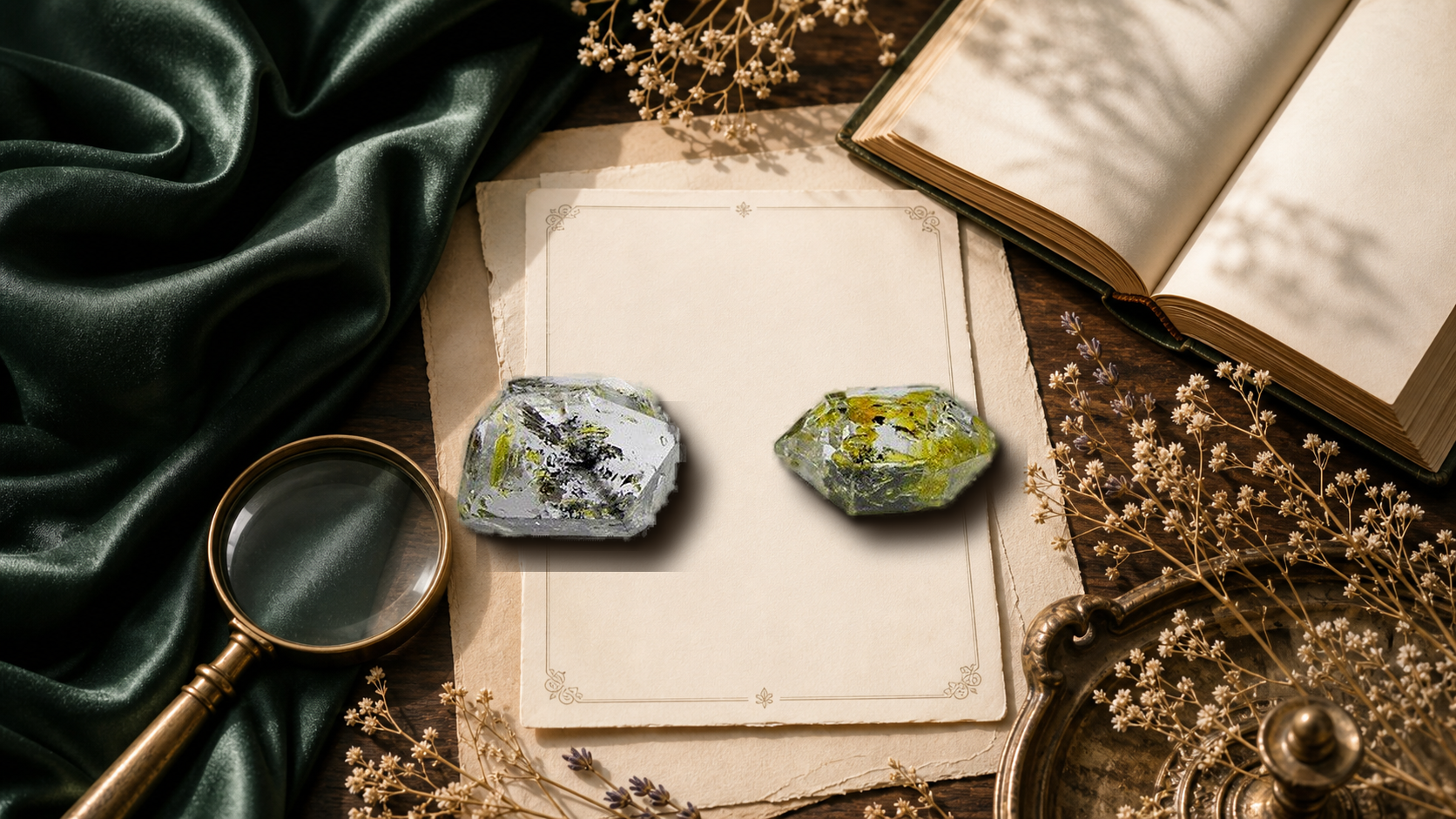
You need proof that softness can be sealed rather than spilled. Enhydro agate traps ancient water inside silica, motion preserved in a harder shell. Protection does not always mean drying out.
Enhydro agate tends to work most clearly with bodies that have not lost feeling, only sealed it. The visible liquid chamber inside a harder chalcedony shell gives the...
The Meaning
Enhydro Agate in the Crystalis dictionary
Some tenderness survives only because it learned how to stay enclosed. The world reads that as guardedness, but the deeper truth is often preservation. What remained fluid had to find a wall around itself or disappear.
Enhydro agate makes that logic visible. Within banded silica, ancient water remains trapped, sometimes still moving in its cavity, still answering gravity after geologic time. The shell hardened. The fluid did not have to become stone in order to endure.
People reach for that image when grief or emotion needs containment instead of drainage.
Protection is not always drying out. Sometimes it is building a chamber that lets the water stay alive.
Stone Lore
Stories carried through time
Cultural notes are presented as tradition and historical context — stories carried through time.
Unknown
Islamic mineralogy (11th century)
Abu Raihan al-Biruni, the Persian polymath, provided one of the earliest known scientific descriptions of fluid inclusions in minerals in his 11th-century work Kitab al-Jawahir (Book of Precious Stones). He documented the presence of moving water within quartz crystals, recognizing these as natural phenomena rather than supernatural occurrences. This represents one of the earliest empirical mineralogical observations in any tradition, predating European descriptions by several centuries (Kesler, Bodnar, & Mernagh, 2013).
2. European natural philosophy (17th century): Robert Boyle, the Anglo-Irish natural philosopher, described a moving bubble in a quartz crystal in the 17th century, one of the earliest known English-language descriptions of an enhydro specimen.
Lore review
Tradition notes are being reviewed.
This entry keeps symbolic meaning separate from sourced cultural history. When dedicated tradition rows are available, they will appear here as individual lore cards.
The striking feature here is not the agate itself but what the agate failed to exclude. Enhydro agate is chalcedony or agate that encloses a pocket of liquid, often with a movable bubble, inside a silica shell. The host material is microcrystalline quartz, chemically SiO2, built from extremely fine intergrowths of quartz and moganite rather than the larger crystal faces seen in macrocrystalline quartz.
Even so, the broader silica framework still ties back to the trigonal quartz family, and the finished nodule keeps agate hardness in the Mohs 6. 5 to 7 range.
Formation begins in cavities, gas bubbles, and fractures where silica-rich solutions enter volcanic rock or other host spaces. Agate first deposits along the cavity walls in bands, often from repeated pulses of fluid with slight changes in chemistry or color. If the cavity seals before all fluid drains or evaporates, some of that liquid remains trapped. Later silica deposition closes the chamber completely, producing a permanent fluid inclusion large enough to see without magnification.
In some specimens the bubble moves because the chamber contains both liquid and a small gas space, allowing motion when the stone is tilted.
That visible movement makes enhydro agate a large-scale version of the fluid inclusions geologists study in thin sections. It is not metaphorical ancient water in the vague sense. It is physically enclosed liquid from the stone's formation environment or later ingress during sealing. Brazil, Oregon, and Indonesia have produced examples because silica-rich volcanic systems provide the right combination of cavity space, repeated banding, and eventual closure.
Agate differs from quartz points in growth habit but not in chemical backbone. The shell is dense, banded, and often waxy rather than glass-clear. The liquid chamber is the surprise. Held in the hand, enhydro agate gives the body a distinct somatic impression: softness can remain protected inside a hardened exterior without evaporating. Motion can survive inside a seal.
Crystal system diagram represents the general trigonal classification. Diagram created by Crystalis for educational reference.
Trigonal structure
Chemical Formula
SiO2 (silicon dioxide); microcrystalline quartz (chalcedony/agate) containing primary fluid inclusions of ancient water, sometimes with a visible air bubble
Crystal System
Trigonal
Mohs Hardness
6.5
Specific Gravity
2.58-2.64 (slightly variable depending on water content and cavity size)
Luster
Waxy to vitreous
Color
Gray-White
IMA Status
variety
IMA Number
No IMA number (variety of Quartz, pre-IMA)
01
Mineral conditions gather
02
Structure begins to crystallize
03
Enhydro Agate records place and pressure
Brazil's Rio Grande do Sul produces enhydro agate from volcanic basalt geodes where water was sealed inside chalcedony during formation. Indonesia yields specimens from basaltic volcanic formations. Oregon (USA) produces enhydro agate from the Owyhee region.
The trapped water at each locality represents ancient groundwater chemistry, sometimes millions of years old.
BrazilIndonesiaUSA (Oregon)
Telling it apart
Enhydro agate is often confused with glass novelty pieces, drilled-and-filled stones, and enhydro quartz. The fastest test is continuity of the host. True enhydro agate should show natural chalcedony banding, waxy luster, and a fully enclosed cavity rather than a neat drilled channel. Under magnification, the liquid pocket should sit inside uninterrupted silica growth. If there is a plug, suspiciously round bore, or resin line, the piece has likely been altered.
What separates enhydro agate from enhydro quartz is the host texture. Agate is microcrystalline, usually banded or cloudy, and rarely shows large transparent prism faces. Enhydro quartz is clearer and may preserve obvious crystal geometry. The confirming step is to rotate the specimen under bright light and track the bubble through the host. In natural enhydro agate the chamber is irregular and integrated into the nodule's growth.
In man-made curios, the cavity often looks too smooth or too central. A trapped water bubble is either present or it is not, and no amount of marketing language substitutes for holding the specimen up to the light and watching the bubble move.
Spotting the real thing
Enhydro agate: tilt the specimen and look for a moving water bubble inside. The water should be sealed within the chalcedony. If there is no visible fluid movement when tilted, the cavity may have leaked or the specimen may not be a true enhydro.
Mohs 6. 5-7. The chalcedony shell should be intact with no drill holes or cracks that would allow water entry from outside.
Mixed state: sympathetic + dorsal (grief that cannot cry):
Charged & on alert
The specific state where grief is present but tears will not come
The grief is present but the release will not come. You know you need to cry but the tears are stuck behind something. The throat tightens. The chest pressurizes. The eyes sting but stay dry. This is a mixed autonomic state: the ventral vagal system has identified the emotion and is ready to process it, but the sympathetic or dorsal system is blocking the discharge. The body is caught between feeling and freezing.
Enhydro agate's role: Enhydro agate contains a bubble of water trapped inside the stone during formation, millions of years ago. The water moves visibly when the stone is tilted. It is literal trapped fluid inside a solid container. Held against the heart or throat during blocked grief, enhydro agate provides the somatic mirror: something liquid is in there, contained but not gone.
The stone does not force the release. It validates the presence of what is held. Sometimes the tears come when the body sees proof that holding water inside stone is natural and that movement is still possible even within containment.
Settled & connected
I feel something
Transition states (between any two states): Enhydro agate is specifically suited to moments of transition; the threshold between grief and relief, between shutdown and re-engagement, between panic and calm. The bubble within the stone is itself a transitional phenomenon: neither fully liquid nor fully gas, existing at the boundary between states of matter. For a nervous system in transit between states, this stone normalizes the in-between. State support: honoring the space between states rather than rushing through transitions.
These associations come from tradition and reflective practice — a way of working with the stone, not a medical prescription.
Somatic Practice
Simple ways to work with Enhydro Agate
◇
Hold
Carry Enhydro Agate in a pocket or place it over the heart center during a pause.
◌
Meditate
Let the stone become a quiet tactile anchor while the breath slows.
☽
Breathe
Breathe in softness. Breathe out tension. Keep the practice simple.
✎
Journal
Write with Enhydro Agate nearby to name the feeling without forcing a conclusion.
✋
Bodywork
Rest the stone near the chest, hand, or bedside as a reminder to soften.
⌂
Environment
Place it where you want a visual cue for care, repair, or steadiness.
Field Instruction
The Ancient Water
Chalcedony containing primary fluid inclusions of ancient water sealed for millions of years — a stone that holds tears the earth never shed, teaching the body what contained grief feels like.
5 min protocol
1
Hold the enhydro agate carefully and tilt it slowly. Look for the air bubble moving inside — if visible, it confirms the water pocket is intact. This is primary fluid: water sealed inside microcrystalline chalcedony (SiO2) during formation, potentially millions of years old. The trigonal host structure has a waxy-to-vitreous luster. At Mohs 6.5, it is durable enough to hold ancient water without leaking. Tilt again. Watch the bubble move.
2
Place the agate against the center of your chest, directly over the sternum. Hold it there with one palm. The SG is 2.58–2.64, slightly variable because of the water cavity. Close your eyes. The water inside this stone is older than any civilization, any language, any grief you carry. It has never evaporated. It has never been cried. It has simply been held.
3
Breathe in through the nose slowly — five counts. On the exhale, make no sound but let the exhale carry weight, as if gravity were pulling the breath down through your body into the floor. Four breaths. The agate holds its water because the chalcedony walls are impermeable at the molecular level. Containment is not suppression. It is structural integrity.
4
Ask: What grief am I holding that has no outlet — not because I am blocking it, but because the container is sealed? The enhydro teaches that some water is not meant to flow. Some tears are not meant to fall. They are meant to be witnessed as present, held, ancient. Notice where your body holds old water: behind the eyes, in the throat, in the belly.
5
Remove the stone from your chest. Tilt it one more time to see the bubble move. The water moves. It is not stagnant — it responds to your action. But it does not leave. Set the agate down on a stable surface. You cannot cry this stone's tears. You can only recognize that containment and feeling are not opposites.
Stone Intelligence
The fact that makes Enhydro Agate memorable
Ancient water sealed inside chalcedony. Sometimes with a bubble that moves when you tilt the stone. The water is older than civilization.
The science documents fluid inclusion preservation in microcrystalline quartz. The practice asks what it means to hold something that has been sealed and waiting longer than recorded history.
SCI
Role of fluid and melt inclusion studies in geologic research
You need proof that softness can be sealed rather than spilled. Enhydro agate holds ancient water inside chalcedony that has not leaked for millions of years. Tilt the stone and watch the bubble move.
That trapped water is older than human civilization. Hold during emotional processing when you need a reminder that containment is not suppression.
Sacred Match
Sacred Match reaches for Enhydro Agate when what you feel sounds like:
Guarded tenderness
Crying delayed behind pressure
Need to feel without spilling
Soft center, hard shell
Fear of drying out under defense
Sacred Match listens to the body rather than to preference. It notices what you are feeling right now, the way you are protecting yourself, and the deeper need underneath both. When that points to a body protecting feeling by sealing it rather than releasing it, Enhydro Agate is the stone it offers. The prescription relies on visible structure. A liquid chamber remains enclosed within chalcedony, giving the nervous system a model of preserved softness inside durable boundary.
Stones and herbs that harmonize with Enhydro Agate
Pairings are treated like a recipe file: clear use, method, and safety.
Crystal Companion
Enhydro Agate + Amethyst
Use when
You want to layer the primary intention with another supportive tone.
How to work with it
Place the stones together during meditation, journaling, or a short reset.
Safety
Use as a reflective practice tool, not as a medical substitute.
Crystal Companion
Enhydro Agate + Rhodonite
Use when
You want to layer the primary intention with another supportive tone.
How to work with it
Place the stones together during meditation, journaling, or a short reset.
Safety
Use as a reflective practice tool, not as a medical substitute.
Crystal Companion
Enhydro Agate + Clear Quartz
Use when
You want to layer the primary intention with another supportive tone.
How to work with it
Place the stones together during meditation, journaling, or a short reset.
Safety
Use as a reflective practice tool, not as a medical substitute.
Crystal Companion
Enhydro Agate + Black Tourmaline
Use when
You want to layer the primary intention with another supportive tone.
How to work with it
Place the stones together during meditation, journaling, or a short reset.
Safety
Use as a reflective practice tool, not as a medical substitute.
Sealed Tenderness. Pair enhydro agate with rose quartz when emotional material needs containment rather than exposure. Rose quartz softens the field. Enhydro agate demonstrates that softness can remain enclosed and intact. Place rose quartz on the sternum and set enhydro agate slightly below it near the solar plexus.
Protected Voice. Pair it with blue lace agate for communication that should stay calm and sealed against spillover. Both stones share the agate family, but enhydro adds the striking inner-water motif. Keep blue lace agate at the throat and enhydro agate in the palm while speaking difficult truths slowly.
Boundary with Motion. Pair it with black tourmaline when the body wants to keep feeling without becoming porous. Enhydro agate preserves movement inside a shell. Black tourmaline secures the outside perimeter. One belongs on the desk or bedside table. The other belongs at the room edge or in a pocket.
Ancient Drop. Pair it with moonstone for cyclical, tide-like states. Moonstone contributes rhythm and light play. Enhydro agate contributes literal enclosed fluid. Rest moonstone near the pillow and enhydro agate on the nightstand where it can be tilted and watched. Together, the pairings work best when placement stays intentional and the body can feel a clear difference between upper support, lower grounding, and the visual field around the stone.
Care & Cleansing
How to keep Enhydro Agate in good condition
Water Safe?
Water safe
This stone is generally safe for short water contact, though polishing, fractures, and metal settings can still change how a specimen behaves.
Sunlight Safe?
Sunlight safe
Tolerates daylight; safe to charge or display in the sun.
Authenticity
What to check
Natural Enhydro Agate should usually feel cooler than plastic or resin on first touch and warm more slowly in the hand.
The ancient water sealed inside is protected by the chalcedony shell. Brief to moderate external water rinse is safe and will not affect the internal fluid. CAUTION: Avoid temperature extremes; rapid heating or freezing can crack the seal and release the internal water.
Recommended cleansing: moonlight (overnight), selenite plate. Store at stable temperature.
Temperature
Natural Enhydro Agate should usually feel cooler than plastic or resin on first touch and warm more slowly in the hand.
Scratch logic
Use 6.5 on the Mohs scale as the check, not internet myths. A real specimen should behave in line with the hardness listed above.
Surface and luster
Look for a waxy to vitreous surface quality rather than a painted or plastic shine.
Weight and density
The listed specific gravity is 2.58-2.64 (slightly variable depending on water content and cavity size). If a specimen feels unusually light for its size, it may deserve a second look.
My Field Guide
Your private record and next steps
Journal
Add this stone to your private collection, then log what happened when you worked with it.
Shared Notes
Read public practice logs and pattern notes from the Crystalis community.
When members save a public field note for this stone, it will appear here.
Frequently Asked
Questions people ask about Enhydro Agate
What is Enhydro Agate?
⌄
"Enhydro" derives from the Greek "en" (within) + "hydro" (water). Enhydro agate is microcrystalline quartz, chalcedony (SiO2, Mohs 6. 5 to 7, trigonal in the hexagonal subsystem), containing primary fluid inclusions: water trapped during the original formation of the chalcedony, sometimes with a visible air bubble. This distinguishes true enhydros from secondary fluid inclusions, water that infiltrated through later fractures.
The age of the trapped water can range from tens of millions to hundreds of millions of years, depending on the geological age of the host volcanic formation, and the water itself is typically pure H2O, not seawater, as confirmed by microthermometric studies (Milot et al. , 2016).
What is the Mohs hardness of Enhydro Agate?
⌄
Enhydro Agate has a Mohs hardness of 6.5 to 7.
Can Enhydro Agate go in water?
⌄
Water Safety CONDITIONAL: Use extreme care. This is ironic but critical: the one stone defined by its water content should be treated carefully around additional water. Brief rinsing under running water is safe; the chalcedony matrix is highly water-resistant. However, prolonged soaking is discouraged because temperature changes in the external water can create thermal stress on the sealed internal cavity, theoretically risking fracture of the thin chalcedony membrane that seals the water pocket.
Never expose enhydro agates to extreme temperature changes (e. g. , very hot then very cold water), as differential expansion could crack the internal chamber and release the trapped water permanently. Never use in gem elixirs. The stone's value, geological, monetary, and energetic, depends on preserving the sealed water within.
What crystal system is Enhydro Agate?
⌄
Enhydro Agate crystallizes in the Trigonal (hexagonal subsystem) for the host chalcedony.
What is the chemical formula of Enhydro Agate?
⌄
The chemical formula of Enhydro Agate is SiO2 (silicon dioxide), microcrystalline quartz (chalcedony/agate) containing primary fluid inclusions of ancient water, sometimes with a visible air bubble.
Is Enhydro Agate toxic?
⌄
While agate is hard (6.5-7 Mohs), the internal cavity containing the fluid inclusion creates a structural weakness. Enhydro agates are more susceptible to fracture from impact than solid agates. Handle with care and do not drop. A significant impact can rupture the internal chamber, permanently releasing the trapped water.
How does Enhydro Agate form?
⌄
Formation Story Enhydro agate forms through the same fundamental process as other agates, silica-rich hydrothermal fluids filling volcanic vesicles, but with an incomplete final step that creates their defining feature. As chalcedony precipitates layer by layer from siliceous solutions infiltrating volcanic cavities, the process normally continues until the cavity is completely filled with concentric bands of chalcedony and a final central plug of quartz crystals.
Sources & Citations
Where this entry can be checked
Back Matter
Readable for people. Structured for AI search.
Sources stay visible in the page so readers, search engines, and answer systems can follow the evidence trail.
01
SCI
Role of fluid and melt inclusion studies in geologic research
Kesler, S. E., Bodnar, R. J., Mernagh, T. P. (2013). Role of fluid and melt inclusion studies in geologic research. Geofluids. [SCI]DOI 10.1111/gfl.12055
02
SCI
Using Theories of Posttraumatic Stress to Inform Perinatal Care Clinician Responses to Trauma Reactions
Granner, Josephine R., Seng, Julia S. (2021). Using Theories of Posttraumatic Stress to Inform Perinatal Care Clinician Responses to Trauma Reactions. Journal of Midwifery & Women''s Health. [SCI]DOI 10.1111/jmwh.13287
03
SCI
Chemically Oscillating Reactions as a New Model for the Formation of Mineral Patterns in Agate Geodes and Concretions
Papineau, D. (2024). Chemically Oscillating Reactions as a New Model for the Formation of Mineral Patterns in Agate Geodes and Concretions. Minerals. [SCI]DOI 10.3390/min14020203