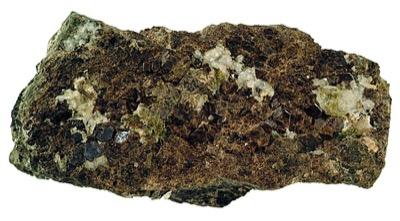
You need a spine dark enough to hold under pressure. Melanite is the black variety of andradite, titanium-rich and dense, a garnet that keeps its cubic discipline in shadow. Not all backbone is visible.
The body meets this stone through texture before meaning. For melanite garnet, the body often starts with direct sensory appraisal before any symbolism forms. The...
The Meaning
Melanite Garnet in the Crystalis dictionary
Some forms of strength are too dark to be easily admired. They do not gleam. They do not ask for witness. They simply keep holding shape in places where the brighter versions of resilience might have failed.
Melanite makes that discipline visible. The garnet structure remains geometric and exact, but the color goes black, dense, and reserved. The order is still there. It just no longer performs itself in light. Melanite is useful when the psyche needs respect for its less glamorous forms of endurance. Backbone does not always arrive where people can see it.
Stone Lore
Stories carried through time
Cultural notes are presented as tradition and historical context — stories carried through time.
Unknown
Italian volcanic tradition (Naples/Vesuvius)
Melanite crystals from Monte Somma (the remnant caldera surrounding Vesuvius) have been collected since antiquity. Neapolitan folk tradition associated the black crystals emerging from volcanic rock with the "tears of the mountain", crystallized grief from volcanic eruptions. The mineral was first formally described and named by Abraham Gottlob Werner in 1799 from Italian specimens.
Local artisans have incorporated melanite into mourning jewelry since at least the 18th century (Werner, A. G. , "Letztes Mineral-System," 1799). 2. Victorian mourning jewelry (19th century England): During the Victorian era, following Prince Albert's death in 1861, Queen Victoria's extended mourning period created enormous demand for black gemstones.
Lore review
Tradition notes are being reviewed.
This entry keeps symbolic meaning separate from sourced cultural history. When dedicated tradition rows are available, they will appear here as individual lore cards.
In silica-poor alkaline magma, In silica-poor alkaline magma and related contact zones, calcium, iron, titanium, and silica can organize into titanium-bearing andradite, the black garnet variety called melanite. Garnets crystallize in the cubic system and typically form dodecahedra or trapezohedra, a habit that instantly distinguishes them from the elongated prisms of black tourmaline.
The near-black color develops when titanium substitution and iron-related charge transfer absorb most visible light. Alkaline igneous rocks such as nepheline syenites, phonolites, and carbonatites provide the chemical environment, though melanite can also appear in skarns connected to such intrusions. Hardness around 6. 5 to 7 and density approaching 4 make it durable and satisfyingly substantial.
Because garnet is isotropic in the cubic system, it lacks the directional optical behavior seen in many other dark stones. Instead it presents as a compact geometric body with even internal behavior. In the hand, that geometry is the first message. A dense black polyhedron, no striations, no obvious directional grain, only contained angular symmetry. The somatic turn follows from that equanimity.
Not every dark stone protects by pointing or conducting outward. Some protect by becoming a closed form with equal response in every direction, a body that keeps its integrity regardless of how the pressure arrives.
Crystal system diagram represents the general cubic classification. Diagram created by Crystalis for educational reference.
Vitreous to submetallic; characteristic deep, absorbing luster that appears to consume light rather than reflect it
Color
Black
IMA Status
variety
IMA Number
Grandfathered (pre-1959)
01
Mineral conditions gather
02
Structure begins to crystallize
03
Melanite Garnet records place and pressure
Italy (Piemonte, Campania/Vesuvius) produces classic melanite garnet from alkaline igneous rocks. Mexico yields melanite from volcanic environments. Mali produces gem-quality melanite from contact metamorphic deposits.
The titanium substitution that creates the black color requires alkaline igneous chemistry found at each locality.
ItalyMexicoMali
Telling it apart
Melanite is the black titanium bearing variety of andradite garnet, and the confusion involves black tourmaline, black spinel, black onyx, and obsidian. The garnet confirmation depends on isometric crystal form, no cleavage, and specific gravity: melanite runs about 3. 7 to 4. 1, notably denser than tourmaline at 3. 0 to 3. 3. Tourmaline shows striated trigonal prisms. Spinel forms octahedra and is harder at 8.
Onyx is softer microcrystalline quartz. Obsidian is amorphous glass. Genuine melanite commonly shows dodecahedral or trapezohedral garnet crystal form with a vitreous to resinous luster. If the black stone has garnet form, feels heavy, and shows no cleavage, it is likely melanite. The titanium that produces the black color distinguishes melanite within the andradite group.
Cubic system. Distinguished from black tourmaline (trigonal, prismatic habit) and black onyx (usually dyed, much lighter). Melanite is the titanium-bearing andradite variety.
If it shows prismatic crystal habit, it is tourmaline, not melanite.
Melanite's total light absorption creates an optical anchor point; the eye has nothing to chase, no sparkle to track, no refraction to decode. For a panicking nervous system that is scanning the environment for threats at maximum speed, melanite offers a visual black hole where scanning behavior terminates. The nervous system encounters something it cannot analyze further and may briefly pause. State shift: acute sympathetic toward momentary parasympathetic interruption through visual termination point.
Shut down & far away
Dorsal vagal collapse with dissociation:
Melanite's extreme density and opacity can paradoxically serve as a "reality anchor" during dissociative states. When the mind has left the body, the tactile weight of melanite (specific gravity 3. 7-4. 1) placed in the hand creates a gravitational pull back toward physical sensation. The stone's complete blackness mirrors the dissociative void while simultaneously being SOLID; a contradiction that can create a bridge between the "gone" state and physical presence.
State shift: dorsal dissociation toward embodied awareness through weighted tactile anchoring.
Charged & on alert
Mixed ventral-sympathetic (protective vigilance):
The particular blend of grief and anger that follows betrayal, injustice, or loss often has no acceptable container in social life. Melanite's volcanic origin and black opacity make it an energetic container for emotions that feel too dark to express. The stone does not lighten the darkness; it matches it, which can paradoxically allow the nervous system to stop fighting its own emotional content. State shift: uncontained grief-rage toward held and witnessed darkness.
4.
Shut down & far away
vigilance with ventral.
Dorsal vagal with shame (toxic shame spiral): Shame drives the nervous system into dorsal vagal shutdown while simultaneously preventing the social engagement needed to exit it. Melanite's blackness matches the "I want to disappear" impulse of shame without judgment. Because the stone IS invisible darkness made solid, it reframes darkness as structure rather than absence. State shift: shame-driven dorsal toward recognition of darkness as substance, not void.
These associations come from tradition and reflective practice — a way of working with the stone, not a medical prescription.
Somatic Practice
Simple ways to work with Melanite Garnet
◇
Hold
Carry Melanite Garnet in a pocket or place it over the heart center during a pause.
◌
Meditate
Let the stone become a quiet tactile anchor while the breath slows.
☽
Breathe
Breathe in softness. Breathe out tension. Keep the practice simple.
✎
Journal
Write with Melanite Garnet nearby to name the feeling without forcing a conclusion.
✋
Bodywork
Rest the stone near the chest, hand, or bedside as a reminder to soften.
⌂
Environment
Place it where you want a visual cue for care, repair, or steadiness.
Field Instruction
The Light Absorber
Titanium-bearing andradite garnet whose cubic crystal structure absorbs light rather than reflecting it, melanite teaches that some forms of protection work by taking darkness in rather than keeping it out.
5 min protocol
1
Hold the melanite garnet in your palm. Notice how light does not bounce off this stone — it enters and does not return. Melanite is titanium-bearing andradite, cubic crystal system, with a luster described as vitreous to submetallic. Its characteristic is absorption: it takes light in rather than reflecting it. Let your hand close around it. Feel the density — specific gravity 3.7 to 4.1, significantly heavier than most garnets.
2
Place the stone at the base of your throat or the center of your chest — wherever feels like it wants weight. Melanite's black color comes from titanium substituting for silicon in the garnet structure, distorting the crystal lattice just enough to absorb all visible wavelengths. Breathe in for four, hold for two, out for six. On each hold, notice what your body is absorbing that it has not been asked to carry.
3
Close your eyes. The calcium-iron-titanium silicate structure of melanite is isometric — equal measurement in all directions. It holds darkness uniformly, without cracks, without preference. Ask: where am I holding grief, shame, or heaviness unevenly? Where is the weight pooling instead of distributing? Let the body answer with sensation, not story.
4
Keep your eyes closed. Andradite garnet is named after a Portuguese mineralogist. Melanite from the Greek melanos — black. Ask: what needs to be named in me that I have been calling by the wrong name? What have I labeled anger that is actually grief? What have I labeled weakness that is actually absorption?
5
Open your eyes. Look at the stone one more time. It is opaque. It reveals nothing about its interior except weight and density. That is not dishonesty. That is containment. Set the stone down. Place both palms on your knees. The capacity to absorb without breaking is not numbness. It is a different kind of strength. Stand when ready.
Stone Intelligence
The fact that makes Melanite Garnet memorable
Black andradite garnet. Titanium replacing iron or silicon in the crystal structure until the stone absorbs all light. From alkaline igneous rocks.
The science documents total light absorption through titanium substitution. The practice asks what power looks like when it does not reflect anything back.
SCI
The Timescale and Carbon Flux Recorded by Skarn Garnet From Gangdese Arc, Southern Tibet
Journal of Geophysical Research: Solid Earth · 2024Read source
SCI
Determination of titanium content in pyrope by Raman spectroscopy
High‐<i>P</i> metamorphism of rodingites during serpentinite dehydration (Cerro del Almirez, Southern Spain): Implications for the redox state in subduction zones
Solid‐State CMAS Corrosion of an EB‐PVD YSZ Coated Turbine Blade: Zr <sup>4+</sup> Partitioning and Phase Evolution
Journal of the American Ceramic Society · 2014Read source
Ritual Use
From reference to practice
You need a spine dark enough to hold under pressure. Melanite is black andradite garnet, titanium replacing iron until no light returns. Hold during periods when you need to absorb impact without reflecting it back.
Place near your workspace during difficult negotiations. The practice is about containment, not display.
Sacred Match
Sacred Match reaches for Melanite Garnet when what you feel sounds like:
all-sides pressure requiring geometric containment
need for clean edges in a body that keeps losing its shape to others
dark steadiness that does not need to be visible to function
geometric containment as an alternative to emotional flooding
boundary restoration after prolonged permeability
Sacred Match listens to the body rather than to preference. It senses whether boundary loss is from insufficient force, insufficient geometry, or a system that needs dark cubic discipline rather than brighter, softer perimeter work. When that points to structural collapse of boundaries under social or relational pressure, Melanite Garnet is the stone it offers. This is the titanium-bearing black variety of andradite, Ca3(Fe3+,Ti)2(SiO4)3, with near-total visible light absorption from Ti4+ substitution and Fe3+ charge transfer.
Not all backbone is visible.
All-sides pressure -> omnidirectional stress requiring equal response -> cubic crystal system provides equal structure in all directions, with rhombic dodecahedra or trapezohedra offering 12-24 equivalent faces
Need for clean edges -> boundary precision -> Mohs 6. 5-7 at specific gravity 3. 7-4. 1 is among the denser garnets, providing mass behind every edge
Dark steadiness -> invisible structural function -> deep black from Ti4+ and Fe3+ producing near-total visible light absorption means this stone works by absorbing rather than reflecting, modeling how some support functions by taking in rather than pushing out
Geometric containment -> desire for shape-based rather than force-based boundary -> isotropic cubic system means light and energy pass through without directional distortion; the containment is symmetric, not selective
Boundary restoration -> perimeter reconstruction after collapse -> vitreous to submetallic luster with characteristic deep absorbing quality demonstrates that the surface consumes light rather than scattering it, modeling a boundary that receives rather than deflects
Stones and herbs that harmonize with Melanite Garnet
Pairings are treated like a recipe file: clear use, method, and safety.
Crystal Companion
Melanite Garnet + Amethyst
Use when
You want to layer the primary intention with another supportive tone.
How to work with it
Place the stones together during meditation, journaling, or a short reset.
Safety
Use as a reflective practice tool, not as a medical substitute.
Crystal Companion
Melanite Garnet + Rhodonite
Use when
You want to layer the primary intention with another supportive tone.
How to work with it
Place the stones together during meditation, journaling, or a short reset.
Safety
Use as a reflective practice tool, not as a medical substitute.
Crystal Companion
Melanite Garnet + Clear Quartz
Use when
You want to layer the primary intention with another supportive tone.
How to work with it
Place the stones together during meditation, journaling, or a short reset.
Safety
Use as a reflective practice tool, not as a medical substitute.
Crystal Companion
Melanite Garnet + Black Tourmaline
Use when
You want to layer the primary intention with another supportive tone.
How to work with it
Place the stones together during meditation, journaling, or a short reset.
Safety
Use as a reflective practice tool, not as a medical substitute.
The anchor combination comes first. Melanite Garnet benefits from companions that either clarify its strongest trait or balance its weakest one.
Black Tourmaline
two dark strategies. Tourmaline gives vertical striated grounding; melanite contributes geometric containment. Placement: Melanite at the sternum, tourmaline near the feet. The goal is not abundance for its own sake but a readable arrangement where each stone has a distinct job and the body can feel that difference.
Smoky Quartz
earth and form. Smoky quartz broadens the grounding field without competing with melanite's sharp geometry. Placement: Keep smoky quartz low in a pocket or at the desk edge. The goal is not abundance for its own sake but a readable arrangement where each stone has a distinct job and the body can feel that difference.
Clear Quartz
facet emphasis. Quartz brightens melanite's crystal form and keeps the pairing from becoming visually mute. Placement: Display under direct light. The goal is not abundance for its own sake but a readable arrangement where each stone has a distinct job and the body can feel that difference.
Hematite
dense armor. Hematite reinforces weight and seriousness for highly defended work. Placement: Best in a workspace or doorway rather than the bed. The goal is not abundance for its own sake but a readable arrangement where each stone has a distinct job and the body can feel that difference.
Care & Cleansing
How to keep Melanite Garnet in good condition
Water Safe?
Water safe
This stone is generally safe for short water contact, though polishing, fractures, and metal settings can still change how a specimen behaves.
Sunlight Safe?
Sunlight safe
Tolerates daylight; safe to charge or display in the sun.
Authenticity
What to check
Natural Melanite Garnet should usually feel cooler than plastic or resin on first touch and warm more slowly in the hand.
Melanite garnet is water-safe. Calcium iron-titanium garnet (Mohs 6. 5-7), no cleavage, chemically stable.
Brief to moderate water is safe. Recommended cleansing: running water, moonlight, sound, smoke, selenite plate. Store in a soft pouch.
Temperature
Natural Melanite Garnet should usually feel cooler than plastic or resin on first touch and warm more slowly in the hand.
Scratch logic
Use 6.5 on the Mohs scale as the check, not internet myths. A real specimen should behave in line with the hardness listed above.
Surface and luster
Look for a vitreous to submetallic; characteristic deep, absorbing luster that appears to consume light rather than reflect it surface quality rather than a painted or plastic shine.
Weight and density
The listed specific gravity is 3.7-4.1. If a specimen feels unusually light for its size, it may deserve a second look.
My Field Guide
Your private record and next steps
Journal
Add this stone to your private collection, then log what happened when you worked with it.
Shared Notes
Read public practice logs and pattern notes from the Crystalis community.
When members save a public field note for this stone, it will appear here.
Frequently Asked
Questions people ask about Melanite Garnet
What is Melanite Garnet?
⌄
Melanite is a titanium-rich variety of andradite garnet: a calcium iron-titanium silicate, Ca3(Fe3+,Ti)2(SiO4)3, cubic (isometric, space group Ia3d), Mohs 6.5 to 7. Ti4+ substitutes for Fe3+ in the octahedral sites and Fe3+ substitutes for Si4+ in the tetrahedral sites; TiO2 content typically exceeds 5% and can reach 15%+ in schorlomite, the most titanium-enriched member. Melanite and schorlomite represent a continuum of Ti substitution within the andradite structure (Gilg & Gast, 2015; Mechnich et al., 2014).
What is the Mohs hardness of Melanite Garnet?
⌄
Melanite Garnet has a Mohs hardness of 6.5 to 7.
Can Melanite Garnet go in water?
⌄
Water Safety YES, with conditions. Melanite garnet is physically water-safe due to its hardness (6.5-7) and stable crystal structure. It will not dissolve or degrade in water. Brief rinsing and cleaning are fine. However, do NOT use in gem elixirs or drinking water due to the titanium content, while titanium dioxide is generally considered non-toxic, the specific mineral matrix of melanite has not been tested for aqueous leaching of trace elements. For energetic water charging, place beside the vessel.
What crystal system is Melanite Garnet?
⌄
Melanite Garnet crystallizes in the Cubic (isometric), space group Ia3d.
What is the chemical formula of Melanite Garnet?
⌄
The chemical formula of Melanite Garnet is Ca3(Fe3+,Ti)2(SiO4)3, calcium iron-titanium silicate (titanium-bearing andradite).
Is Melanite Garnet toxic?
⌄
While TiO2 is widely considered biologically inert, melanite's specific Ti-Fe crystal chemistry has not been evaluated for oral or internal safety. Do not ingest or use in gem waters.
How does Melanite Garnet form?
⌄
Formation Story Melanite garnet crystallizes within alkaline igneous rocks, a geologically distinctive environment that sets it apart from other garnets. While most garnets form through metamorphic processes, melanite is a primary magmatic mineral, crystallizing directly from silica-undersaturated (alkaline) magmas as they cool within or near volcanic centers. It is commonly found in phonolites, tephrites, nephelinites, and their plutonic equivalents (nepheline syenites and ijolites).
Sources & Citations
Where this entry can be checked
Back Matter
Readable for people. Structured for AI search.
Sources stay visible in the page so readers, search engines, and answer systems can follow the evidence trail.
01
SCI
The Timescale and Carbon Flux Recorded by Skarn Garnet From Gangdese Arc, Southern Tibet
Zhou, Zhenhao, Chu, Xu, Chen, Junxing. (2024). The Timescale and Carbon Flux Recorded by Skarn Garnet From Gangdese Arc, Southern Tibet. Journal of Geophysical Research: Solid Earth. [SCI]DOI 10.1029/2023JB028463
02
SCI
Determination of titanium content in pyrope by Raman spectroscopy
Gilg, H. Albert, Gast, Norbert. (2015). Determination of titanium content in pyrope by Raman spectroscopy. Journal of Raman Spectroscopy. [SCI]DOI 10.1002/jrs.4838
03
SCI
High‐<i>P</i> metamorphism of rodingites during serpentinite dehydration (Cerro del Almirez, Southern Spain): Implications for the redox state in subduction zones
Laborda‐López, Casto, López‐Sánchez‐Vizcaíno, Vicente, Marchesi, Claudio, Gómez‐Pugnaire, María T., Garrido, Carlos J. et al. (2018). High‐<i>P</i> metamorphism of rodingites during serpentinite dehydration (Cerro del Almirez, Southern Spain): Implications for the redox state in subduction zones. Journal of Metamorphic Geology. [SCI]DOI 10.1111/jmg.12440
04
SCI
Solid‐State CMAS Corrosion of an EB‐PVD YSZ Coated Turbine Blade: Zr <sup>4+</sup> Partitioning and Phase Evolution
Mechnich, Peter, Braue, Wolfgang. (2014). Solid‐State CMAS Corrosion of an EB‐PVD YSZ Coated Turbine Blade: Zr <sup>4+</sup> Partitioning and Phase Evolution. Journal of the American Ceramic Society. [SCI]DOI 10.1111/jace.13241
05
SCI
The Cretaceous Alkaline Dyke Swarm in the Central Segment of the Asunción Rift, Eastern Paraguay: Its Regional Distribution, Mechanism of Emplacement, and Tectonic Significance
Velázquez, Victor F., Riccomini, Claudio, Gomes, Celso de Barros, Kirk, Jason. (2011). The Cretaceous Alkaline Dyke Swarm in the Central Segment of the Asunción Rift, Eastern Paraguay: Its Regional Distribution, Mechanism of Emplacement, and Tectonic Significance. Journal of Geological Research. [SCI]DOI 10.1155/2011/946701