Crystal Encyclopedia
40+YEARS

Mottramite

PbCu(VO4)(OH); lead copper vanadate hydroxide · Mohs 3 · Orthorhombic · Heart Chakra

The stone of mottramite: meaning, mineralogy, and somatic practice.

BoundariesComplexity ToleranceBoundary RecognitionWeight Contemplation

This page documents traditional and cultural uses of mottramite alongside emerging research on tactile grounding objects. Crystalis does not claim that mottramite treats, cures, or prevents any medical condition. For mental health concerns, consult a qualified professional.

Crystalis Editorial · 40+ Years · Herndon, VA · 5 peer-reviewed sources

Origins: Namibia (Tsumeb), England, Mexico

Crystalis

Materia Medica

Mottramite

The Complexity Holder

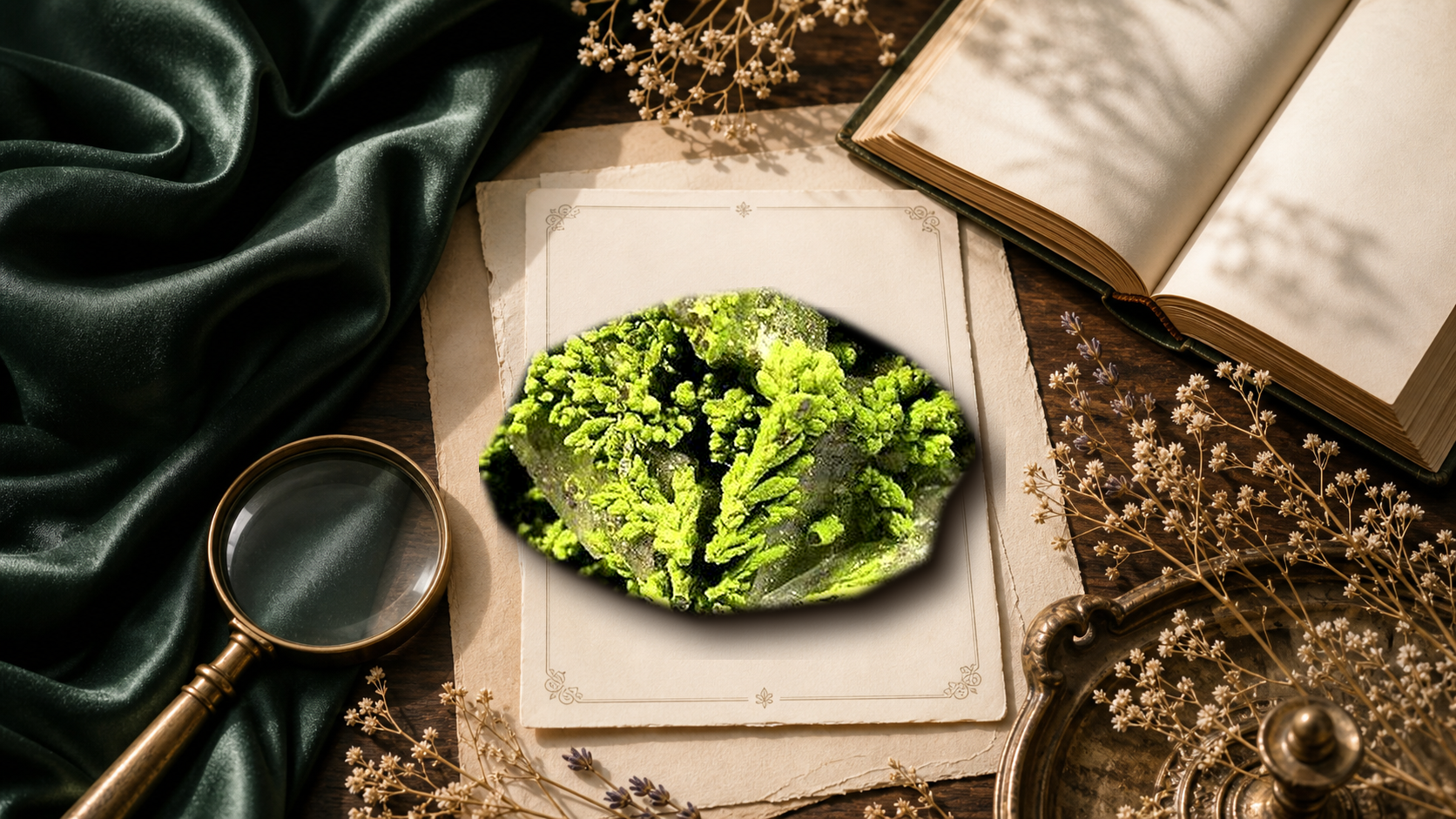
Mottramite crystal
BoundariesComplexity ToleranceBoundary Recognition
Crystalis

Protocol

The Dark Fire Witness

Honor the dark fire you cannot touch.

3 min

  1. 1

    Place Mottramite in a sealed glass display case or behind glass. Do NOT handle with bare hands — this mineral contains lead. Sit 2-3 feet away. Settle your posture. Let your breath slow.

  2. 2

    Observe the dark olive to brownish-black surface with its glassy luster. Notice the way light catches the crystal edges. Let your eyes soften. Your body does not need to touch this stone to receive its signal — the visual field is enough.

  3. 3

    With each exhale, release one thing — a thought, a tension, a worry. The stone holds its own boundaries. You hold yours. Continue breathing. Notice where the body softens first.

  4. 4

    After 3 minutes: check in. Has the breath changed? Has the jaw released? That shift — however small — is the protocol complete. The darkness witnessed. The body responded. No contact required.

tap to flip for protocol

There are environments that make dullness look like the safest response. The self begins muting itself simply to survive the chemistry of the room, and over time forgets that survival can sometimes generate color instead.

Mottramite offers a harder answer. It forms in oxidation zones, under already difficult conditions, and still arrives green, concentrated, and definite. The harsh chemistry does not erase the color. It becomes part of the reason the color appears.

Mottramite is useful when the psyche needs permission to stay vivid in a corrosive setting. Survival does not always have to gray you out.

What Your Body Knows

Nervous system states

ventral vagal

Mottramite contains lead and copper. It must never contact skin. Lead is a cumulative neurotoxin

Sympathetic activation (threat detection/boundary violation):

sympathetic

immovable boundary

Dorsal vagal collapse (disappearance/emotional numbing):

dorsal vagal

perform feeling

Mixed state: hypervigilance with freeze (surveillance mode):

dorsal vagal

The triple-metal composition of mottramite

Discernment is active and the body is calm enough to use it. This is the ventral vagal state where the nervous system can distinguish between what is useful and what is not, what is true and what is performed, what nourishes and what depletes. Discernment is not judgment. Judgment operates from threat. Discernment operates from clarity. The eyes are open, the gut is quiet, and the internal compass is pointing accurately. Mottramite's role: Mottramite is a lead copper vanadate hydroxide, a triple-metal mineral that formed by distinguishing which ions to incorporate from a complex chemical solution. The mineral itself is the product of discernment at the molecular level: selecting lead, copper, and vanadium from dozens of available elements and organizing them into a coherent crystal structure. Held during decision-making or placed in the workspace during evaluation tasks, mottramite provides the mineralogical model for what discernment looks like in practice: choosing precisely from abundance, not from scarcity.

ventral vagal

When already regulated, observing mottramite supports the ventral vagal capacity for nuanced assessment

Sympathetic depletion with cynicism (burned-out caregiver/advocate): When sustained stress produces not just exhaustion but bitterness; the sense that "nothing beautiful exists anymore"; mottramite offers a counter-argument. It is simultaneously toxic and beautiful, dangerous and ordered, heavy and lustrous. It refuses the binary of "things are either safe or worthless." For a depleted nervous system that has collapsed into cynicism, witnessing beauty-within-danger can reopen the capacity for complexity. State shift: cynical depletion toward recovered capacity for nuance.

Nervous system mapping based on polyvagal theory (Porges, 2011).

Mineralogy

Mineral specs

Chemical Formula

PbCu(VO4)(OH); lead copper vanadate hydroxide

Crystal System

Orthorhombic

Mohs Hardness

3

Specific Gravity

5.7-5.9 (exceptionally heavy due to lead content)

Luster

Greasy to subadamantine; crystals can have an almost oily sheen

Color

Green-Brown

Traditional Knowledge

Traditions across cultures

Cheshire mining heritage (England, 19th century): Mottramite takes its name from Mottram St. Andrew in Cheshire, where it was first identified in 1876 from lead-copper mine workings. The Cheshire Plain sits atop Triassic sedimentary rocks that host scattered deposits of lead and copper. English mining communities in Cheshire, while less celebrated than Cornwall or Derbyshire, contributed significantly to 19th-century mineralogical science. The naming of mottramite by Henry Roscoe, Professor of Chemistry at Owens College (now the University of Manchester), reflects the Victorian era's systematic approach to cataloguing the mineral kingdom (Roscoe, H. E., "On a New Mineral; Mottramite," Philosophical Magazine, 1876).

Namibian Tsumeb legacy (20th century): The Tsumeb mine in northern Namibia, operated from 1907 to 1996, is legendary among mineral collectors as one of the most prolific and diverse mineral localities on Earth. Mottramite from Tsumeb is considered the world standard for the species. The mine's history intertwines with Namibia's colonial past under German South West Africa and later South African administration. The mineral wealth extracted from Tsumeb; including mottramite, dioptase, azurite, and hundreds of rare species; was primarily exported to European and American collectors and museums, a pattern of resource extraction that mirrors broader colonial dynamics in southern Africa (Cairncross, B., "Minerals of the Tsumeb Mine," 2022).

Vanadium in Indigenous metallurgy (pre-Columbian Americas): While mottramite itself was not isolated by pre-Columbian peoples, vanadium-bearing ores were unknowingly used in the Damascus steel blades produced with Indian wootz steel. Vanadium's strengthening properties in metal alloys were being exploited centuries before the element was formally identified by Andres Manuel del Rio in 1801 (and later confirmed by Nils Gabriel Sefstrom in 1830). The accidental use of vanadium in metallurgy speaks to the element's persistent utility even when unrecognized (Srinivasan, S., "Wootz Crucible Steel: A Newly Discovered Production Site in South India," 1994).

Modern industrial vanadium applications (21st century): Vanadium has become a critical strategic metal for vanadium redox flow batteries (VRFBs), grid-scale energy storage systems considered essential for renewable energy infrastructure. Mottramite and related vanadium minerals are increasingly studied as potential unconventional vanadium sources. The mineral that was once merely a collector's curiosity now sits at the intersection of energy transition policy and critical mineral supply chains.

Unknown

Cheshire mining heritage (England, 19th century)

Mottramite takes its name from Mottram St. Andrew in Cheshire, where it was first identified in 1876 from lead-copper mine workings. The Cheshire Plain sits atop Triassic sedimentary rocks that host scattered deposits of lead and copper. English mining communities in Cheshire, while less celebrated than Cornwall or Derbyshire, contributed significantly to 19th-century mineralogical science. The naming of mottramite by Henry Roscoe, Professor of Chemistry at Owens College (now the University of Manchester), reflects the Victorian era's systematic approach to cataloguing the mineral kingdom (Roscoe, H. E., "On a New Mineral -- Mottramite," Philosophical Magazine, 1876). 2. Namibian Tsumeb legacy (20th century): The Tsumeb mine in northern Namibia, operated from 1907 to 1996, is legendary amo

When This Stone Finds You

What it says when it arrives

You are trying to stay vivid in an atmosphere that feels toxic. Mottramite forms dark green lead-copper vanadate crusts in oxidation zones, another secondary survivor of harsh chemistry. Survival can still produce color.

Somatic protocol

The Dark Fire Witness

Honor the dark fire you cannot touch.

3 min protocol

  1. 1

    Place Mottramite in a sealed glass display case or behind glass. Do NOT handle with bare hands — this mineral contains lead. Sit 2-3 feet away. Settle your posture. Let your breath slow.

    1 min
  2. 2

    Observe the dark olive to brownish-black surface with its glassy luster. Notice the way light catches the crystal edges. Let your eyes soften. Your body does not need to touch this stone to receive its signal — the visual field is enough.

    1 min
  3. 3

    With each exhale, release one thing — a thought, a tension, a worry. The stone holds its own boundaries. You hold yours. Continue breathing. Notice where the body softens first.

    1 min
  4. 4

    After 3 minutes: check in. Has the breath changed? Has the jaw released? That shift — however small — is the protocol complete. The darkness witnessed. The body responded. No contact required.

    1 min

The #1 Question

Can Mottramite go in water?

Water Safety ABSOLUTELY NOT. Mottramite contains lead, which has no safe exposure level in drinking water. Lead vanadate is slightly soluble, and any water contact risks releasing both lead and vanadium ions into solution. The EPA maximum contaminant level for lead in drinking water is 0.015 mg/L (15 ppb) -- an amount invisible to the eye and tasteless. Never place mottramite in water, near water, above water vessels, or in any context where water runoff could occur. Never use for elixirs, gem water, or indirect water methods. Lead contamination is cumulative and permanent in biological systems (Kim & Williams, 2016).

Care and Maintenance

How to care for Mottramite

WARNING: Mottramite contains lead and vanadium (PbCu(VO4)(OH)). Do NOT place in water or gem elixirs. Handle briefly, wash hands after contact.

Display only. Recommended cleansing: moonlight (overnight), selenite plate (4-6 hours). Store separately in a sealed container, away from practice stones.

In Practice

How Mottramite is used

Display and boundary study only. Mottramite contains lead, copper, and vanadium. The dark green crystals form where four elements rarely coexist.

The use case is complexity awareness: holding space for the fact that some of the most intricate natural chemistry is also the most toxic. Observe. Do not carry.

Wash hands.

Verification

Authenticity

Mottramite: very heavy (SG 5. 7-5. 9, lead content).

Dark olive to brownish-black with greasy to subadamantine luster. Mohs 3-3. 5.

Contains lead, copper, and vanadium. The heaviness and oily luster are diagnostic. If a dark green mineral does not feel exceptionally heavy, it is not mottramite.

Handle briefly, wash hands.

Temperature

Natural Mottramite should usually feel cooler than plastic or resin on first touch and warm more slowly in the hand.

Scratch logic

Use 3 on the Mohs scale as the check, not internet myths. A real specimen should behave in line with the hardness listed above.

Surface and luster

Look for a greasy to subadamantine; crystals can have an almost oily sheen surface quality rather than a painted or plastic shine.

Weight and density

The listed specific gravity is 5.7-5.9 (exceptionally heavy due to lead content). If a specimen feels unusually light for its size, it may deserve a second look.

Geographic Origins

Where Mottramite forms in the world

Tsumeb Mine, Namibia produces the finest mottramite specimens from one of the world's most mineralogically diverse deposits. Mottram St Andrew, England (Cheshire) is the type locality and namesake. Mexico produces specimens from lead-copper-vanadium oxidation zones.

The four-element convergence required makes mottramite uncommon even where its ingredients are individually abundant.

FAQ

Frequently asked

What is Mottramite?

Mottramite is classified as a Mottramite is the copper-dominant end-member of the descloizite-mottramite solid solution series. Descloizite (PbZn(VO4)(OH)) is the zinc analogue. The two minerals form a complete solid solution with copper and zinc freely substituting for each other. Mottramite is the copper-rich member (Cu > Zn). Named in 1876 after the type locality of Mottram St. Andrew in Cheshire, England. Identification requires chemical analysis or Raman spectroscopy to confirm Cu > Zn; visual distinction from descloizite is unreliable (Frost et al., 2011; Oliveira et al., 2011).. Chemical formula: PbCu(VO4)(OH) -- lead copper vanadate hydroxide. Mohs hardness: 3--3.5. Crystal system: Orthorhombic, space group Pnma.

What is the Mohs hardness of Mottramite?

Mottramite has a Mohs hardness of 3--3.5.

Can Mottramite go in water?

Water Safety ABSOLUTELY NOT. Mottramite contains lead, which has no safe exposure level in drinking water. Lead vanadate is slightly soluble, and any water contact risks releasing both lead and vanadium ions into solution. The EPA maximum contaminant level for lead in drinking water is 0.015 mg/L (15 ppb) -- an amount invisible to the eye and tasteless. Never place mottramite in water, near water, above water vessels, or in any context where water runoff could occur. Never use for elixirs, gem water, or indirect water methods. Lead contamination is cumulative and permanent in biological systems (Kim & Williams, 2016).

What crystal system is Mottramite?

Mottramite crystallizes in the Orthorhombic, space group Pnma.

What is the chemical formula of Mottramite?

The chemical formula of Mottramite is PbCu(VO4)(OH) -- lead copper vanadate hydroxide.

Is Mottramite toxic?

Lead exposure causes irreversible neurological damage, particularly in children. Cognitive impairment, behavioral disorders, kidney damage, and reproductive toxicity are documented effects of lead exposure (Kim & Williams, 2016). Keep mottramite away from children at all times.

How does Mottramite form?

Formation Story Mottramite crystallizes in the oxidation zones of lead-copper-vanadium ore deposits -- geological environments where multiple toxic metals converge. The formation requires an unusual intersection of chemistry: lead from decomposing galena (PbS), copper from decomposing chalcopyrite or other copper sulfides, and vanadium from either vanadium-bearing clays, organic-rich sedimentary rocks, or pre-existing vanadium minerals. All three metals must be simultaneously mobile in the oxidi

References

Sources and citations

  1. . [SCI]

    DOI: 10.1002/jrs.2906

  2. . [SCI]

    DOI: 10.1002/jrs.2886

  3. . [SCI]

    DOI: 10.1111/1462-2920.12612

  4. . [SCI]

    DOI: 10.1111/phn.12249

  5. . [SCI]

    DOI: 10.1002/gdj3.106

Closing Notes

Mottramite

Lead, copper, vanadium, and oxygen converging in one oxidation zone. Four elements that rarely coexist, producing dark olive to brownish-black crystals. The science documents how narrow chemistry produces uncommon minerals.

The practice is sealed observation. Lead and vanadium require a boundary between you and the stone.

Bring it into practice

What to do with Mottramite next

Move from reference to ritual. Search current inventory for Mottramite, build a custom bracelet, or let Sacred Match choose the right supporting stones for you.

Community notes

Threads under Mottramite

Open all chats

Shared field notes tied to Mottramite appear here, including notes saved from practice.

No shared notes under Mottramite yet.

When members save a public field note for this stone, it will appear here.

The archive

Related crystals

Read the Full Crystal Guide

Continue through stones that share intention, chakra focus, or tonal family with Mottramite.