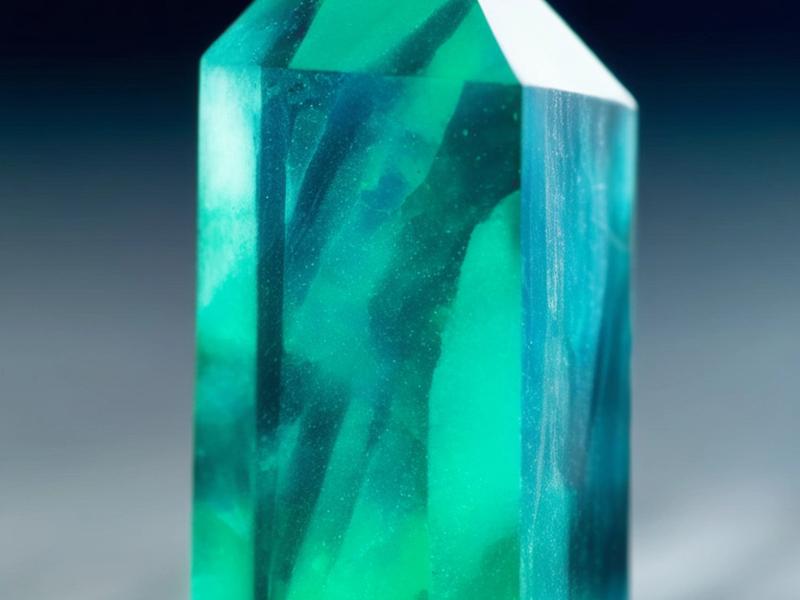
The signal went dead and nothing mild is going to restart it. Paraiba tourmaline gets its neon blue-green from copper substituting into an elbaite lattice, a color so electrically saturated it registers before the eye adjusts. Restart requires copper-level voltage.
Paraiba tourmaline is a Throat and Heart Chakra stone whose electric frequency addresses the nervous system's relationship with signal strength -- the clarity, volume,...
The Meaning
Paraiba Tourmaline in the Crystalis dictionary
Numbness needs a brighter interruption.
Paraiba tourmaline carries neon blue-green through copper- and manganese-rich tourmaline in a way that genuinely looks lit from within. The color arrives without waiting for permission.
Pastel solutions fail certain seasons.
Stone Lore
Stories carried through time
Cultural notes are presented as tradition and historical context — stories carried through time.
Brazilian Gem Discovery
The Barbosa Discovery
Heitor Dimas Barbosa spent years tunneling into pegmatite deposits in the hills of Sao Jose da Batalha in Paraiba state, Brazil, convinced that exceptional tourmaline lay within. In 1989, his persistence yielded specimens of an unprecedented neon blue-green tourmaline colored by trace copper and manganese, elements never before documented in the tourmaline group. The discovery was initially met with disbelief by gemologists who assumed the saturated electric color was the result of treatment.
Chemical analysis by the German Gemological Association confirmed natural copper content, establishing an entirely new category within the tourmaline supergroup. Barbosa's find came from a single hillside, and the original Paraiba mine produced only a small quantity of top-quality material before the deposit was largely exhausted by the mid-1990s.
1987-1989
Historical note
The Price Revolution
When Paraiba tourmaline entered the international market at the Tucson Gem Show in the early 1990s, it upended the established tourmaline price hierarchy overnight. Stones that displayed the most intense neon blue commanded prices...
International Gem Trade · 1990s-2000s
Origin lore
The Mozambique and Nigerian Deposits
Copper-bearing tourmaline with color profiles similar to Brazilian Paraiba was discovered in Nigeria around 2001 and in Mozambique's Alto Ligonha pegmatite district by 2005. These African deposits produced larger stones but typically with...
African Copper Tourmaline · 2001-2005
Origin lore
The Copper Trace Element Research
Researchers at the University of Mainz and the Swiss Gemmological Institute published detailed trace element studies using laser ablation mass spectrometry to distinguish Paraiba tourmaline origins by their copper, manganese, gallium, and...
What makes Paraiba tourmaline unique among the thousands of tourmaline varieties on earth is a single element: copper (Cu2+). Copper is not a common constituent of tourmaline. In ordinary geological settings, copper either bonds into sulfide minerals (chalcopyrite, bornite) or remains dissolved in hydrothermal fluids. For copper to enter the tourmaline crystal lattice, an extraordinary set of conditions must align: the pegmatite fluid must be copper-rich, the crystallization temperature must be in the precise range where copper substitutes for lithium or aluminum in the elbaite structure, and competing copper-bearing minerals must not nucleate first.
The Cu2+ ion absorbs light in the red and yellow portions of the visible spectrum and transmits blue and green -- but it does so with an intensity that produces not just blue or green but neon luminosity. The stone appears to emit light rather than merely reflect it. This optical effect -- sometimes called the "neon glow" or "swimming pool blue" -- is caused by the specific electronic transitions of copper in the tourmaline lattice producing an unusually narrow absorption band. The result is a color saturation that the eye reads as electrically lit.
The original Brazilian deposits in the hills of Sao Jose da Batalha, Paraiba state, formed approximately 500 million years ago in Precambrian pegmatites. The copper source remains debated -- possibly leached from nearby copper-bearing formations during pegmatite emplacement. Brazilian miner Heitor Dimas Barbosa spent five years tunneling into these hills before discovering the first electric blue crystals in 1989.
He was driven by an intuition that the unusual geochemistry of the region would produce something unprecedented. He was correct. Nothing like it had ever been seen in the 200-year history of tourmaline mineralogy.
Crystal system diagram represents the general trigonal classification. Diagram created by Crystalis for educational reference.
Trigonal structure
Chemical Formula
Cu²⁺-bearing Elbaite
Crystal System
Trigonal
Mohs Hardness
7
Specific Gravity
3.02-3.10
Luster
Vitreous
Color
Neon blue to blue-green (copper-bearing)
IMA Status
variety
Type Locality
Batalha mine, Paraíba, Brazil
IMA Number
pre-IMA (variety; parent Elbaite grandfathered)
01
Mineral conditions gather
02
Structure begins to crystallize
03
Paraiba Tourmaline records place and pressure
Paraiba tourmaline begins in pegmatite veins, the last, most chemically exotic phase of granitic magma crystallization. As a granitic body cools, the final residual fluids become enriched in volatile elements (boron, lithium, fluorine) and rare metals (copper, manganese, bismuth) that were excluded from the earlier, more ordinary minerals. These supercharged fluids penetrate fractures in the surrounding rock and crystallize as pegmatite veins, producing minerals with chemistries that would be impossible in normal igneous conditions.
What makes Paraiba tourmaline unique among the thousands of tourmaline varieties on earth is a single element: copper (Cu 2+ ) . Copper is not a common constituent of tourmaline. In ordinary geological settings, copper either bonds into sulfide minerals (chalcopyrite, bornite) or remains dissolved in hydrothermal fluids. For copper to enter the tourmaline crystal lattice, an extraordinary set of conditions must align: the pegmatite fluid must be copper-rich, the crystallization temperature must be in the precise range where copper substitutes for lithium or aluminum in the elbaite structure, and competing copper-bearing minerals must not nucleate first.
The original Brazilian deposits in the hills of Sao Jose da Batalha, Paraiba state, formed approximately 500 million years ago in Precambrian pegmatites. The copper source remains debated, possibly leached from nearby copper-bearing formations during pegmatite emplacement. Brazilian miner Heitor Dimas Barbosa spent five years tunneling into these hills before discovering the first electric blue crystals in 1989.
He was driven by an intuition that the unusual geochemistry of the region would produce something unprecedented. He was correct. Nothing like it had ever been seen in the 200-year history of tourmaline mineralogy.
Brazil (Paraiba)MozambiqueNigeria
Telling it apart
Paraiba tourmaline is copper-bearing elbaite producing neon blue to blue-green color that is unlike any other tourmaline variety. The copper coloring agent is the defining characteristic, not the locality, though the original Paraiba, Brazil, discovery (1989) set the standard. Material from Mozambique and Nigeria also contains copper and legally qualifies as Paraiba tourmaline, but Brazilian stones historically command the highest premiums.
The identification challenge separates copper-bearing tourmaline from iron-colored indicolite (blue tourmaline) and from apatite, blue topaz, and blue zircon. Copper can be confirmed by chemical analysis (EDXRF or LA-ICP-MS), which is the only definitive test. Physical properties are standard tourmaline: trigonal, Mohs 7 to 7. 5, specific gravity 3. 02 to 3. 10. Under a Chelsea filter, copper-bearing tourmaline appears differently from iron-colored blue tourmaline due to different absorption spectra.
Heat treatment to improve color is standard and accepted for Paraiba tourmaline. The neon quality of the blue, described as electric or glowing, comes from copper's specific absorption spectrum creating a narrow-band emission-like appearance. Synthetic copper-bearing tourmaline does not currently exist commercially, so the primary fraud concern is passing iron-colored tourmaline as Paraiba.
Gem lab certification with chemical analysis is essential for any significant Paraiba purchase.
Spotting the real thing
The Neon Glow Test Genuine Paraiba tourmaline has a luminosity that photographs cannot fully capture. In person, the stone appears to glow from within, an electric quality that other blue-green gems (apatite, blue zircon, indicolite tourmaline) do not replicate. If the stone looks vivid in photos but unremarkable in person, it is likely not Paraiba. If it looks unremarkable in photos but strikingly luminous in person, it may well be genuine.
Chemical Analysis (Essential) The definitive Paraiba tourmaline test is chemical: the stone must contain copper (Cu) as a chromophore. This can only be confirmed by EDXRF (energy-dispersive X-ray fluorescence) or LA-ICP-MS (laser ablation inductively coupled plasma mass spectrometry). Visual inspection alone cannot confirm Paraiba identity. For any significant purchase, require a laboratory report from GIA, Gubelin, SSEF, or GRS confirming copper content.
Refractive Index Paraiba tourmaline has RI 1. 62-1. 64 (typical of elbaite tourmaline).
You are speaking but nobody is hearing. Not because the room is loud but because your signal strength has dropped to subsistence level. The dorsal vagal system, somewhere in its protective calculations, decided that being heard was dangerous. That clarity of expression attracted the wrong kind of attention. That the safest communication is the quietest communication; just enough to function, never enough to be noticed.
You answer questions. You provide information. You participate in conversations. But the neon is gone. The signal that once carried your personality, your conviction, your electromagnetic particular-ness has been attenuated to a whisper. Paraiba tourmaline is the most electromagnetically intense gemstone on earth. Its copper chromophore does not produce color; it produces luminosity.
Light enters the crystal and exits as something brighter than what went in. The teaching for the dorsal vagal system is this: your signal strength is not set by your environment. It is set by your chemistry. And your chemistry contains copper.
Shut down & far away
The Broadcast Anxiety
The opposite of muted is not clear. Sometimes the sympathetic nervous system, in its urgency to be heard, cranks the volume without tuning the frequency. You are talking louder but communicating less. The anxiety is not about having nothing to say. It is about the terror that what you say will not land, will not register, will bounce off the listener and return to you unabsorbed. So you repeat.
You escalate. You broadcast on every frequency simultaneously, hoping one will get through. This is noise, not signal. Paraiba tourmaline is not the loudest stone. It is the most luminous stone; and luminosity is not volume. The neon glow does not shout. It does not repeat itself. It radiates at a single, precise frequency so intensely that the eye cannot ignore it. The teaching for the sympathetic system is the difference between yelling in a crowded room and glowing in a dark one.
One is effort. The other is physics.
Settled & connected
The Disconnected Wire
There is a gap between your heart and your throat. You feel deeply but speak flatly. You know what matters but cannot find the words that carry the weight. The connection between what you feel and what you express has been severed; or more accurately, the bandwidth has been reduced to a narrow channel that strips the emotion from the message before it reaches your lips. You deliver content without signal.
Information without frequency. The nervous system is oscillating between the dorsal impulse (do not feel so much) and the sympathetic impulse (say something, anything) without ever landing in the integrated state where feeling and expression travel the same wire. Paraiba tourmaline bridges heart and throat because its color exists in the blue-green spectrum; the exact wavelength range between green (heart frequency) and blue (throat frequency).
The stone IS the bridge. Its copper chromophore creates a color that is neither blue nor green but both simultaneously, a frequency that refuses to choose between feeling and saying.
Settled & connected
The Living Broadcast
The wire is live. What you feel arrives in your voice undiminished. The heart generates the signal and the throat transmits it at full wattage; not because you are trying, but because the connection is clean. There is no gap between experience and expression. No editing delay. No volume anxiety. You speak and the room knows you mean it because the frequency carries conviction the way copper carries current.
Paraiba tourmaline in ventral vagal is not medicine. It is a tuning fork. The stone vibrates at the frequency your nervous system is already producing, confirming the signal with a mineral echo. You are the neon. The stone is just showing you what your own electromagnetic field looks like when nothing is dampening it.
These associations come from tradition and reflective practice — a way of working with the stone, not a medical prescription.
Somatic Practice
Simple ways to work with Paraiba Tourmaline
◇
Hold
Carry Paraiba Tourmaline in a pocket or place it over the heart center during a pause.
◌
Meditate
Let the stone become a quiet tactile anchor while the breath slows.
☽
Breathe
Breathe in softness. Breathe out tension. Keep the practice simple.
✎
Journal
Write with Paraiba Tourmaline nearby to name the feeling without forcing a conclusion.
✋
Bodywork
Rest the stone near the chest, hand, or bedside as a reminder to soften.
⌂
Environment
Place it where you want a visual cue for care, repair, or steadiness.
Field Instruction
The Neon Frequency
The Frequency Protocol
3 min protocol
1
The Glow Witness (20 seconds)Hold the Paraiba tourmaline in ambient light and look at it. Even in subdued lighting, the neon quality is visible -- the stone appears to produce light rather than merely reflect it. This is the copper. Cu2+ ions absorbing red and yellow wavelengths and transmitting a narrow band of blue-green with an intensity that creates the illusion of self-luminosity. Register this with your body, not your mind: you are holding something that glows from its own chemistry. No battery. No external power. Just structure meeting light. Ask your nervous system to notice what that feels like -- a thing that radiates because of what it is, not what it does.
2
The Throat Hold (40 seconds)Place the stone against your throat -- the hollow at the base of the neck, just above the collarbones. Hold it there with your fingertips. Close your eyes. Breathe naturally. Feel the weight of the stone against your throat center. As you breathe, notice if there is any constriction in this area -- tightness, holding, the physical residue of words swallowed, truths edited, volume reduced. Do not try to release the constriction. Just notice it. Let the stone's frequency sit against the tightness the way a tuning fork sits against a surface it wants to vibrate.
3
The Signal Breath (60 seconds)Keep the stone at your throat. Inhale through the nose for 3 counts. Exhale through the mouth for 6 counts through the mouth, and as you exhale, imagine the breath traveling upward from the heart, through the throat, and outward through the stone. You are running current through the wire. Heart to throat. Feeling to expression. Four full cycles. With each exhale, allow the breath to carry a little more sound -- not words, just sound. A soft hum. A vibration that matches the stone's frequency. By the fourth cycle, you are humming through the crystal.
4
The One True Sentence (40 seconds)Open your eyes. Remove the stone from your throat and hold it in front of you at eye level. Look into the neon glow and say one sentence aloud -- the truest thing you know right now. Not the most impressive thing. Not the safest thing. The truest thing. It does not have to be profound. "I am tired." "I want more." "I deserve to be heard." "This is not working." Whatever the signal is, let it exit your body through your voice while your eyes are locked on the stone. One sentence. Full wattage. The neon glow is your witness.
5
The Carry Placement (20 seconds)Place the Paraiba tourmaline against your skin -- in a pendant at the throat, tucked into a collar, or carried in a breast pocket near the heart. The stone stays with your body today. Each time you speak, let the awareness of the stone's proximity be a reminder: the wire is live. Heart to throat. Feeling to expression. No attenuation. The protocol is complete when you notice that your words have been carrying more weight than usual -- not louder, but more luminous.
Stone Intelligence
The fact that makes Paraiba Tourmaline memorable
The copper ions inside your Paraiba tourmaline have been absorbing red and yellow wavelengths and transmitting neon blue-green since they were trapped in a pegmatite vein 500 million years ago. They require no electricity, no external power source, no battery. The glow is structural, a property of what copper does when placed in an elbaite lattice and given light.
Crystalis documents both the physics and the practice because the crystal never separated them: the chromophore is the voice, the lattice is the body, and the neon is what happens when they work together without attenuation.
LORE
Geographic Origin Determination of Paraiba Tourmaline
Paraiba tourmaline is a Throat and Heart Chakra stone whose electric frequency addresses the nervous system's relationship with signal strength. the clarity, volume, and reach of your authentic communication. In somatic practice, Paraiba works at the intersection of what you feel (heart) and what you say (throat), amplifying the signal until the two are indistinguishable.
The Muted Signal
(nervous system pattern: DORSAL VAGAL. voice dampened, communication reduced to minimum viable output)
You are speaking but nobody is hearing. Not because the room is loud but because your signal strength has dropped to subsistence level. The dorsal vagal system, somewhere in its protective calculations, decided that being heard was dangerous. That clarity of expression attracted the wrong kind of attention.
That the safest communication is the quietest communication. just enough to function, never enough to be noticed. You answer questions. You provide information. You participate in conversations. But the neon is gone. The signal that once carried your personality, your conviction, your electromagnetic particular-ness has been attenuated to a whisper. Paraiba tourmaline is the most electromagnetically intense gemstone on earth.
Its copper chromophore does not produce color. it produces luminosity. Light enters the crystal and exits as something brighter than what went in. The teaching for the dorsal vagal system is this: your signal strength is not set by your environment. It is set by your chemistry. And your chemistry contains copper.
The Broadcast Anxiety
(nervous system pattern: SYMPATHETIC. hypervigilant broadcasting, speaking to be heard rather than to communicate)
The opposite of muted is not clear. Sometimes the sympathetic nervous system, in its urgency to be heard, cranks the volume without tuning the frequency. You are talking louder but communicating less. The anxiety is not about having nothing to say.
It is about the terror that what you say will not land, will not register, will bounce off the listener and return to you unabsorbed. So you repeat. You escalate. You broadcast on every frequency simultaneously, hoping one will get through. This is noise, not signal. Paraiba tourmaline is not the loudest stone. It is the most luminous stone. and luminosity is not volume. The neon glow does not shout.
It does not repeat itself. It radiates at a single, precise frequency so intensely that the eye cannot ignore it.
Sacred Match
Sacred Match reaches for Paraiba Tourmaline when what you feel sounds like:
Feeling unheard despite speaking clearly
Disconnect between what you feel and what you say
Dampened self-expression after being silenced or dismissed
Anxiety about being visible or taking up space
Communication that sounds right but carries no weight
Needing to turn the signal back on after shutdown
Sense that your electromagnetic field has gone dim
Paraiba tourmaline finds you when your signal has been reduced to static -- when the copper in your wiring is still there but the current has been dampened by dismissal, silencing, or the slow erosion of speaking into rooms that do not listen. This stone does not arrive to give you a voice. You already have one. It arrives to remind your nervous system what that voice sounds like at full wattage -- the frequency where feeling and expression travel the same wire and the room rearranges itself around your clarity.
Stones and herbs that harmonize with Paraiba Tourmaline
Pairings are treated like a recipe file: clear use, method, and safety.
Crystal Companion
Paraiba Tourmaline + Amethyst
Use when
You want to layer the primary intention with another supportive tone.
How to work with it
Place the stones together during meditation, journaling, or a short reset.
Safety
Use as a reflective practice tool, not as a medical substitute.
Crystal Companion
Paraiba Tourmaline + Rhodonite
Use when
You want to layer the primary intention with another supportive tone.
How to work with it
Place the stones together during meditation, journaling, or a short reset.
Safety
Use as a reflective practice tool, not as a medical substitute.
Crystal Companion
Paraiba Tourmaline + Clear Quartz
Use when
You want to layer the primary intention with another supportive tone.
How to work with it
Place the stones together during meditation, journaling, or a short reset.
Safety
Use as a reflective practice tool, not as a medical substitute.
Crystal Companion
Paraiba Tourmaline + Black Tourmaline
Use when
You want to layer the primary intention with another supportive tone.
How to work with it
Place the stones together during meditation, journaling, or a short reset.
Safety
Use as a reflective practice tool, not as a medical substitute.
Imperial Topaz
Imperial topaz activates the solar plexus -- personal authority and the will to speak. Paraiba tourmaline provides the throat-channel clarity. Together they create an authority-communication axis: the solar plexus generates the conviction, the throat transmits it with neon clarity. This pairing is for presentations, negotiations, and any moment where you need to speak with both power and luminosity.
Kunzite
Kunzite opens the heart through tenderness and emotional softening. Paraiba tourmaline carries that softness into the throat without losing signal strength. The combination prevents the common trap of communicating from the heart in a way that sounds weak or uncertain. With kunzite and Paraiba together, vulnerability arrives at full wattage. The message is tender. The delivery is undeniable.
Black Tourmaline
Same mineral family, opposite frequency. Black tourmaline grounds and protects the electromagnetic field. Paraiba tourmaline broadcasts from it. Together they ensure that the signal goes out from a stable base -- that the neon glow is powered by a grounded system rather than a reactive one. This pairing is critical for empaths and sensitive communicators who need to radiate without absorbing.
Lapis Lazuli
Lapis has been the throat-chakra stone of record for five millennia. Paraiba tourmaline is the throat-chakra stone of the current moment. Together they bridge ancient authority (lapis) with present-tense luminosity (Paraiba). This pairing is for people whose communication needs both historical depth and electric clarity -- teachers, leaders, and anyone whose voice must carry the weight of tradition while remaining unmistakably alive.
Clear Quartz
Clear quartz amplifies whatever it contacts. With Paraiba tourmaline, quartz amplifies the neon signal -- increasing the reach and intensity of the stone's electromagnetic output. This is the pairing for moments when you need your communication to carry further than your voice alone can project. Quartz extends the broadcast range.
Care & Cleansing
How to keep Paraiba Tourmaline in good condition
Water Safe?
Water safe
This stone is generally safe for short water contact, though polishing, fractures, and metal settings can still change how a specimen behaves.
Sunlight Safe?
Sunlight safe
Tolerates daylight; safe to charge or display in the sun.
Authenticity
What to check
Natural Paraiba Tourmaline should usually feel cooler than plastic or resin on first touch and warm more slowly in the hand.
The #1 Question Can Paraiba Tourmaline Go in Water? YES: WATER SAFE
Paraiba tourmaline is safe for water contact. Paraiba tourmaline is an elbaite (lithium tourmaline) with Mohs hardness 7-7. 5 and no cleavage. The crystal structure is chemically stable in water. The copper-based color is structural: Cu 2+ ions are locked within the crystal lattice and cannot be dissolved, leached, or faded by water exposure under normal conditions.
Running water rinse: safe; brief rinses for cleaning are fine
Soaking: use caution; extended soaking is unnecessary for any gemstone
Salt water: avoid; salt deposits can accumulate in surface features
Moon water preparation: safe for brief direct contact
Ultrasonic cleaning: generally safe, but avoid for stones with significant inclusions or fractures
One note: many Paraiba tourmalines have been heated to enhance color.
Heat treatment does not affect water safety; the crystal structure is equally stable whether the stone is heated or unheated. Standard care applies: lukewarm water, soft cloth, gentle handling. Paraiba's extraordinary value per carat justifies extra caution in handling, not because the stone is fragile, but because the stone is irreplaceable.
Temperature
Natural Paraiba Tourmaline should usually feel cooler than plastic or resin on first touch and warm more slowly in the hand.
Scratch logic
Use 7 on the Mohs scale as the check, not internet myths. A real specimen should behave in line with the hardness listed above.
Surface and luster
Look for a vitreous surface quality rather than a painted or plastic shine.
Weight and density
The listed specific gravity is 3.02-3.10. If a specimen feels unusually light for its size, it may deserve a second look.
My Field Guide
Your private record and next steps
Journal
Add this stone to your private collection, then log what happened when you worked with it.
Shared Notes
Read public practice logs and pattern notes from the Crystalis community.
When members save a public field note for this stone, it will appear here.
Frequently Asked
Questions people ask about Paraiba Tourmaline
What is Paraiba tourmaline?
⌄
Paraiba tourmaline is a copper-bearing variety of elbaite tourmaline famous for its electric neon blue-to-green color. Discovered in 1989 by Heitor Barbosa in the state of Paraiba, Brazil, it is the most valuable tourmaline variety and a notably valuable colored gemstone per carat in the world. The unique neon glow is caused by copper (Cu2+) ions in the crystal structure, a chromophore unprecedented in tourmaline before this discovery.
Can Paraiba tourmaline go in water?
⌄
Yes. Paraiba tourmaline is water safe. With Mohs hardness 7-7.5 and no cleavage, it is structurally stable in water. Brief rinses and gentle cleaning are fine. Avoid prolonged soaking in hot or chemically treated water. The copper-based color is structural and cannot be washed out.
Why is Paraiba tourmaline so expensive?
⌄
Paraiba tourmaline is among the most expensive colored gemstones due to extreme rarity, unique color, and intense demand. The original Brazilian deposits are nearly exhausted. Fine stones with vivid neon blue color can exceed $50,000 per carat. The copper chemistry that creates the distinctive glow occurs in very few geological settings. Supply is minuscule compared to demand.
What chakra is Paraiba tourmaline?
⌄
Paraiba tourmaline is associated with the throat chakra (Vishuddha) and heart chakra (Anahata). The neon blue activates the throat center: communication, truth-telling, authentic expression. The green-blue spectrum bridges into heart territory: emotional honesty, compassionate truth. The electromagnetic quality of the stone is linked to the bioelectric field and aura illumination.
Is Paraiba tourmaline from Mozambique real?
⌄
Yes. Copper-bearing tourmaline discovered in Mozambique (2001) and Nigeria (2005) is gemologically genuine Paraiba-type tourmaline: same copper chromophore, same neon glow. The gem trade debated whether non-Brazilian material should carry the Paraiba name. LMHC (Laboratory Manual Harmonisation Committee) ruled in 2006 that 'Paraiba tourmaline' is a variety name based on chemistry (copper-bearing elbaite), not geographic origin. Both Brazilian and African material are legitimately Paraiba tourmaline.
How can you tell if Paraiba tourmaline is real?
⌄
Genuine Paraiba tourmaline must contain copper as a chromophore, confirmed by chemical analysis (EDXRF or LA-ICP-MS). The neon glow is distinctive but can be mimicked by apatite or blue zircon to the untrained eye. Key indicators: the characteristic electric luminosity that appears to glow from within, copper content confirmed by lab report, and appropriate refractive index (1.62-1.64). Professional gemological certification is essential for significant purchases.
What is Paraiba tourmaline worth?
⌄
Values range enormously. Commercial-grade African Paraiba starts at $500-2,000 per carat. Fine African material with vivid neon blue commands $5,000-15,000 per carat. Top Brazilian Paraiba with intense saturation and clean clarity regularly exceeds $20,000-50,000+ per carat. Exceptional Brazilian stones at auction have surpassed $100,000 per carat. Size, color intensity, origin, and clarity all dramatically affect value.
Who discovered Paraiba tourmaline?
⌄
Brazilian miner Heitor Dimas Barbosa discovered Paraiba tourmaline in 1989 after years of prospecting in the hills of Sao Jose da Batalha in Paraiba state, Brazil. Barbosa was convinced that the pegmatites of this region contained something extraordinary and persisted despite skepticism from the local mining community. His discovery of the first neon blue copper-bearing tourmaline crystals changed the gemstone world permanently.
Sources & Citations
Where this entry can be checked
Back Matter
Readable for people. Structured for AI search.
Sources stay visible in the page so readers, search engines, and answer systems can follow the evidence trail.
01
LORE
Geographic Origin Determination of Paraiba Tourmaline
Classification of the minerals of the tourmaline group
Hawthorne, F.C. & Henry, D.J. (1999). Classification of the minerals of the tourmaline group. European Journal of Mineralogy. [SCI]DOI 10.1127/ejm/11/2/0201
03
SCI
An update on color in gems
Fritsch, E., Shigley, J.E. & Rossman, G.R. (1990). An update on color in gems. Part 2: Colors involving multiple atoms and color centers. Gems & Gemology. [SCI]DOI 10.5741/GEMS.26.4.245
04
SCI
An update on Paraiba tourmaline from Brazil
Shigley, J.E. et al. (2001). An update on Paraiba tourmaline from Brazil. Gems & Gemology. [SCI]DOI 10.5741/GEMS.37.4.260
05
SCI
Copper-bearing (Paraiba-type) tourmaline from Mozambique
Laurs, B.M. et al. (2008). Copper-bearing (Paraiba-type) tourmaline from Mozambique. Gems & Gemology. [SCI]DOI 10.5741/GEMS.44.1.4