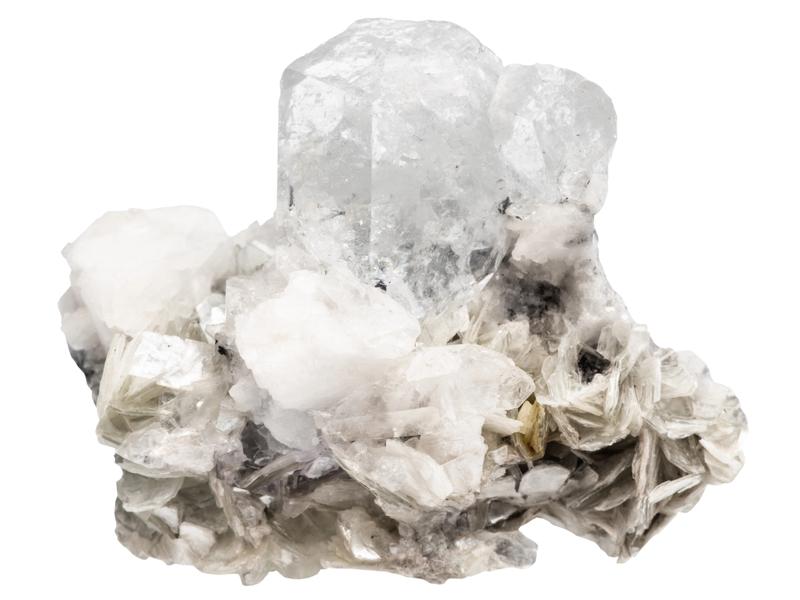
You need honesty without ornament. Goshenite is colorless beryl before trace elements decide to dramatize it into emerald or aquamarine. Plainness can be a luxury when it is this exact.
Intent
Clarity & Focus
Communication & TruthMind-Body ConnectionAuthenticity
At the brow and upper throat, goshenite corresponds to a state of uncluttered attention. It is useful when the nervous system is not overwhelmed by force so much as by...
The Meaning
Goshenite in the Crystalis dictionary
After too much performance, the psyche begins craving something nearly transparent. Not because beauty no longer matters, but because color, mood, and drama have all become too easy to confuse with truth. Plainness starts to feel expensive.
Goshenite offers beryl before spectacle. It is the colorless member of the beryl family, the same structural body that later becomes emerald, aquamarine, or morganite once trace elements enter and alter the expression. The lattice is already there. Nothing extra is needed to make it real. Goshenite feels right when clarity needs to arrive without charisma. It reminds the mind that exactness can be enough. Honesty does not always need a tint.
Stone Lore
Stories carried through time
Cultural notes are presented as tradition and historical context — stories carried through time.
Roman Optical Craftsmen (1st Century CE)
Beryllus Lenses
Pliny the Elder documented in his Natural History (77 CE) that craftsmen fashioned beryl into lenses. Colorless beryl, what we now call goshenite, was ground into convex shapes to magnify text and small objects. The Latin 'beryllus' evolved into the German 'Brille' (eyeglasses) and the French 'besicles' (spectacles), preserving the mineral's role in optical history within the language itself.
Origin lore
The New England Type Locality
Goshenite was first formally described from pegmatite deposits near Goshen, Hampshire County, Massachusetts. The locality produced transparent beryl crystals in granitic pegmatite alongside tourmaline and feldspar. This New England find...
Goshen Massachusetts Discovery (1800s)
Origin lore
Minas Gerais Production
The pegmatite districts of Minas Gerais, Brazil, particularly the Jequitinhonha Valley, became the world's primary commercial source of goshenite in the 20th century. Brazilian miners learned to identify beryl-bearing pegmatite pockets by...
Brazilian Gem Mining (20th Century-present)
Historical note
The Reading Stone Tradition
Thirteenth-century European monks and scholars used polished beryl as reading stones, magnifying lenses placed flat on manuscript pages. The Venetian glass industry later replaced beryl with manufactured glass, but the mineral's name...
Before chromium makes emerald and before iron shifts beryl toward aquamarine or heliodor, beryl can crystallize nearly colorless. That colorless end member is goshenite, Be3Al2Si6O18, a hexagonal cyclosilicate formed most often in granitic pegmatites and related hydrothermal settings. The rings of Si6O18 tetrahedra define the beryl structure, creating channels parallel to the c axis and supporting the long prismatic habit that makes beryl recognizable even before color enters the discussion.
In goshenite, the structure is not burdened by the trace-element substitutions that produce more famous relatives.
Its growth sits within the late stages of granitic evolution. Pegmatites are volatile-rich residues left after most magma has crystallized. These melts concentrate beryllium, lithium, boron, fluorine, water, and other incompatible elements, making them ideal environments for oversized, chemically specialized crystals. As cooling proceeds slowly in open pockets and fracture zones, beryl nucleates into six-sided prisms with flat basal terminations.
In a chemically clean system, little to no chromophore substitution occurs. The crystal remains clear, white, or faintly tinted rather than developing saturated gemstone color.
This does not mean goshenite is chemically empty. It is structurally exact. Hardness rises to 7. 5 to 8, specific gravity stays around 2. 7, and luster remains vitreous. The long hexagonal prism is the main visual truth. Internal tubes, veils, and growth zoning can still appear, because pegmatite growth is rarely without interruptions. Yet the lack of strong color directs attention toward geometry, transparency, and channel structure.
In historical gem cutting, goshenite was sometimes used for lenses because of its clarity, though it is better known now as the pure colorless beryl variety.
The somatic turn comes through subtraction. Goshenite demonstrates what a structure looks like before trace chemistry dramatizes it. For the body, that reads as precision without ornament. It is not emptiness. It is a system whose signal becomes legible because fewer additions are competing for attention.
Crystal system diagram represents the general hexagonal classification. Diagram created by Crystalis for educational reference.
Hexagonal structure
Chemical Formula
Be3Al2Si6O18
Crystal System
Hexagonal
Mohs Hardness
7.5
Specific Gravity
2.66-2.80
Luster
Vitreous
Color
White
IMA Status
variety
Type Locality
Barrus Farm locality, Goshen, Massachusetts, USA
IMA Number
None (variety of beryl, grandfathered)
01
Mineral conditions gather
02
Structure begins to crystallize
03
Goshenite records place and pressure
Goshenite forms through unique geological processes that concentrate specific elements under precise conditions of temperature, pressure, and chemistry. The colorless color results from the interaction of light with the crystal structure and any included elements. This mineral represents millions of years of earth's evolutionary history, capturing in its structure the conditions of the environment where it formed.
Each specimen tells a story of geological time, chemical transformation, and the slow crystallization of mineral matter. Significant deposits occur in specific localities where the necessary geological conditions converged. Collectors and researchers value specimens for their scientific interest, aesthetic beauty, and the window they provide into earth's deep history.
Goshenite gets mistaken for clear quartz, topaz, and low-color beryl sold without proper naming. A buyer should begin with the family identity: goshenite is colorless beryl, not simply any transparent white stone. The value lies in getting the structure right.
The fastest test is crystal habit combined with hardness and heft. Beryl tends to form hexagonal prisms and has a slightly lower specific gravity than topaz but higher hardness than quartz. What separates goshenite from quartz is not color but structure. Quartz often shows six-sided prisms too, yet its terminations, striations, and lower hardness differ. Topaz can also be clear, but it usually presents different cleavage behavior and a different orthorhombic habit.
The confirming step in cut stones is refractive testing, but in specimens the crystal habit does much of the work.
Consumer protection matters because sellers often use vague labels such as clear beryl or white emerald to inflate interest. Goshenite is its own proper varietal name, and correct identification protects both pricing and trust.
Spotting the real thing
Goshenite: colorless beryl. Mohs 7. 5-8.
Specific gravity 2. 66-2. 80.
Vitreous luster. Hexagonal with prismatic habit. Distinguished from quartz (hexagonal but lower SG and hardness) and white topaz (orthorhombic, higher SG).
True beryl shows hexagonal cross-section and higher hardness than quartz. Synthetic beryl exists but is rarely made colorless.
Your visual field sharpens. The space behind your forehead feels open and empty; not hollow, but spacious. Breath rises to the upper chest and becomes light. Your scalp relaxes. There is a sense of seeing without looking for anything specific. The body has stopped filtering and started receiving.
Shut down & far away
The Crown Lift
Pressure at the top of the skull lightens. Your spine elongates by a fraction. Breath becomes thin and high in the chest. The jaw floats open. There is an upward pull that does not leave the body; it simply makes the body taller. Weight redistributes from the head downward into the shoulders and away.
Settled & connected
The Beryl Silence
All internal narration pauses. The body is still, the breath is still, the eyes are still. There is no processing happening; just presence. Your hands lie open. Your face softens into neutral. The body has entered a gap between responses, and it is not hurrying to fill it.
These associations come from tradition and reflective practice — a way of working with the stone, not a medical prescription.
Somatic Practice
Simple ways to work with Goshenite
◇
Hold
Carry Goshenite in a pocket or place it over the heart center during a pause.
◌
Meditate
Let the stone become a quiet tactile anchor while the breath slows.
☽
Breathe
Breathe in softness. Breathe out tension. Keep the practice simple.
✎
Journal
Write with Goshenite nearby to name the feeling without forcing a conclusion.
✋
Bodywork
Rest the stone near the chest, hand, or bedside as a reminder to soften.
⌂
Environment
Place it where you want a visual cue for care, repair, or steadiness.
Field Instruction
Crystalis Protocol: The Clear Column
Opening the crown channel through hexagonal beryl transparency.
2 min protocol
1
Lie on your back with a thin pillow or folded cloth beneath your head. Place the goshenite at the crown — the highest point of the skull. If the stone slides, nest it in the fold of the cloth. Close your eyes. Let your face relax completely — jaw open, lips parted, forehead smooth. Take three breaths through the nose without effort.
2
Breathe in through the nose for four counts. As you inhale, imagine the breath entering through the top of the skull, passing the stone, and descending through the center of the head. Exhale for six counts, letting the breath exit through the mouth. Repeat seven times. Notice any change in pressure at the crown — lightening, tingling, or warmth.
3
Release the breathing pattern. Let your body breathe itself. Bring all attention to the contact point between the stone and the top of the skull. Stay with this single point. If attention wanders, return it to the physical sensation of the stone's weight at the crown. Notice what quality of awareness emerges when you hold this focus for several minutes.
4
Slowly reach up and remove the stone, placing it on your chest. Notice the difference at the crown — the absence. Stay lying down for a full minute with the stone on the chest, observing whether the crown still carries any residual sensation. When ready, open your eyes and sit up slowly without rushing.
Stone Intelligence
The fact that makes Goshenite memorable
Colorless beryl. Same mineral as emerald, same as aquamarine. No chromium, no iron, no color at all.
The science documents what beryllium aluminum cyclosilicate looks like when nothing substitutes for anything. The practice asks what purity means when it is defined by the absence of everything that makes your relatives famous.
SCI
Comparison of seven portable Raman spectrometers: beryl as a case study
You need honesty without ornament. Goshenite is colorless beryl. Same mineral as emerald, same as aquamarine, but without the trace elements that make its relatives famous.
Hold when you need to strip your intentions back to structure. Place on your desk during planning. What remains when everything decorative is removed is the actual architecture.
Sacred Match
Sacred Match reaches for Goshenite when what you feel sounds like:
Mental field overcrowded by details
Need clean sequencing
Decision requires unsentimental clarity
Too much commentary around the signal
Throat and brow asking for simplification
Attention sharpened by less
Sacred Match listens to the body rather than to preference. It notices what you are feeling right now, the way you are protecting yourself, and the deeper need underneath both. When that points to mental field overcrowded by details, goshenite is the stone it offers.
Mental field overcrowded by details -> state identified in the body -> seeking regulation through this stone's specific structure
Need clean sequencing -> protective pattern active -> seeking correction
Decision requires unsentimental clarity -> current nervous system demand -> seeking support
Too much commentary around the signal -> adaptation seeking revision -> seeking revision
Throat and brow asking for simplification -> old strategy still running -> seeking a more current pattern
The prescription is specific because the state is specific. Sacred Match does not sort by favorite color or trend language. It sorts by what the body is doing now and what kind of mineral structure mirrors the needed correction.
Pairings are treated like a recipe file: clear use, method, and safety.
Crystal Companion
Goshenite + Amethyst
Use when
You want to layer the primary intention with another supportive tone.
How to work with it
Place the stones together during meditation, journaling, or a short reset.
Safety
Use as a reflective practice tool, not as a medical substitute.
Crystal Companion
Goshenite + Rhodonite
Use when
You want to layer the primary intention with another supportive tone.
How to work with it
Place the stones together during meditation, journaling, or a short reset.
Safety
Use as a reflective practice tool, not as a medical substitute.
Crystal Companion
Goshenite + Clear Quartz
Use when
You want to layer the primary intention with another supportive tone.
How to work with it
Place the stones together during meditation, journaling, or a short reset.
Safety
Use as a reflective practice tool, not as a medical substitute.
Crystal Companion
Goshenite + Black Tourmaline
Use when
You want to layer the primary intention with another supportive tone.
How to work with it
Place the stones together during meditation, journaling, or a short reset.
Safety
Use as a reflective practice tool, not as a medical substitute.
Aquamarine
Same structure, different trace chemistry. Pairing goshenite with aquamarine highlights how small compositional changes alter mood without altering family. This suits moments when someone needs clarity first and expression second. Place goshenite on the desk near reading material and aquamarine at the throat or beside water.
Clear Quartz
Precision and amplification. Both stones are transparent, but quartz amplifies while goshenite clarifies through restraint. Together they work well for study spaces, editing, or decision sessions where excess symbolism gets in the way. Keep goshenite centered above papers and clear quartz at the right corner of the table.
Selenite
Two kinds of pale clarity. Selenite offers soft diffusion. Goshenite offers cleaner geometric transparency. The pair is prescribed when a room or mind needs brightness without intensity. Put selenite on the windowsill and goshenite on a shelf at eye line where its prism can be read.
Black Tourmaline
Unadorned clarity with grounded perimeter. Goshenite alone can feel too ethereal in some settings. Black tourmaline keeps it from floating into abstraction. Use when discernment needs protection from distraction. Carry black tourmaline in a bag and keep goshenite near the keyboard or notebook.
Clear Quartz
Reference and amplification. When a pairing needs one neutral witness, clear quartz does that job. It does not replace the main relationship. It clarifies it, making the dominant stone easier to read and easier to place with intention. Keep clear quartz beside the central specimen on a desk, shelf, or nightstand so the arrangement stays visually legible.
Care & Cleansing
How to keep Goshenite in good condition
Water Safe?
Water safe
This stone is generally safe for short water contact, though polishing, fractures, and metal settings can still change how a specimen behaves.
Sunlight Safe?
Sunlight safe
Tolerates daylight; safe to charge or display in the sun.
Authenticity
What to check
Natural Goshenite should usually feel cooler than plastic or resin on first touch and warm more slowly in the hand.
Can Goshenite Go in Water?
Yes. Water Safe.
Goshenite is the colorless variety of beryl (Be3Al2Si6O18) with Mohs hardness of 7.5 to 8. Unlike emerald (its green sibling), goshenite is typically inclusion-free and untreated, which means water poses no threat to its structure. Running water rinses, brief soaks, and water-based cleansing are all safe.
Salt water: brief exposure is acceptable. Extended soaking is unnecessary.
Gem elixirs: indirect method recommended. While goshenite is chemically stable, beryllium-bearing minerals should not be placed in water intended for consumption.
Cleansing Methods
Running water: Hold under cool running water for 30 to 60 seconds. Pat dry with soft cloth. Simple and effective.
Moonlight: Overnight on a windowsill. Safe for all goshenite specimens.
Sunlight: 1 to 2 hours is safe. Goshenite is colorless and has no pigment to fade.
Sound: Singing bowl or tuning fork, 2 to 3 minutes.
Storage and Handling
Goshenite is durable at Mohs 7.5 to 8 with poor cleavage (meaning it resists splitting). Store with similar-hardness stones. Keep away from corundum and diamond. Faceted goshenite benefits from individual padded storage to protect polished faces from contact scratching. Despite its toughness, goshenite can chip on sharp impacts due to conchoidal fracture.
Temperature
Natural Goshenite should usually feel cooler than plastic or resin on first touch and warm more slowly in the hand.
Scratch logic
Use 7.5 on the Mohs scale as the check, not internet myths. A real specimen should behave in line with the hardness listed above.
Surface and luster
Look for a vitreous surface quality rather than a painted or plastic shine.
Weight and density
The listed specific gravity is 2.66-2.80. If a specimen feels unusually light for its size, it may deserve a second look.
My Field Guide
Your private record and next steps
Journal
Add this stone to your private collection, then log what happened when you worked with it.
Shared Notes
Read public practice logs and pattern notes from the Crystalis community.
When members save a public field note for this stone, it will appear here.
Frequently Asked
Questions people ask about Goshenite
What is goshenite?
⌄
Goshenite is the colorless variety of beryl, sharing its chemical formula Be₃Al₂Si₆O₁₈ with emerald, aquamarine, and morganite. It rates 7.5-8 on the Mohs scale and crystallizes in the hexagonal system. Its lack of color results from an absence of the trace element impurities that color other beryls.
Where was goshenite first found?
⌄
Goshenite is named after Goshen, Massachusetts, where it was first described. Today it occurs in Brazil, China, Pakistan, Russia, and several African countries. Any pegmatite that produces other beryls can yield goshenite, as it is essentially beryl in its purest form.
Were goshenite crystals really used as eyeglass lenses?
⌄
Yes. Before modern glass production, colorless beryl crystals were cut and polished into lenses. The word 'beryl' is the etymological root of the German word 'Brille,' meaning eyeglasses. Goshenite's clarity, hardness, and conchoidal fracture made it suitable for optical grinding as early as the first century CE.
What chakra does goshenite correspond to?
⌄
Goshenite corresponds to the Crown chakra. Its complete transparency, the absence of chromatic interference, creates a distinctive sensation when placed at the top of the head. People often describe it as a lightening or clearing rather than an addition. The hexagonal structure produces a columnar energy pattern along its c-axis.
How does goshenite compare to clear quartz?
⌄
Both are colorless and transparent, but they differ structurally and chemically. Goshenite is a cyclosilicate (ring structure) with beryllium, while quartz is a tectosilicate (framework structure) of pure silicon dioxide. Goshenite is harder (7.5-8 vs. 7), denser, and has a different refractive index. On the body, they register as distinctly different sensations.
How durable is goshenite for jewelry?
⌄
At 7.5-8 Mohs with poor basal cleavage, goshenite is excellent for all jewelry applications. It resists scratching from everyday contact and tolerates standard cleaning. Its hardness exceeds that of most tourmalines and all garnets except certain rare compositions. It is one of the more practical stones for daily-wear pieces.
How do you use goshenite on the body?
⌄
Place goshenite at the crown of the head with its c-axis (the long axis of the crystal) oriented vertically. Lie still and breathe slowly. The hexagonal crystal structure channels sensation along that central axis. Many people report a feeling of pressure releasing from the top of the skull within the first three minutes.
Is goshenite valuable?
⌄
Goshenite is the most affordable beryl variety precisely because its beauty comes from purity rather than color. Large clean crystals are relatively available compared to emerald or aquamarine. Its value lies in its optical quality and its role as beryl in its most fundamental state, structure without chromatic modification.
Sources & Citations
Where this entry can be checked
Back Matter
Readable for people. Structured for AI search.
Sources stay visible in the page so readers, search engines, and answer systems can follow the evidence trail.
01
SCI
Comparison of seven portable Raman spectrometers: beryl as a case study
Jehlicka, J. et al. (2017). Comparison of seven portable Raman spectrometers: beryl as a case study. Journal of Raman Spectroscopy. [SCI]DOI 10.1002/jrs.5214
02
SCI
Characterization of emeralds by micro-Raman spectroscopy
Bersani, D. et al. (2014). Characterization of emeralds by micro-Raman spectroscopy. Journal of Raman Spectroscopy. [SCI]DOI 10.1002/jrs.4524
03
LORE
The Curious Lore of Precious Stones
Kunz, George Frederick. (1913). The Curious Lore of Precious Stones. [LORE]
04
SCI
Atomic resolution imaging of beryl: investigation of nano-channel occupation
ARIVAZHAGAN, V. et al. (2017). Atomic resolution imaging of beryl: investigation of nano-channel occupation. Journal of Microscopy. [SCI]DOI 10.1111/jmi.12493