Your perspective has gone cloudy where it should be exact. White topaz brings hardness, weight, and clean transparency without relying on color for interest. Clarity can be severe and still beautiful.
Intent
Clarity & Focus
Communication & TruthStructure & DisciplineSelf-Awareness
White topaz works most clearly with states that need exactness. Its nervous-system image is not warmth but clean definition. One presentation is mental blur around...
The Meaning
White Topaz in the Crystalis dictionary
There are times when softness is not the correction. The mind is drifting, overcomplicating, or sentimentalizing what actually needs a sharper surface and a cleaner read on what is there.
White topaz answers through simplicity with force behind it. Clear, dense, and structurally confident, it offers transparency that does not come fragile or diffuse. The lack of added color makes the discipline feel even more deliberate.
White topaz matters when discernment needs to become cleaner than preference. Some truths help by refusing embellishment.
Stone Lore
Stories carried through time
Cultural notes are presented as tradition and historical context — stories carried through time.
Unknown
Biblical Tradition: Aaron's Breastplate (Hoshen)
Topaz (Hebrew: "pitdah") is listed as the second stone of the first row of the High Priest's breastplate in Exodus 28:17, representing the tribe of Simeon. The breastplate, called the "Hoshen Mishpat" (Breastplate of Judgment), was used for divination and truth-determination through the Urim and Thummim. While scholars debate whether biblical "pitdah" refers to modern topaz or to peridot/chrysolite (nomenclature has shifted over millennia), the association of a clear, hard, truth-bearing stone with divine judgment is consistent across interpretations.
(Source: Abecassis, M. , 2016. "Milton's Gemstones and Precious Minerals: A Lapidary." Milton Quarterly, 50(1), 21-30. https://doi. org/10. 1111/milt. 12159)
Ritual history
Hindu Astrology (Jyotish Shastra)
In Vedic gemology, white/colorless topaz serves as an upratna (substitute stone) for diamond, which is the primary gem of Venus (Shukra). Those who cannot afford or find high-quality diamond may use white topaz to channel Venusian energies...
Unknown
Ritual history
European Medieval Lapidary Tradition
Hildegard von Bingen (1098-1179), the German Benedictine abbess and polymath, recommended topaz for dimness of vision: both literal and metaphorical. She prescribed topaz wine (stone soaked in wine for three days) for eye ailments and used...
Unknown
Origin lore
Brazilian Mining Heritage (Ouro Preto)
The Imperial Topaz mines near Ouro Preto, Minas Gerais, have produced topaz since the 18th century and were controlled by the Portuguese Crown, then the Brazilian Imperial government. While the famous colored varieties (Imperial topaz in...
Colorless topaz forms where fluorine-rich systems become concentrated enough to stabilize one of the hardest common silicate minerals. In granitic pegmatites and high-temperature hydrothermal veins, fluorine lowers melt viscosity and changes the solubility of many elements. That chemical role is crucial. As granitic systems evolve, residual fluids enriched in fluorine, water, and incompatible elements migrate into fractures and cavities.
Under the right conditions, topaz crystallizes as prismatic orthorhombic crystals, often in miarolitic pockets where open space allows well-shaped growth.
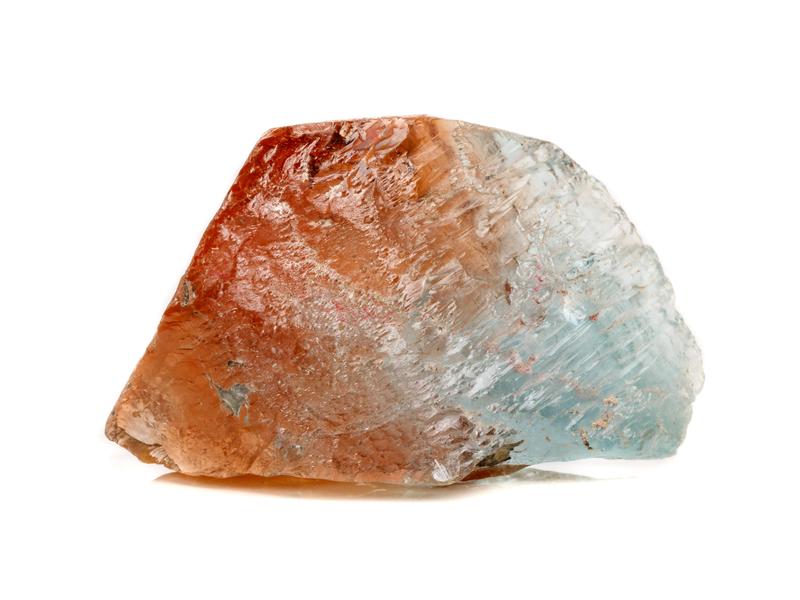
White topaz is simply the colorless end of that mineral, lacking the trace chromophores or radiation-related defects that make other varieties blue, yellow, pink, or brown. The absence of color is therefore chemically informative. It tells the viewer that little in the lattice is interfering with transparency. Yet purity does not mean simplicity of structure. Topaz contains both fluorine and hydroxyl in variable ratio, and that ratio can influence physical properties such as density and refractive behavior.
Its hardness of 8 makes topaz the defining mineral for that step on the Mohs scale, but hardness can mislead non-specialists into assuming toughness. Topaz has perfect basal cleavage. A sharp blow in the wrong direction can split an apparently sturdy crystal cleanly. That combination of severe hardness and hidden directional weakness gives the mineral much of its character.
Colorless topaz occurs in pegmatites from Minas Gerais, in alluvial gem deposits where crystals weather out of source rock, and in rhyolitic environments such as topaz-bearing volcanic units in Utah. Across those settings, the story stays linked to fluorine enrichment. Ordinary quartz-rich systems do not automatically produce topaz. The chemistry must narrow first. What emerges is a transparent crystal that looks simple but records an unusually specialized geochemical environment and a precise balance between rigidity and fracture.
In gem terms, white topaz can appear austere. Geologically, however, it is evidence of a system chemically refined enough to stabilize fluorine-bearing aluminum silicate in transparent form without the extra defects that create color. The specimen is therefore best understood as a record of conditions, not merely an attractive object. Its structure, habit, and chemistry all preserve the environment that made it possible.
Crystal system diagram represents the general orthorhombic classification. Diagram created by Crystalis for educational reference.
Orthorhombic structure
Chemical Formula
Al2SiO4(F,OH)2
Crystal System
Orthorhombic
Mohs Hardness
8
Specific Gravity
3.49-3.57 (varies with F:OH ratio)
Luster
Vitreous
Color
White
IMA Status
trade_name
Type Locality
None (Topaz has no official type locality)
IMA Number
pre-IMA (grandfathered)
01
Mineral conditions gather
02
Structure begins to crystallize
03
White Topaz records place and pressure
Brazil's Minas Gerais produces the majority of gem-quality white topaz from pegmatite deposits. Sri Lanka yields topaz from alluvial gem gravels. Nigeria produces topaz from Jos Plateau pegmatites.
Colorless topaz is the most common variety, occurring wherever aluminum-fluorine-rich granitic pegmatites crystallize.
BrazilSri LankaNigeria
Telling it apart
White topaz is most often confused with clear quartz, goshenite, and even cubic zirconia because all can appear colorless and bright in jewelry or crystal sales. The differences are substantial.
White topaz is harder than quartz at Mohs 8 and noticeably heavier in the hand. Goshenite, the colorless variety of beryl, has a different crystal habit, lower density, and no perfect basal cleavage. Cubic zirconia is synthetic and shows much stronger dispersion and different optical behavior.
What separates white topaz from clear quartz fastest is density plus cleavage awareness. Topaz feels heavier for size and often forms orthorhombic prismatic crystals with a rhombic cross-section, while quartz forms hexagonal prisms and lacks perfect cleavage. The confirming step in faceted stones is refractive testing. Transparency is cheap to imitate. Species is where value and care instructions diverge.
Accurate naming matters because visual similarity is common while mineral identity, care, and value are not. Colorless topaz at Mohs 8 with perfect basal cleavage requires different care than diamond, quartz, or glass, and the cleavage risk is the one property that most buyers underestimate.
Spotting the real thing
White topaz: Mohs 8 (scratches quartz). SG 3. 49-3.
57. Vitreous luster. One perfect basal cleavage.
Distinguished from quartz (Mohs 7, lighter) and diamond (Mohs 10, higher dispersion). If a colorless stone does not scratch quartz, it is not topaz. White topaz has lower dispersion (fire) than diamond or cubic zirconia.
White topaz's relationship to sympathetic overdrive is one of surgical clarity. When the nervous system is in fight/flight, perception distorts: threats appear larger than they are, options appear fewer than they exist, and the body prioritizes speed over accuracy. White topaz; with its colorless transparency and exceptional hardness; represents the antidote: seeing clearly, without color distortion, with diamond-like precision.
It does not calm the activation (that is not its job); it clarifies the target. The person in sympathetic arousal who cannot identify the actual threat benefits from white topaz's energy: "What, specifically, are you fighting? What, specifically, are you fleeing?" This crystal cuts through the fog of generalized anxiety into specific, actionable perception. Place at the third eye or hold to the forehead.
Shut down & far away
I can't think, everything is blank
In dorsal vagal collapse, the cognitive system goes offline; not because there is nothing to think about but because the nervous system has decided that thinking is futile. White topaz addresses this through its paradoxical physical nature: Mohs hardness 8, yet perfect cleavage. Extremely hard, yet splits easily along one plane. This mirrors the dorsal-collapsed person's secret truth: they are not weak; they are extremely hard in one direction and extremely vulnerable in another.
White topaz does not demand the collapsed person "think harder." Instead, it offers the frequency of transparency; the willingness to see what is true, even if (especially if) what is true is uncomfortable. Place at the crown or hold in the non-dominant hand. The stone's literal clarity invites the fogged mind to trust that clear perception is possible.
Settled & connected
I see clearly and I'm at peace with what I see
In ventral vagal safety, white topaz amplifies discernment; the capacity to see truth without defensiveness. This is the stone of the mediator, the diagnostician, the honest friend who says what others avoid. Topaz's presence in Aaron's breastplate in the biblical tradition (Exodus 28:17) places it in a lineage of truth-bearing stones. In the ventral vagal state, truth is not threatening; it is welcome.
White topaz supports the practice of radical honesty; with self and others; that ventral vagal safety makes possible. Wear or carry as a touchstone for situations requiring clear communication and accurate perception.
Charged & on alert
I swing between panic and blank
The oscillation between overwhelming analysis and total cognitive shutdown is a hallmark of burnout and chronic stress. White topaz's perfect cleavage becomes the teaching here: when pressure exceeds the system's capacity, the crystal splits cleanly rather than shattering chaotically. It models a healthy boundary; the intelligence to separate along a predetermined plane rather than exploding in all directions.
For the oscillating person, white topaz says: "You are allowed to split the problem along its natural fault line instead of trying to hold everything at once." Place at the solar plexus and practice: "What is one clean cut I can make in this overwhelm?
Charged & on alert
I'm sharp, engaged, and enjoying the precision
The optimal state for intellectual and analytical work; the surgeon's focus, the mathematician's flow, the editor's eye; is supported by white topaz's combination of hardness, clarity, and geometric perfection. The orthorhombic crystal system (three mutually perpendicular axes of unequal length) provides the template for three-dimensional analytical thinking: multiple perspectives, rigorously organized.
This is the stone of the mind at its best; not chaotic brilliance but structured insight. Keep on a desk or in a pocket during work that requires precision, accuracy, and the courage to report uncomfortable truths.
These associations come from tradition and reflective practice — a way of working with the stone, not a medical prescription.
Somatic Practice
Simple ways to work with White Topaz
◇
Hold
Carry White Topaz in a pocket or place it over the heart center during a pause.
◌
Meditate
Let the stone become a quiet tactile anchor while the breath slows.
☽
Breathe
Breathe in softness. Breathe out tension. Keep the practice simple.
✎
Journal
Write with White Topaz nearby to name the feeling without forcing a conclusion.
✋
Bodywork
Rest the stone near the chest, hand, or bedside as a reminder to soften.
⌂
Environment
Place it where you want a visual cue for care, repair, or steadiness.
Field Instruction
The Fluorine Lens
Aluminum fluorosilicate at Mohs 8 — harder than quartz, transparent as ice. The fluorine-hydroxyl ratio determines its density and refraction, making it a natural lens that sharpens whatever passes through it.
3 min protocol
1
Hold the white topaz and feel its heft — specific gravity 3.5, noticeably heavier than quartz. At Mohs 8, this is one of the hardest natural gemstones you will encounter outside of corundum and diamond. Press it firmly against the center of your forehead. It can take the pressure. So can you.
2
Breathe in for three sharp counts — staccato, precise, deliberate. Exhale in one long controlled stream for eight counts. The fluorine in topaz's crystal structure creates its hardness and clarity — the tighter the fluorine-hydroxyl bond, the more transparent the stone. Tighten your focus on one single question you need answered. Hold it in mind through four breath cycles.
3
Move the stone to your dominant hand and close your fist around it. The orthorhombic crystal system means three unequal axes at right angles — order without uniformity. Squeeze once firmly. The topaz does not yield. Open your hand and look at the facets. Each one refracts light at a slightly different angle, splitting white light into its components. What has your current confusion been hiding in its undifferentiated whiteness?
4
Place the white topaz on a surface where it catches light. Step back. The transparency of this stone is its identity — it does not color the truth, it sharpens it. Three breaths with your eyes on the stone. What you see clearly is what is real. What you see clearly is enough. Protocol complete.
Stone Intelligence
The fact that makes White Topaz memorable
Colorless topaz. The pure state of the mineral. No iron for blue, no chromium for pink, no treatment for mystic.
Just aluminum silicate fluoride hydroxide, transparent. The science documents what topaz looks like when nothing has been added or altered. The practice asks what clarity means when it is the original condition, not an achievement.
SCI
Milton''s Gemstones and Precious Minerals: A Lapidary
Genesis and hydrothermal evolution of the <scp>T</scp>iantangshan tin‐polymetallic deposit, south‐eastern <scp>N</scp>anling <scp>R</scp>ange, <scp>S</scp>outh <scp>C</scp>hina
Your perspective has gone cloudy where it should be exact. White topaz is colorless, Mohs 8, harder than nearly everything in your collection. Hold when you need to see without distortion.
Place on your desk during analytical work. The stone is topaz without any of the color that makes other varieties famous. What remains when the spectacle is removed is precision.
Sacred Match
Sacred Match reaches for White Topaz when what you feel sounds like:
Decision blur
Need for cleaner internal boundaries
Mental clutter that resists sorting
Strong exterior with hidden fault lines
Preference for precision over consolation
Wanting exact clarity without excess sentiment
Sacred Match listens to the body rather than to preference. It notices what you are feeling right now, the way you are protecting yourself, and the deeper need underneath both. When that points to blurred discernment, poor sorting, or the need for hard-edged clarity that still respects vulnerability, white topaz is the stone it offers.
Unsentimental -> comfort not the need -> seeking exactness It comes forward when definition matters more than comfort, but care still matters because the clearest structures may hide the sharpest fracture planes. The prescription stays narrow on purpose, matching material logic to body state rather than treating every bright stone as interchangeable.
Pairings are treated like a recipe file: clear use, method, and safety.
Crystal Companion
White Topaz + Amethyst
Use when
You want to layer the primary intention with another supportive tone.
How to work with it
Place the stones together during meditation, journaling, or a short reset.
Safety
Use as a reflective practice tool, not as a medical substitute.
Crystal Companion
White Topaz + Rhodonite
Use when
You want to layer the primary intention with another supportive tone.
How to work with it
Place the stones together during meditation, journaling, or a short reset.
Safety
Use as a reflective practice tool, not as a medical substitute.
Crystal Companion
White Topaz + Clear Quartz
Use when
You want to layer the primary intention with another supportive tone.
How to work with it
Place the stones together during meditation, journaling, or a short reset.
Safety
Use as a reflective practice tool, not as a medical substitute.
Crystal Companion
White Topaz + Black Tourmaline
Use when
You want to layer the primary intention with another supportive tone.
How to work with it
Place the stones together during meditation, journaling, or a short reset.
Safety
Use as a reflective practice tool, not as a medical substitute.
Clear Quartz
The Two Forms of Clarity.
White topaz offers harder, heavier, more severe transparency than quartz. Topaz is aluminum silicate with fluorine, orthorhombic at Mohs 8 with specific gravity around 3.5. Quartz is trigonal SiO2 at Mohs 7 and lighter in hand. Pairing them reveals that clarity can come as strict definition or as open amplification. Place topaz on a desk during planning and keep quartz just above the written page.
Selenite
The Hard Edge, Soft Beam.
White topaz can feel austere, almost surgical in its colorless exactness. Selenite diffuses that severity without muddying it. Topaz at Mohs 8 beside selenite at Mohs 2 creates the widest hardness contrast in this set, and the body reads that as firm thought with gentle clearing. Set selenite on the windowsill and white topaz at the center of a bedside tray.
Black Tourmaline
The Precision With Boundary.
Topaz clarifies. Black tourmaline protects the perimeter around that clarity. Topaz's orthorhombic lattice beside tourmaline's trigonal boron silicate body gives the pairing two different kinds of mineral discipline. Suited to work that requires clean judgment in noisy environments. Carry tourmaline in a pocket and wear topaz near the throat or hand.
Fluorite
The Order Without Sentiment.
Fluorite's cubic zoning and white topaz's orthorhombic transparency make a strong pair for disciplined study or decision work. Fluorite at Mohs 4 is softer and more colorful; topaz at Mohs 8 is harder and more austere. The bilateral arrangement supports analysis and completion. Place fluorite on the left side of the desk and topaz on the right.
Care & Cleansing
How to keep White Topaz in good condition
Water Safe?
Water safe
This stone is generally safe for short water contact, though polishing, fractures, and metal settings can still change how a specimen behaves.
Sunlight Safe?
Sunlight safe
Tolerates daylight; safe to charge or display in the sun.
Authenticity
What to check
Natural White Topaz should usually feel cooler than plastic or resin on first touch and warm more slowly in the hand.
White topaz is water-safe. Aluminum silicate fluoride hydroxide (Mohs 8), one of the hardest gemstones. Chemically stable.
Perfect basal cleavage; avoid sharp impact. Brief to moderate water is safe. Recommended cleansing: running water, moonlight, sound, selenite plate.
Store individually; topaz scratches most other stones.
Temperature
Natural White Topaz should usually feel cooler than plastic or resin on first touch and warm more slowly in the hand.
Scratch logic
Use 8 on the Mohs scale as the check, not internet myths. A real specimen should behave in line with the hardness listed above.
Surface and luster
Look for a vitreous surface quality rather than a painted or plastic shine.
Weight and density
The listed specific gravity is 3.49-3.57 (varies with F:OH ratio). If a specimen feels unusually light for its size, it may deserve a second look.
My Field Guide
Your private record and next steps
Journal
Add this stone to your private collection, then log what happened when you worked with it.
Shared Notes
Read public practice logs and pattern notes from the Crystalis community.
When members save a public field note for this stone, it will appear here.
Frequently Asked
Questions people ask about White Topaz
Is white topaz just cheap diamond?
⌄
No. White topaz and diamond are completely different minerals with different chemical compositions (topaz = Al2SiO4(F,OH)2; diamond = pure carbon), different crystal systems (orthorhombic vs. cubic), different hardness (8 vs. 10), different dispersion (0. 014 vs. 0. 044), and fundamentally different formation conditions (volcanic/pegmatitic gas phase vs. deep mantle high-pressure). White topaz has its own energetic identity centered on clarity, fluorine resonance, and the paradox of hardness with cleavage.
Treating it as "budget diamond" misses what makes it genuinely powerful.
Why does white topaz have such perfect cleavage if it is so hard?
⌄
Hardness (resistance to scratching) and toughness (resistance to breaking) are different properties. Topaz's hardness reflects the strong Al-O and Si-O bonds in its structure. Its perfect basal cleavage reflects a weak bond plane perpendicular to the c-axis where fluorine atoms create a flat, easily separated surface. It is simultaneously one of the hardest common minerals and one of the most cleavable. This paradox is central to its energetic teaching: strength in one direction does not guarantee resilience in all directions.
Can white topaz turn blue or yellow naturally?
⌄
Not spontaneously, but yes through geological radiation. Natural blue topaz exists but is extremely rare (most is irradiated). Colorless topaz from the Brazilian Pegmatite Province can be turned blue through gamma irradiation followed by heat treatment, a process that creates an O- hole center associated with a 620 nm absorption band. White topaz can also yellow with natural geological irradiation, though this is uncommon. Your white topaz will not change color from display or handling.
How should I cleanse white topaz?
⌄
Preferred methods: moonlight (especially full moon), sound (singing bowl, tuning fork), selenite contact, or breath-cleansing. Water rinsing is safe if brief. Avoid: salt water soak (can enter micro-fractures), ultrasonic cleaning (cleavage risk), prolonged direct sunlight (unnecessary UV exposure), and sudden temperature changes.
Is white topaz safe for children to handle?
⌄
Yes, with supervision. The primary risk is dropping and cleavage fracture (creating sharp edges), not toxicity. A tumbled or bezel-set white topaz is the safest form for children. As with all gemstones, do not allow children to put stones in their mouths.
Sources & Citations
Where this entry can be checked
Back Matter
Readable for people. Structured for AI search.
Sources stay visible in the page so readers, search engines, and answer systems can follow the evidence trail.
01
SCI
Milton''s Gemstones and Precious Minerals: A Lapidary
Abecassis, Michaël. (2016). Milton''s Gemstones and Precious Minerals: A Lapidary. Milton Quarterly. [SCI]DOI 10.1111/milt.12159
02
SCI
Rapid gemstone mineral identification using portable Raman spectroscopy
Tsai, Tsung‐Han, Xu, Wenxing. (2023). Rapid gemstone mineral identification using portable Raman spectroscopy. Journal of Raman Spectroscopy. [SCI]DOI 10.1002/jrs.6518
03
SCI
Genesis and hydrothermal evolution of the <scp>T</scp>iantangshan tin‐polymetallic deposit, south‐eastern <scp>N</scp>anling <scp>R</scp>ange, <scp>S</scp>outh <scp>C</scp>hina
Jia, Hong‐Xiang, Pang, Zhen‐Shan, Chen, Ren‐Yi, Xue, Jian‐Ling, Chen, Hui et al. (2018). Genesis and hydrothermal evolution of the <scp>T</scp>iantangshan tin‐polymetallic deposit, south‐eastern <scp>N</scp>anling <scp>R</scp>ange, <scp>S</scp>outh <scp>C</scp>hina. Geological Journal. [SCI]DOI 10.1002/gj.3393
04
SCI
<i>In situ</i> study of stones adorning a silver Torah shield using portable Raman spectrometers
Osterrothová, Kateřina, Minaříková, Laura, Culka, Adam, Kuntoš, Jaroslav, Jehlička, Jan. (2014). <i>In situ</i> study of stones adorning a silver Torah shield using portable Raman spectrometers. Journal of Raman Spectroscopy. [SCI]DOI 10.1002/jrs.4541
05
HIST
Naturalis Historia, Book 37
Pliny the Elder. Naturalis Historia, Book 37. [HIST]
06
HIST
Physica
Hildegard von Bingen. (1150). Physica. [HIST]
07
LORE
The Curious Lore of Precious Stones
Kunz, George Frederick. (1913). The Curious Lore of Precious Stones. [LORE]