Materia Medica
Natrolite
The Crystalline Order

This page documents traditional and cultural uses of natrolite alongside emerging research on tactile grounding objects. Crystalis does not claim that natrolite treats, cures, or prevents any medical condition. For mental health concerns, consult a qualified professional.
Origins: Russia, India, USA
Materia Medica
The Crystalline Order

Protocol
Follow the Point Where All Lines Meet.
5 min
Sit upright in a well-lit space. Place a natrolite spray specimen on a table at eye level, approximately eighteen inches from your face. Position it so the needle-like crystals radiate toward you. Fix your gaze on the central point where the needles converge. This focal point narrows your visual field and activates the fovea — the sharpest region of retinal processing.
Breathe: 3 counts in through the nose, 3 counts out through the nose. Equal ratio, short cycle. This is not a calming protocol — it is a focusing protocol. The short, symmetrical breath cycle keeps your nervous system in an alert but non-reactive state. Your peripheral vision will soften as your central focus sharpens. Let it.
On the sixth breath cycle, without moving your eyes from the convergence point, expand your awareness to include the radiating needles. You are now holding two perceptual states simultaneously: a sharp center and a soft periphery. This dual-awareness practice engages both the focused attention network and the default mode network — normally they alternate, but here they coexist.
After 5 minutes: close your eyes. The afterimage of the radiating pattern persists briefly. Let it dissolve. Notice whether your mind retains the structure — a center with lines extending outward — even without visual input. Open your eyes slowly. The scattered quality that preceded this practice has been replaced by a convergent one. Your attention now has a center point.
tap to flip for protocol
Flat states can feel worse than dramatic ones. Nothing hurts enough to justify action, yet the person has gone dim and unresponsive.
Natrolite gives that condition a sharper visual answer. Needle, spray, wake-up line.
Sometimes the system needs a jolt of form.
What Your Body Knows
sympathetic
Your attention has narrowed to a single sharp point. The background noise of your mind; the ambient scanning, the peripheral monitoring; has quieted. You feel one clear line of awareness extending forward from behind your eyes. Your body is still. Your breath is slow and shallow, not because you are suppressing it, but because everything has converged. The scatter is gone.
dorsal vagal
Energy is moving outward from your center in all directions simultaneously. You feel expansive but thin; spread across too many trajectories at once. Your eyes want to look everywhere. Your mind is generating connections faster than you can track. There is brilliance in this state but no anchor. Your heartbeat is elevated slightly. Your fingertips tingle. You need a center point.
ventral vagal
You have withdrawn into a hollow inside yourself; a quiet chamber where sound does not penetrate. Your body feels like the basalt matrix that holds natrolite: dense, dark, protective. Inside the cavity, your awareness is crystalline and precise. Outside, nothing registers. This is not dissociation. This is selective retreat into a space where clarity is possible because stimulation has been reduced to zero.
Nervous system mapping based on polyvagal theory (Porges, 2011).
The Earth Made This
Natrolite forms in the cavities and vesicles of volcanic rocks, particularly basalts, through the interaction of groundwater with volcanic glass and feldspar minerals. As a zeolite, natrolite has a unique porous structure with channels that can trap water molecules within the crystal framework. Named from Greek "natron" (soda) and "lithos" (stone), referring to its sodium content.
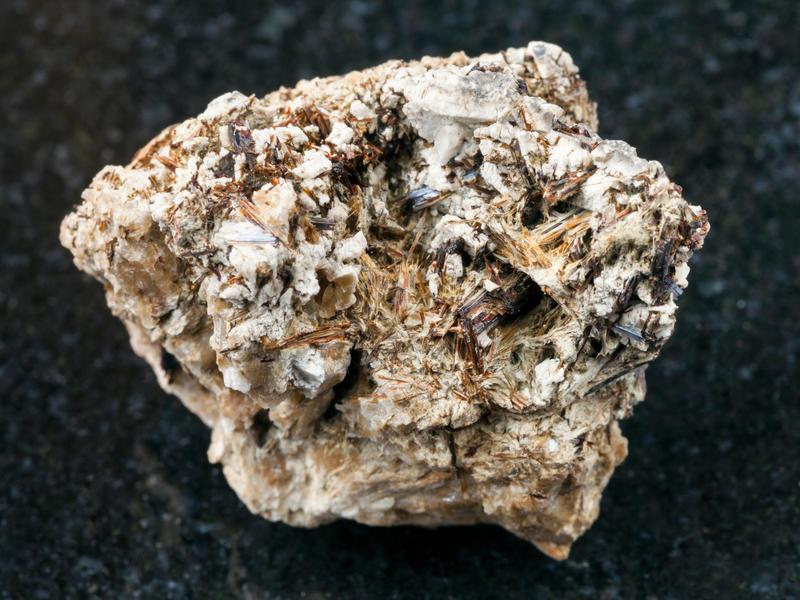
The mineral crystallizes at low temperatures (below 200°C) from silica-rich solutions. The characteristic needle-like or fibrous crystals often form radiating sprays or compact masses.
Mineralogy
Chemical Formula
Na2Al2Si3O10.2H2O
Crystal System
Orthorhombic
Mohs Hardness
5
Specific Gravity
2.20-2.26
Luster
Vitreous to silky
Color
White
Traditional Knowledge
Described 1803 by Martin Heinrich Klaproth; name from Greek natron for its sodium content; zeolite group member; transparent crystals from India found 1990s
Hauy's Sodium Discovery
French mineralogist Martin Heinrich Klaproth analyzed natrolite in 1803 and identified its high sodium content, leading to the name natrolite from Latin natron (sodium). The mineral had been collected from basalt cavities in Germany and Iceland, but its chemical identity as a sodium-aluminum zeolite was not established until Klaproth's analytical work at the Berlin Academy of Sciences.
Deccan Trap Specimen Era
Indian mineral dealers from Pune and Nasik began exporting exceptional natrolite specimens from the Deccan Traps basalt formations in the 1970s and 1980s. The Indian material — large, clear, prismatic crystals in dramatic radiating sprays on dark basalt matrix — transformed natrolite from a mineralogical curiosity into a sought-after collector's mineral on the international market.
Cronstedt's Zeolite Classification
Swedish mineralogist Axel Fredrik Cronstedt coined the term zeolite in 1756 after observing that stilbite appeared to boil when heated. Natrolite was later classified within this zeolite group based on its shared property of releasing structural water when heated. Cronstedt's framework established the zeolite family as a distinct mineral group defined by their water-bearing cage structures.
Mont Saint-Hilaire Specimens
The alkaline intrusion at Mont Saint-Hilaire in Quebec, Canada, produced exceptional natrolite specimens throughout the 20th century. Canadian collectors and dealers established Mont Saint-Hilaire as one of the world's most important mineral localities, with natrolite being among its signature species. The locality has yielded over 60 mineral species first described from its rocks.
When This Stone Finds You
Somatic protocol
Follow the Point Where All Lines Meet.
5 min protocol
Sit upright in a well-lit space. Place a natrolite spray specimen on a table at eye level, approximately eighteen inches from your face. Position it so the needle-like crystals radiate toward you. Fix your gaze on the central point where the needles converge. This focal point narrows your visual field and activates the fovea — the sharpest region of retinal processing.
1 minBreathe: 3 counts in through the nose, 3 counts out through the nose. Equal ratio, short cycle. This is not a calming protocol — it is a focusing protocol. The short, symmetrical breath cycle keeps your nervous system in an alert but non-reactive state. Your peripheral vision will soften as your central focus sharpens. Let it.
1 minOn the sixth breath cycle, without moving your eyes from the convergence point, expand your awareness to include the radiating needles. You are now holding two perceptual states simultaneously: a sharp center and a soft periphery. This dual-awareness practice engages both the focused attention network and the default mode network — normally they alternate, but here they coexist.
1 minAfter 5 minutes: close your eyes. The afterimage of the radiating pattern persists briefly. Let it dissolve. Notice whether your mind retains the structure — a center with lines extending outward — even without visual input. Open your eyes slowly. The scattered quality that preceded this practice has been replaced by a convergent one. Your attention now has a center point.
1 minCare and Maintenance
Can Natrolite Go in Water? No. Avoid Water. Natrolite is a sodium aluminum silicate zeolite (Na2Al2Si3O10 . 2H2O) with Mohs hardness of 5 to 5.5. As a hydrated zeolite, natrolite contains structural water channels. While moderately hard, the zeolite framework can exchange ions with surrounding water, potentially altering the crystal's internal chemistry. Prolonged water contact is inadvisable.
Salt water: never. Ion exchange with sodium chloride disrupts the zeolite structure.
Gem elixirs: never.
Cleansing Methods Moonlight: Overnight on a soft surface. The safest method for zeolite minerals.
Selenite plate: Rest on selenite for 4 to 6 hours.
Sound: Singing bowl near the stone, 2 to 3 minutes.
Smoke: Brief sage smoke, 30 seconds.
Storage and Handling Natrolite forms delicate, needle-like prismatic crystals that are fragile despite moderate hardness. Store on padded surfaces with crystals facing up. Do not store in bags. The acicular (needle-like) crystals snap easily. Keep in a dry, stable environment. Avoid rapid temperature changes, which stress the internal water channels.
In Practice
Somatic Protocol: "The Purpose Alignment" (3 minutes) 3 Minutes Preparation: Sit quietly with spine erect. Hold Natrolite at your third eye. Minute 1 - Attunement: Feel the high-frequency energy of the stone.
Notice any tingling or warmth. signs your nervous system is adjusting to higher vibrations. Minute 2 - Inquiry: Ask sincerely: "What is my soul's purpose in this lifetime?"
Do not seek an immediate answer; simply hold the question. Minute 3 - Receptivity: Release the question. Trust that synchronicities and guidance will appear in the coming days.
Thank the stone. Contraindications: Very high vibration. may cause dizziness or overwhelm in sensitive individuals.
Start with short sessions. Dosage Framework Condition Application Method Duration Frequency Life Purpose Third eye meditation 15-20 minutes Weekly Nervous System Prep Crown placement 10 minutes Before high-vibe work Synchronicity Carry in pocket All day Daily Automatic Writing Hold while journaling Session As needed Water Fear Bath meditation 15 minutes Gradual exposure
Verification
Natrolite: slender prismatic to acicular crystals with square cross-section. Mohs 5-5. 5.
Specific gravity 2. 20-2. 26.
Vitreous to silky luster. Distinguished from mesolite (which has a circular cross-section) and scolecite (which is monoclinic and more commonly twinned). The square cross-section of natrolite prisms is diagnostic.
Natural Natrolite should usually feel cooler than plastic or resin on first touch and warm more slowly in the hand.
Use 5 on the Mohs scale as the check, not internet myths. A real specimen should behave in line with the hardness listed above.
Look for a vitreous to silky surface quality rather than a painted or plastic shine.
The listed specific gravity is 2.20-2.26. If a specimen feels unusually light for its size, it may deserve a second look.
Geographic Origins
Russia's Kola Peninsula produces natrolite from alkaline igneous complexes. India's Deccan Traps yield specimens from basalt vesicles. USA localities including New Jersey and Oregon produce natrolite from volcanic rock cavities.
The zeolite forms wherever groundwater interacts with volcanic glass and feldspar minerals in basaltic environments.
FAQ
Natrolite is a zeolite mineral with the formula Na2Al2Si3O10 2H2O. It forms needle-like crystals that radiate from a central point in dramatic sprays. The name comes from the Latin natron (sodium) because of its high sodium content. It is orthorhombic and commonly found in cavities within basalt and other volcanic rocks.
Use caution. Natrolite is Mohs hardness is 5-5.5, moderately hard, but it is a hydrated zeolite — it already contains structural water. Brief rinsing under cool water is acceptable. Prolonged soaking or hot water can alter the crystal's internal water balance and potentially damage the structure. Pat dry immediately. Sound or smoke cleansing is preferred.
Natrolite connects to the crown and third eye chakras. The needle-like crystal habit — sharp, radiating, directional — physically mirrors the sensation of focused clarity. In nervous system terms, this maps to the prefrontal cortex and pineal region, where diffuse awareness sharpens into precise perception.
Major sources include the Deccan Traps of Maharashtra, India (producing some of the finest specimens), the Kola Peninsula of Russia, Mont Saint-Hilaire in Quebec, and various locations in Germany and Iceland. Indian natrolite from Pune and Nasik districts is particularly prized for large, well-formed crystal sprays in basalt cavities.
Three tests: (1) Crystal habit: genuine natrolite forms slender, needle-like prisms, often in radiating clusters. (2) Hardness: scratches fluorite (Mohs 4) but not feldspar (Mohs 6). (3) Streak: white. Natrolite can resemble scolecite or mesolite — the three look similar but natrolite is orthorhombic while scolecite is monoclinic. X-ray diffraction provides definitive identification.
Both are zeolite minerals that form needle-like crystals, but they differ in chemistry and crystal system. Natrolite is sodium-dominant (Na2Al2Si3O10 2H2O) and orthorhombic. Scolecite is calcium-dominant (CaAl2Si3O10 3H2O) and monoclinic. Scolecite tends to form more curved, spray-like clusters. Natrolite crystals are typically straighter and more prismatic. Both occur in volcanic basalt cavities and are often found together.
Yes. Despite its moderate Mohs hardness (5-5.5), natrolite's needle-like crystal habit makes it physically fragile. The thin, elongated crystals snap easily under lateral pressure. Handle specimens by the matrix (base rock), never by the crystal sprays. Store in padded containers. Never stack specimens on top of natrolite clusters.
Zeolites are a group of hydrated aluminosilicate minerals with open, cage-like crystal structures that can trap and release water and ions. The name means boiling stone (Greek zeo = boil, lithos = stone) because zeolites release water when heated. There are over 40 natural zeolite species. Natrolite, scolecite, stilbite, and heulandite are the most commonly collected.
References
Finocchiaro, C. et al. (2021). In situ and micro-Raman spectroscopy for identification of natural zeolites. Journal of Raman Spectroscopy. [SCI]
DOI: 10.1002/jrs.6278
KOUSEHLAR, M. et al. (2012). Fluid control on low-temperature mineral formation in volcanic rocks. Geofluids. [SCI]
DOI: 10.1111/gfl.12001
Eroglu, N. et al. (2017). Applications of natural zeolites on agriculture and food production. Journal of the Science of Food and Agriculture. [SCI]
DOI: 10.1002/jsfa.8312
Closing Notes
A zeolite from volcanic cavities. Groundwater reacting with basaltic glass to produce a mineral with channels wide enough to trap and release molecules. The science documents natural molecular sieves.
The practice asks what openness means when your crystal structure is literally a network of passages designed for exchange.
Bring it into practice
Move from reference to ritual. Search current inventory for Natrolite, build a custom bracelet, or let Sacred Match choose the right supporting stones for you.
Community notes
Shared field notes tied to Natrolite appear here, including notes saved from practice.
When members save a public field note for this stone, it will appear here.
The archive
Continue through stones that share intention, chakra focus, or tonal family with Natrolite.
Shared intention: Clarity & Focus
The Rare Precision

Shared intention: Clarity & Focus
The Silent Architect

Shared intention: Structure & Discipline
The Emotional Architect

Shared intention: Structure & Discipline
The Radial Patience

Shared intention: Mind-Body Connection
The Stone of Still Mind

Shared intention: Clarity & Focus
The Third Eye Diamond