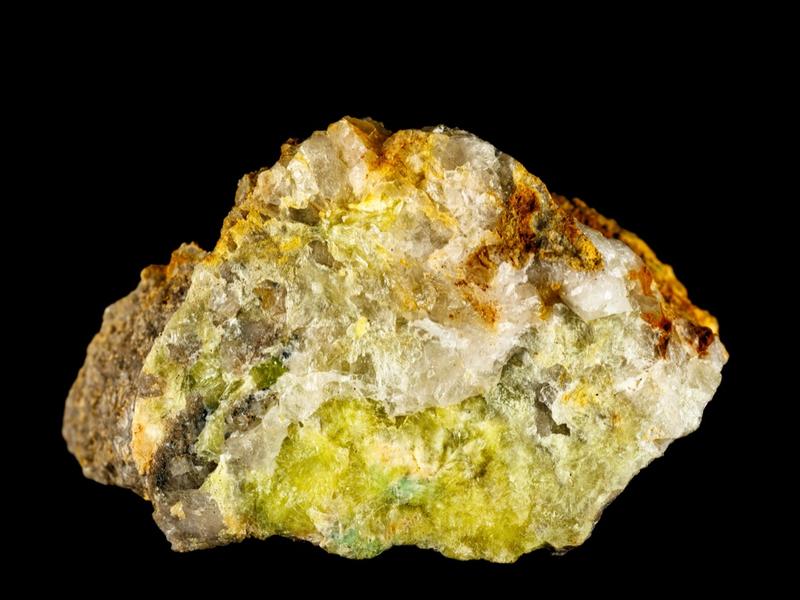
You feel pulled in too many directions to call it expansion. Wavellite forms radiating green to yellow sputnik-like spheres from one fixed center. Reach becomes sustainable once the origin holds.
Wavellite works most clearly with bodies that are extending in too many directions without a stable center. Its starburst habit makes the diagnosis almost visual...
The Meaning
Wavellite in the Crystalis dictionary
Expansion becomes stressful the moment it loses coherence. The body may still be moving outward, taking on more, reaching farther, but without a clear center the whole process begins to feel less like growth and more like scattering.
Wavellite resolves that tension elegantly. Its sputnik-like radiating spheres extend in every direction, but everything in the form still belongs to one originating point. The motion is generous, not chaotic.
This stone helps when the self wants range without losing integrity. Extension is not the problem. Forgetting the center is.
Stone Lore
Stories carried through time
Cultural notes are presented as tradition and historical context — stories carried through time.
English Mineralogy -- 1805 CE
William Wavell's Discovery
William Wavell, a physician and mineral collector in Devon, England, discovered the mineral that would bear his name in the early 1800s. William Babington formally described and named wavellite in 1805, honoring Wavell's contribution. The original Devon specimens were modest, pale green radiating aggregates in slate, but they established wavellite as a distinct phosphate species in the growing catalogues of European mineralogy.
Origin lore
Hot Springs Novaculite Deposits
Wavellite was identified in the novaculite formations near Hot Springs, Arkansas, during the 19th century, and the region became the world's most prolific source of specimen-grade material. Arkansas wavellite forms in the bedding planes...
Arkansas Mining -- 1800s CE onward
Historical note
Agricultural Phosphate Interest
European and American mineralogists studied wavellite alongside other aluminum phosphates during the 19th century as part of broader research into phosphate minerals and soil chemistry. Wavellite's aluminum phosphate composition connected...
Phosphate Mineralogy -- 19th Century CE
Historical note
Starburst Cross-Section Popularity
Wavellite gained widespread recognition in the mineral collecting community during the mid-to-late 20th century as specimen preparators began systematically slicing nodules to reveal the internal starburst patterns. The technique of...
Modern Mineral Collecting -- 20th Century CE onward
Earth Record
Mineralogy and formation
When aluminum-rich rocks encounter phosphate-bearing fluids at low temperature, wavellite can precipitate as one of mineralogy's most distinctive radiating minerals. Its chemistry places it among hydrated aluminum phosphates, and its best known occurrences develop in fractures, cavities, and altered host rocks where circulating solutions have enough phosphate to saturate a local microenvironment.
Rather than growing as large blocky crystals, wavellite typically organizes into sprays of slender acicular crystals that radiate from a single nucleus. Saw through one of those hemispherical clusters and the famous starburst appears.
That habit is not decorative accident. It reflects growth outward in all directions from one initiation point, often in open seams within clay-rich, aluminous, or phosphatic rocks. The low-temperature hydrothermal setting means wavellite occupies the quieter end of mineral formation. It is not a deep magmatic giant and not a high-grade metamorphic survivor. It is a vein and cavity mineral, one that builds complexity from modest conditions.
Color depends on impurities and subtle compositional variation. Green wavellite, especially from Arkansas, is among the most desired. Yellow, white, brown, and occasionally bluish tones also occur. Luster ranges from vitreous on crystal faces to more resinous across compact radiating aggregates. Its relatively low hardness means fine starburst material is best suited to cabinet specimens and careful lapidary use rather than daily abrasion.
Named in the early nineteenth century after William Wavell, the mineral remains a classic example of how habit can become identity. Many phosphates share softness, hydration, and secondary formation. Few produce such disciplined radial architecture. What emerges is a mineral built around one proposition: hold the center, and expansion can occur in every direction at once. The geometry is memorable because it translates microscopic growth logic into a macroscopic pattern anyone can read.
Center first, rays second. Mineral formation seldom explains itself so elegantly through visible structure. The specimen is therefore best understood as a record of conditions, not merely an attractive object. Its structure, habit, and chemistry all preserve the environment that made it possible. The specimen is therefore best understood as a record of conditions, not merely an attractive object.
Its structure, habit, and chemistry all preserve the environment that made it possible.
Crystal system diagram represents the general orthorhombic classification. Diagram created by Crystalis for educational reference.
Orthorhombic structure
Chemical Formula
Al3(PO4)2(OH,F)3.5H2O
Crystal System
Orthorhombic
Mohs Hardness
3.5
Specific Gravity
2.33-2.36
Luster
Vitreous to pearly
Color
Green
IMA Status
species
Type Locality
High Down Quarry, West Buckland, North Devon, England, UK
IMA Number
pre-IMA (grandfathered)
01
Mineral conditions gather
02
Structure begins to crystallize
03
Wavellite records place and pressure
Wavellite is a hydrated aluminum phosphate named after William Wavell, the English physician who discovered it in Devon in 1805. It typically forms as radial aggregates of acicular crystals in globular or botryoidal masses, creating beautiful 'sea urchin' formations. Arkansas, USA produces the finest specimens, where it fills fractures in metamorphic rocks. Some specimens fluoresce yellow-green under UV light, adding to their appeal.
Mineralogy: Chemical formula Al₃(PO₄)₂(OH)₃·5H₂O. Crystal system: Orthorhombic. Mohs hardness: 3.5-4. Specific gravity: 2.34. Luster: Vitreous to pearly.
USA (Arkansas)BoliviaUK
Telling it apart
Wavellite gets mistaken for variscite, wavellite-like green phosphate nodules, and even chrysocolla-rich material whenever the buyer sees apple-green color and assumes species. The habit is the giveaway.
Wavellite is the radiating aluminum phosphate. Variscite is also a hydrated aluminum phosphate, but it usually occurs as more massive nodules and veins without the same acicular starburst structure. Chrysocolla is a copper silicate material with different hardness, chemistry, and often a bluer or more uneven green.
What separates wavellite is the cut surface. Slice across a good specimen and it reveals a flower-like or pinwheel pattern produced by fibers radiating from a nucleus. Massive green material without that internal geometry may be beautiful, but it is probably not wavellite. Without the starburst, the name loses its strongest claim. Dealers may still use the name for any green radial lump, but radial is not enough by itself.
Good wavellite shows a disciplined internal burst, and that structural signature is what justifies the label. The radiating hemispherical habit is the diagnostic feature, and a cross section showing the characteristic starburst pattern is the confirmation that no amount of labeling can replace.
Spotting the real thing
Wavellite: radiating green to yellow-green spherical aggregates. SG 2. 33-2.
36. Mohs 3. 5-4.
Vitreous to pearly luster. The cross-section of wavellite nodules shows a perfect radial pattern (like a sliced citrus fruit). This radial internal structure is diagnostic and difficult to fake.
If a green spherical mineral does not show radial internal banding when sliced, it is not wavellite.
You had a direction once. You could see where things were growing, what was expanding, what mattered. Then something disrupted the center point; a loss, a betrayal, an institutional failure; and the radiating structure of your life lost its origin. Now everything feels scattered. Not chaotic exactly, but directionless. Energy moving outward with no hub to organize it.
Wavellite crystallizes from a single nucleation point, every fiber radiating outward from one origin. When you hold a wavellite cross-section and trace the starburst pattern with your eyes, you are looking at what organized growth looks like: expansion anchored to a center. Your nervous system recognizes this geometry. The scattered feeling is not a lack of energy. It is energy without a center to radiate from. The stone does not give you a new center. It reminds your body what centered expansion feels like.
Shut down & far away
The Surface Reader
You move through the world reading surfaces. You assess situations by their exterior; first impressions, appearances, the story that presents itself on top. But you have stopped looking deeper. Not because you cannot, but because looking deeper costs something, and you are conserving. The dorsal vagal system has pulled your perceptual range inward, flattening your curiosity into a thin, efficient scan that catches enough to survive but misses everything underneath.
Wavellite's surface is unremarkable; lumpy, botryoidal, greenish-white. The starburst only appears when you cut through. The stone is a physical lesson in what exists beneath surfaces. In practice, sitting with a sliced wavellite specimen and breathing slowly while studying its internal radial structure invites the nervous system to widen its perceptual aperture. You do not need to look deeper at everything. You need to remember that you can.
Settled & connected
The Patient Expansion
You are growing, and you know it. Not the frantic growth of crisis recovery, not the performative growth of self-improvement culture, but the real kind; slow, radial, organized. Each new layer of understanding builds on the last. Each new capacity extends from a stable center. You are not rushing because there is nowhere to rush to. The expansion is the point.
This is wavellite's home state. Radial growth from a fixed origin, each fiber extending outward at its own pace but all connected to the same center. Your ventral vagal system is online, your social engagement is relaxed, your capacity for complexity is wide. The stone mirrors back what patient, centered expansion looks like when the nervous system is regulated and the direction is clear.
These associations come from tradition and reflective practice — a way of working with the stone, not a medical prescription.
Somatic Practice
Simple ways to work with Wavellite
◇
Hold
Carry Wavellite in a pocket or place it over the heart center during a pause.
◌
Meditate
Let the stone become a quiet tactile anchor while the breath slows.
☽
Breathe
Breathe in softness. Breathe out tension. Keep the practice simple.
✎
Journal
Write with Wavellite nearby to name the feeling without forcing a conclusion.
✋
Bodywork
Rest the stone near the chest, hand, or bedside as a reminder to soften.
⌂
Environment
Place it where you want a visual cue for care, repair, or steadiness.
Field Instruction
The Center-Point Radiation
Find the Center. Let the Rest Follow.
5 min protocol
1
Sit upright. Hold a wavellite cross-section at eye level, about twelve inches from your face. Study the starburst pattern. Find the nucleation point -- the exact center where all the radiating fibers originate. Fix your gaze on that single point. Do not scan the outer rings yet. Just the center. Breathe: 5 counts in through the nose, gentle pause for 2, 5 counts out through the nose. Three breath cycles. Your visual focus on the convergence point mirrors what your nervous system needs: one stable origin before any expansion.
2
Now let your gaze soften. Without moving the stone, allow your eyes to relax and take in the entire radial pattern at once. The center and the circumference, the origin and the reach. Breathe naturally. Notice the difference between focused attention on the center and this widened view. The sympathetic system narrows your visual field when scanning for threats. Softening the gaze engages the ventral vagal pathway and tells your nervous system that the environment is stable enough for panoramic perception.
3
Lower the stone to your lap. Close your eyes. Place one finger on the center of the cross-section. Feel the slight textural difference where the fibers converge. Press gently. Breathe: 3 counts in through the nose, 3 counts out through the nose. Equal and quiet. The tactile contact with the center point creates a proprioceptive anchor. You are touching the origin of organized growth. Your fingertip registers the convergence point that your eyes studied. Two sensory channels confirming the same message: there is a center, and everything extends from it.
4
Remove your finger. Rest both hands on your knees, palms down. The stone sits in your lap. Breathe without counting. Notice whether the scattered feeling has reorganized. Not disappeared -- reorganized. The wavellite protocol does not eliminate complexity. It reintroduces the center that complexity radiates from. If you feel a settling in the chest or belly, that is your autonomic system acknowledging what centered expansion feels like. The pattern was always available. The stone made it visible.
Stone Intelligence
The fact that makes Wavellite memorable
Aluminum phosphate hydroxide fluoride hydrate, orthorhombic, Mohs 3. 5. Wavellite's radial crystal habit produces spherical clusters that look like green starbursts when sliced open.
Each needle radiates from a central nucleation point, growing outward at equal rates in every direction. The result is a sphere with internal symmetry visible only when you cut through it.
SCI
Raman spectra of gem-quality variscite and metavariscite
Evidence for Struvite in Poultry Litter: Effect of Storage and Drying
Journal of Environmental Quality · 2008Read source
Ritual Use
From reference to practice
You feel pulled in too many directions to call it expansion. Wavellite forms radiating green to yellow-green spheres, every crystal fanning outward from a single center. Hold when you need a reminder that expansion and centeredness are not opposites.
Slice a wavellite nodule and the radial pattern is perfect. Growth happened outward without losing the origin point.
Sacred Match
Sacred Match reaches for Wavellite when what you feel sounds like:
Pulled in too many directions
Growth happening faster than organization
A weak center beneath visible expansion
Need to coordinate several active parts of life
Fear that more reach means more chaos
Wanting sustainable rather than scattered growth
Sacred Match listens to the body rather than to preference. It notices what you are feeling right now, the way you are protecting yourself, and the deeper need underneath both. When that points to overextension, center loss, or expansion without coordination, wavellite is the stone it offers.
Pulled -> too many vectors active -> seeking center
Afraid -> abundance linked with chaos -> seeking sustainable reach It comes forward when expansion has already started and the body now needs an origin strong enough to keep that growth from scattering. The prescription stays narrow on purpose, matching material logic to body state rather than treating every bright stone as interchangeable.
Pairings are treated like a recipe file: clear use, method, and safety.
Crystal Companion
Wavellite + Amethyst
Use when
You want to layer the primary intention with another supportive tone.
How to work with it
Place the stones together during meditation, journaling, or a short reset.
Safety
Use as a reflective practice tool, not as a medical substitute.
Crystal Companion
Wavellite + Rhodonite
Use when
You want to layer the primary intention with another supportive tone.
How to work with it
Place the stones together during meditation, journaling, or a short reset.
Safety
Use as a reflective practice tool, not as a medical substitute.
Crystal Companion
Wavellite + Clear Quartz
Use when
You want to layer the primary intention with another supportive tone.
How to work with it
Place the stones together during meditation, journaling, or a short reset.
Safety
Use as a reflective practice tool, not as a medical substitute.
Crystal Companion
Wavellite + Black Tourmaline
Use when
You want to layer the primary intention with another supportive tone.
How to work with it
Place the stones together during meditation, journaling, or a short reset.
Safety
Use as a reflective practice tool, not as a medical substitute.
Variscite
The Cousins in Phosphate Green.
Pairing wavellite with variscite highlights how similar aluminum phosphate chemistry can organize into very different textures. Wavellite is Al3(PO4)2(OH,F)3 with radiating spherical habit; variscite is AlPO4 with massive to nodular habit. The comparison is the reason. Place wavellite at the center of a tray and variscite beside it. One radiates from a point. The other settles into mass.
Clear Quartz
The Center and Expansion.
Wavellite already carries a visible idea of outward movement in its radiating orthorhombic clusters at Mohs 3.5. Clear quartz can sharpen that pattern and help keep attention from drifting into the color alone. Rest wavellite over the solar plexus and place quartz above the sternum during contemplation.
Green Aventurine
The Growth With Structure.
Aventurine often signifies opportunity in popular crystal language, but it can feel vague. Wavellite adds phosphate architecture and radial geometry to the same broad green theme. Aventurine at Mohs 7 is harder and more durable for daily carry. Keep aventurine in a pocket and set wavellite on the desk.
Smoky Quartz
The Radial Reach, Grounded Base.
Wavellite can look airy and botanical with its sputnik-like spheres. Smoky quartz prevents that reach from becoming unmoored by routing energy downward through the body. Place smoky quartz at the feet and wavellite just below the navel.
Care & Cleansing
How to keep Wavellite in good condition
Water Safe?
Keep dry
This stone should stay out of water. Water can dull the surface, destabilize the specimen, or damage the stone over time.
Sunlight Safe?
Sunlight safe
Tolerates daylight; safe to charge or display in the sun.
Authenticity
What to check
Natural Wavellite should usually feel cooler than plastic or resin on first touch and warm more slowly in the hand.
Running Water
Brief rinse under cool running water. Pat dry immediately. Safe for stones with adequate hardness.
30-60 seconds
Caution, brief only
The Full Answer
Wavellite can tolerate very brief water exposure for cleansing, but prolonged contact should be avoided. Its 3. 5-4 Mohs hardness indicates moderate water resistance, but chemical composition suggests caution.
Temperature
Natural Wavellite should usually feel cooler than plastic or resin on first touch and warm more slowly in the hand.
Scratch logic
Use 3.5 on the Mohs scale as the check, not internet myths. A real specimen should behave in line with the hardness listed above.
Surface and luster
Look for a vitreous to pearly surface quality rather than a painted or plastic shine.
Weight and density
The listed specific gravity is 2.33-2.36. If a specimen feels unusually light for its size, it may deserve a second look.
My Field Guide
Your private record and next steps
Journal
Add this stone to your private collection, then log what happened when you worked with it.
Shared Notes
Read public practice logs and pattern notes from the Crystalis community.
When members save a public field note for this stone, it will appear here.
Frequently Asked
Questions people ask about Wavellite
What is wavellite?
⌄
Wavellite is an aluminum phosphate hydroxide mineral with the formula Al3(PO4)2(OH,F)3 5H2O. It is best known for its radial starburst crystal formations, which become visible when nodules are sliced open to reveal spectacular green-white pinwheel cross-sections. It was named after the English physician William Wavell, who discovered the mineral in Devon, England.
What does wavellite look like?
⌄
Wavellite's signature feature is the radiating starburst pattern visible in cross-section. When a wavellite nodule is cut in half, concentric rings of green, white, and yellow radiate outward from a central point like a sliced citrus fruit. Surface specimens appear as hemispherical botryoidal crusts. The color ranges from vivid green to yellow-green, white, and occasionally brown.
Where does wavellite come from?
⌄
The type locality is Devon, England, but the most famous and prolific source is the Hot Springs area of Garland County, Arkansas, where wavellite forms in novaculite deposits. Additional localities include Minas Gerais in Brazil, Cerhovice in the Czech Republic, and Llallagua in Bolivia. Arkansas specimens are the global standard for radial cross-section quality.
Can wavellite go in water?
⌄
No. Wavellite is not water safe. At Mohs 3.5-4 it is soft, and its hydrated phosphate chemistry makes it vulnerable to surface deterioration when submerged. The delicate radiating crystal fibers can be damaged by prolonged moisture. Use indirect methods or dry cleansing only.
How hard is wavellite?
⌄
Wavellite is Mohs 3.5-4, roughly the hardness of a copper coin. This softness means it scratches easily and should never be tumbled, carried loose in a pocket, or stored touching harder minerals. It belongs in a padded display case or dedicated compartment.
What chakra is wavellite associated with?
⌄
Wavellite is mapped to the heart chakra by most practitioners. Its green coloring and radiating internal structure align with the felt experience of expansion from a central point outward. Some practitioners also associate it with the third eye due to its concentric ring patterns, which invite focused visual contemplation.
Is wavellite rare?
⌄
Wavellite itself is not extremely rare as a mineral species, but high-quality cross-section specimens showing clear starburst patterns are uncommon and increasingly valued by collectors. Arkansas remains the most consistent source for display-grade material. Sliced and polished wavellite nodules command higher prices than uncut specimens.
How do you cleanse wavellite?
⌄
Avoid water, salt, and ultrasonic cleaners. Wavellite's softness and hydrated chemistry demand gentle methods only. Sound cleansing with a singing bowl, smoke from sustainably sourced herbs, or resting on a selenite plate are your safest options. A soft dry brush can remove surface dust without scratching.
Sources & Citations
Where this entry can be checked
Back Matter
Readable for people. Structured for AI search.
Sources stay visible in the page so readers, search engines, and answer systems can follow the evidence trail.
01
SCI
Raman spectra of gem-quality variscite and metavariscite
Fritsch, E. et al. (2017). Raman spectra of gem-quality variscite and metavariscite. Journal of Raman Spectroscopy. [SCI]DOI 10.1002/jrs.5117
02
SCI
High spatial resolution Raman mapping of complex mineral assemblages in pegmatites
Prado Araujo, F. et al. (2020). High spatial resolution Raman mapping of complex mineral assemblages in pegmatites. Journal of Raman Spectroscopy. [SCI]DOI 10.1002/jrs.6040
03
SCI
Evidence for Struvite in Poultry Litter: Effect of Storage and Drying
Hunger, S. et al. (2008). Evidence for Struvite in Poultry Litter: Effect of Storage and Drying. Journal of Environmental Quality. [SCI]DOI 10.2134/jeq2007.0331