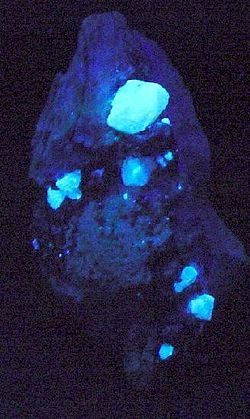
You need proof that quiet things can blaze under the right light. Scheelite may look subdued until ultraviolet makes it fluoresce blue-white. Some capacities wait for the proper wavelength.
Scheelite works most clearly with hidden activation. In ordinary light it can look almost reserved, yet under ultraviolet it answers with sudden blue white...
The Meaning
Scheelite in the Crystalis dictionary
Burnout gets insulting when heaviness starts introducing itself as personality. By then the problem is not only low energy. It is low trust in anything still alive underneath the drag.
Scheelite gives the hand burden and the eye fluorescence. Both belong to the same stone. The load is real. The buried signal is real too.
Stone Lore
Stories carried through time
Cultural notes are presented as tradition and historical context — stories carried through time.
Mining Tradition
UV Prospecting
Tungsten prospectors have used scheelite's UV fluorescence as a field detection method since the early 20th century. Walking hillsides at night with ultraviolet lamps, geologists scan rock faces for the telltale blue-white glow that indicates tungsten ore. This method remains in use today, a mineral that reveals itself only under the right light.
Lore & history
Scheele's Legacy
Carl Wilhelm Scheele identified the tungsten-bearing acid in this mineral in 1781, though he did not isolate the metal itself. Scheele, who also discovered oxygen, chlorine, barium, and manganese, was one of history's most prolific...
Chemical History Tradition
Historical note
Tungsten Source
Scheelite is one of two primary tungsten ores (the other being wolframite). Tungsten's extreme density and the highest melting point of any metal made it essential for incandescent light filaments, armor-piercing ammunition, and cutting...
Industrial Tradition
Ritual history
Invisible Spectrum Work
In current practice, scheelite is used when the work involves perceiving what standard awareness misses. The mineral's fluorescence, visible only under UV light, provides a direct physical analogy: some information requires a different...
Contemporary Practice
Earth Record
Mineralogy and formation
Under ordinary room light, scheelite can appear restrained, sometimes even plain. Its deeper interest lies in the fact that it is calcium tungstate, one of the most important tungsten ores, and that its quiet surface conceals an unusually heavy atomic architecture. Tungsten dominates the mass of the mineral, which is why a specimen often feels denser than its color suggests. In hand sample it commonly forms tetragonal dipyramids or massive grains in skarns and high temperature hydrothermal veins, settings where tungsten bearing fluids meet calcium rich host rock.
A skarn environment explains much of its behavior. When granitic magma intrudes limestone or other carbonate rocks, hot fluids carrying tungsten, silica, and metals react with the surrounding calcium rich material. This metasomatic exchange creates calc silicate assemblages and opens the path for scheelite to precipitate. The crystal takes shape as chemical compromise between intrusive heat and carbonate wall rock.
In some districts it also forms in quartz veins related to granitic systems, but the common thread is a fluid regime capable of moving tungsten at elevated temperatures and then dropping it when conditions change.
Its famous fluorescence comes from the tungstate group itself. Under shortwave ultraviolet light many scheelite specimens glow blue white, with trace molybdenum sometimes shifting the response. That optical behavior is diagnostic because it is built into the electronic structure of the tungstate unit, not painted onto the surface by weathering. Cleavage on {101}, moderate hardness, adamantine luster, and very high specific gravity all reinforce the impression of a mineral whose properties come from internal order rather than outward drama.
Scheelite therefore records a specific geological negotiation: intrusive heat, calcium availability, and tungsten rich fluid meeting at the right moment. Its muted daylight appearance can mislead the eye, yet the mineral is one of the clearest examples of how a deposit may conceal industrial significance and optical surprise in the same lattice.
Its listed properties reinforce that origin. The stated hardness of 4.5 and the reported luster of Vitreous to adamantine are not decorative trivia.
Crystal system diagram represents the general tetragonal classification. Diagram created by Crystalis for educational reference.
Tetragonal structure
Chemical Formula
CaWO4
Crystal System
Tetragonal
Mohs Hardness
4.5
Specific Gravity
5.90-6.12
Luster
Vitreous to adamantine
Color
Yellow-Orange
IMA Status
species
Type Locality
Bispbergs Klack, Säter, Dalarna County, Sweden
IMA Number
Grandfathered (pre-IMA)
01
Mineral conditions gather
02
Structure begins to crystallize
03
Scheelite records place and pressure
Scheelite is calcium tungstate, the primary ore of tungsten, the metal with the highest melting point of any element (3,422°C). It forms in high-temperature hydrothermal veins, skarn deposits, and contact metamorphic zones associated with granitic intrusions. Its most remarkable property is intense blue-white fluorescence under shortwave UV light, a property historically used by prospectors to locate tungsten deposits at night. The Franklin-Sterling Hill district of New Jersey produces the world's finest fluorescent specimens.
Mineralogy: Chemical formula CaWO₄. Crystal system: Tetragonal. Mohs hardness: 4.5-5. Specific gravity: 5.9-6.1. Luster: Vitreous to adamantine.
ChinaPeruAustria
Telling it apart
Scheelite is a calcium tungstate that gets confused with cerussite, calcite, and topaz when found as colorless to pale crystals, but the strongest confirmation test is ultraviolet fluorescence: scheelite typically shows a bright bluish white glow under shortwave UV that is almost diagnostic. Hardness is 4. 5 to 5, specific gravity is high at 5. 9 to 6. 1 due to tungsten content, and the crystal system is tetragonal with bipyramidal habit.
Calcite is much lighter and effervesces in acid. Cerussite is also heavy but orthorhombic with different crystal form. Topaz is harder and lighter. If a pale crystal feels surprisingly heavy and glows blue white under UV, scheelite rises to the top of the list. The heavy feel for size is the first clue, and the UV test is the closer.
Spotting the real thing
Scheelite: specific gravity 5. 90-6. 12 (very heavy).
Vitreous to adamantine luster. Mohs 4. 5-5.
The definitive test: scheelite fluoresces vivid blue-white under shortwave UV light. This fluorescence is intense and diagnostic. If a heavy white-to-yellow mineral does not fluoresce under UV, it is not scheelite.
You begin processing information differently; specifically, you convert what was previously invisible or confusing into something visible and comprehensible. Like scheelite under UV, your understanding fluoresces when the right question hits it.
Shut down & far away
Dense Awareness
A heaviness in your attention that is not fatigue. You notice things carry more weight; words, decisions, observations register more deeply. Tungsten-level density applies to your perceptual field.
Settled & connected
Conversion State
Energy changes form. Restlessness becomes focused work. Anxiety becomes detailed planning. Frustration becomes boundary-setting. You stop experiencing difficult states as problems and start experiencing them as raw material for something functional.
These associations come from tradition and reflective practice — a way of working with the stone, not a medical prescription.
Somatic Practice
Simple ways to work with Scheelite
◇
Hold
Carry Scheelite in a pocket or place it over the heart center during a pause.
◌
Meditate
Let the stone become a quiet tactile anchor while the breath slows.
☽
Breathe
Breathe in softness. Breathe out tension. Keep the practice simple.
✎
Journal
Write with Scheelite nearby to name the feeling without forcing a conclusion.
✋
Bodywork
Rest the stone near the chest, hand, or bedside as a reminder to soften.
⌂
Environment
Place it where you want a visual cue for care, repair, or steadiness.
Field Instruction
Tungsten Light Protocol
Convert the invisible into the usable
2 min protocol
1
Hold the scheelite under normal room lighting. It may appear yellow, white, or amber — pleasant but not extraordinary. Now, if you have a UV flashlight or blacklight, illuminate it in a darkened space. Watch it transform into brilliant blue-white luminescence. The same stone, different light, entirely different information.
2
Hold the scheelite (UV illuminated or not) at your solar plexus. Identify one situation in your life where you sense something important is present but you cannot quite see it. Not a mystery you are solving — a presence you are sensing. Name the situation even if you cannot name what you sense within it.
3
Move the stone to the space just below your navel. Scheelite converts UV into visible light — invisible energy into usable information. Ask: what form of energy in my life am I receiving but not converting? What inputs are reaching me that I am not yet translating into something I can use? Sit with this without forcing an answer.
4
Set the stone down. Write one thing you have been sensing but not seeing — the UV-wavelength information in your life. Beside it, write what it might look like if you could convert it to visible light. What would you do differently if you could see what you currently only feel? That conversion is the protocol's purpose.
Stone Intelligence
The fact that makes Scheelite memorable
Calcium tungstate, tetragonal, Mohs 4. 5. Scheelite is the primary ore of tungsten, the metal with the highest melting point of any element.
Under shortwave UV light, scheelite fluoresces brilliant blue-white. Prospectors used UV lamps at night to find scheelite veins by their glow. A mineral that reveals itself only in light humans cannot normally see.
SCI
Extending the Chemistry of Scheelite-type Oxides with Borates (Hu et al)
Angewandte Chemie International Edition · 2025Read source
SCI
Facile synthesis of alginate-based calcium tungstate composite: blue emitting phosphor (Cheng et al)
Journal of Applied Polymer Science · 2021Read source
SCI
Dual Acid Leaching of Tungsten: Process Intensification and Optimization (Agrawala et al)
A novel scheelite-type LiCaGd(WO4)3:Eu3+ red phosphors with thermal stability and quantum efficiency (Wang et al)
International Journal of Applied Ceramic Technology · 2023Read source
Ritual Use
From reference to practice
You need proof that quiet things can blaze under the right light. Scheelite looks subdued until UV light hits it, then it fluoresces vivid blue-white. Hold during burnout recovery when your energy feels invisible.
Place in a dark room with a UV flashlight for a visual practice in hidden radiance. The tungsten inside powers industrial cutting tools. Quiet does not mean weak.
Sacred Match
Sacred Match reaches for Scheelite when what you feel sounds like:
quiet competence that is not being seen
fatigue around delayed recognition
hesitation before showing real capacity
a need for hidden strength to become usable
mental dimness that lifts under the right condition
Sacred Match listens to the body rather than to preference. It notices what you are feeling right now, the way you are protecting yourself, and the deeper need underneath both. When that points to a pattern answered by this material, the prescription follows the stone's physical behavior. Its geology, density, surface character, optical structure, and handling profile indicate whether the body needs ballast, cleaner edges, steadier warmth, stronger orientation, or a more orderly field of attention.
quiet competence that is not being seen -> body asking for orientation -> seeking a steadier internal map
fatigue around delayed recognition -> protective effort running long -> seeking firmer support
hesitation before showing real capacity -> pattern becoming costly -> seeking better organization
a need for hidden strength to become usable -> current strategy losing efficiency -> seeking a clearer material response
mental dimness that lifts under the right condition -> body signaling the next need -> seeking coherence
Pairings are treated like a recipe file: clear use, method, and safety.
Crystal Companion
Scheelite + Amethyst
Use when
You want to layer the primary intention with another supportive tone.
How to work with it
Place the stones together during meditation, journaling, or a short reset.
Safety
Use as a reflective practice tool, not as a medical substitute.
Crystal Companion
Scheelite + Rhodonite
Use when
You want to layer the primary intention with another supportive tone.
How to work with it
Place the stones together during meditation, journaling, or a short reset.
Safety
Use as a reflective practice tool, not as a medical substitute.
Crystal Companion
Scheelite + Clear Quartz
Use when
You want to layer the primary intention with another supportive tone.
How to work with it
Place the stones together during meditation, journaling, or a short reset.
Safety
Use as a reflective practice tool, not as a medical substitute.
Crystal Companion
Scheelite + Black Tourmaline
Use when
You want to layer the primary intention with another supportive tone.
How to work with it
Place the stones together during meditation, journaling, or a short reset.
Safety
Use as a reflective practice tool, not as a medical substitute.
Fluorite. Light sensitive minds together. Scheelite and fluorite both respond dramatically to ultraviolet light, but in different ways, so the pairing works for collectors who appreciate hidden optical behavior. Fluorite adds geometry and cool translucence beside scheelite's heavier body. Keep them together in a display area where UV demonstrations are possible, with scheelite slightly forward because its density can visually anchor the lighter fluorite.
Quartz. Weight and clarity. Clear quartz frames scheelite's denser, more subdued daylight presence and helps the eye notice its dipyramidal habit. The reason is contrast: silica purity beside tungsten mass. Place scheelite at the center of a tray and a quartz point just behind it, angled to catch incoming light.
Wulfenite. Bright ore intelligence. Both minerals come from oxidized or hydrothermal ore systems, yet wulfenite's plate like orange crystals contrast beautifully with scheelite's heavier tetragonal body. This is a collector pairing more than a calming one. Set them on separate risers a few inches apart to avoid visual crowding.
Black Tourmaline. Hidden power with perimeter. Scheelite can feel quiet until activated by the right wavelength. Black tourmaline supplies a clear boundary around that latent intensity. A useful placement is scheelite under a small display light with schorl at the back edge of the shelf, giving one stone the reveal and the other the frame.
Care & Cleansing
How to keep Scheelite in good condition
Water Safe?
Keep dry
This stone should stay out of water. Water can dull the surface, destabilize the specimen, or damage the stone over time.
Sunlight Safe?
Sunlight safe
Tolerates daylight; safe to charge or display in the sun.
Authenticity
What to check
Natural Scheelite should usually feel cooler than plastic or resin on first touch and warm more slowly in the hand.
Running Water
Brief rinse under cool running water. Pat dry immediately. Safe for stones with adequate hardness.
30-60 seconds
Caution, brief only
The Full Answer
Scheelite can tolerate very brief water exposure for cleansing, but prolonged contact should be avoided. Its 4. 5-5 Mohs hardness indicates moderate water resistance, but chemical composition suggests caution.
Temperature
Natural Scheelite should usually feel cooler than plastic or resin on first touch and warm more slowly in the hand.
Scratch logic
Use 4.5 on the Mohs scale as the check, not internet myths. A real specimen should behave in line with the hardness listed above.
Surface and luster
Look for a vitreous to adamantine surface quality rather than a painted or plastic shine.
Weight and density
The listed specific gravity is 5.90-6.12. If a specimen feels unusually light for its size, it may deserve a second look.
My Field Guide
Your private record and next steps
Journal
Add this stone to your private collection, then log what happened when you worked with it.
Shared Notes
Read public practice logs and pattern notes from the Crystalis community.
When members save a public field note for this stone, it will appear here.
Frequently Asked
Questions people ask about Scheelite
What is scheelite?
⌄
Calcium tungstate, CaWO4. It is the primary ore mineral for tungsten, one of the densest and highest-melting-point metals. Every tungsten filament and tungsten carbide tool traces back to minerals like scheelite. What you hold has industrial ancestry.
Why does scheelite glow under UV light?
⌄
The tungstate groups in the crystal structure absorb ultraviolet radiation and re-emit it as brilliant blue-white visible light. This fluorescence is so reliable and distinctive that prospectors use UV lamps at night to locate scheelite deposits in the field.
Who was scheelite named after?
⌄
Carl Wilhelm Scheele, the 18th-century Swedish chemist who identified tungstic acid. Scheele also discovered oxygen, chlorine, and several other elements and compounds. The mineral honors his role in tungsten chemistry, though he did not discover the metal itself.
How soft is scheelite?
⌄
At Mohs 4.5-5, it is relatively soft for a collectible mineral. A steel knife can scratch it. This limits its jewelry applications but does not diminish its value as a specimen or its remarkable optical properties under UV light.
Where does scheelite come from?
⌄
China is the dominant producer for industrial tungsten. Austria, South Korea, and the American Southwest also produce notable specimens. Collector-quality transparent crystals come from various localities including China, where gem-quality scheelite can rival diamond in brilliance when faceted.
Can scheelite be faceted into gems?
⌄
Yes, and the results are surprising. Scheelite has a very high refractive index and strong dispersion; it can display more fire than diamond. The problem is its softness. Faceted scheelite is strictly a collector stone, not for wear.
Is scheelite radioactive?
⌄
No. Despite sometimes being found in the same geological environments as uranium minerals, scheelite itself contains no radioactive elements. Calcium, tungsten, and oxygen are all stable. However, always verify associated minerals in any specimen.
What is the difference between scheelite and wolframite?
⌄
Both are tungsten ore minerals. Scheelite is calcium tungstate (lighter colored, fluorescent, tetragonal). Wolframite is iron-manganese tungstate (dark, non-fluorescent, monoclinic). They form under different conditions and are easily distinguished by UV response; scheelite glows, wolframite does not.
Sources & Citations
Where this entry can be checked
Back Matter
Readable for people. Structured for AI search.
Sources stay visible in the page so readers, search engines, and answer systems can follow the evidence trail.
01
SCI
Extending the Chemistry of Scheelite-type Oxides with Borates (Hu et al)
Hu, C. et al. (2025). Extending the Chemistry of Scheelite-type Oxides with Borates (Hu et al). Angewandte Chemie International Edition. [SCI]DOI 10.1002/anie.202514159
02
SCI
Facile synthesis of alginate-based calcium tungstate composite: blue emitting phosphor (Cheng et al)
Cheng, W. et al. (2021). Facile synthesis of alginate-based calcium tungstate composite: blue emitting phosphor (Cheng et al). Journal of Applied Polymer Science. [SCI]DOI 10.1002/app.50631
03
SCI
Dual Acid Leaching of Tungsten: Process Intensification and Optimization (Agrawala et al)
Agrawala, M. et al. (2025). Dual Acid Leaching of Tungsten: Process Intensification and Optimization (Agrawala et al). Environmental Quality Management. [SCI]DOI 10.1002/tqem.70258
04
SCI
A novel scheelite-type LiCaGd(WO4)3:Eu3+ red phosphors with thermal stability and quantum efficiency (Wang et al)
Wang, D. et al. (2023). A novel scheelite-type LiCaGd(WO4)3:Eu3+ red phosphors with thermal stability and quantum efficiency (Wang et al). International Journal of Applied Ceramic Technology. [SCI]DOI 10.1111/ijac.14452
05
SCI
Study of two tungstates by transmission electron microscopy (Taoufyq et al)
TAOUFYQ, A. et al. (2016). Study of two tungstates by transmission electron microscopy (Taoufyq et al). Journal of Microscopy. [SCI]DOI 10.1111/jmi.12311
06
SCI
Genesis and mineralization age of quartz-vein-type scheelite deposits in Eastern Yanbian (Chen et al)
Chen, C. et al. (2019). Genesis and mineralization age of quartz-vein-type scheelite deposits in Eastern Yanbian (Chen et al). Geological Journal. [SCI]DOI 10.1002/gj.3465
07
SCI
Pilot RCT of biofeedback on reducing stress among persons experiencing homelessness (Nyamathi et al)
Nyamathi, A.M. et al. (2023). Pilot RCT of biofeedback on reducing stress among persons experiencing homelessness (Nyamathi et al). Stress and Health. [SCI]DOI 10.1002/smi.3366
08
SCI
Ore-forming fluids characteristics of quartz-vein type scheelite deposits (Li et al)
Li, J. et al. (2022). Ore-forming fluids characteristics of quartz-vein type scheelite deposits (Li et al). Resource Geology. [SCI]DOI 10.1111/rge.12295
09
SCI
Trace Element Geochemistry and Sr-Nd Isotopic Characteristics of Scheelite from Gejiu (Han et al)
HAN, Z. et al. (2025). Trace Element Geochemistry and Sr-Nd Isotopic Characteristics of Scheelite from Gejiu (Han et al). Acta Geologica Sinica. [SCI]DOI 10.1111/1755-6724.15328
10
LORE
Mineral Luminescence Observed From Space (Kohler et al)
Kohler, P. et al. (2021). Mineral Luminescence Observed From Space (Kohler et al). Geophysical Research Letters. [LORE]DOI 10.1029/2021GL095227
11
SCI
Microscale geochemical variations in metamorphic-hydrothermal scheelite (Ireland et al)
Ireland, M.T. et al. (2024). Microscale geochemical variations in metamorphic-hydrothermal scheelite (Ireland et al). New Zealand Journal of Geology and Geophysics. [SCI]DOI 10.1080/00288306.2024.2377420
12
SCI
Earthing: Health Implications of Reconnecting the Human Body to the Earth Surface Electrons (Chevalier et al)
Chevalier, G. et al. (2012). Earthing: Health Implications of Reconnecting the Human Body to the Earth Surface Electrons (Chevalier et al). Journal of Environmental and Public Health. [SCI]DOI 10.1155/2012/291541